“Going into nothingness”: a methodology for managing the state through attention, interoception and brain rhythms#
Working title.Methodological book on the method (neurotechnology of increasing alpha rhythm / Onto Nothing / NIHILO).Version:1.4 - working draft (basis for editing and additions by the author).Author:Konstantin Shel is the author of the ONTO NOTHING method, founder of ex NIHILO, chief researcher, speaker, author of books. ·Draft date: 01.08.2026
How to read this book (symbols)#
The book is intended asliving document: here is the foundation, which the author corrects and supplements. To prevent different layers from mixing, the following notes have been added:
- 📖 Science- a statement based on published research (at the end of the book there is a bibliography with links).
- 🧭 Method— a description of the practice as it is structured in the author’s approach (from interview No. 146 and the structure of the method).
- 🔬 Hypothesis- the author's assumption about the mechanism or effect thatnot yet verifiedand requires research. Presented honestly as a hypothesis, not as a fact.
- ✍️ [To the author - add]— a place where your material is waiting: precise scripts, formulations, cases, data, personal narrative.
The main principle of the book:don't confuse three things— (1) what science says, (2) how practice works, (3) what we are still only guessing. It is this separation that makes a method defensible and allows, over time, to turn a “program” into a “method” and a “method” into a testable scientific statement.
About the author#
Konstantin Shel is the author of the ONTO NOTHING method, founder of ex NIHILO, chief researcher, speaker and entrepreneur. Born in 1991 in Omsk; at the age of twelve he moved to Moscow.
Sixteen years of practice at the intersection of neuromarketing, neurophysiology and memetics began with the system of “attention engineering” - an expanded version of Patrick Renvoise's model of the six buttons of the reptilian brain - and led to a question that this system could not explain: why people who know all the right steps still do not do them.
At the age of twenty-five, my own experience of panic attacks forced me to look for the answer not in marketing, but in myself: dozens of psychologists, bodily and meditative practices - not a single one gave a lasting result. The answer was born at the kitchen table with my friend Ilya Novitsky: the phrase “antivirus” for anxiety and insufficiency was compressed step by step into one word - and the internal dialogue stopped. This is how the ONTO NOTHING protocol was born.
The subjective effect of the method was verified instrumentally - with partner Neiry, one of the leading developers of consumer EEG devices: complete reversal of the ratio of beta, alpha and theta rhythms in a minute of practice. Since then, more than 1,200 people have tried the method in practice over three years; A formal EEG study is currently underway (50 people have been completed) with partners Neiry, NEYROX and LQ lab - its protocol and intermediate data are discussed in chapters 26–31 of this book.
Konstantin is the author of the book"Big Bang of Consciousness", a chronicle of the origins of the method, published on the website.
Annotation#
The method is an integrative training system that teaches a person to quickly and consciously change their state: stop internal dialogue, transfer attention from the “head” to the body, maintain and switch focus between brain areas and organs, and enter states of deep peace, concentration and “flow”. The stated physiological landmark isfaster, deeper and more sustainable transition from stress (beta) mode to alpha mode(in three parameters - speed, depth, retention - according to the author's observations, an improvement of approximately 2 times), as well as an increase in heart rate variability as an indicator of restored self-regulation.
The book describes the method on three levels:theoretical foundations(what science knows about these mechanisms),the methodology itself(architecture, stages, protocols) andevidentiary frame(how to measure and check it, where are the limits of applicability and what are the risks). The method begins with the semantic layer: chapters 13–15 teach you to distinguishunit of disseminating information(“meme”) andthe way in which it is given to a person(“vectority” of experience, intentionality).
Chapter 13 examines memetics, along with the program's documented failure and the few criteria that have withstood empirical testing; Chapter 14 - phenomenology and the only published step-by-step procedure for exploring experience, the microphenomenological interview, honestly naming its main gap (there are no published inter-rater agreement statistics); Chapter 15 brings both lines togethersemantic pipeline, powered by what the platform already collects—819 voice transcripts from 39 people. At the intersection of two disciplines, a working definition is introducedmental constructas assemblages from a unit of meaning, a mode of givenness, a bodily tone and a typical action.
The core of the methodology is the systemONTO: map fromeight modes of consciousness (0–7), where the zero mode serves as a point of reference, and the other seven are cultivated and differ in the object of attention, the dominant rhythm, the relation to thoughts and the sense of self (Chapter 18). There, the modes are translated into the language of devices: section 18.17 honestly fixes the resolution limit - EEG upload distinguishes three groups of states, not eight; Section 18.18 constructs a vegetative map of the eight modes; Section 18.19 takes inventory of login protocols and gives an inconvenient result: of the eight modes, exactly one has a complete protocol.
In practice, the method unfolds not in a single session, but ina program of six cycles of 40 days— about 240 days of active work plus 3–4 week pauses between cycles to check whether the skill holds without a presenter. The first cycle —Self-regulation— is already available and complete in itself: in it a person goes through memetics, receives the neurotechnology of turning off the internal dialogue, and learns to switch state at will. The other five cycles deepen the work (neuroplasticity, transfer, being and data, goals, integration) — section 25.16.
🔬 Why such duration. The program is designed so that a person who has completed the full path (minimum — the fourth cycle, in full — the sixth) leaves it as amethod master— that is, can lead others through this method himself. The author's idea: the method should reproduce itself through trained masters, and this is exactly why it is structured as a sequence of complete cycles, not as a one-time course. This is not stated as a proven pedagogical model — it is the author's goal of the program architecture (section 25.16).
Chapter 19 expands into a working safety system: preparation, room conditions, requirements for the presenter, a three-level protocol for dealing with an unwanted reaction - and an honest list of what is not yet in this system, starting with the lack of informed consent.
Chapters 21–23They give a verbatim protocol of practice: seven phrases, four stages and five phases of dissolution of the “I”, written down so that a session can be conducted on them, along with an analysis of what is confirmed in them by publications, what remains a hypothesis of the method and what the device does not distinguish.
The measurement starts with the body: Chapter 26 breaks down everything that wearables provide (HRV, resting heart rate, breathing, sleep, temperature), into three reliability classes and published accuracy figures. The method builds two proprietary indices on top of the measurementsKonstantin Shel — NSI(Neurodynamic Self-regulation Index, a cross-section of the ability to self-regulate “here and now”) andMNPI(Multidimensional Neurodynamic Plasticity Index, multi-session profile of the same ability): they serve to verify the state and skill of self-regulation, and their reliable change over time (ΔMNPI) is an attempt to capture neuroplasticity (Chapter 27).
In the same place, section 27.22 examines all eighteen columns of real equipment unloading by reliability classes, shows what each of them actually means, and highlights in themfour independent state vectors; section 27.23 splits "retention" into three horizons and introduces a separate carry indexRI, intentionally not mixed with MNPI; Section 27.26 brings together ten working papers of the method and shows what exactly they do not agree on - three different compositions of the NSI index, three different MNPI formulas, two incompatible sets of sub-indices, and one direct contradiction about whether band attitudes can be read as emotions; Section 27.27 relates analysis bands to individual alpha peak frequency and explains why one of the record values in the method data is a small denominator artifact rather than a phenomenon.
Chapter 28 examines what happens to the body over weeks and months of regular practice, why a person’s baseline moves on its own, and how to distinguish the effect of the method from the season, phase of the cycle, and regression to the mean; the evidence base is also collected thereagainstmethod statements and three predictions with numerical thresholds formulated prior to data collection.
Chapter 29 examines the source code of the method platform (Telegram bot, Mini App, database, local AI layer) - eight sources of the initial cut, fifty-two checks in eleven categories, nine EEG protocols, a diary with voice transcripts - and holds two thoughts at the same time: the platform collects research data andis itself part of the intervention, that is, the source of the eleven threats to validity listed there; It also provides an honest inventory of what has actually been accumulated, and identifies four discrepancies between the MNPI production formula and Chapter 27.
Chapter 30 has been brought to a pre-registration form - seven measurement points, one primary outcome instead of eight, multiplicity corrections named in advance and a table of literary benchmarks with which the method will have to be compared.
Chapter 31 containslongitudinal case: eleven sessions in thirty-five days with a full matrix of metrics, a breakdown of which of the measured multipliers hold up (depth x 2.2, retention x 3.7, speed x 3... x 7 - and why the book maintains its most conservative estimate of "about two times"), and the eight caveats without which this case cannot be presented.
Part IX - Applications. The goal is to provide both practical guidance and a scientific framework for further research.
Table of contents
Part I. Introduction and Problem#
1. About the book and positioning method#
🧭 This book describes the method asstep-by-step self-regulation training system. Its task is not to inspire, but to explain: what the method consists of, why each step is arranged exactly as it is, what happens in the brain and body, and how to distinguish the real effect from self-hypnosis.
The method stands at the intersection of three traditions:neurofeedback and psychophysiology(working with brain rhythms and HRV),contemplative practices(concentration meditation, working with attention and “silence of the mind”) andbody-oriented approach(interoception, return of sensitivity to the body). His hallmark is his attempt to do it all.fast, manageable and measurable, relying on hardware feedback (EEG, HRV sensors) and a structured protocol.
It is important to define the framework of integrity from the very beginning: the methodpositioned as a practice for health, sustainability and productivity (wellness and development), and not as a medical treatment. When it comes to mental health conditions, the book distinguishes between “self-regulatory support” and “therapy”; clinical claims require clinical evidence (see Part V).
2. The problem of modern man#
🧭 The starting point of the method is a common condition that a person describes as “noise in the head,” chronic fatigue, absent-mindedness, doubt and a feeling of “treading water.” The method suggests looking at it not as a set of individual symptoms, but asthree interrelated deficits: attention deficit, energy deficit and lack of connection with the body.
📖 There are at least two well-studied mechanisms behind this.
The first is the mode of operation of the brain.When a person is chronically tense and “in his head,” fast, “working” rhythms dominate; states of restoration, insight, and calm clarity are associated with increased alpha and theta activity. The ability to voluntarily shift the balance towards alpha/theta is essentially a skill, not a given (Chapter 4).
The second is a break in the “body → brain” connection.The body continuously sends interoceptive signals to the brain (heart, breath, internal organs), and it is on these that emotions and the sense of self are built. When this channel is narrowed or noisy, a person recognizes his states worse, loses intuition and emotional support. 📖 Interoception is now considered one of the key components of mental health: its impairment is consistently associated with anxiety, depression and PTSD (review ineClinicalMedicine, 2024; roadmap Khalsa et al., 2018).
🔬 Method hypothesis:Most of the “psychological” complaints of modern man are not so much “wrong thoughts” asimpaired self-regulation at the level of brain rhythms and interoception, and work more effectively with this “lower floor” than just with the content of thoughts. This is plausible and consistent with the direction of science, but as a strong causal claim it requires testing.
3. Method answer: thesis and promise#
🧭 The method promises to teach a personin a short timedo three things:
- Stop internal dialogue- almost instantly enter the “silence of the mind.”
- Move and maintain attention— from the head to the body, between brain areas and organs, switching flexibly.
- Consciously change your state- enter into concentration, deep peace and “flow” and stay in them.
🔬 The declared objective marker of progress is associated primarily withspeed of transition from “work”/stress (beta) mode to alpha mode, and also withdepththis state and its abilityhold. It is precisely according to these three parameters -speed, depth, retention- the method claims improvementapproximately 2 times; This has already been confirmed in a number of cases, and a study is currently underway collecting data from a larger and more heterogeneous sample (different ages, etc.). An additional objective benchmark is an increase in HRV.
The formulation “approximately 2 times” requires careful operationalization: it is necessary to determine in advance how the transition speed (beta → alpha change latency), depth (alpha power relative to the individual norm/IAF) and retention (the time of a stable stay in a state) are measured, under what conditions (eyes open/closed, with control for artifacts) and whether we are talking about a shift in the moment (state) or a stable skill (trait). More details in chapters 4, 26 and 27.
🧭 One clarification to the promise is about what stands before it.Everything said above concerns state management. But the method has a layer that logically precedes this and in which nothing is trained instrumentally: a person learnsdistinguish units of meaningwith which his mind is filled, andthe way they are given to him. The author puts it this way: before the “annihilation of the self” occurs, internal differentiation must occur - a person begins to distinguish one meme from another and notice what meanings revolve around it. The stated consequence is an increase in critical thinking and resistance to manipulation: captured attention returns, and the person stops doing something he didn’t intend to do. This layer is parsed intochapters 13–15— along with an honest assessment of what is confirmed by research and what remains the author’s hypothesis.
Summary of Part I.The problem is real and has measurable neurophysiological correlates. The promise of the method is ambitious, but does not contradict science - provided that we carefully separate what is proven from what is claimed.
Part II. Theoretical foundations#
This part is the scientific foundation. It is needed so that each practical step of the method (Parts III–IV and VII) can be linked to the mechanism and so that the wording of the book is defensible.
4. Brain rhythms: alpha and theta#
📖 Alpha rhythm (≈8–12 Hz)For a long time it was considered simply an “idle” of the brain, but the modern understanding is different. According totime-inhibition hypothesis(Klimesch, Sauseng, Hanslmayr, 2007) and models"gating through inhibition"(Jensen, Mazaheri, 2010), alpha is an active mechanismfunctional inhibition: Enhancing alpha in a cortical area dampens its processing, freeing up resources and protecting relevant activity from interference. In other words, alpha is a tooldistribution of attention: not “turning off”, but controlled suppression of excess.
📖 Theta rhythm (≈4–8 Hz), especially frontomedial theta, is associated with memory, control, and meditative focus. The combination of “quiet alertness + internal focus of attention” is often accompanied by an increase in both alpha and theta.
🧭 In the method, the work is carried out “in increased alpha/theta mode”: attention without internal dialogue, calm and collected. From a theoretical point of view, this makes sense: by reducing “noise” processing (including verbal) and maintaining focused attention, a person creates conditions for the growth of alpha/theta.
📖 How much alpha can be “trained”.Neurofeedback studies show that voluntary alpha upregulation is achievable in a significant proportion of people and in a number of RCTs improves working memory (e.g.npj Science of Learning, 2024). But there are three honest caveats:
- Individual differences.Some people are “non-responders”; learning ability depends on the initial alpha level (Scientific Reports, 2021).
- What exactly is changing?Some works document the changefrequency of occurrencealpha spindles, but not themamplitudes (Scientific Reports, 2017). This is an important clarification for the method: its thesis “about 2 times” refersnot to the amplitude as such, but to the dynamics of the transitionbeta→alpha - entry speed, depth and state retention (see chapter 3). These parameters are measured differently than alpha power, but they still need to be rigorously operationalized.
- Condition and artifacts.Alpha is heavily dependent on closing the eyes, relaxation, and sleepiness; without artifact control (EMG/EOG), it’s easy to mistake a nap as an “achievement.”
🔬 Method hypothesis:the specific combination of “stopping the internal dialogue + directed bodily attention” provides morefasttransition to alpha/theta mode, greaterdepthand the bestretentionthan normal relaxation. This is the key testable hypothesis of the entire approach (see Chapter 30; operationalization of faster/deeper/longer in formulas - Section 27.7).
5. The passive mode network (DMN), the self, and rumination#
📖 Default mode network (DMN)active when we are not busy with an external task: it serves mind wandering, autobiographical memory, thoughts about ourselves and others, and planning. Excessive and sticky DMN activity is associated withrumination- repetitive self-examination, characteristic of anxiety and depression. 📖 Experienced meditation practitioners demonstrate reduced activity in key DMN nodes and other connectivity (Brewer et al.,PNAS, 2011).
📖 Dissolution of "I".Experiences of weakening ego boundaries (in deep meditation and in psychedelic states) are accompanied by a restructuring of the activity and connectivity of the DMN and self-referential networks (Lebedev et al., 2015, “Finding the self by losing the self”). This shows that the sense of self is not a constant, but a brain construct that can be modulated.
🧭 The method contains an image"demon"- a source of intrusive narrative thoughts, which the author associates with the DMN. As a working metaphor, this is apt and points in the right direction. But the book deliberately clarifies:
- DMN — not a pathology and not an “enemy”: It is the support system for memory, planning and social cognition. The goal of the method is not to “turn it off” forever, but to return itflexible regulation(be able to enter silence and come back out).
- “Less DMN” ≠ “always better”: excessive or inept suppression can lead to flattening, detachment, and in vulnerable cases, depersonalization (see Part V).
🔬 Method hypothesis:after a high-quality “unloading” (Baseline) and training in attention management, the obsessive narrative (“demon”) loses its power because the person stops involuntarily “feeding” the corresponding networks. The formulation is plausible, but requires verification using objective metrics (rumination, DMN connectivity).
6. Inner dialogue and mental silence#
📖 Inner speech- a constant “voice in the head” - is closely related to self-control, planning and... rumination. The ability to arbitrarily pause it is a rare and useful skill.
📖 “Silence of mind” is not an empty metaphor.Neuroscience describes the conditionmind blanking(lack of conscious content) as separate, recognizable by brain activity (e.g.PNAS, 2022; review inTrends in Cognitive Sciences, 2025). An important subtlety: “emptiness” happensvarious kinds- from collected, clear “non-dual” silence to locally sleep-like, low-excited activity (decreased tone, “failure”). Outwardly similar, physiologically - different.
🧭 In the method, stopping the internal dialogue is a basic skill, to which a special sequence leads (chapter 16): pronouncing a phrase, its gradual reduction to the image of “I” and “dissolution” of this image, after which silence sets in. Subjectively, a person feels that he is “doing it himself,” and over time he can stop the dialogue even with his eyes open.
🔬/📖 Practical conclusion for the method:need todistinguish between clear silence and drowsy failureaccording to objective signs (preservation of tone, alpha/theta pattern vs delta growth, response to stimulus). This is not only a theoretical subtlety - it is a criterion for the quality of practice and the subject of EEG feedback.
7. Interoception: the body as the basis of the “I”#
📖 Interoception- perception of internal body signals (heartbeat, breathing, state of organs). According to an influential modelinteroceptive output (Seth, 2013; Barrett & Simmons, 2015, Nature Reviews Neuroscience), the brain does not passively “read” the body, butpredictshis condition; emotions and the very sense of “I” arise from this predictive modeling of the body (the key role is played by the insula, insula). Hence the strong thesis:a stable sense of oneself bodily by nature.
📖 Interoception is an active topic in clinical science: its dysregulation is associated with anxiety, depression, PTSD, etc. (eClinicalMedicine, 2024). But the connectionnot linear- and this is fundamental for the method:
- Varyaccuracy(objective accuracy of perception),sensitivity(subjective confidence) andawarenessinteroception; they dissociate.
- With anxiety, it is often not “weak” that is harmful, butmismatchedinteroception (high anxiety sensitivity with low accuracy). Therefore, simply “increasing attention to the body” cansharpenpanic and hypochondriacal anxiety.
- The goal, then, is not “more signal,” butaccurate, calm, non-confrontational awareness.
🧭 The method works with the body “layer by layer”: lungs → heart → kidneys → liver → intestines → pelvic area, plus muscles and skin; attention is directed not to the breath, but to “the organ itself.” Here the book makes an honest disclaimer aboutresolution of interoception: a person normally poorly distinguishes individual internal organs (for example, a “kidney”), and it is more correct to talk aboutdirected attention to the bodily area and associated sensations, and not about the literal “perception of an organ.” This does not invalidate the practice (directed attention to the area is a working tool), but it protects the formulations from criticism.
🔬 Method hypothesis:systematic training of directed bodily attention restores interoceptive communication and, through it, emotional stability and “intuition.” Consistent with the science of interoception; the specific magnitude and sustainability of the effect must be measured (eg, the MAIA-2 questionnaire).
8. Attention as a tool#
📖 Attention is a trained function. Researchfocused attention meditationshow that regular practice improves sustained attention and changes the corresponding neural activity (review model - Lutz et al., 2008, “Attention regulation and monitoring in meditation”; longitudinal EEG data in beginners -SCAN, 2020). Classically distinguished mechanismsdirection, hold, monitor and switchattention.
🧭 In the method, attention is the main “working organ”. The practitioner learns: (1)guideattention to a specific area (frontal lobe, left/right lobe, back of the head, crown, center of the head, neck/spine, face, root of the tongue); (2)holdhim there; (3)switchbetween zones; (4)let go. Separate reception -root of tongueas a “lever” to turn off internal speech.
🔬/📖 The key cycle of the method is “hold → switch → release → hold.”The idea that it is flexible switching and voluntary regulation (and not static “sticking” in one state) that develop self-regulation is consistent with the ideas about training cognitive control. The specific contribution of this cycle to alpha/HRV growth is a testable hypothesis.
9. States: focus, flow, transcendence#
🧭 The method trains several target states:focus(calm alertness with open eyes),transcendental state(attention “expands beyond”, attachment to a specific object disappears, a person is a “conductor of flow”) anddeep states(closed eyes, deep peace, shift to the aunt).
📖 What is known and what is controversial:
- Flowis being actively studied, buthe does not have a stable EEG marker. Some studies find an increase in frontal theta with moderate alpha (Katahira et al., 2018), others - on a large sample (>700 game sessions) -don't findfrontal-median theta in flow (bioRxiv, 2024). The hypothesis of “transient hypofrontality” (temporary decrease in activity of the prefrontal cortex) remains just that: a hypothesis.
- Therefore the bookdoesn't state“we enter into the stream and see it on the EEG” as an established fact. More correctly: the method trains subjectively recognizable states, and their electrophysiological correlates are the subject of its own research.
🔬 Method hypothesis:the described states have reproducible EEG/HRV signatures that are distinguishable from each other. This is a beautiful and testable program - with careful operationalization of each state.
A note on “transcendence.”In the book this word is used asdescription of the subjective mode of attention(extended, non-objective), and not as a metaphysical statement. This usage protects the method from redundant statements and leaves room for empiricism.
🧭 Where does this lead?In the method, the target states do not remain in three general words: they are expanded into a systemONTO— eight numbered modes (0–7) with separate proposed EEG signatures, entry conditions and risks. Full Map, Comparative Matrix, and Fair Science/Hypothesis Divide -in chapter 18. Here, in the theoretical part, it is important to fix only the frame: the more accurately the state is operationalized, the more verifiable the statement about it.
10. Self-regulation of the whole organism: HRV, gut-brain axis, lifestyle#
📖 Heart rate variability (HRV)- indicator of flexibility of the autonomic nervous system.Biofeedback for HRV- one of the most evidence-based methods of self-regulation: meta-analyses show a decrease in stress and anxiety and relief of depressive symptoms with moderate effect sizes (Psychological Medicine; Scientific Reports, 2021). For the method, this is the most “solid” of the objective outcomes: the increase in HRV (RMSSD, HF power) is plausible and well measured.
📖 Gut-brain axisis real: the state of the gastrointestinal tract, microbiome and vagus nerve affect mood and stress reactivity. At the same time, there are especially many simplifications in the popular presentation, so the book is carefully worded.
🧭 In the method, the intestines are given a special place (mandatory study; thesis about “clean intestines that do not take energy”), and the role oflifestyle, sleep and self-observation(fitness trackers to monitor factors that interfere with “good brain rhythm”).
🔬 Method hypothesis:the state of the intestines directly affects the rhythms of the brain and the “phenomenology” of the condition. The direction is plausible (gut-brain axis), but the specific cause-and-effect relationship of “clean gut → better rhythms” requires careful testing and careful formulation.
Summary of Part II.Each layer of the method is based on a real, researched mechanism: alpha as a tool of inhibition/attention; DMN as a substrate of self-narrative; interoception as the bodily basis of the “I”; attention as a trained function; HRV as a measurable index of self-regulation. Strong, but not yet proven statements are honestly labeled as hypotheses - they form the research agenda (Appendix B).
Part III. Method: architecture, baseline and layer 0 - semantics#
This part describes the method as a reproducible sequence. Where practice is based on personal experience and author's findings, marks are left✍️ [To the author - add]for precise scripts, timings and wording.
First, the entire method map (Chapter 11), thenStage 0 - Baseline(chapter 12), and immediately after itLayer 0 - Semantics(chapters 13–15). The logic is this: before a person learns to stop the internal dialogue, he must learn to distinguishwhat exactlyhis mind is busy and where it comes from what he is busy with. The unit of spreading information (“meme”, in the living language of the participants - “thought virus”) and the way in which it is given to a person (“vectority” of experience) are two different questions, and they are analyzed by two different disciplines: memetics (Chapter 13) and phenomenology (Chapter 14). Chapter 15 brings both lines togethersemantic pipeline: how a unit of meaning is extracted from the voice messages that participants already leave in the bot and what is then done with it.
⚠️ Status alert - for chapters 13-15.Of the three layers of the book (science / practice / hypothesis), this material is the most asymmetrical. The practice here is original and vibrant, the hypotheses are strong, and the scientific support is patchy: phenomenology has a working methodology and published protocols, memetics has a documented failure as a research program and few surviving empirical results. The book does not smooth out this gap, but shows it directly: sections 13.3 and 14.7 are written about exactly what these disciplines do not have.
11. Method architecture#
🧭 The method is designed astwo stagesAndthree layers.
Stage 0 - Baseline (preparation).Complete psychological and information “unloading” about yourself. Creates a reference point and removes “narrative noise” before technical work.
Stage 1 - Neurotechnology.Sequential development of three layers:
- Brain Layer- turning off the internal dialogue, attention zone, connection.
- Body Layer- organs, muscles, skin, bodily ligaments.
- State Layer- systemONTO: eight modes of consciousness (0–7), of which zero is the normal state (reference point), modes 1–3 are practiced with eyes closed, modes 4–7 with open eyes.
Method card:
STAGE 0 - BASELINE (upload)
   └─ psychological + information unloading about yourself
   └─ tests / brain check / dense reports
   └─ “book about yourself” → starting point

LAYER 0 - SEMANTICS (chapters 13–15) - before neurotechnology
   └─ memetics: distinguishing units of meaning (what the mind is doing and where it came from)
   └─ phenomenology: vectoriality, mode of givenness, mental construction
   └─ differentiation: “my intention” ≠ “someone else’s unit”

STAGE 1 – NEUROTECHNOLOGY
   ├─ Layer 1. BRAIN
   │ ├─ turning off VD (phrase → “I” → dissolution → silence)
   │ ├─ attention zones (forehead, left/right, back of the head, crown,
   │ │ center, neck/spine, face, root of tongue)
   │ └─ links/protocols (hold → switch → release)
   │
   ├─ Layer 2. BODY
   │ ├─ organs: lungs → heart → kidneys → liver → intestines → pelvis
   │ ├─ + muscles + skin
   │ └─ bodily ligaments (2–5 points simultaneously) → interoception
   │
   └─ Layer 3. STATES - ONTO system (8 modes, 0–7)
         │
         ├─ [0] ONTO DEFAULT · “DMN mode” – reference point, not cultivated
         │
         ├─ EYES CLOSED
         │ ├─ [1] ONTO NOTHING MPE - awareness without content
         │ ├─ [2] ONTO VISCERAL · V-MPE - organ awareness
         │ └─ [3] ONTO GENESIS ATS - theta: memory reconsolidation
         │
         └─ OPEN EYES
               ├─ [4] ONTO PRESENCE · OP - panoramic presence
               ├─ [5] ONTO FOCUS FP - effortless focus on one
               ├─ [6] ONTO INSIGHT · TIS - theta: insights
               └─ [7] ONTO ENGAGE TFS - thread in task

MEASUREMENT → EEG (alpha/theta) HRV questionnaires biomarkers
Layer 0 - Semantics.In the map above there is a block that was not in the earlier editions of the book and which, according to the logic of the method, standsbefore anything else. Before a person learns to stop internal dialogue, he must learn to noticewhat exactlythis dialogue is filled in and where the content comes from. The unit of spreading information (“meme”, in the living language of the participants - “thought virus”) and the way in which it is given to a person (“vectority” of experience) are two different questions, and they are analyzed by two different disciplines: memetics and phenomenology. The author calls their intersectionmental construct; This layer is described in detail inchapters 13–15, which come immediately after in the book.
🔬 Why is the order this way?To stop a thought, you need an object - something that is stopped. Until a person distinguishes one unit of meaning from another, the “stop” turns into a struggle with an indistinguishable background, and the silence after the session is filled with the same content as before. Hence the working hypothesis of the method: the semantic layer does not speed up entry into the state, but affectsholding the resultafter leaving. It is formulated with a numerical threshold and can be refuted - section 13.10, prediction 3.
Sequence logic.First, remove the excess self-narrative (Baseline) and learn to distinguish the meanings with which it is filled (Layer 0), then learn silence (Layer 1), restore connection with the body (Layer 2), and only then train holistic states (Layer 3). Each subsequent layer builds on the skill of the previous one. The same order, laid down for a time and brought to specific procedures with their durations, is section 25.2; the separate time that layer 3 takes after the body is section 25.10.
12. Stage 0 - Baseline: psychological unloading#
🧭 What is this.Before working with brain rhythms, a person goes throughpsychological unloading: “lays out” as fully as possible his ideas about himself, his life, success, values, beliefs, conflicts. The result is a “book about yourself”: a dense, structured portrait of how the mind describes itself, where the contradictions are and what gets in the way.
🧭 Tools.Valid questionnaires and, if possible, a hardware brain scan; collecting information about yourself into a single document.(The author already has a set of valid techniques in his arsenal - see Appendix D and the label below.)
🧭 Composition of the starting block and its timing - sections 25.2–25.5.In practice, Baseline unfolds in two checkups: a ten-minute checkupNSIon the transition “closed → open eyes” and a forty-minute check-upMNPI“Six I”, which answers the question of what the mental “I” consists of. Both passaftertheoretical block andtofirst practice; this order is recorded as a rule of method in section 25.2.
📖 Why does this work even before any “technology”.Structured written self-reflection and “naming” of experiences is an independently acting factor (this, among other things, reduces the load of self-narrative). Hence an important methodological consequence: Baselineis itself an active intervention, and when assessing the effects of a method, its contribution must be taken into account separately (Chapter 30).
🔬 Hypothesis (link to Chapter 5):high-quality unloading weakens the intrusive narrative, “unloading” the DMN and facilitating subsequent learning of attention control.
✍️ [To the author - add]:the psychometric part of the Baseline battery - which questionnaires and scales go next to the two hardware checks and in what order; “book about yourself” format, example questions and structure of the final report; criteria for readiness to move to Stage 1.
13. Memetics: a unit of disseminated information#
13.1. Why is this layer ahead of neurotechnology?#
🧭 Method position.Before a person undergoes neurotechnology - where the internal dialogue stops and, ultimately, the “dissolution of the Self” (Chapter 16) - something simpler and much less spectacular must happen to him:internal differentiation. He must begin to distinguish one unit of meaning from another and notice what kind of meanings revolve around him.
The argument here is not ideological, but engineering. The method works with attention. Attention is captured by meanings. If a person does not distinguish meanings, then technically he will receive silence - and will return exactly to the same semantic field from which he came. The effect will dissipate not because the technique is bad, but because there is nowhere to put its result.
🔬 The causal chain stated by the author(hypothesis, not fact):
- A person understands the nature of the work of memes and how they are arranged inside the mind.
- Critical thinking grows; it becomes more difficult to manipulate.
- He notices the moment of capture - when he begins to do something different from what he originally wanted.
- Attention returns to your own intention.
- Behavior changes, followed by real life events: work, money, well-being.
⚠️ This is the strongest promise in the book and the weakest backed.Steps 1–3 are in principle operationalizable and testable (see 13.10). Step 4 will be partially measured through a diary and questionnaires. Step 5 - “starts to earn more money” - is not measured as a trackable indicator in the current data of the method: the platform collects finances already at Point A (29.3), but like raw bank statements and notes - a background of stress, and not structured income that can be compared before and after; employment is represented by one blank line in the questionnaire, and there is no indicator of professional results at all (Chapter 29). As long as there is no measurable indicator of income, this statement remains the personal observation of the author andshould not be presented as the result of a method. The Chapter 20 rule applies here without exception.
🧭 What does this layer give to the method practically?Three things, each of which is needed further in the program:
- Material for Baseline.Psychological Unloading (Chapter 12) collects what the mind says about itself. The semantic layer adds a second question:where did it come fromand what of this the person actually formulated himself.
- A fulcrum for stopping internal dialogue.It’s easier to stop what you first learned to notice. Differentiation is the practice of noticing.
- Intelligent entry into an observation position.Noticing a unit of meaning from the outside is already a small step of disidentification, the same in direction as the “annihilation of the self,” but incomparably softer and safer (Chapter 19).
13.2. Meme as a replicator: where did the concept come from?#
📖 The term was introduced by Richard Dawkins in the book “The Selfish Gene” (1976), in the last chapter. The logic was this: if evolution is not about genes as such, but aboutreplicators(that which is copied and subjected to selection), then the culture must have its own replicator. Dawkins called himmeme- a unit of cultural transmission: melody, idea, phrase, fashion, way of building arches.
📖 Dawkins highlightedthree qualities of a successful replicator:
- durability(longevity) - how long the copy is saved;
- fertility(fecundity) - how quickly new copies are made from it;
- copy accuracy(copying-fidelity) - how similar the copy is to the original.
⚠️ Dawkins himself stipulated that the gene↔meme analogy should not be taken literally and that he introduces it primarily as an illustration of the idea of a replicator in general, and not as a ready-made science. This clause was regularly lost in subsequent popularization.
📖 The line was continued by Susan Blackmore (“The Meme Machine”, 1999): her version is stronger - the ability to imitate is what made a person a person, and “I” is a construct collected by memes (“memeplex of self”). This is an interesting parallel for the method, but its status is the same: a theoretical framework, not a proven model.
⚠️ Separately, about the “mental virus” and the “thought virus.”Both expressions come not from scientific literature, but from two popular 1996 books: Richard Brodie, Virus of the Mind, and Aaron Lynch, Thought Contagion. These are vivid metaphors, not terms. More information about their status in this book is section 13.6.
13.3. Honestly: memetics failed as a scientific program#
This section is required. The method is going to rely on the concept of a meme - which means the reader must know exactly what it is based on.
📖 Facts.Specialized peer-reviewed journal -Journal of Memetics — Evolutionary Models of Information Transmission— published since 1997 andceased to exist in 2005; the editorial conclusion directly stated that the discipline did not work out.
📖 Radim Khvaja (Chvaja, 2020,Perspectives on Science, 28(4), 542–570) conducted a comparative case analysis: why memetics did not take place, while a neighboring program - evolutionary cultural anthropology in the spirit of the theory of double inheritance - did. The main reasons boil down to the fact that memetics remained at the level of metaphor and did not develop operational definitions and empirical procedures, while its competitors immediately built measurable models.
📖 Agner Fog (“Whatever happened to memetics?”, 2023, working preprint, non-peer-reviewed publication) adds to this an institutional argument: memetics found itself “between two stools” - the natural sciences did not accept it due to lack of data, the humanities - due to reductionism.
📖 The most substantive theoretical objection was formulated by Dan Sperber (“An objection to the memetic approach to culture,” in the collection R. Aunger (ed.),Darwinizing Culture: The Status of Memetics as a Science, Oxford University Press, 2000, p. 163–173). Essence: in cultural unitsno copy accuracy. People don't copy ideas - they do it every timerecreatethem again from their own material. Sperber distinguishesreproduction(copy) andre-production(over-production): the cultural unit is not transmitted, butstarts- triggering, not copying. And since there is no copying, then the main condition of Darwinian selection, on which the entire structure was based, is also absent.
⚠️ What does this mean for the book?Three rules that apply further in the text:
- The word "memetics" in this bookdoes not mean “science with its own laws”. It meansarea of questions: what units of meaning are distributed between people, by what signs they can be seen and what happens to them in a particular head.
- Not a single statement like “the meme behaves like a gene” is used as an explanation in the method. Only those patterns that are confirmed by direct experiments are used (section 13.5).
- Everything that the method adds beyond this is marked 🔬 and lives in the status of a hypothesis until its own data appears.
🔬 A paradox worth noting.Academically, memetics lost - and at the same time, over the same twenty years, its basic intuition has become an everyday fact: everyone knows the word “meme”, the mechanics of viral spread have become an industry, and the question “who actually chose what I’m thinking about now” has become practical. The method works precisely with this practical side, and it is more honest to say this than to pretend that there is an established discipline behind you.
13.4. What survived: reconstruction instead of copying#
Sperber's objection killed memetics as a Darwinian program—and at the same time gave the method its main theoretical lever. It's worth expanding on this in detail.
📖 Model of cultural attraction.If the unit is not copied, but is reassembled each time by the receiving mind, then the stability of cultural forms is explained not by the accuracy of transmission, but bycognitive attractors- because the human mind is designed in such a way that, when reassembled, it systematically slides towards certain forms. An idea survives not because it is copied well, but because it is easy and the samere-assembledthousands of different heads.
🔬 Why is this important for the method - and why is it exactly what the author claims.If a unit is not copied but recreated, thenthe point of application of force is the recreating mind itself. Not the source of the message, not the platform, not “information hygiene,” but the state and attention of the one who is reassembling the meaning at that moment. The author’s thesis - “the semantics of the meanings that a person has depends largely on attention and state” - is a direct consequence of Sperber’s model, although the author came to it from practice, and not from literature.
This also gives the method its niche. Classic “media literacy” works at the input: it teaches you to check sources. The method works onreassembly: if the unit is still recreated, then it is importantin what conditionthere is someone who recreates it. Hence the connection of the semantic layer with the ONTO modes (Chapter 18) and with state measurement (Chapter 27).
⚠️ The status of this bundle isa hypothesis, not a consequence. Sperber showed that there is reassembly; he made no claim that it depended on the level of activation, the rhythm of the brain, or the training of attention. The statement “in alpha mode a person reassembles meaning differently than in stressed beta mode” has not been verified in the literature. How to check it - section 13.10 and chapter 15.
13.5. Unit Tracking Criteria: What Really Predicts Spread#
The author formulates the request as follows: “there are very clear criteria by which a meme can be tracked.” There really are criteria - but they came not from memetics, but from experimental psychology and cognitive anthropology, which studied exactly this issue empirically. Below is what passed the test.
📖 Emotional activation.Berger & Milkman (2012,Journal of Marketing Research, 49(2), 192–205) analyzed what materialsThe New York Timeswere more often included in the “most forwarded” list. It was not the sign of emotion that was decisive, butactivation level: content that evokes highly activating states - awe, anger, anxiety - diverges significantly more widely, while content that evokes low-activating states (primarily sadness) - significantly worse. Positive content generally diverged more widely than negative content, but activation explained more than valence.
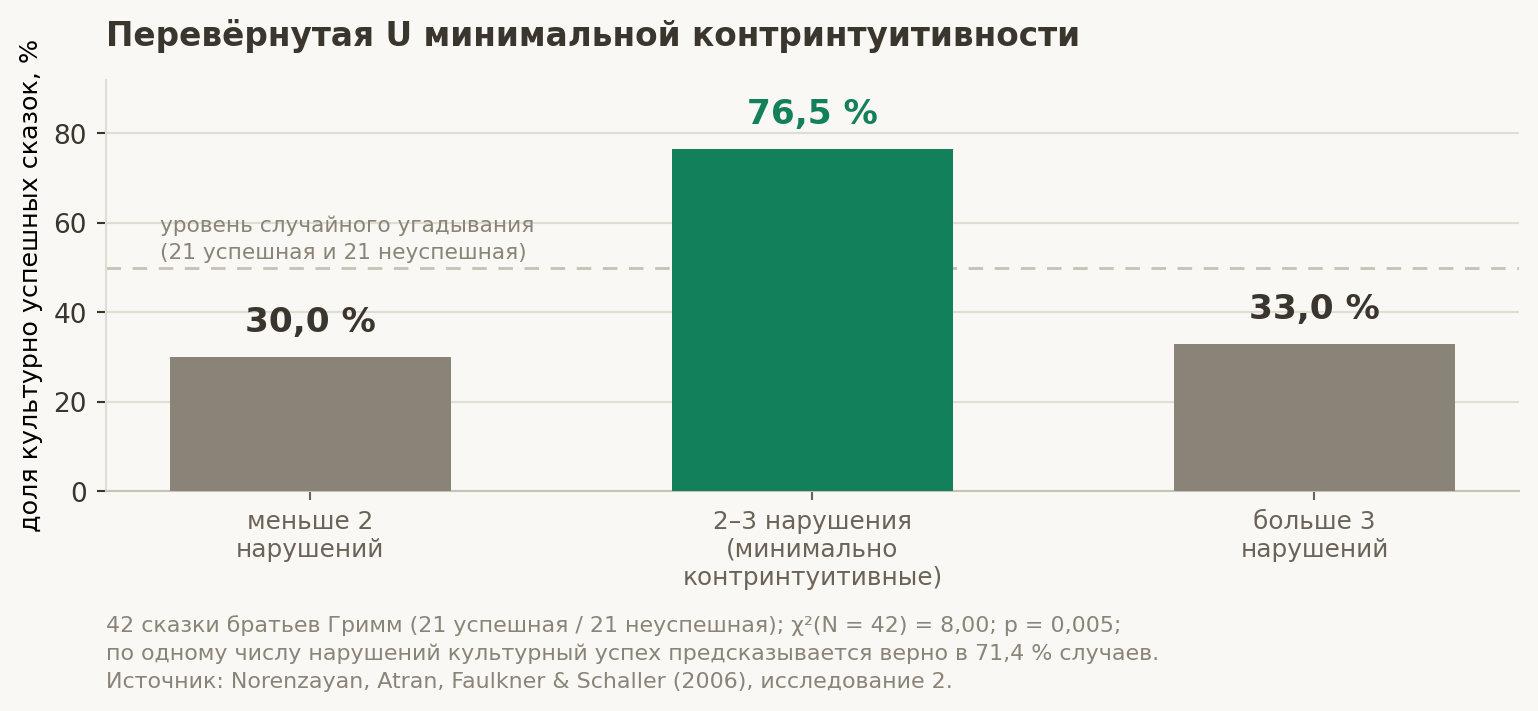
📖 Minimal counterintuitiveness.Norenzayan et al (Norenzayan, Atran, Faulkner & Schaller, 2006,Cognitive Science, 30(2), 531–553) tested why some stories live for centuries while others disappear. In the second study they took42 fairy tales from the Brothers Grimm- 21 culturally successful and 21 unsuccessful - and counted the number of violations of intuitive expectations in each (a talking animal, a disappearing object, etc.). The result is an inverted U:
- stories from2–3disorders (“minimally counterintuitive”, MCI) -76,5 %of these were in the successful sample;
- stories fromless than 2violations - are successful only in30 %cases;
- stories frommore than 3violations - are successful only in33 %cases;
- the difference is significant: χ²(N = 42) = 8.00, p = 0.005; Based on the number of violations alone, the cultural success of a fairy tale is predicted correctly in71,4 %cases.
In the first study (94 participants, 82 delayed one week later), the same profile was replicated in memory: minimally counterintuitive sets were remembered better than both normal and oddity-loaded sets.
📖 Emotional selection in urban legends.Heath, Bell & Sternberg (2001)Journal of Personality and Social Psychology, 81(6), 1028–1041) showed using urban legends that what is conveyed is predominantly what causes a strong emotional reaction, regardless of whether it is true. Specific effect sizes are not given in this book: the full text of the article could not be verified, and the rule of section 27.26 (“any number that is not in the sources does not appear in the book”) applies here too.
📖 Reconstructability.The fourth criterion follows from Sperber’s model (13.4), and it has a convenient practical consequence:a stable unit survives the retelling in its own words, an unstable unit crumbles. If the wording cannot be conveyed except literally, it means that it is not the meaning that is at work, but the form.
Summary table of criteria.
| Criterion | What we look at in practice | What has been shown empirically | Source | Status |
|---|---|---|---|---|
| Activation | What state does contact with a unit cause: anger, anxiety, delight - or sadness, lethargy? | High activation increases propagation, low activation decreases | Berger & Milkman, 2012 | 📖 confirmed |
| Minimal counterintuitiveness | How many violations of ordinary expectations are there in the formulation? | Optimum 2–3 violations; 76.5% versus 30% and 33% | Norenzayan et al., 2006 | 📖 confirmed |
| Emotional selection | Does the unit cause a strong reaction regardless of truth | The direction of the effect is shown; numbers are not given here | Heath et al., 2001 | 📖 direction |
| Reconstructability | Does the unit experience retelling in their own words? | Theoretical model of cultural attraction; There are no direct measurements within the method | Sperber, 2000 | 🔬 author’s operationalization |
| Longevity · fertility · copying accuracy | Dawkins' historical frame | Not operationalized; accuracy of copying is disputed | Dawkins, 1976; Sperber, 2000 | ⚠️ frame, not measurement |
⚠️ Transfer limits.All three empirical results were obtained onpublicmaterial: newspaper articles, fairy tales, urban legends. The method is going to apply them tointernalthe speech of a particular person - to what he says in his diary. That the criteria will work on this material,not proven; this is an assumption, and Chapter 15 describes how to test it. Before testing, the table above is a working tool of differentiation, not a measuring device.
13.6. “Thought virus” and “psychic virus”: the status of terms in this book#
⚠️ Both expressions -metaphors, not scientific terms. Their source is two popular books from 1996: Richard Brody, Virus of the Mind: The New Science of the Meme, and Aaron Lynch, Thought Contagion: How Belief Spreads Through Society. None of them are peer-reviewed scientific papers, and no peer-reviewed source defines “psychic virus” operationally.
🧭 Why does the book still preserve them?Participants in the method use these words, they accurately convey the feeling - “something from the outside has entered my head and is now in control of me.” Refusal of living language for the sake of terminological purity would make the material sterile. Therefore, the rule is: the words remain, butwhenever a statement about a mechanism is based on them, the verifiable formulation appears next to them.
⚠️ Where the metaphor lies - and this is important.The viral metaphor carries a picture of a passive carrier: the virus penetrates, multiplies, the host does not decide anything. This picture contradicts two pillars of the method at once:
- Sperber models(13.4): the unit does not penetrate and does not multiply - itreassembledby the person himself from his own material, that is, the person is a co-author of what he allegedly “infected”;
- the method's own promise: if a person is a passive carrier, then there is nothing and no need to regain attention. The whole point of the layer is that there is human participation.
🧭 Working replacement.Instead of “I was captured by a thought virus,” the method offers a formulation that describes the same thing, but does not deprive the person of authorship:“I am now reassembling someone else’s unit and acting according to it, and not according to my intention”. It’s longer and sounds worse, but you can immediately see where the lever is.
13.7. Grabbing attention and going astray#
🧭 The mechanism is as the author describes it.The meme captures the mind; a person begins to do something different from what he originally wanted; he goes out of his way. Returning attention to this process reverses the movement.
Let’s break this down into its components so that we can see what is verifiable here and what is not yet.
First: “captures consciousness.”This has a direct analogue in what the book has already sorted out. Chapter 5 describes the passive mode network (DMN) and mind wandering: a person spends a significant portion of his waking hours not in the current task, but in an internal narrative, and this narrative is not chosen arbitrarily - itpops up. The semantic layer adds one question to this that is not in Chapter 5:what exactlythe wandering is filled and where the filling comes from. The wandering mechanism is neurophysiological; the content of wandering is semantic. The method states that both need to be worked on, and that the second is usually ignored.
Second: “does not do what he originally wanted.”It is operationalizable, and quite cheap: it is necessary that the intention be recordedtocontact. Hence the diary format in Chapter 15: the intention for the day is recorded with a morning voice message, and the evening one records what has been done. The discrepancy between them is a measurable quantity, not a sensation.
Third: “goes astray.”This is where the book begins to tone down. “Path” is not a measurable category, and no formula will test it. All that the method can honestly measure is the stability of intentions over time and a subjective assessment of compliance with one’s values, that is, questionnaires. Statements about income, career and “real events” remain outside the evidentiary framework until the corresponding indicators are present in the platform (13.1).
⚠️ A separate risk of this frame.The idea “there is something else in my head” can also be used destructively - as a way to devalue any doubts of one’s own (“it’s not me who doubts, it’s a meme”) or as a tool of pressure from the presenter (“you’re not talking now”). This is a standard mechanism for closed groups, and the method must protect against it directly. Rule:the differentiation tool is applied by the participant to himself and only to himself. The presenter does not have the right to classify other people’s statements as “meme”, “capture” or “not you”. Formally, this rule relates to Chapter 19 and is included in the requirements for the presenter - section 19.5, where a violation is directly named as a basis for removal from leading.
13.8. Differentiation: the first practical task of the layer#
🧭 Differentiation is the skill of noticing a unit of meaning asseparate object, and not as your own thought. The task looks primitive until the first attempt to complete it.
Four steps that the participant masters:
- Notice— to catch the moment when a formulation appeared in your head that you did not construct.
- Name— formulate it in one phrase, out loud. Until it is named, it cannot be considered.
- Track source- where did you meet her: conversation, tape, family, professional environment, book. Often the source is not remembered, and this in itself is informative.
- Check action- compare what you did after contact with what you were going to do before.
Signs of seizure - a practical checklist.None of the signs by themselves prove anything; the meaning is in their coincidence.
| Sign | How is it checked? | What is it based on? |
|---|---|---|
| The action does not coincide with the intention formulated in advance | Morning intention vs. evening report | 🧭 practice method |
| There is urgency without a deadline | “Why is this necessary right now?” - no answer | 🧭 practice method |
| High activation without new fact | There is anger/anxiety/delight, but no new information | 📖 Berger & Milkman, 2012 |
| The wording is reproduced verbatim | Trying to retell it in your own words - the content falls apart | 📖/🔬 Sperber, 2000, author’s operationalization |
| There are exactly 2-3 “oddities” in the formulation | Too smooth or too wild - usually doesn't stick | 📖 Norenzayan et al., 2006 |
| The unit does not worry about the question “what if it’s the other way around?” | Direct test for reversibility | 🧭 practice method |
⚠️ The threshold beyond which training becomes harmful.Constantly monitoring your own thoughts for “foreignness” is exactly what clinical psychology describes as excessive metacognitive vigilance, and for some people it increases anxiety rather than reducing it. The method already has a similar problem with bodily attention (Chapter 7) and with depersonalization (Chapter 19), and the solution here is the same:differentiation is trained in doses, in the allotted time- for example, two fixed windows per day according to the diary, - andnot as background mode. The participant must be told this directly at the entrance.
🔬 Order hypothesis.Differentiation is puttostopping the internal dialogue (Chapter 16), and not after, because stopping requires an object, and the object requires the ability to isolate it. This is verified by comparing two groups: one goes through the semantic layer before neurotechnology, the other goes through neurotechnology right away. Prediction - in section 13.10.
13.9. Memetics Mastery Protocol#
✍️ [To the author - to add].Below is the framework into which your actual protocol is built. The wording in square brackets is something that is not in the book and that only you have.
- [Exact sequence of classes]- how many steps, what duration, in what order, what homework, what analysis.
- [Verbatim wording of tasks]- how exactly do you ask a person to notice the unit. What matters here is your vocabulary, not paraphrase: what worked in Chapter 16 was that the scripts were given verbatim.
- [Material for first recognition]— what do you give a person to practice on for the first time: advertising, tape, family phrases, professional jargon. What do you give first and why.
- [How do you distinguish “yours” from “someone else’s”]- your criterion. The book has six of them (13.8), and they are all external; yours, according to the interview, is closer to the physical - describe it.
- [What to do with a detected unit]- the method assumes that detection is followed by action. Which? This is a critical gap: without an answer, the layer remains diagnostic and does not change anything.
- [Typical mistakes of participants]- what people fail at at this stage, what it looks like, what you say.
- [Mastery criterion]- how do you understand that a person can be transferred to layer 1. An observable sign is desirable, and not a feeling of the leader.
- [Duration]— how long a layer occupies in the calendar: days, weeks, number of meetings.
- [Your cases]— specific stories: what unit did the person discover, what changed. One detailed case here is worth ten paragraphs of theory; format - as in section 31.5.
- [Borders]— for whom this layer is contraindicated or difficult. Relate to chapter 19.
13.10. What can be falsified here?#
The section is modeled after Chapter 28: predictions are formulatedtodata collection, with numerical thresholds, and the book undertakes to publish the result regardless of direction.
🔬 Prediction 1—Differentiation as a skill, not as knowledge.After passing the semantic layer, the participant must distinguish units of meaningbetter than a person who was simply told a theory. Test: blind test on 30 short formulations (15 of them are reproducible “sticky” constructions with 2-3 violations of expectations, 15 are neutral), the participant classifies. Threshold: the proportion of correct classifications among those who passed the layer is higher than in the “read the chapter” group by at least 15 percentage points. If there is no difference, the layer gives knowledge, not skill, and this must be recognized.
🔬 Prediction 2—The intention-action discrepancy is reduced.According to the diary: the proportion of days in which the evening report contains the main thing from the morning intention. Threshold: an increase of at least 20 percentage points from the individual baseline over 8 weeks, while controlling for the number of entries (otherwise the increase is explained by the fact that the person has become more careful in keeping a diary rather than living).
🔬 Prediction 3 - Layer order matters.The group that passed the semantic layer before neurotechnology achieves the same level on the MNPI (Chapter 27)no worsethan the group that started with neurotechnology, and is superior to it in terms of retention on the Y2/U3 horizon (section 27.23.1). Rationale: the distinction of meanings should not affect the speed of entry into the state, but the ability not to crumble after exiting. If the advantage is found in entry speed, but not in retention, the model is incorrect, even if the result is “good.”
⚠️ A prediction that the book does not consciously articulate.About income. It sounds more impressive than all three combined and that is why it should not be on the research agenda until there is neither an indicator nor a way to separate the effect of the method from selection: people who come to the method are already changing something at this point in their lives. Until this is resolved, the question appears in Appendix B as an open question rather than in the chapter as a prediction.
14. Phenomenology: vectoriality and mental construction#
If memetics answers the question "Whatspins in a person’s head and where it comes from,” then phenomenology answers the question “Howit’s built there.” The first without the second gives a catalog of contents. The second without the first gives an empty form. The method needs both, and it is at their intersection that what the author callsmental construct(Section 14.6).
14.1. Vectorality: intentionality as the basic structure of experience#
📖 What is called vectorization.Franz Brentano in “Psychology from an Empirical Point of View” (1874) returned the scholastic concept to philosophyintentionality: every mental actaimed at something. You can't just see - you seesomething. You can't just be afraid - you're afraidsomething. You can’t just wish, remember, doubt - each act has its own subject. Direction is not a property of some states of consciousness, but a sign that distinguishes the mental from the physical.
📖 Edmund Husserl made a method out of this. In “Ideas for Pure Phenomenology” (1913), the description of experience is divided into two poles:noesis- the act itself (how exactly I am addressed to it: I perceive, remember, imagine, fear) andnoema- what I am turned to, takenexactly as it was given to me, and not as it is in itself. The same tree can be given as perceived, as remembered and as imaginary - the noema is different for the same object.
🧭 What does the method take from this.The author calls this directionvectorial, and the word is precise: every moment of experience has a direction, and this direction can be noticed separately from what it points to. The practical consequence is direct: usually a person livesthroughtheir acts, seeing only their subject. He sees the problem, and not how the problem is given to him. He sees “this person annoys me,” and not “I address this person in such and such a way.” Switching attention from the subject to the way of givenness is the first phenomenological move, and this is the first thing worth teaching.
🔬 The point where it comes right down to the method.ONTO system mode 1 -ONTO NOTHING— defined in Chapter 18 as “awareness without content.” In Husserl's language, this is a statement that the noetic pole can be preserved when the noematic pole is removed: the act is there, the object is not. This is a strong statement, and it is not indisputable: whether “events of pure consciousness” exist without any object or whether we are talking about a state with a very poor and difficult to verbalize object is an open question in the philosophy of consciousness. The book records it as open (Appendix B) and suggests not to argue, but to describe: what exactly a person is doing in mode 1 is learned not from theory, but from the procedure of section 14.4.
14.2. Natural installation and era: how to see the structure in general#
📖 Natural installationis Husserl's name for the default way we live: the world simply is, things are simply the way they are, thoughts are simply true. We do not notice the work that the world gives us - we notice the result of this work.
📖 era(ἐποχή, “abstention”) - a procedural move by which this installation is suspended. Not denying the existence of the world and not doubting it, butbracketing the question of existence: I stop asking if it's true and start looking,how exactlyit has been revealed to me. Attention turns from the object to its givenness.
⚠️ Three frequent changeswhich you should protect yourself from right away, because each of them takes practice aside:
- Epoche is not “stopping thoughts.”Thoughts can go; It is not their presence that changes, but the position towards them.
- An era is not a doubt.Doubt remains within the question of truth. The era puts this question aside entirely.
- Epoch is not detachment or indifference.Judgment of existence is suspended, not participation. Mixing these things gives exactly the flattened, alienated result, the risk of which Chapter 19 warns about.
🧭 Link to Chapter 13.Differentiating memes and eras is the same gesture applied to different layers. Differentiation isolatescontent(“this formulation came from outside”). The era highlightsway of giving(“This is how this formulation presents itself to me: as obviousness, as urgency, as someone else’s voice, as a bodily contraction”). The first can be done without knowing how to do the second, but deeply - no: content, separated from the way it is given, remains simply another content, and the next one quickly takes its place.
14.3. Neurophenomenology: mutual restrictions#
📖 Francisco Varela (Varela, 1996,Journal of Consciousness Studies, 3(4), 330–349) proposed a programneurophenomenology. Her idea is in one thesis: subjective reports and objective measurements are not arranged hierarchically - neither the report is “explained” by physiology, nor physiology is “interpreted” by the report. They are put in relationmutual restrictions(mutual constraints): a disciplined description of experience specifies what to look for in the data, and the structure of the data specifies what to specify in the description. A prerequisite is that the report must be receivedmethod, and not by naive introspection.
📖 Testing the program in practice.Lutz, Lachaux, Martinerie & Varela, 2002PNAS, 99(3), 1586–1591) conducted an experiment that provides a direct structural precedent for the method. The participants (there were only four of them, and this is a fundamental limitation of the work) performed a simple visual task, but before each trial they gave a brief report about the state of attention in which they approached it. The reports were not adjusted to predetermined scales - they were collected inphenomenal clusters, derived from the descriptions themselves. Next, the clusters were used as a variable to split the EEG data: and it turned out that different clusters corresponded to different synchronization patterns and different reaction times - that is, the first person actually marked out what looked like noise in the general pile of data.
🧭 Why is this important here?The method platform already collects both halves: the EEG upload (Chapter 29) and the voice diary (Section 29.7, 819 voice transcripts from 39 people). What she doesn't have isdisciplines on the reporting side. A diary entry is a free story; the phenomenal cluster is the result of the procedure. The difference between what the method does now and what Lutz and his co-authors did is not in the instruments or the amount of data, but in this procedure. It is described in the next section.
⚠️ Four participants. Lutz's work is prooffeasibilityapproach, not its effectiveness. It cannot be referred to as confirmation of the method; it is possible and necessary to refer to it as an example of a research design.
14.4. Microphenomenological interview: operational procedure#
The author says that “there are well-known formulas for the study of phenomenology.” There are no formulas in the mathematical sense - but there is a published step-by-step procedure, the only one of its kind, and this is the closest that exists.
📖 Interview.Claire Petitmengin (2006,Phenomenology and the Cognitive Sciences, 5(3–4), 229–269) described the second-person interview method: the interviewer helps a person describe a specific moment of his own experience with a level of detail that is inaccessible to the person himself. Key rules:
- A single episode, not a generalization.The question is not “how do you usually enter the state,” but “remember that specific time, Tuesday, that entry - what came first?” Generalizations are the enemy: they reveal a person's theory about himself, not his experience.
- Evocation.A person is brought back to the moment through sensory details - where he was, what he saw, heard, what his posture was. The sign that the evocation has taken place is observable: the speech changes (present tense instead of the past), the pace slows down, the gaze becomes unfocused, and gestures appear that repeat those of that time.
- Reorienting attention from “what” to “how”.The person almost always tells the content. The interviewer's job is to bring him back to the way: "how did you know it started?", "what came before that?", "what was it like - an image, a sound, a bodily sensation?"
- Questions that are empty in content.The interviewer has no right to suggest content - only to direct attention. “Did you feel anxious?” - a forbidden question. “How did you feel?” - allowed.
- Ban on "why".The question “why” evokes an explanation, and an explanation replaces a description. They only ask “what”, “how”, “where”, “when”, “what happened before this”.
- Iterative refinement.The same moment is passed several times, each time with greater resolution.
📖 Analysis.Petitmengin, Remillieux & Valenzuela-Moguillansky, 2019,Phenomenology and the Cognitive Sciences, 18(4), 691–730) published a procedure for processing the resulting descriptions. The transcript is cut into elementary units; from specific units, more general ones are stepwise derived through a set of described abstraction operations; from the resulting two structures are assembled:
- synchronous structure— what was present in the experience at the same time, what layers were present at the same moment;
- diachronic structure- the sequence of stages through which the experience passed: where it began, what the transition was, how it ended.
🧭 What does the method get out of this right now.Diachronic structure is exactly the description that entry protocols lack. Section 18.19 fixes an inconvenient fact: of the eight modes, exactly one has a complete protocol. Microphenomenological interview is a wayget the missing seven, and not from the author’s head, but from the experience of those who already have access. The procedure is known, reproducible and does not require equipment.
⚠️ She requires something else - interviewer training. This is not a conversation based on a checklist: almost all natural reactions of the interlocutor (to clarify, sympathize, assume, ask “why”) are prohibited in this procedure. Without preparation, the interview turns into a leading conversation, and the result is worse than no data because it looks like data.
14.5. What the procedure gives: a precedent with warning signs of attacks#
📖 Petitmengin, Baulac & Navarro (2006,Epilepsy & Behavior, 9(2), 298–306) applied microphenomenological interviewing tonine patients with epilepsyto find out whether the attack has subjective warning signs before the aura. Results:
- sixdiscovered in themselves precursors that they were not previously aware of - for5–24 hoursbefore the attack;
- sixBased on this, we developed avoidance strategies - we learned to change behavior when warning signs appeared;
- fiveWe have developed strategies for interrupting the aura, that is, interfering with a process that has already begun.
🧭 Why is this work here?It is the only published analogue found of the entire causal chain that the author states:differentiation → noticing → returning agency → changing real events. People learned to distinguish what was previously an indistinguishable background to them - and this changed not their self-report of well-being, but the physical events in their lives. Moreover, the distinction here arose not from attention training as such, but precisely fromdescription procedures: harbingers existed before, but were not highlighted as an object.
⚠️ What this job is not.Nine patients, no control group, no randomization; attack frequency and effectiveness of strategies were recorded by self-report. This is a feasibility study, not proof of effectiveness. It is impossible to present it as “science has proven that discrimination changes events.” It is possible to present it as “there is a published precedent, structured in the same way as our application, and it provides grounds for checking it seriously.”
🔬 Transfer to method.If the procedure allows one to detect the precursors of an epileptic seizure hours before it, then it, in principle, can also detect the precursors of what the author calls attentional capture - a transition after which a person begins to do something different from what he intended (section 13.7). The test is described in Chapter 15.
14.6. Mental construction: where memetics and phenomenology converge#
🧭 Author's thesis.Both sciences are needed because together they revealmental construct- an entity that coexists in the head as a basic structure. Not a separate thought or a separate belief, but a stable assembly that is reproduced over and over again and determines behavior over and over again.
Let's figure out what each half gives.
Memetics provides content.What is the unit, where does it come from, what are its characteristics, how sticky it is (Chapter 13). But memetics says nothing aboutHowthe unit is present in a specific head: as evidence or as doubt, as a voice or as an image, as pressure in the chest or as acceleration of speech. For memetics, the unit is a point.
Phenomenology gives form.Method of givenness, vector, synchronous and diachronic structure. But phenomenology, by its structure, is indifferent to origin: it is not interested in where a person got it. For phenomenology, the unit is structure without history.
🔬 The working definition the book offers.A mental construct is a stable combination of four layers, reproduced in a person over and over again:
| Construction layer | What is this | What is being researched | Where in the method |
|---|---|---|---|
| Unit of meaning | The formulation that a person reproduces: “I need to be useful”, “it’s dangerous to relax”, “first I’ll earn money, then I’ll live” | Chapter 13 Criteria; voice diary | Layer 0, Chapter 12 (Baseline) |
| Method of giving | How it is presented: as obviousness, urgency, someone else’s voice, a picture, a ban | Microphenomenological interview (14.4) | Layer 0, Chapter 30 |
| Flesh tone | What happens in the body at the moment of her presence: where it contracts, what happens to breathing | Interoception (Chapter 7), HRV and Wearable Devices (Chapter 26) | Layer 2 |
| Typical action | What a person does next is repeatable | Discrepancy between intention and report (13.7, 15.6) | Layer 0, diary |
🧭 The practical meaning of this assembly.Working only with content allows you to replace a belief with another belief - the structure is preserved, the filling changes. Working only with the body gives temporary relaxation - the structure returns along with the situation. Working only with the state gives you the ability to enter silence - and exit back into the same structure. The method states that disconnection occurs where all four layers are visibleat the same time as one thing, and that this is precisely what makes subsequent neurotechnology not a technique, but a change.
⚠️ This statement is central to the entire layer andunverified. It follows neither from Sperber, nor from Husserl, nor from Varela; This is the author's model. It is formulated specifically enough to be falsifiable (15.6), and until this point remains a hypothesis.
14.7. Honestly: what microphenomenology doesn't have#
Section 13.3 was about the weakness of memetics. This one is about the weaknesses of the phenomenological procedure. They are of a different kind: there is a working method, but there are also claims that it has not yet fully answered.
📖 Fundamental objection.Nisbett & Wilson (1977)Psychological Review, 84(3), 231–259) in the classic paper “Telling more than we can know” showed through a series of experiments that people systematically do not have access to the processes that determine their judgments and choices: they produce plausible explanations that have nothing to do with the real reasons, and do so with confidence. If this is true in general terms, then any verbal report of an experience is a confabulation.
📖 Answer from the school of microphenomenology.Petitmengin et al (Petitmengin, Remillieux, Cahour & Carter-Thomas, 2013,Consciousness and Cognition) return to the experiments of Nisbett and Wilson and argue that their conclusion is true forspontaneousself-report, but does not describe what happens in a guided interview: under the guidance of the interviewer, participants gain access to details of the process that do not appear in the free report. The dispute is not over; it continues.
⚠️ What remains unresolved is the list that the method must keep before its eyes:
- There are no published interrater agreement statistics.The 2019 analysis procedure is described step by step, but data on the extent to which two independent analysts, having processed one transcript, will obtain the same structure, could not be found in the open literature. For the method that builds indices on ICC and SEM in Chapter 27, this is a fundamental gap: without consistency, reliability cannot be considered, and without reliability, change (RCI) cannot be considered.
- Suggestion on the part of the interviewer.The procedure is specifically designed against him - hence the ban on substantive questions and “why”. But design is not equal to proof: there are few controlled tests for suggestibility within the framework of the procedure itself.
- Retrospective.The recalled moment is described, and memory is reconstructive. Evocation reduces the problem, but does not eliminate it.
- Small samples.Key works - from four to several dozen participants. This is fine for qualitative research and not sufficient for making statements about a population.
- Price.One interview - from an hour; decoding and analysis - many times more. It is unrealistic to scale this to all participants in a method, and Chapter 15 is structured around this limitation.
🧭 What does this mean for the method?Microphenomenology is used asa tool of discovery, not measurement. It is used to extract structures - what the entrance to the mode consists of, what are the precursors of capture, how does mode 1 differ from mode 4 in experience. The found structures are then turned into short verifiable items that can be asked to everyone and counted. This is the same path that Lutz and his co-authors followed: first phenomenal clusters, then the cluster as a variable.
🔬 An open question that the method can close itself.Interrater consistency of microphenomenological analysis is testable, and does not require a grant: two trained analysts and two dozen transcripts from an already collected corpus are sufficient (Section 29.7). If the method does this and publishes it, it will close the gap not only for itself, but also in the discipline itself. Listed in Appendix B.
14.8. Phenomenological layer and “annihilation of the self”#
🔬 Chapter 16 describes stopping the internal dialogue through the sequence “phrase → “I” → dissolution → silence.” In the language of Chapter 14 it looks like this: first removecontent(unit of meaning), then -carrier, to which the content was attached, and what remains is the noetic pole without the noematic one, that is, mode 1.
The phenomenological framework provides here three specific things that the method currently does not have.
The first is the language of distinction.“Empty,” “there was nothing,” “passed out,” and “it was very quiet, but I knew I was there” are perhaps four different states, and in current reports they merge into one. A microphenomenological interview distinguishes them by asking questions about synchronic structure: what was present at the same time, was there a background, was there a sense of duration, was there a sense of oneself as a point or as a volume.
The second is an entry map for the remaining seven modes.Section 18.19 states that only one mode has a complete protocol. Diachronic structure (14.4) is a ready-made format for the rest: a sequence of stages with signs of transition between them, obtained from those whose input is reproduced.
Third is the fuse.Chapter 19 lists the risks: depersonalization, flattening, detachment. Phenomenologically thisnot the samethat mode 1: in depersonalization there is a characteristic feeling of alienation of oneself and the world, which is not present in descriptions of deep peace. The difference is made by the method of givenness, and this means that it can be caught by asking about the method of givenness - that is, noticeably earlier than it takes shape in a complaint. To formulate this question in the form of two or three points for the session exit protocol is a specific task, and it has not been done.
⚠️ The reservation about the status of “awareness without content” from section 14.1 also applies here: whether experience without an object is possible at all is a controversial issue, and the method is not obliged to solve it. It is enough for him to describe what the participants communicate, and not pass off the description as an ontology.
14.9. Protocol for mastering the phenomenological position#
✍️ [To the author - to add].Below is the frame. In square brackets is what only you have.
- [How do you explain vectorization]- in their own words, those that work on living people. Participants most likely do not need the terms “noesis” and “noema”; what do you replace them with?
- [First exercise on switching “what” → “how”]- verbatim. Where does a person begin: with the perception of an object in the room, with an emotion, with a memory?
- [Your version of the era]— how you give suspension of judgment without turning it into detachment. This is the thinnest part of the layer, and it is here that an error costs the most (14.2).
- [Formulation of questions with which you return a person to experience]- your analogue of rules 14.4. A list of ten working questions here is more valuable than any explanation.
- [How do you train presenters not to give hints]- if the layer will work not only with you, this is critical.
- [What do you do with the found structure]- the person described what his entrance or his grip consists of. What next? This is the same gap as in 13.9, and here it is even more noticeable.
- [Mastery criterion]- which shows that the person owns the position and does not retell it.
- [Mode Link]— what descriptions have you already heard for modes 1–7 and what is repeated in them among different people. This is direct material for section 18.19.
- [Your observations about how the description of experience changes with practice]— does it become more detailed, do new distinctions appear? If yes, it is measurable and can become a sub-index.
- [Duration and place in the calendar]— how much it takes and how it is combined with the memetic layer: in parallel or sequentially.
15. Semantic conveyor: from audio message to unit of meaning#
The two previous chapters describe what the method wants to see. This one is how he will see it on the material that he already has. The author formulates the problem directly: a unit of disseminated information “can be isolated from what a person will leave as an audio message in a bot, and this can be investigated.” Below is exactly how.
15.1. What's already in the data#
📖 Initial condition (according to the inventory of Chapter 29).In the platform diary -1,011 entries from 39 people, of which819 (81%) - voice message transcripts; the first one is datedMarch 30, 2026. Section 29.7 already states that this is an advantage for phenomenological analysis: dictated speech is closer to spontaneous than typed text, it retains repetitions, self-interruptions and pauses - things that are cleared out during printing.
🧭 What is missing from this data?Markings. Entries exist as free text: they can be read, but cannot be counted. The job of the pipeline is to turn an array of stories into a set of objects, each of which has attributes, a date, and an owner. Without this step, both memetics and phenomenology remain a conversation.
⚠️ Three limitations of the material that must be mentioned immediately.First, 39 people is a convenience sample, not a population. Secondly, not everyone keeps a diary and not evenly: the recording activity itself is a variable (and, very likely, correlates with involvement and with the result - that is, it is a confound, not a neutral background). Thirdly, four months of observations is less than the U3 horizon from section 27.23.1, that is, these data cannot be used to judge long-term transport.
15.2. Conveyor: six steps#
🧭 The conveyor is designed like a funnel: a wide automatic layer on top, a narrow manual layer on the bottom. The point of the design is that the expensive procedure (microphenomenological interview, 14.4) is not applied to all records, but only to those that the automatic layer has marked as interesting.
Step 1 - collection.Voice message in a bot, automatic transcription. Already working.
Step 2 - normalization.The record receives the required fields: date and time, participant (in pseudonymized form),origin - dictated or typed, audio duration, number of words, program stage, closest EEG session. The origin field is required: without it, lexical metrics are invalid (15.5).
Step 3 - automatic marking.Cheap, reproducible, completely formal features: the proportion of first-person singular pronouns, the proportion of words of negative and positive tone, activation markers, markers of obligation (“must”, “should”, “must”), markers of urgency without a date, the proportion of modalities of possibility. It is considered a program, not a person, according to a fixed dictionary.
Step 4 - selecting candidates.A record is marked as a candidate if it containsreproducible wording: a construction that is not encountered by the same person for the first time, or carries signs from the summary table of section 13.5. The selection is automatic and intentionally redundant—it’s cheaper to skip the extra stuff than to lose it.
Step 5 - manual marking of the candidate.The person fills out the unit card (15.3). This is the only step where a trained marker is needed, and it is also the bottleneck of the conveyor.
Step 6 - in-depth interview on a subset.A microphenomenological interview is conducted only on units that are repeated regularly in one person or occur in many people. The result is synchronic and diachronic structures (14.4), which are returned to step 3 in the form of new automatic features. The circuit closes.
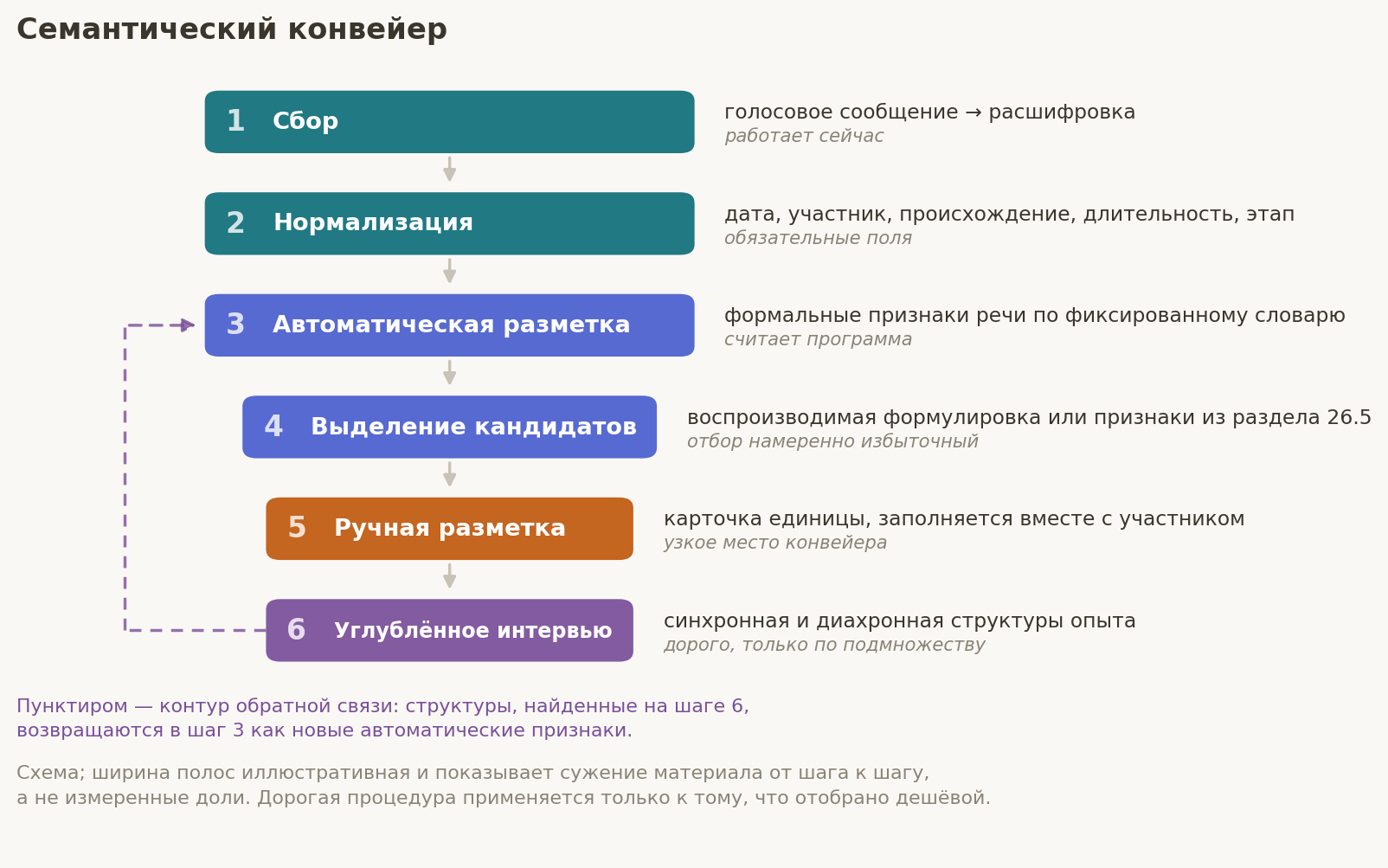
⚠️ The weak point of the design is step 5.It is manual, which means it is limited in volume and subject to discrepancies between markers. This is where interrater agreement (14.7) should be measured, and it is its absence that will make all further figures unverifiable. Rule:until the published ICC for the unit card is available, the results of step 5 are not used in the indices, only in the descriptive part.
15.3. Unit card: what is marked#
🧭 Minimum card. Intentionally short: the long one will not be filled out.
| Field | What is included | Type |
|---|---|---|
| Formulation | Verbatim, as pronounced by the participant | text |
| First appearance | Date of first entry where we met | date |
| Frequency | How many times have I met this member? | number |
| Source | Source named by participant or “not recalled” | category |
| Activation | High / low / no - based on speech characteristics and self-report | category |
| Modality of given | Voice / image / bodily sensation / “just knowing” | category |
| Bodily localization | Where is it being recalled, if is it being recalled? | text |
| Typical action | What does the participant do next? | text |
| Divergence from intention | Yes / no / not applicable | category |
| Experiences retelling | Yes/no - test for reconstructability (13.5) | category |
🧭 The first four fields are filled in by appointment. Fields five through eight require either a participant response or an interview—which is why the card is filled out with the participant, not for them. This is fundamental: a marker who independently decides what is in a person’s head produces not data, but his own interpretation.
⚠️ The “source” field will be empty more often than you would like. This is not a defect: the lack of recall of the source is in itself informative and probably correlates with the “embeddedness” of the unit. This is a hypothesis, and it should be tested, and not considered obvious.
15.4. Automatic markers: I-talk and what it really is#
Of all the automatic signs, one deserves its own analysis because it is both the most tempting and the most misunderstood.
📖 What is I-talk.The proportion of first person singular pronouns (“I”, “me”, “me”, “my”) in speech. The metric is cheap, fully automatic, robust - and very widely used.
📖 What is really known about her?Meta-analysis by Edwards and Holtzman (Edwards & Holtzman, 2017,Journal of Research in Personality; 21 studies, n = 3,758) link I-talk to depressionr ≈ 0,13- that is, weak. A larger work by Tackman et al. (Tackman et al., 2019,Journal of Personality and Social Psychology, 116(5), 817–834; N = 4 754, six laboratories, two countries) clarifies the picture fundamentally: the connection isr = 0,10(95% CI [0.07, 0.13]) and - more importantly -it is not specific for depression. The same pattern is produced by general negative emotionality, and when it is controlled, the connection between I-talk and depression significantly weakens.
⚠️ What follows from this?I-talk isa marker of general negative emotionality, not a diagnostic sign. The value r ≈ 0.10–0.13 means that in terms of the proportion of “I” in speechit is impossible to say anything about an individual person. Any use of this metric to evaluate a specific participant is a mistake. In the workbook and in the platform, it is only valid as a group variable.
🔬 Where real contribution is possible here - and it is not trivial.All works cited -interpersonal: They compare different people to each other at one moment. The method has a different construction:repeated measurements within one person— up to hundreds of entries from one participant over a period of months. The question “does I-talk change in the same person along with his condition” isanother question, than “are depressed people different from non-depressed people”, and it has been studied noticeably less. Meanwhile, it is precisely this that is relevant to the method: the claim of Chapter 16 is to weaken the self-narrative, and I-talk is the most direct existing operationalization of the self-narrative that can be calculated automatically.
🔬 Hence the prediction.For a participant who has passed the self-narrative stage, the proportion of I-talk in diary entries should decrease relative to his own baseline, and this decrease should coincide in time with an increase in MNPI - despite the fact that it is pointless to compare the absolute level of I-talk between different participants. This is formally tested by a multilevel model with participant as a random effect. Numerical thresholds - Section 15.6.
⚠️ Required condition.Section 29.7 has already fixed the rule: lexical metrics cannot be calculated from a mixed array of dictated and typed records,origin must be included in the model as a covariate. Dictated speech differs systematically from printed speech in the proportion of pronouns—and without this correction, any “method effect” found may be the effect of the participant typing more frequently over a period of time.
15.5. Covariates, pitfalls and prohibitions#
⚠️ A list of what must be included in the model, and what cannot be done. It is compiled from mistakes that are made regularly in studies of this type.
Required covariates:
| Covariate | Why is it required? |
|---|---|
| Origin of recording (voice/text) | Systematically shifts all lexical metrics (29.7) |
| Record length | Word shares are unstable on short texts; short recording gives noisy score |
| Journaling frequency | Changes with involvement; otherwise the effect of method is confused with diligence |
| Times of Day | Morning and evening speech differ in tone and structure |
| Program stage | The content of records changes simply because tasks change |
| Transcription quality | Recognition errors are not random: they are more common in fast and emotional speech, that is, they correlate with the characteristic being studied |
Prohibitions:
- Do not interpret I-talk at the individual level (15.4).
- Do not show the participant his semantic metrics in real time.The metric that can be seen begins to optimize: a person will say “I” less often. This is exactly the threat to validity that Chapter 29 lists for the platform in general; here it is maximum.
- Do not classify other people's statements as a “meme” or “hijacking”- Rule 13.7 also applies to the marker.
- Do not quote participants' diary entriesneither in a book, nor in presentations, nor in reports without separate written consent specifically for quotation. Consent to participate in a study does not constitute such consent. The voice diary is the most sensitive array of all that the method has: people say things there that they would not write.
- Do not run the pipeline until participants know that their records are being analyzed and how.At the time of writing, the method has no informed consent at all (section 19.8) - and the semantic layer turns this gap from administrative to ethical.
15.6. Pre-registered semantic shift hypothesis#
It is formulated along the lines of Chapter 28: before data collection, with thresholds, with an obligation to publish the result in any direction.
🔬 Main hypothesis.Within a participant, the proportion of I-talk in diary entries decreases from the individual baseline after completing the self-narrative phase, and the magnitude of the decrease is positively related to ΔMNPI over the same period.
- Design:multilevel model, participant—random effect; covariates—all six from Section 15.5.
- Baseline:at least 10 entries before the stage; participants with fewer entries are not included in the analysis.
- Primary outcome:one is the coefficient on the stage × time interaction for I-talk. Not eight outcomes, but one; the multiplicity adjustment is announced in advance (Chapter 30).
- Content threshold:reduction of at least 15% from the individual baseline. Anything less is considered noise regardless of the p-value.
- Falsification condition:if a decrease is detectedAndin the control period before the start of the stage - the effect is explained by the very fact of keeping a diary, and the hypothesis is rejected.
🔬 Secondary hypothesis (differentiation).The number of different units of meaning that the participant names independently over a fixed period increases after the semantic layer, and the number of repetitions of the same unit decreases. In essence, this is “began to distinguish one meme from another.” The threshold is an increase in the number of distinguished units by at least one and a half times with a non-decreasing total volume of records.
🔬 Third hypothesis (precursors of capture).By analogy with the work on seizure precursors (14.5): participants who have completed a microphenomenological interview on their repeated unit detect bodily or perceptual precursors of its activation and report them earlier than the action itself. The primary outcome was the proportion of episodes in which the precursor was named before the action rather than after. This is the most interesting and weakest of the three hypotheses.
⚠️ What this design does not check.None of the three hypotheses tests the author's main claim - that understanding the nature of memes increases critical thinking and changes life outcomes. The first requires a separate instrument (standardized critical thinking scales exist), the second requires indicators that the method does not have (13.1). The book captures this as a rupture rather than closing it with language.
15.7. Will this be included in MNPI?#
⚠️ The short answer is no, and it's a conscious decision.
Section 27.9 defines four subindices of the MNPI, section 29.8 lists four discrepancies between Chapter 27 and the production formula, and section 27.26 shows that three different NSI formulations and three different MNPI formulas already coexist in the method working papers. Adding a fifth subindex to this design, built on the newest and least reliable metric, means increasing confusion and at the same time deteriorating the interpretability of the entire index.
🧭 Solution.Semantic indicators are being maintainedseparate circuit— the same as the RI carry index (Section 27.23), which is not intentionally mixed with the MNPI. The circuit has its own name, its own units and its own separate validation.
Conditions under which the question of inclusion can be raised again- all three, not any of them:
- Interrater consistency of unit card markings (ICC) has been published and is at least as good as that accepted for the remaining components of the MNPI (Chapter 27).
- Semantic measures showed reproducible relationships with the MNPI in a sample independent of the one on which they were obtained.
- It has been verified that turning it on does not degrade the reliability of MNPI itself - that is, SEM and SE_diff do not increase, and the RCI threshold does not drift away.
📖 A reminder why this rigor is needed: without a stable SEM, reliable change cannot be considered, and without reliable change, the entire measurement circuit of the book (Jacobson-Truax RCI, threshold |RCI| > 1.96) turns into a set of beautiful numbers without interpretation.
15.8. What remains to be written about this chapter?#
✍️ [To the author - to add].
- [Your journal assignment format]- what exactly are you asking to slander. There are currently free records in the data; the pipeline benefits greatly from one or two fixed questions in the morning and evening. What questions do you have?
- [Marker Dictionary]- Russian-language tone and activation dictionaries, which are considered step 3, must be selected and recorded. There are several of them, and they give different results; a choice must be madetoanalysis and announced.
- [Who marks]— are you, the assistant, a trained participant? The quality, volume, and whose consent is needed depend on this.
- [Your observations about repeating units]— what formulations do you hear from participants most often? This is a ready-made starting list, and no one has it but you.
- [Full cycle example]- one real unit, carried out through all six steps: how it was heard, how it was marked, what it was interviewed, what changed. With depersonalization and consent. One such example will make the chapter clearer than all the diagrams.
- [Informed Consent Decision]- before starting the conveyor. Form, volume, what exactly the participant allows: analysis, quotation, publication in an impersonal form. Relate to sections 31.8 and 19.8.
Part IV. Method: layers 1–3 - brain, body, states#
This is where neurotechnology itself begins. The three layers go in the order in which they are trained: first the silence of the mind (chapter 16), then the return of connection with the body (chapter 17) and only after that - holistic states, the ONTO system of eight modes (chapter 18). Each subsequent layer builds on the skill of the previous one; skipping the previous layer does not speed up the development of the next one, but makes it unstable.
16. Layer 1 - Brain#
16.1. Basic Skill: Shutting Down Self-Dialogue#
🧭 Sequence (core technique):
- A person says a reference phrase out loud(working example: “I have everything to believe in myself”) — five minutes per sentence.
- The phrase step by stepis declining: “I have everything” → “I am everything” → “I am” → “I am everything” → “Everything is I” → “I.”Each step lasts the same five minutes.; the complete sequence is seven phrases (21.5).
- At the last stage manvisualizes the image of “I”Anduploads his ideas about himself into it— layer by layer, from childhood to the projection of the future (21.15).
- Then "I"together with the entire visual series is compressed into a point and dissolves. There comes a “click” of silence: the internal dialogue turns off, and the person plunges intonothing.
- The full procedure - steps 1–4 - is completed once.This is a training pass, not a daily form: after it, returning to the state becomesphysiological level skill, entry takes seconds and requires no phrases or upload. The only exception is older age (25.6, 25.7).
🧭 Mechanics.While the phrase is long, it is pronounced out loud; as the pronunciation decreases, the pronunciation subsides; at the moment the image dissolves, speech stops and silence sets in. A skill is formed: over time - stopping internal dialogue in 1–2 seconds, incl. with eyes open; subjectively - the feeling “I do it myself.”
📖 Connection with theory (chapters 6, 5):the technique leads from external speech to internal speech and then to its suspension; the image of the “dissolution of the Self” echoes data on the weakening of self-reference.Quality criterion:distinguish clear silence from a drowsy “failure” (by EEG and by the preservation of vigilance).
🧭 The verbatim protocol is in chapters 21–23.Here is the reception scheme. The full procedure—seven phrases with analysis of each, four stages, five phases of dissolution of the “I” and five age layers of unloading—is written out in Chapter 21; what is confirmed by publications and what remains a hypothesis of the method is in Chapter 22; connection with measurement - in chapter 23.
✍️ [To the author - add]:precise wording of key phrases and their variations for different requests; timings; voice instructions for audio practice; common mistakes and how to correct them.
16.2. Areas of attention#
🧭 The practitioner learns to direct and maintain attention in the following areas:frontal lobe; left and right lobes; back of the head; crown; center of the head; neck/spine (notch at the back of the head); face. Separately -root of tongueas a technique for turning off inner speech.
⚠️ Reservation on wording (important for scientific defensibility)."Attention in the frontal lobe" isphenomenological instruction(direct your attention to the forehead/front of the head), andNotthe statement that the practitioner selectively activates a specific cortical area. The method operates with subjective “attention anchors”; the question of their precise neural projection is a matter of research, not a ready-made statement.
16.3. Bundles (protocols)#
🧭 Bundle- a combination of several zones held by attention simultaneously (and/or in a given sequence). Examples:forehead + root of tongue→ clarity and silence; then connect the left/right lobe, the crown. Example chain:going into silence → forehead → root of tongue → forehead + left + right → crown → face.
🔬 Different ligaments, according to the author’s observations, give different subjective and (presumably) physiological effects; this has not yet been systematically studied. The task being tested is to correlate specific connections with the EEG/HRV response (Chapter 30).
17. Layer 2 - Body#
🧭 Principle.Attention is directednot on breathing, but on “the organ itself”- how it feels, “works”, changes; plus visualization (for example, “seeing” the heart in “darkness/silence” and simultaneously feeling it inside).
🧭 Processing order:lungs → heart → kidneys → liver → (return to kidneys) → intestines → pelvic/reproductive area. Must be addedmusclesAndleather.
🧭 Body ligaments:holding 2–5 “points” simultaneously (for example, forehead + heart; heart only; intestines + heart) with high quality of attention.
📖/⚠️ Scientific Disclaimer (Chapter 7):it would be more correct to talk aboutdirected attention to the bodily areaand associated sensations rather than a literal “kidney/liver perception”—interoceptive resolution is limited. And: Intensifying attention to the body, it is important to cultivatecalm, non-confrontationalawareness so as not to provoke anxious hyperfixation in sensitive people.
🔬 Hypothesis:holding several bodily “points” with high quality returns interoceptive communication and triggers long-term shifts in body parameters. Measured by MAIA-2, HRV, physiological markers.
🧭 What comes after the body.When layer 2 is passed, layer 3 begins - states (Chapter 18). It is not part of the 27 meeting program and requires separate time: section 25.10.
✍️ [To the author - add]:detailed instructions for each organ; how exactly visualization is introduced; signs of “correct” contact with the area; working with typical difficulties (I can’t feel an organ / I’m lost in thoughts / anxiety from paying attention to the body).
18. Layer 3 - States: ONTO system (eight modes)#
18.1. Why does the method need a state map?#
🧭 Layers 1 and 2 giveskills: silence of the mind and contact with the body. Layer 3 answers the question,where to apply these skills. Practice without a map of states quickly degenerates into either “meditation in general” or an endless list of techniques. The map asks three things:
- Addressability.It is clear which state is for which task: memory reconsolidation is not the same as work productivity, and “emptiness” is not the same as creative insight.
- Verifiability.Each mode has its own putative neurophysiological signature, which means that the “this is where we entered” hypothesis can be refuted, not just confirmed.
- Common language.With the participant, with the researcher, with the device. Without a common vocabulary, EEG feedback is impossible: it is not clear what is considered a success of a session.
🧭 The method adopts the systemONTO- eight modes, numberedfrom 0 to 7. Zero is the usual state of consciousness, the starting point; modes 1–3 are practiced with eyes closed, modes 4–7 with open eyes.
🧭 When it comes down to it.Layer 3 is mastered after the body has been worked out. A program of 27 meetings brings a person to mode 2; modes 3–7 begin outside it, and a separate time is laid down for them - section 25.10.
It is important about numbering.There are really eight modes, but the numbering starts from zero, because the zero mode is the only one thatnot cultivated. Everyone already has it. It is needed as a basis for comparison: any statement about the effect of a method is a statement about the difference with mode 0.
18.2. Full mode map#
| № | ONTO mode | Abbr. | Scientific name | Eyes | The essence |
|---|---|---|---|---|---|
| 0 | ONTO DEFAULT | "DMN Mode" | Default Mode Network State | any | Normal state: thoughts, internal dialogue, self-commenting. Starting point |
| 1 | ONTO NOTHING | MPE | Minimal Phenomenal Experience | closed | Pure awareness without content: without body, without time, without boundaries |
| 2 | ONTO VISCERAL | V‑MPE | Visceral Minimal Phenomenal Experience | closed | Pure awareness of the internal organs; somatic presence without thoughts |
| 3 | ONTO GENESIS | ATS | Alpha‑Theta State | closed | Theta-dominant state of memory reconsolidation and neuroplasticity |
| 4 | ONTO PRESENCE | OP | Open Presence | open | Panoramic objectless presence; perception of the entire field without fixation |
| 5 | ONTO FOCUS | FP | Focused Presence | open | Effortless focus on one object in the complete absence of thoughts |
| 6 | ONTO INSIGHT | TIS | Transcendent Insight State | open | Theta-dominant insights, “downloading” of ready-made meanings |
| 7 | ONTO ENGAGE | TFS | Task‑Focused State | open | Flow work: full cognitive involvement in the task |
🔬 The status of this table.The taxonomy itself isauthor's working model, rather than an established scientific classification. Each mode separately has a prototype in the literature (MPE by Metzinger, alpha-theta by Peniston, open presence by Josipovic, focused attention by Lutz, insight by Jung-Beeman, flow by Csikszentmihalyi), buta set of eight distinguishable states as a system has not been validated by anyone. The language being tested is in Section 18.15 and Appendix B.
18.3. Four axes along which modes differ#
🧭 Modes differ not in “depth” on one scale, but in position on four independent axes. This is fundamental: two modes can be equally “deep” and yet completely opposite.
Axis 1. Object of attention
- missing (nothing) →1 / MPE
- internal body, organs →2 / V‑MPE
- internal flow of images and memory →3 / ATS
- the entire field at once, without fixing →4 / OP
- one object or action →5 / FP
- spontaneously coming insights →6 / TIS
- external task →7 / TFS
- own thoughts about yourself →0 / DMN mode
Axis 2. Dominant EEG rhythm
- frontal alpha + global coherence →1 / MPE
- alpha with intact sensorimotor rhythm + active insula →2 / V‑MPE
- theta > alpha (crossover) →3 / ATS
- preservation of posterior alpha with eyes open →4 / OP
- suppression of posterior alpha, increase in frontal theta →5 / FP
- theta‑dominance + theta‑gamma connection →6 / TIS
- alpha suppression, frontal theta, moderate beta, high complexity →7 / TFS
- beta in speech areas, high signal complexity →0 / DMN mode
Axis 3. Attitude to thoughts
- complete absence →1, 2, 4, 5
- spontaneous insights without thinking →6
- thoughts strictly on task →7
- reliving and rewriting past experiences →3
- uncontrolled flow →0
Axis 4. Sense of “I”
- disembodied witness →1
- somatic self →2
- dissolved, observing →3
- presence dissolved in the field →4
- merged with the object →5
- host →6
- merged with the task →7
- “I’m like a character in the story” →0
18.4. Mode 0 - ONTO DEFAULT (“DMN Mode”)#
Definition.Normal waking state with an active passive mode network: internal dialogue, planning, memories, self-commenting, mind wandering. In the ONTO system this iszero state- not cultivated, but serving as a reference point for everyone else.
🧭 Phenomenology.A continuous stream of thoughts, mostly verbal. The constant presence of “I” as the hero of the story: “I did”, “I need”, “what if”. Attention jumps; the present moment is perceived fragmentarily, through the filter of interpretations. The body is in the background, most often not realized.
📖 Brain networks.The DMN nuclei—medial prefrontal cortex (mPFC), posterior cingulate cortex (PCC), and precuneus, angular gyrus—are active and functionally connected. This is an established fact (Chapter 5) and not a hypothesis of the method.
🔬 Putative EEG signature(from working materials of the method;thresholds are copyrighted, not standard): increased beta in speech zones (T3, T4, F7, F8); dominance of microstate C; high signal complexity (LZC). Source wording:“the main difference from other states is high beta in speech areas + dominance of microstate C + high signal complexity”.
🧭 Place in practice.Practicebegins with exiting mode 0 and ends with returning to it- but, according to the concept of the method, “with different qualities”: less noise, more awareness, shorter episodes of sticking.
⚠️ A disclaimer that the book consciously keeps.In some popular materials about the method, the DMN mode is presented as a “breakdown”, “parasitic program”, “diagnosis”. A book of such a framedoes not accept. The DMN is an essential system: autobiographical memory, social cognition, future modeling, creative incubation. It is not the regime itself that is pathological, butinability to get out of it- getting stuck in rumination. The purpose of the method is correctly formulated asexpansion of the repertoire, not as “disabling the DMN.”
✍️ [To the author - add]:How do you explain to the participant the difference between “bad thoughts” and normal DMN function; what signs of sticking do you use as a signal to practice.
18.5. Mode 1 - ONTO NOTHING (MPE)#
Definition.Pure awareness without content: no object, no body, no sense of time, no self/not-self boundary. There is consciousness, but there is “nothing” to be aware of. This core of the method is the very “nothing” from which it received its name.
📖 Scientific prototype.ConceptMinimal Phenomenal Experience (MPE)coined by Thomas Metzinger to describe "pure consciousness" without content; also found in literature aspure consciousness experience (PCE). Related phenomenon -mind blanking(Chapter 6), which in 2022 is described inPNASas a separate state of consciousness.
🧭 Phenomenology.Complete absence of inner speech and images. Disappearance of the body diagram: Practitioners describe the "absence of the body" or "dissolution of contours." Time does not flow - the session is perceived as an instant or as “no duration”. After leaving, there is a distinct feeling of relaxation and “purity”.
🔬 Declared EEG signature(summary from working papers; see warning below):
| Indicator | Meaning |
|---|---|
| Frontal alpha (Fz) | +40% to baseline |
| Alpha Fz/Pz ratio | > 0,8 |
| Frontal-median theta | +25–50 % |
| Beta-2 in T3/T4 | ↓ ≥ 50 % |
| Sensorimotor rhythm (C3/C4) | ↓ 30–50 % |
| Fz–Pz coherence | ≥ 0,7 |
| LZ complexity | 0,35–0,5 |
| Microstate D | > 60 % |
| Microstate C | < 15 % |
| Frequency of microstate changes | 2–3 per second |
📖 One physiological marker that has actually been published is respiration.Farrow and Hebert (Psychosomatic Medicine, 1982) recorded565 episodes of spontaneous respiratory arrest40 practitioners; the relationship between episodes and self-reports of “pure consciousness” was significant at the levelp< 10⁻¹⁰. This is old work with known limitations (a non-randomized sample of practitioners from the same tradition), but it remains the strongest objective evidence that the "no content" state has a bodily signature and is not just a verbal report.
🧭 How they enter.Through layer 1: phrase → “I” → dissolve → silence, then hold silence without an object. Eyes closed.Hold durationat the start - from a few seconds; This is normal: MPE usually occurs in bursts rather than plateauing all at once. This is the duration of the hold, not the entry: the entry procedure itself takes thirty to forty minutes (21.22, discrepancy 4).Full Procedure - Chapter 21:seven phrases verbatim (21.5–21.12), four stages (21.13), five phases of dissolution of the “I” (21.14) and three bodily supports that are maintained throughout (21.4). A summary is given here; there is a text that you can follow.
How is it different from its neighbors?
- from mode 2 (V‑MPE):in MPE there is no body at all; in V‑MPE the body is the only content.
- from mode 3 (ATS):MPE is alpha dominant with high coherence; in ATS theta exceeds alpha and autobiographical material emerges.
- from drowsiness:clarity is maintained; there are no sleep spindles or vertex potentials.
⚠️ The key risk is “dry nothingness”.State where theta 3–5 Hz increaseswithoutalpha coherence. Subjectively, it looks like emptiness; in fact, it is a fall into drowsiness or dissociation. It differs in that after it there is no clarity and rest, but there is stupor. For the practitioner, this is a signal to shorten the duration and return to mode 2 (bodily support).
⚠️ The second risk is contamination by theory.If the participant is told in advance what they “should” experience, self-reports will be adjusted to the description. This is critical for the study: the instructions must be neutral, and the report categories must be specified in advance and equally for all groups.
18.6. Mode 2 - ONTO VISCERAL (V‑MPE)#
Definition.Pure awareness of the internal organs: there are no thoughts, but there is a clear presence of the body from within. The somatic version of “nothing” is consciousness without a narrative, but with bodily content.
🧭 Phenomenology.Attention is “inside” - in the chest, stomach, pelvis. Organs are felt as volumes and processes, and not as pictures. The sense of “I” shifts from the head to the torso. Breathing becomes quieter and slower on its own, without control.
🔬 Declared EEG signature:sensorimotor rhythm in C3/C4/Czsaved(≥ 95% baseline) - this is the main difference from MPE, where SMR is suppressed; occipital alpha preserved; beta in T3/T4 is reduced by 20–30%; frontal-median theta is moderate (lower than in MPE); LZ‑complexity 0.45–0.55; Cz–Pz coherence is increased; microstateB > 35 % (⚠️ in another fragment of the same materials microstate C is indicated - a contradiction, see 18.15).
📖 The main objective marker is HEP. Heartbeat‑evoked potential- heartbeat-evoked EEG potential, the amplitude of which reflects the intensity of interoceptive signal processing. Work by Gálvez-Pol et al shows that HEPmaximum during exhalation and in the pause after exhalation.
🧭 Practical corollary: exhalation is a “portal.”If the HEP data are correct, the window of best interoceptive access is at the end of expiration. Hence the working rule: entering mode 2 is tied to the pause after exhalation, and not to inhalation.
📖 Closest clinical analogue.ProtocolVBS(visceral body scan) - Desdentado et al, 2025, registration NCT06237530,n= 48, retention 66%, adherence ≈ 56%. The work is important for two things: it sets four target systems for visceral attention (cardiac, respiratory, gastrointestinal, urinary) and honestly shows thata third of the participants drop out— visceral attention is not tolerated by everyone.
🧭 HRV reference:RMSSD > 50 ms.
How is it different from its neighbors?From MPE - the presence of bodily content and intact SMR. From mode 5 (FP) with an internal object - eyes closed and the absence of a single point of focus: in V‑MPE attention is three-dimensional and can cover several organs.
⚠️ Risks.Reactivation of traumatic material (bodily memory); for beginners - discomfort, nausea, anxiety when paying attention to the stomach. Dosage; if there is persistent discomfort, return to external attention.
✍️ [To the author - add] - discrepancy with Chapter 17.In Chapter 17, the order of elaboration includeskidneys, liver and pelvis, and in the source materials on V‑MPE these organs are not described as objects of attention (there are four VBS protocol systems). You need to decide: (a) consider the kidneys/liver part of the author's expansion and mark it as 🧭, or (b) reduce the order of chapters 17 and 18 to a single list. Now both versions have been preserved in the book so that the discrepancy is visible and not glossed over.
18.7. Mode 3 - ONTO GENESIS (ATS)#
Definition.Alpha-Theta State: eyes closed, theta exceeds alpha, consciousness is on the border of wakefulness and sleep, without falling into sleep. Autobiographical material emerges; state is used formemory reconsolidation.
📖 Operational crossover criterion.Theta exceeds alphaat least 1 µV for at least 3 minutes; leads O1/O2 and P3/P4. Classic Peniston installation: active electrode Pz (in variants O1 or T4‑P4), reference A1 or linked ears, impedance < 5 kOhm. Theta and alpha are rewarded, delta (>20 µV means sleep) and high beta are inhibited.
🔬 Author's “ATS coefficient”:decrease in occipital alpha by 30–50% with simultaneous parietal-central theta 4–7 Hz, held for more than 2 minutes without delta sleep.
📖 Important distinction: frontal-median theta ≠ hippocampal theta.These are different generators, and it is impossible to replace one with the other in explanations. Additionally: fmθ 6–7 Hz symmetrical - normal variant; 7–8 Hz asymmetric is associated in a number of studies with pathological patterns.
🔬 The falsifying rule (the most important in this chapter). If theta increases, but RMSSD decreases and heart rate increases, this is not ATS.It's stress or falling asleep. Having an explicit falsifiability rule is what distinguishes a measurable model from a non-falsifiable one.
📖 Evidence base - and its honest assessment.
For:Peniston & Kulkosky (1989) - 80% versus 20% abstinence in alcoholism; Peniston (1991) - 12 of 15 veterans with PTSD in remission; van der Kolk et al (2016) - 73% vs. 32% responder to treatment.
Against and with reservations:in Peniston's original worksthere was no sham control; Of the nine RCTs of neurofeedback for PTSD, only three were sham-controlled; AAPB/ISNR assigns alpha-theta level«probably efficacious» (Level 3), that is, not the highest; meta-analysisJMIR(2025) givesg = −0,16(almost zero effect); Berman (2025) —d = −1,32, but with a confidence rating of “very low to low”; Sterman (1996) explicitly stated thatATS is not experimentally distinguished from normal sleep onset.
📖 Conclusion for the book.Mode 3 is the only one of the eight that has clinical RCTs. And it is he who has the evidentiary picturecontradictory: strong early results, weak recent meta-analyses. Claims of “proven effectiveness” cannot be made; correct wording -“a promising protocol with an ambiguous evidence base that requires sham control”.
🧭 Precondition (phase 0).Before ATS, 5-10 sessions of sensorimotor rhythm training and training in voluntary hand warming to 94°F (34.4°C) as an indicator of parasympathetic shift. Without this preparation, they cannot enter Mode 3.
🧭 Dosage:20–40 minutes per session, course 15–30 sessions.
⚠️ Contraindications are the strictest in the system.
Absolute:epilepsy; recent traumatic brain injury; active psychosis; bipolar disorder in manic phase.Relative:severe depression with suicidal thoughts; pregnancy; taking psychotropic drugs; children's age (only from 12–14 years old, 10–15 minutes).
⚠️ Abreaction protocol(strong emotional response).Never wake up abruptly.Stay close, don’t interrupt the process, let it complete, take it out gently. Phrase“It’s okay, it’s just a session”in the source materials is explicitly marked aswrong action: it devalues the experience and interrupts reconsolidation. The practitioner must have a pre-worked scenario and, when working with trauma, the supervision of a clinical specialist.
18.8. Mode 4 - ONTO PRESENCE (OP)#
Definition.Open Presence: eyes are open, attention is panoramic and not fixed on any one object. Perceiving the entire field at once - without choice, without commenting, without effort.
📖 The key physiological sign is the reversal of the Berger effect.Normally, eye opening suppresses occipital alpha (this is the Berger effect, 1929). Method approval: in mode 4posterior alpha is preserved with open eyes. This is a rare case when practice declares not “an increase in the indicator”, butviolation of a well-known physiological pattern— that is, it provides a clear, easily verified and easily refuted target.
🔬 Author's indexes(designed within the framework of the method;not available in the literature, there are no standard values):
- OP_Index= (Alpha_O1 + Alpha_O2) / (Beta_T3 + Beta_T4) - target> 2,0
- NOI= Theta_Fz / (Alpha_O1 + Alpha_O2) - target corridor0,3–0,6
- OI= Alpha_(eyes open) / Alpha_(eyes closed) - target≥ 0,8(that is, opening the eyes “eats” no more than 20% of alpha)
- Coherence Fz–Pz 0.5–0.65; microstate D > 50%; LZ-complexity 0.4–0.6
📖 fMRI data (Josipovic, 2012).Anticorrelation between the DMN and the dorsal attention network was measured in three conditions: simple fixationr= −0.41, focused attentionr = −0,58, nondual awarenessr = −0,22. That is, in the state of open presence, anti-correlationweakens— networks stop suppressing each other. Practical detection threshold: values “weaker” than −0.3.
📖 Vegetative profile:RMSSD > 50 ms, SDNN > 70 ms, HF > 500 ms², LF/HF < 1.5, pNN50 > 15%; Heart rate 55–65; respiratory rate 6–10 per minute.
⚠️ The main trap of mode 4 is “pseudo-presence”.High Alphaalong withhigh beta 20–30 Hz in the frontal leads isNotOP. This is a tense imitation: a person “makes a presence” by holding it with an effort of will. The real sign isabsencefrontal beta voltage.
How is it different from its neighbors?From mode 5 (FP) - intact rear alpha and absence of an object. From mode 7 (TFS) - preserved alpha and moderate signal complexity. From mode 1 (MPE) - with open eyes and the presence of perception of the outside world.
⚠️ Risks are the most alarming statistic in the system.Review by Farias et al (2020) on the undesirable effects of meditation practices: about these or those25–87% report adverse effectsparticipants (scatter due to different definitions and collection methods),3–37 %functional impairments are noted. Risks specific to open presence practices -depersonalization/derealizationAndabulia(loss of motivation, “it doesn’t matter”).
Absolute contraindications:active psychosis; severe dissociative disorder; acute suicidality; unstable bipolar disorder.
🧭 Corollary to the method.These numbers are not an argument against practice - they are an argument formandatory screening and monitoring(Chapter 19). A method that collects data and reports the proportion of casualties is superior to a method that only reports successes.
18.9. Mode 5 - ONTO FOCUS (FP)#
Definition.Focused Presence: eyes are open, attention is held effortlessly on one object, there are no thoughts at all - including thoughts about the object itself. The object can be an external object (flame, dot, text), an internal sensation (heartbeat, warmth in the chest) or a simple action (walking, drawing, washing dishes).
📖 Scientific prototype."Mature" stagefocused attention (FA)as classified by Lutz, Slagter, Dunne & Davidson (2008); in the yogic tradition -dharana/dhyana, ekagrata; in Amishi Jha terminology -effortless focused attention. A key sign of maturity: the effort to retain it disappears, the object “holds” attention on its own.
🧭 Phenomenology.Complete stop of internal dialogue. Merging with the object: “I became the light of a candle,” “I became the movement of a pen.” Time stretches or disappears. The perception of the object becomes super-clear. Bodily awareness is reduced - if the object is external; if the object is internal, on the contrary, it dominates, but without the rest of the body.
📖/🔬 EEG signature:rear alpha (O1, O2)depressed- the main difference from mode 4 (Klimesch, 1999: alpha desynchronization during active visual processing); frontal theta (Fz, FCz) is significantly increased (Jensen & Tesche, 2002; Onton et al., 2005); beta in the dorsolateral prefrontal cortex is moderately increased (attention control); beta in speech zones (T3, T4, F7, F8) is suppressed - confirmation of the absence of internal dialogue; microstateB(with an external object) orA(with internal), > 40%; LZ‑difficulty 0.3–0.45 —lowest in the system.
📖 Brain networks.The dorsal attention network is activated (frontal eye fields, superior parietal cortex). The DMN is suppressed. The client network is active in monitoring mode, butdoesn't switchattention. The reticular nucleus of the thalamus selectively filters irrelevant inputs.
🧭 Application.Sports and martial arts (spot concentration in shooting, golf); craft and creativity as a process; surgery and camera work; attention therapy for ADHD and anxiety (reduction of rumination).
How is it different from its neighbors?From mode 4 - suppressed rear alpha and the presence of an object. From mode 7 - lack of cognitive load: in FP there is no decision making, only perception. From drowsiness - the absence of sleep spindles and frontal (rather than diffuse) localization of theta.
18.10. Mode 6 - ONTO INSIGHT (TIS)#
Definition.Transcendent Insight State: eyes are open (sometimes closed), theta dominates, there is no discursive thinking, but holistic insights arise spontaneously - “ready-made packages of meaning” that are experienced as coming, and not as constructed.
🧭 Phenomenology.There are no logical chains. Ideas come completely and instantly, with unusual clarity - “as if illuminated by truth.” The source is experienced as external or as “from the depths”. The emotional tone is a slight euphoria of discovery or deep neutrality, within which solutions emerge. Bodily - “expansion in the chest”, goosebumps at the moment of insight.
📖 The scientific basis is the strongest in terms of mechanism.Works by Jung-Beeman and Kounios (2004; bookThe Eureka Factor, 2015) showed that moments of insight are accompanied by activationright superior temporal gyrus (aSTG)Andburst of gamma activityimmediately before the realization of the decision, which is preceded by the growth of alpha. Theta-gamma phase-amplitude coupling (Canolty & Knight, 2010) is a plausible neurophysiological “downloading” mechanism: theta phase modulates gamma amplitude. Gruzelier (2009) showed improvements in creative performance after alpha/theta neurofeedback—with the same sham control caveats as for Mode 3.
🔬 EEG criteria:theta/alpha ratio > 1 in Fz, FCz, T7, T8; beta in speech zones (T3, T4) is reduced; presence of theta-gamma connection; LZ‑complexity 0.45–0.6; absence of vertex potentials and sleep spindles.
How does it differ from mode 3 (ATS).The EEG patterns are similar - both are theta dominant. The difference is functional and conditional:ATS - eyes closed, working with the past (reconsolidation); TIS - open eyes, receiving new things (insight).In practice, they flow into each other.
🧭 Application.Creativity and invention; strategic decisions without protracted analysis; psychotherapy (spontaneous insights about the causes of problems); education.
🧭 A practical note of the method is “artifact removal.”An insight in mode 6 is not saved on its own: an attempt to immediately think about it returns you to mode 0 and destroys the state. The working rule is to recordminimal movement(one word, key phrase, voice recorder) and return to the mode, and expand into text later, in mode 7.
✍️ [To the author - add]:your own protocol for “removing the artifact” - how exactly you do it, how long the window lasts, what is lost during the delay.
18.11. Mode 7 - ONTO ENGAGE (TFS)#
Definition.Task-Focused State: eyes open, mind completely absorbed in the task. There are no extraneous thoughts, but there is thinking - fast, relevant, without self-commenting. This is “thought in the service of action.”
📖 Scientific prototype - flow.Csikszentmihalyi (1975, 1990): clear goal, immediate feedback, balance of challenge and skill. Dietrich (2003): hypothesistransient hypofrontality- a temporary decrease in the activity of the prefrontal cortex, which explains the disappearance of the internal critic.
🧭 Phenomenology.Merging with activity. Time distortion. Immediate feedback without reflection. A sense of control and a strong challenge. No fatigue; calm joy from the process.
📖/🔬 EEG signature:posterior alpha is significantly suppressed; frontal theta is moderately to highly elevated andgrows with the complexity of the task(Gevins et al., 1997; Onton et al., 2005); beta in the fronto-central zones (Fz, FCz, C3, C4) is increased - “ordered beta”, not alarming; beta in speech zones is variable (short internal commands are possible); microstates change quickly, B and C dominate; LZ‑complexity 0.6–0.8 —highest in the system. Applied summary indicator -Engagement IndexBerka et al (2004): beta/(alpha + theta).
⚠️ Important caveat (see Chapter 9).Stable EEG flow markerdoesn't exist. Katahira et al (2018) find an increase in frontal theta; work in 2024 on a sample of more than 700 gaming sessions of frontal-median theta in a streamdoesn't find. Transient hypofrontality remains a hypothesis. Therefore, mode 7 is defined first in the bookoperationally(by task, behavior and self-report), and its electrophysiology is a subject of research, not ready-made knowledge.
How is it different from its neighbors?From mode 5 - the presence of cognitive dynamics and higher beta. From mode 6 - with directed thinking instead of using ready-made thinking. Fromstress and overload- the fact that beta does not go off scale, LF/HF does not take off, there is no disorganization. This distinction is practically important: subjectively, “I’m very switched on” can mean both mode 7 and pre-burnout.
12.18. Comparison matrix#
🔬 Summary of expected differences. Table -working model for testing, and not established standards.
| Sign | 0 DMN | 1 MPE | 2 V‑MPE | 3 ATS | 4 OP | 5 FP | 6 TIS | 7 TFS |
|---|---|---|---|---|---|---|---|---|
| Eyes | any | closed | closed | closed | open | open | open | open |
| Object | thoughts about yourself | No | organs | memory | the whole field | one | insights | task |
| Rear alpha | avg. | ↑↑ | save | ↓ 30–50 % | save when open eyes | ↓ | ↓ | ↓↓ |
| Frontal theta | norm | ↑ 25–50 % | moderate | > alphas | moderate | ↑↑ | > alphas | ↑↑ |
| Beta in speech areas | ↑↑ | ↓ ≥ 50 % | ↓ 20–30 % | ↓ | ↓ | ↓ | ↓ | variab. |
| SMR (C3/C4) | — | ↓ 30–50 % | save ≥ 95% | — | — | variab. | — | ↑ |
| Microstate | C | D > 60 % | B (⚠ controversial) | — | D > 50 % | B or A | quick change | B and C |
| LZ complexity | high | 0,35–0,5 | 0,45–0,55 | low | 0,4–0,6 | 0,3–0,45 | 0,45–0,6 | 0,6–0,8 |
| Thoughts | flow | No | No | images of the past | No | No | insights | according to the task |
| HRV | basic | ↑ | RMSSD > 50 | ↑ (drop = not ATS) | RMSSD > 50, LF/HF < 1,5 | ↑ | slightly ↓ | slightly ↓ |
| Cultivated | No | Yes | Yes | Yes | Yes | Yes | Yes | Yes |
Quick rules for distinguishing (for practitioners with the device):
- Alpha saved atopeneyes → mode 4, not 5 and not 7.
- Thetahigheralpha → mode 3 (eyes closed) or 6 (eyes open).
- Lowest signal complexity → mode 5. Highest → mode 7 and mode 0.
- Beta in speech areas is not suppressed → internal dialogue is not stopped → this is mode 0 or 7, but not 1, 2, 4, 5, 6.
- Theta increases and HRV decreases → thisNottarget mode, but stress or falling asleep.
18.13. Dynamics of transitions and daily cycle#
🧭 The ONTO system is not a ladder that can be climbed once, buttransition map. Basic scheme:
[0] DMN mode
     │ close your eyes, stop the internal dialogue
     ▼
[1] MPE ──────────────► [2] V-MPE ──────────► [3] ATS
     │ open your eyes (bodily support) (reconsolidation)
     ▼
[4] OP ─── focus ──► [5] FP ──► [7] TFS
     ▲ │
     └──────── release focus ◄─────────────┘
                                             │
                                        [6] TIS (insight)
                                             │
     return to [0] DMN mode - but with less noise
🧭 Example of a daily cycle:
- Morning: 3 / ATS(reconsolidation after sleep) →1 / MPE(practice) →4 / OP(output per day) →7 / TFS(Job).
- Day: 7 / TFS(task) → short-term6 / TIS(insight) → again7 / TFS.
- Evening: 7 / TFS → 5 / FP(focused rest) →2 / V‑MPE(body scan) →1 / MPE(deep nothingness) → sleep.
🧭 Transition rules (workers, edited by the author):
- Mode 4 - nodal.Almost all transitions between “internal” and “external” modes pass through open presence. The ability to quickly enter 4 is more important than the ability to sit for a long time at 1.
- Mode 3 - not for entering from the street.Requires preparation (phase 0: SMR + hand warming) and screening.
- From 7 they do not go directly to 1.First, release the focus (→ 4), then close your eyes.
- Returning to 0 is mandatory and normal.Practice does not “stay” in the regime—it changes the quality of the zero.
✍️ [To the author - add]:your actual transitions—what connectives (Chapter 24) you use for each; how long does each transition take for a beginner and an experienced one; what crossings do you consider unsafe?
18.14. Two dictionaries: scientific names and “buttons”#
🧭 In the materials of the method, there is parallelconsumer nomenclature— “buttons” that are understandable to a participant without neurophysiology. The button number coincides with the mode number: there is only one number series in the method.
| "Button" | ONTO mode | Stated duration |
|---|---|---|
| 01 · Pure Nothing | 1 / MPE | 3–30 seconds, eyes closed |
| 02 · Visceral Mind | 2 / V‑MPE | ~2 minutes |
| 03 · Quantum Genesis | 3 / ATS | 20–40 minutes |
| 04 · Active Presence | 4 / OP | instantly, eyes open |
| 05 · Focus Presence | 5 / FP | ⚠️ not indicated in sources |
| 06 · Transcendent Download | 6 / TIS | 5–15 minutes |
| 07 · Embodied Flow | 7 / TFS | on request |
| — | 0 / DMN mode | no button: this is a reference point, not a cultivated state |
🧭 Focus Presence is a standalone mode, not a transition phase between 4 and 7.Effortless focus on one object differs from panoramic presence by the presence of an object, and from flow work by the absence of cognitive load: in FP there is no decision making, only perception (18.9). Instrumentally, it is recognized by the lowest LZ-complexity value among all eight modes - 0.3–0.45 (18.17.2). There are eight modes in the system, and Focus Presence has its own button.
🧭 “Nothing” is both a state and an entry point; what exactly depends on the regime.When the goal of the session is zeroing itself, MPE is a full-fledged mode among the eight: it has its own protocol (Chapter 21), its own instrument signature (18.17.2) and its own entry signs. When the target is any other cultivated mode, the same MPE works asentry node: first zeroing, then expanding to target mode (node rule - 18.19). The two roles do not compete, but are distributed according to the purpose of the session, and both are reflected in the program: button 01 exists both as an independent practice and as a mandatory first step of the other six.
✍️ [To the author - add]:the stated duration of Focus Presence is the only cell in this table that is not found in the sources.
18.15. What is science and what is a working hypothesis?#
This section is mandatory: it protects the method from fair criticism and at the same time turns the regime map into a research program.
📖 What is supported in the literature:
- the existence of states of “consciousness without content” (MPE / PCE, mind blanking);
- change in DMN–DAN anticorrelation in nondual awareness—specific meanings Josipovic (2012);
- alpha-theta crossover as a reproducible EEG phenomenon and the Peniston protocol (with reservations about the level of evidence);
- insight neuroscience: right temporal lobe, gamma burst, role of theta (Jung-Beeman, Kounios);
- focused attention as a separate category of meditation practices (Lutz et al., 2008);
- flow as a phenomenological construct (Csikszentmihalyi) -but without a reliable EEG marker;
- HEP as a marker of interoceptive processing; connection of HEP with the respiratory phase;
- spontaneous cessation of breathing in deep meditation (Farrow & Hebert, 1982);
- undesirable effects of meditation practices—quantified (Farias et al., 2020).
🔬 What is the author's design and requires verification:
- the taxonomy itself of eight modes- that these are precisely eight distinguishable states, and not a continuum with arbitrarily placed boundaries;
- all composite indexes— OP_Index, NOI, OI, PNI (“Pure Nothing Index”), MPE index, ATS coefficient. They are constructed inside a method:no publications, no normative data, no ROC/AUC, no test-retest reliability. They should be calledperformance indicators of the method, not “markers”;
- all specific thresholds(+40%, > 0.8, ≥ 0.7, > 60%, > 2.0 and others) - today these are guidelines taken from working materials, and not the results of measurements on a sample;
- linking microstates to regimes- the weakest point, see below.
⚠️ Internal contradictions of source materials— it is important to fix them, not smooth them out:
| What contradicts | What is the discrepancy? |
|---|---|
| Microstate in MPE | classes are indicated in different fragmentsA, CAndD |
| Microstate in V‑MPE | indicatedBAndC |
| Gamma direction | in some places there is an increase, in others there is a decrease |
| Alpha direction | "increased" and "lowered" for the same mode |
| LZ complexity | “falls” and at the same time “the brain becomes critical” (which implies growth) |
| Fate of DMN | “suppressed” and “disengaged but active” |
| Vegetatics in OP | parasympathetic shift and sympathetic activation |
Why did this happen?Source materials are several independent sessions of working with language models, compiled into one file. Duplicates and discrepancies are a trace of this process, and not the author’s mistake. But for the book they mean one thing:these specific numbers cannot be published as facts. Their place is in the research protocol, in the “what we are checking” column.
🔬 Minimum verifiable wording(for Appendix B and Chapter 30):
Eight ONTO modes are distinguishable by EEG and HRV: a classifier trained on labeled epochs distinguishes them from each other and from mode 0 reliably above the level of chance, with blind labeling and cross-validation between people.
It's one sentence, but it transforms the entire chapter from description to exploration. If the hypothesis is confirmed for at least 3-4 modes, the method will have something that almost no other self-regulation practice has:objectively distinguishable map of states.
18.16. Security by mode#
⚠️ Summary (details - Chapter 19). Different modes carrydifferentrisks; general screening does not cover them.
| Mode | Main risk | Absolute contraindications |
|---|---|---|
| 1 / MPE | “dry nothingness” (falling into drowsiness/dissociation); depersonalization in susceptible people | active psychosis, severe dissociative disorder |
| 2 / V‑MPE | reactivation of bodily trauma; anxious hyperfixation on organs | — (caution for hypochondria, panic disorder) |
| 3 / ATS | abreaction; falling asleep; destabilization | epilepsy, recent TBI, active psychosis, mania |
| 4 / OP | depersonalization/derealization; abulia | active psychosis, severe dissociative disorder, acute suicidality, unstable bipolar |
| 5 / FP | overexertion when trying to “do” lack of effort | — |
| 6 / TIS | re-evaluation of the content of insights; “insights” without reality check | active psychosis, mania |
| 7 / TFS | replacing flow with pre-burnout; ignoring fatigue | — |
🧭 Dosing rule:a beginner does not enter modes 3 and 6 without first becoming stable in 1, 2 and 4. Depth is increased by holding time, not by the “strength” of the effort.
18.17. Instrument mode map: which of the eight states is visible in the upload#
The previous sections describe modes in the language of research EEG: posterior alpha, frontal theta, C3/C4 SMR, microstate classes, LZ complexity, heart rate variability. This is the right language for hypotheses - andbroken tongue for a practitioner who sits in front of a consumer device. The device does not reveal any topography, microstates, or signal complexity. He gives a table of eighteen columns in one-minute increments.
This section is a translation of Chapter 18 into the language of this table. He answers one question:which of the eight modes are generally distinguishable by the existing equipment, and which are not, and what needs to be added to make it possible.A detailed analysis of the columns themselves - what each means, what can be trusted in it, and what independent axes it contains - is included in section 27.22; his findings are used here.
⚠️ The answer, looking ahead, is unpleasant and it is important to name it right away:this dump divides the eight modes into three groups rather than into eight states. This is not a reason to abandon the device - it is a reason to know exactly what it confirms and what it does not.
18.17.1. Two working axes#
📖 Of the eighteen columns, only six are directly measured:alpha, beta, theta, heart rate, iaf, iapf(plustime). Everything else is derivatives, calculated by the device using closed formulas (see 27.22.1). This means that any instrument map of modes must be builtfrom stripes and only from them- otherwise she will inherit other people's unverifiable assumptions.
The three bands in this download are normalized: their sum per line is 0.940 ± 0.020 (55 lines). This is fundamental:band levels are not independent. The phrase "alpha increased" here always means "alpha increased at the expense of beta or theta." Therefore, it is not the levels that are meaningful, butrelationship:
| Axis | What does it mean | Meaning for modes |
|---|---|---|
| α / β- alpha to beta | release depth: how much “idling” relative to active processing | grows with eyes closed, at rest, when internal dialogue stops |
| θ / α- theta to alpha | shift to drowsiness, images and memory material | key feature:theta above alpha- Thisalpha‑thetacrossover, physiological cue modes 3 and 6 |
🧭 Both axes are counted in one line, both do not depend on the firmware and closed formulas of the device, both have support in the literature. The map is built on them.
Three thresholds around which everything revolves:
- θ/α ≥ 1— crossover has been achieved, theta has overtaken alpha. A classic marker of the Penistone protocol and a claimed sign of ATS.
- θ/α ≈ 0,5— theta “catches up” with alpha; the working boundary of the zone beyond which it makes sense to talk about moving towards modes 3 and 6.
- α/β ≈ 2— the boundary between “active processing dominates” and “letting go dominates.”
⚠️ All three numbers -the author's working guidelines, not measured standards. The value θ/α ≥ 1 is based on the literature on alpha‑theta training; 0.5 and 2 are chosen as convenient boundaries and are subject to replacement as soon as a labeled sample becomes available. To put them in the text as “norms” would be exactly the mistake that section 18.15 warns against.
18.17.2. Instrument signature of eight modes#
🔬 The table translates the comparative matrix 18.12 into unloading terms.These are hypotheses, not measurements.Not a single line has yet been checked against the marked-up record - which is why the last column (“what the device won’t see”) is just as important here as the first.
| Mode | Expected primary sign in upload | Zone | Secondary speakers | What the device will not see |
|---|---|---|---|---|
| 0 · DEFAULT / DMN | betamaximum,alphaaverage →α/β < 2, θ/α low |
beta | concentration index ↑, focus ↑, stressaverage |
that beta is specifically in the speech zones; microstate C; that the content of thoughts is about oneself |
| 1 · NOTHING / MPE | alpha ↑↑, beta ↓ ≥ 50 % → maximum α/β among all modes, θ/α remains low |
alpha | relaxation index ↑, concentration index ↓, chill ↑, stress ↓ |
SMR drop by 30–50%; microstate D; LZ 0.35–0.5;that the eyes are closed |
| 2 · VISCERAL / V‑MPE | alphasaved,beta ↓ 20–30 % → α/β is increased, but lower than in mode 1 |
alpha | heart rate ↓ |
SMR maintained ≥ 95% is the only distinguishing feature of the mode, and it is completely out of reach; interoceptive focus; HEP; RMSSD |
| 3 · GENESIS / ATS | θ/α ≥ 1— the only mode where crossover is expected as a defining feature;alpha ↓ 30–50 % |
theta | relaxation indexambiguousheart rate |
that theta is frontal, not diffuse;HRV (a drop in HRV means that it is not ATS, but stress or falling asleep - the main criterion for the safety of the regime); difference from the first stage of sleep |
| 4 · PRESENCE / OP | alphasavedwith open eyes→ in the file it looks likeindistinguishable from mode 1 |
alpha | chill ↑, self-control ↑ |
eye position - the device knows nothing about it; microstate D; LF/HF |
| 5 · FOCUS / FP | alpha↓ andbeta↓ simultaneously →α/β unpredictable; θ/α is increased, but usually < 1 |
border | concentration index ↑, focus ↑ |
LZ difficulty 0.3–0.45 is the lowest among the modes and its main feature; microstates B/A |
| 6 · INSIGHT / TIS | θ/α ≥ 1 with open eyes→ in the file it looks likeindistinguishable from mode 3 | theta | cognitive score(caution, see 27.22.2) |
gamma burst in the right temporal lobe; rapid change of microstates; eye position |
| 7 · ENGAGE / TFS | beta ↑↑, alpha ↓↓ → minimum α/β, θ/α low |
beta | concentration index ↑↑, focus ↑ |
LZ 0.6–0.8; growth of SMR;distinguishing between flow and pre-burnout - it requires HRV, which is not present in the upload |
⚠️ Mode 5 is the weakest point of the table.According to matrix 18.12, both alpha and beta fall in it simultaneously. In this case, the α/β ratio may not change at all, and its position on the plane depends on which of the bands falls more strongly, which the hypothesis does not specify. This is the only one of the eight modes whose instrument zone cannot be predicted even tentatively. Here, either the hypothesis needs to be further formulated, or it must be recognized that mode 5 requires LZ complexity and cannot be identified without it.
18.17.3. Map: three groups instead of eight#
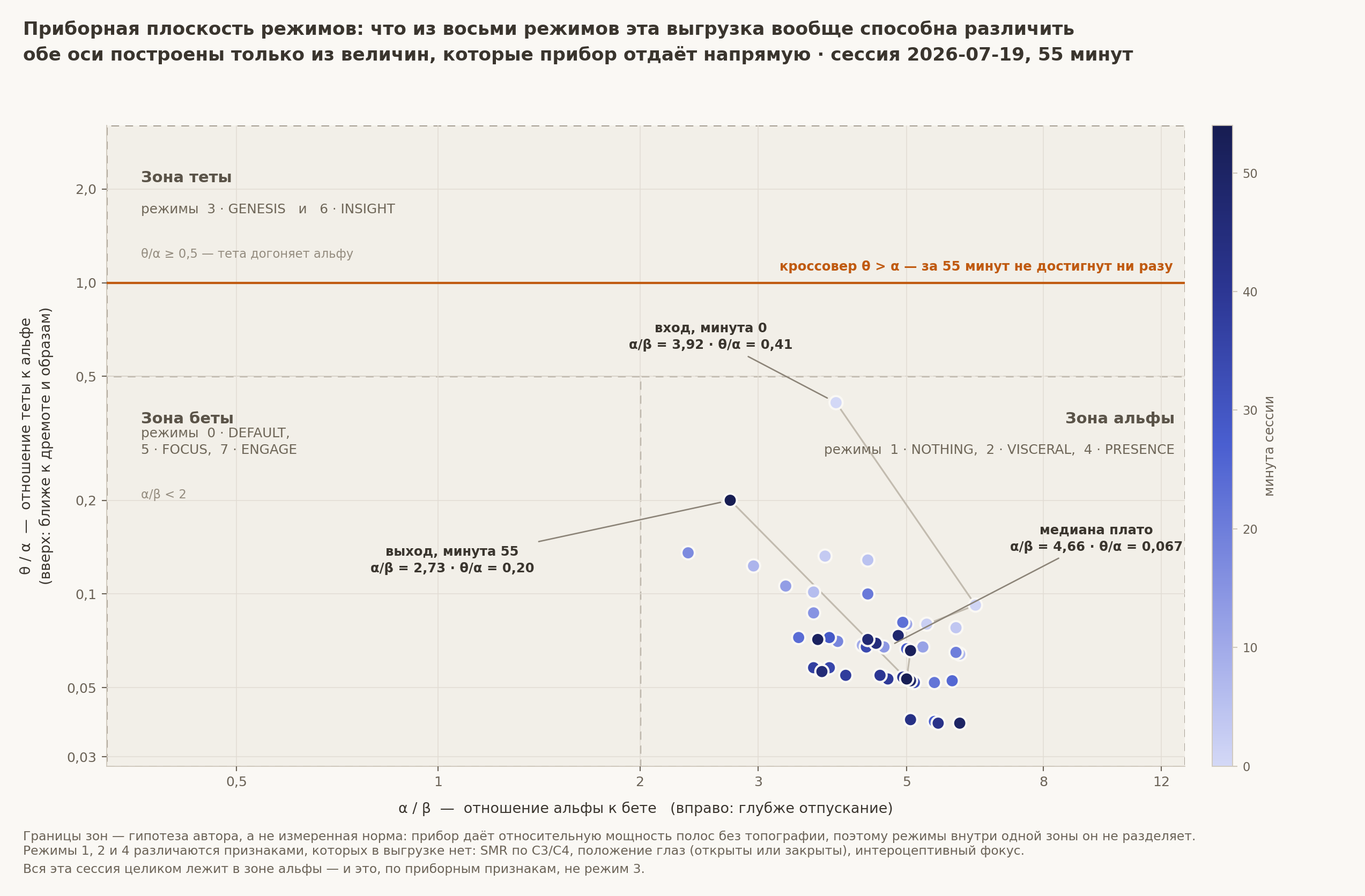
On a plane of two axes, eight modes collapse into three regions:
| Group | Modes | Condition | What distinguishes the modesinsidegroups |
|---|---|---|---|
| Theta zone | 3 · GENESIS, 6 · INSIGHT | θ/α ≥ 0,5 | eye position (closed/open), gamma, microstates |
| Alpha Zone | 1 · NOTHING, 2 · VISCERAL, 4 · PRESENCE | θ/α < 0.5 and α/β ≥ 2 | eye position, C3/C4 SMR, interoceptive focus |
| Beta zone | 0 · DEFAULT, 5 · FOCUS, 7 · ENGAGE | θ/α < 0.5 and α/β < 2 | LZ‑complexity, microstates, HRV |
⚠️ This is the main conclusion of this section.The device in its current format does not confirm or refute the taxonomy of eight modes -he just doesn't allow it. The statement “the device data shows that the person is in mode 4” is incorrect, because exactly the same numbers will be given by mode 1 and, most likely, by mode 2. The correct statement sounds like this:“The data shows that the person is in the alpha dominant zone; which mode 1, 2 or 4 is determined by the protocol and report, and not by uploading".
📖 This limitation is not unique to this device and is not a defect of the method. It follows from the physics of measurement: four channels provide a global spectral picture without spatial resolution, and three of the eight modes differ precisely spatially (SMR - sensorimotor cortex) or contextually (eyes, task). Acknowledging this is not a concession to critics, but a condition for the remaining allegations to be taken seriously.
18.17.4. Five pairs that the device does not distinguish, and what needs to be added#
⚠️ Blind spots, in descending order of severity:
| Pair | Why does it merge? | What is getting divorced? |
|---|---|---|
| 1 ↔ 4 (NOTHING ↔ PRESENCE) | varyonlyeye position: alpha is preserved in both | EC/EO mark |
| 3 ↔ 6 (GENESIS ↔ INSIGHT) | varyonlyeye position: in both theta is higher than alpha | EC/EO mark |
| 1 ↔ 2 (NOTHING ↔ VISCERAL) | sign of mode 2 - preservation of SMR with suppressed beta; SMR is not measured | channel C3/C4 |
| 0 ↔ 7 (DEFAULT ↔ ENGAGE) | both are beta dominant; difference in signal complexity and content | LZ complexity |
| 3 ↔ falling asleep | theta increases in both cases | HRV: increases during ATS, decreases when falling asleep |
The last line is not a methodological subtlety, butsecurity issue. Rule 18.12 “theta increases, but HRV decreases → this is not the target mode” cannot be checked with the existing upload: there is no HRV column in it at all, but oneheart ratevariability is no substitute.
🧭 What to add - in order of value to cost ratio:
- Eyes open/closed with timestamp.It costs zero - this is a line in a notepad. Spoilstwopairs of five and turns three distinguishable groups into five. No other change provides such an increase per unit of effort invested.
- Mode and phase column in the file itself (
mode,phase- see 27.21.6, clause 1). Until the file records which mode was executed, the signatures from 18.17.2 remain hypotheses forever: there is nothing to compare them with. This is not an improvement in accuracy, butcondition for the existence of a check as such. - SMR channel (C3/C4).The only way to bring Mode 2 out of total blindness. Requires different installation, not different processing.
- HRV (RMSSD, LF/HF).Closes the Mode 3 safety criterion and distinguishing Mode 7 from pre-burnout. Technically more accessible than SMR - often removed by the same or a neighboring device.
- Raw signal or derivatives with frequency ≥ 1 Hz.Unlocks transition speed
τ↑(Chapter 27) and makes it possible to post-calculate LZ complexity. - Microstates and LZ‑complexity.They are placed last deliberately: on four channels, the assessment of classes of microstates is unreliable, and the linking of microstates to modes is the most controversial place in Chapter 18 (see 18.15).
📖 Useful to note:The first two points do not require any equipment at all.The most expensive limitation of the method today is not the equipment, but the lack of markings.
18.17.5. How to read the device's output: six rules#
🧭 The rules are working, derived from the analysis of a specific session (27.21 and 27.22), and not from general considerations.
- Look at relationships, not levels.The stripes are normalized, their sum is constant. “Alpha 0.74” without beta and theta nearby means nothing; α/β = 4.7 means.
- A window, not a minute.One line is one minute, and it makes noise. The minimum meaningful window is three minutes, a reliable one is five. The response to “now the alpha has fallen” a minute after it has fallen is a response to noise.
- One column per meaning.
relaxation index,fatigue score,concentration indexAndreverse fatigue- this, according to this session,same axis: Pairwise correlations of all six pairs range in magnitude from 0.77 to 0.99 (see 27.22.1). To look at all four is to look at the same thing four times and decide that there are four confirmations. - Do not confuse “deep” and “even”.Depth of state (spectral shift) and emotional evenness -different independent axes(27.22.4). The condition can be deep and uneven at the same time; You can see it on the device if you know where to look.
- Column titles are not definitions.
cognitive score,focus,chill,alpha gravitycalculated using proprietary formulas of the manufacturer. The name is a marketing label, not an operational definition; none of these columns can be cited as “measured cognitive function.” - Write down by hand what is not in the file.Minimum: time of closing and opening the eyes, mode number, moment of exit, three to five points about how it felt. Five lines in a notepad are more expensive than one more column in an upload.
18.17.6. What the 2026‑07‑19 session says about modes#
🔬 Analysis of one session (55 minutes, full calculation - at 27.21) in terms of this map:
| What is shown | Meaning |
|---|---|
| θ/α: input0,41→ plateau median0,067→ exit0,20 | theta not only did not catch up with alpha - she was on a plateaufifteen times lower |
| Crossover θ > α | not reached once in 55 minutes (0 out of 55); minutes with θ/α > 0.5 - also0 |
| α/β: input3,92→ plateau median4,66→ exit2,73 | α/β ≥ 2 all 55 minutes; the entire session lies in the alpha zone entirely |
alpha> 0.70 per36 of 52minutes plateau |
alpha dominance is stable, not episodic |
heart rate: 81 → 77 → 70 |
steady downward trend throughout the entire record:−4.7 beats/min in 55 minutes, p = 0.0003(27.21). The decrease is uneven from minute to minute; the recording minimum (70) was reached twice - at minute 31 and at the minute of exit |
🧭 Instrument output:this entry -alpha dominant group {1, 2, 4}. And, more importantly, shereliably not mode 3 and not mode 6: If ATS were running, crossover would be the defining feature, but it is completely absent, without a single approximation. This is the first statement about regimes in the book that relies on measurement rather than description—and it is, characteristically,negative. Negative statements of this kind are exactly what this apparatus is capable of, and they are not useless: they close down hypotheses.
🔬 One observation worth checking on other recordings.At the minute of exit, the spectrum had already turned to activation:beta= 0.22 - one of the two highest values for the entire session (only 0.25 was higher at minute 17),alphafell from a plateau of 0.74 to 0.60. Aheart rateat the same minute is equal to 70 - this is the minimum of the entire recording. The spectral picture has returned to activation, the vegetative one has not yet. If this is replicated, the method will have a measurableaftereffect: the state ends in the EEG earlier than in the vegetative state. On one point, this is not a statement, but a clue; it is checked by three minutes of recording after exit (27.21.6, clause 4).
✍️ [To the author - add]:
- What mode was performed in this session.The analysis is carried out blindly; your answer will either confirm the signature of the group {1, 2, 4}, or show that table 18.17.2 needs editing. Both are valuable.
- Confirm or correct signaturesfrom table 18.17.2. Now they are logically derived from matrix 18.12. You've seen dozens of uploads - which columns in practice behave differently than predicted here?
- Your thresholds.If you have working numbers for α/β and θ/α at which you say “entered,” they should replace the guidelines 0.5 and 2, taken here as arbitrary ones.
- Mode 5.Decide whether it is identified by the spectrum at all, or whether its sign is only the complexity of the signal. Table 18.17.2 depends on the answer: now FP is the only mode in which the spectral line is marked as borderline, and it is recognized by the complexity of the signal, and not by band ratios.
- Three entries marked EC/EO- the minimum set after which five of the eight modes will become distinguishable, and this section can be rewritten with measurements instead of hypotheses.
18.18. Body map of modes: what is visible in vegetation#
18.18.1. Why do modes need a second map?#
🧭 Section 18.17 showed a strict restriction: EEG upload in its current form allowsthree groups instead of eight modes. She does not distinguish five pairs of states at all. A natural question is whether some of these blind spots are covered bysecond, independent measurement channel: Autonomic indicators accessible from wearable devices (Chapter 26).
📖 There is a basis for such hope. The EEG spectrum and autonomic balance aredifferent physiological systems with different dynamics, and not two types of the same thing. Alpha dominance with eyes closed and a drop in heart rate may diverge: in the analysis of session 2026‑07‑19 (18.17.6), at the minute of exit the spectrum had already returned to activation, and the heart rate had reached the minimum of the entire recording. If two channels diverge, then each carries information that is not in the other, and this is exactly what is needed to distinguish between stuck together modes.
⚠️ But the time scales do not match.EEG resolves an event lasting seconds, HRV - no shorter than 5 minutes (in the ultra-short version - minutes; see 26.2). Therefore, the body mode mapcannot be second-by-second: it does not describe the moment of entry, butplateau- a stable section of the regime lasting at least 5 minutes. Modes that in practice are maintained for less than five minutes are not described by a vegetative map in principle.
🔬 All contents of this section -hypothesis. Unlike section 18.17, where signatures are derived at least from the author’s matrix 18.12 and tested on one real upload, there is not a single measured point: the body layer in the method has not yet been recorded instrumentally. The section is written asinspection plan, and not as a result.
18.18.2. Expected autonomic signature of eight modes#
🔬 Expectations are formulated so that they can be refuted. Each line is a prediction that is tested against a 5-minute recording window from the chest strap (protocol 26.9). Heart rate and RMSSD are indicatedas a shift relative to the personal baseline of the same day in the same pose, and not in absolute values - the absolute values of HRV between people differ significantly (26.5).
| Mode | Heart rate | RMSSD | Breath | EEG instrument group (18.17.3) | Does vegetation provide something new? |
|---|---|---|---|---|---|
| 0 · DEFAULT / DMN | baseline | baseline | 12–16/min | beta | - this is the starting point |
| 1 · NOTHING / MPE | ↓ moderate | ↑ | slows down spontaneously | alpha | a little: confirms the depth |
| 2 · VISCERAL / V‑MPE | ↓↓ strongest | ↑↑ maximum | slows down | alpha | yes - the only hope to separate 1 ↔ 2 |
| 3 · GENESIS / ATS | ↓ | ↑ required | slowed down | theta | yes - safety criterion (18.18.4) |
| 4 · PRESENCE / OP | ↓ weak | ↑ weak | ordinary | alpha | a little: should be “smaller” than mode 1 |
| 5 · FOCUS / FP | ↑ weak | ↓ or baseline | accelerates weakly | border | yes: separates effort from rest |
| 6 · INSIGHT / TIS | variably | variably | ordinary | theta | little: indefinite expectation |
| 7 · ENGAGE / TFS | ↑ | ↓ | accelerates | beta | yes - flow versus pre-burnout (18.18.4) |
🔬 Three predictions you should check firstbecause they are meaningful and refutable:
- Mode 2 is deeper than mode 1 in vegetatives.Sign of mode 2 - interoceptive focus on the organ; if directed attention to the body does enhance vagal control, Mode 2 RMSSD should outperform Mode 1 RMSSD in the same individual on the same day. On the EEG, these two modes are indistinguishable (18.17.4, pair 1 ↔ 2), and the SMR channel requires a different installation.The chest strap costs an order of magnitude cheaper than a new installation.If the prediction is confirmed, the bodily layer closes the blind zone, which the EEG cannot close. If this is not confirmed, this is a serious argument against the idea that mode 2 is a separate condition and not a variant of mode 1.
- Mode 4 is “smaller” than mode 1.Open eyes maintain a higher tonic level of activation; with equal alpha on the EEG (18.17.4, pair 1 ↔ 4), the shift in heart rate and RMSSD in mode 4 should be less pronounced. This is the second way to divorce a couple who are otherwise divorced only by a note on a notepad.
- Mode 5 is vegetatively more expensive than mode 0.Focused attention is effort; a slight increase in heart rate and a decrease in RMSSD are expected relative to the background state. Mode 5 is the weakest point of the instrument map (18.17.2): its spectrum is not predictable at all. If the vegetative price turns out to be a stable feature, this is the only available way to identify it.
⚠️ What vegetarianism will not give you no matter how good the recording:
- Pair 3 ↔ 6(GENESIS ↔ INSIGHT). The difference between them is the position of the eyes; Not a single vegetative indicator responds to eye position. This pair remains behind the EC/EO mark forever.
- State content.HRV does not distinguish silence from rumination if both are equally calm.
- Moment of entry.The beta→alpha transition of 30–60 seconds is not allowed by any HRV indicator (26.8, paragraph 2).
18.18.3. How the two cards work together#
🧭 The instrument map (18.17) and the body map (18.18) do not add up to the sum, but tograte: one sets the zone, the second — the depth inside the zone.
| What is known | What can be said |
|---|---|
| EEG only | Zone: theta / alpha / beta. Three groups instead of eight |
| Only vegetatives | Direction of shift: rest/effort. Two groups |
| EEG + autonomics | ZoneAnddepth: up to five distinguishable states |
| EEG + autonomics + EC/EO mark | Seven out of eight(only 1 and 2 merge when prediction 1 is unconfirmed) |
| All of the above + SMR channel | Eight |
📖 Pay attention to the penultimate line:The eyes open/close marker remains the cheapest source of resolution in the entire measurement system.She costs nothing and separates two couples; a sternum strap is inexpensive and adds depth; the SMR channel requires other hardware and closes the one remaining pair. This does not change the order of investments - first the notebook, then the belt, then the installation.
⚠️ The formulation of the output with two channels should remain as disciplined as in 18.17.3. Correctly:“alpha-dominant zone with a pronounced vegetative shift - compatible with modes 1 or 2, with the stated protocol of mode 2”. Incorrect: “the device showed mode 2.”
18.18.4. Two safety criteria that only vegetarianism provides#
⚠️ This is practically the most important part of the section: two situations in which the EEGdoes not distinguish the target state from the undesirable one, and vegetation is different.
Criterion 1. Mode 3 (ATS) against falling asleep and against stress.The rule from Matrix 18.12 is:theta increases and HRV decreases → this is not the target mode. When falling asleep, theta power grows in the same way as in ATS, and on four-channel unloading these two statesindistinguishable(18.17.4, last line). The vegetative picture diverges: in the target state, heart rate decreases and RMSSD increases; when falling asleep, HRV decreases; during an alarming response, theta may increase against the background of an increase in heart rate and a decrease in RMSSD.Without HRV, mode 3 runs without safety controls.Of all the arguments for a chest strap, this is the only one that relates not to the quality of the data, but to the safety of the practitioner.
Criterion 2. Mode 7 (ENGAGE) - flow against pre-burnout.Both states are beta dominant and look the same when unloaded (18.17.2, last line). The difference isprice and restoration, and not in the spectrum:
| Sign | Flow | Pre-burnout |
|---|---|---|
| Heart rate during | ↑ | ↑ |
| RMSSD during | ↓ moderate | ↓ sharply |
| Return to baseline after | fast (minutes) | delayed |
| Night HRV the next night | not reduced | reduced |
| Night resting heart rate | not increased | increased |
📖 The line about night is key, and it explains why the method even needs a wearable device in addition to the chest strap.The difference between flow and pre-burnout occurs not in the session, but the next night.Neither the EEG nor the belt can see this horizon; a ring or bracelet is seen (26.2). This is the most concrete example of how “retention” is not one property, but two different dimensions on two different horizons (27.23).
🧭 The working rule of the method: if after a series of sessions in mode 7, nighttime HRV decreases for three nights in a row, and nighttime resting heart rate increases, mode 7 is canceled until the indicators return to the baseline, regardless of what the person reports about his health.This is the first rule in the book, where the instrument indicatortakes precedence over self-report, and this is justified by the fact that pre-burnout is subjectively felt as productivity.
✍️ [To the author - add]:
- Your observations about the body in each mode- what happens to the pulse, breathing, hand temperature, feeling of heaviness. This is your material, and it should replace predictions derived from general physiology in Table 18.18.2.
- Mode 2 is the key question of the entire chapter:Does it differ physically from mode 1 so much that it can be seen by the instrument? Your answer determines whether mode 2 is a separate line item in the system.
- Have there been any cases of pre-burnout?in the practice of mode 7 - and by what signs did you notice them before the devices appeared.
- How do you differentiate ATS from falling asleep?now, without HRV. Your subjective criterion must be written down before the instrumental one appears, otherwise it cannot be compared with it.
- Three sessions with chest strapin different modes (necessarily including a pair of 1 and 2 on the same day) - the minimum set, after which this section can be rewritten with measurements.
18.19. Entry protocols: what is written in the method materials and what is not#
🧭 This entire chapter describes the eight modes asstate: what a person experiences, what rhythm dominates, how the attitude towards thoughts and the feeling of “I” changes. The practitioner needs not a portrait of the state, butentrance to it- what exactly to say, in what order, how long to pause, by what sign to understand that the person is already there. This section brings together everything that is about this in the working materials of the method, and - more importantly - honestly shows what is not in them. The section is deliberately structured as a revision, and not as an instruction: the instructions are written by the author, the book here only fixes the boundary between “written” and “implied.”
📖 Transition route.The materials document one general pattern of movement between modes:
DMN → (close eyes, stop thoughts) → MPE → V-MPE → ATS
                                            ↓ (open your eyes)
                                    OP → FP → TIS / TFS
It reads like this. From the background wandering mode (mode 0, DMN), a person goes into “nothing” (mode 1, MPE) - and then the route branches. With eyes closed, the deepening goes to the bodily layer (mode 2, V-MPE) and then to the theta-dominant layer (mode 3, ATS). If you open your eyes at this very place, the same zero level unfolds outward - into panoramic presence (mode 4, OP), effortless focus (mode 5, FP) and then into insight (mode 6, TIS) or flow work (mode 7, TFS). The diagram matches the transition map of section 18.13 and the four axes of section 18.3: the eye axis here acts as a fork, and not as a minor parameter.
🧭 Knot Rule: Entry is always through “nothing”.The main organizing thesis of the protocols is that the MPE mode is not one of eight in a series, butrequired noderoute. In the materials, it is formulated as an analogy with the Shift key: you cannot type a capital letter without holding Shift, and you cannot enter any of the cultivated modes without going through a stop of internal dialogue. The practical consequence is strict: if a person “immediately” found himself in a flow or in insight, bypassing zeroing, then this is most likely not a method mode, but a habitual state with a similar phenomenological label.
⚠️ This rule is relaxed in the sources, and the book chooses the strict version.In one of the documents, the same idea is written more softly: MPE is called “an acceleration strip, not a single airport” - that is, they allow direct entry into the OP or FP, bypassing zeroing. The two readings are incompatible, and the entire construction of the chapter depends on the choice: with a soft reading, “mode” becomes simply the name of a state, with a strict one, it becomes the result of a reproducible procedure. The book acceptsstrict versionand it does this explicitly: it is the only one that makes the mode a verifiable statement, because it specifies the observable sign of the input (first zeroing, then unfolding) and because it is what all instrument signatures in section 18.17 assume. The soft version remains recorded here as a discrepancy in the sources, and not as a discarded option.
📖 What is actually described for each mode.Below is an inventory, not an assessment: it only says whether the work materials contain entry text, duration and risk analysis.
| № | Mode | Login protocol | Duration | Risks and tolerance |
|---|---|---|---|---|
| 0 | DMN | ✅ described as a starting point, no entry required | — | ⚠️ not highlighted |
| 1 | MPE | ✅ full text of reference: sequence of phrases, pauses, signs of entry - written out verbatim inchapter 21 | ⚠️ sources give three incompatible values - 30 minutes, about 40 minutes and 5 minutes per phrase (21.22, discrepancy 1); the book doesn't choose between them | ✅ general, section 18.16; analysis by elements - chapter 22 |
| 2 | V‑MPE | ❌ no | ❌ no | ⚠️ only general mention of the flesh layer |
| 3 | ATS | ❌ no | ❌ no | ⚠️ marked as requiring separate clearance (18.16), but clearance criteria not specified |
| 4 | OP | ❌ no | ❌ no | ❌ no |
| 5 | FP | 🔬 fragmentary: the sign (“forceless focus”) is described, but not the procedure | ❌ no | ❌ no |
| 6 | TIS | 🔬 fragmentary: the conditions for appearance are described, not the entrance | ❌ no | ❌ no |
| 7 | TFS | ❌ no | ❌ no | ❌ no |
⚠️ Clarification to mode line 1.“5–20 minutes” is the durationretentionstates after login (Section 18.5), and not the duration of the login procedure itself. The procedure for the sources takes thirty-five to forty minutes, and their values do not agree with each other: all the numbers are summarized in the table in section 21.22.
⚠️ The output of inventory is unpleasant, but it is better to know.Of eight modesexactly one has a complete login protocol- at MPE. Two more are described by signs, not by procedure. Five are not described in any way. This means that today the method is reproducible in its key part (zeroing) andnot reproduciblein everything that departs from it: another presenter, taking the materials, will be able to carry out the first step and will be forced to improvise further.Half of this gap is closed:the only existing protocol is not retold, but written out verbatim - Part VI, Chapter 21, with an analysis of the evidence base in Chapter 22 and with markings for measurement in Chapter 23. For the seven other modes, the gap remains open, but it has a sample format: the same sections, the same order and the same obligation to separate the procedure from its rationale.
📖 Two layers of names and why they don't add up.In the materials, the modes are called by two parallel sets of names - scientific and product:
| Scientific layer | Product layer |
|---|---|
| ONTO DEFAULT (DMN) | DMN |
| ONTO NOTHING (MPE) | Pure Nothing |
| ONTO VISCERAL (V‑MPE) | Visceral Mind |
| ONTO GENESIS (ATS) | Quantum Genesis |
| ONTO PRESENCE (OP) | Active Presence |
| ONTO FOCUS (FP) | Focus Presence |
| ONTO INSIGHT (TIS) | Transcendent Download |
| ONTO ENGAGE (TFS) | Embodied Flow |
⚠️ There is no correspondence table in the sources- it is collected here by coincidence of descriptions, and one line was collected ambiguously: nameEmbodied Flowin meaning it approached both effortless focus and stream work - in one place it is described as “attention is self-sustaining,” in another as “complete involvement in the task.” Compliance is fixed:Embodied Flow- ThisTFS,stream work; effortless focus is calledFocus Presenceand stands under its own button 05 (18.14). There are now eight product names per eight modes, and when combining data from two programs (30.9), the product name uniquely indicates the mode.
🔬 The eighth mode: where it gets lost.Section 18.2 presents the system as eight modes (0–7), and this relies ononea document that lists all eight. In other materials the wording is different: “mode 0 of 7” and “mode 1 of 7” are found, that is, the architecture is thereseven-mode. The reconciliation shows exactly where the count diverges: it is not the zero mode that is missing, as one could decide from the discrepancy “there are eight in the folder, seven in the table” (see version log, v0.2), butTFS— stream work. The logic of such an exception is clear: TFS is the only one that is not a meditative state - it is ordinary productive work into which the method leads, but which it itself does not cultivate. The book retains the eight-mode record (it is more complete and includes the target application state), but records:the statement “there are eight modes in the system” is based on one source out of ten, and if the author decides to consider TFS an outcome rather than a mode, that would be a consensus decision, not a retreat.
⚠️ Four discrepancies in instrument input signs.The materials set numerical guidelines for entry, and on four points they contradict each other. The table is not softened: until the contradictions are resolved, none of these thresholds can be used as a criterion for “a person has entered the regime.”
| What | Version A | Version B | Why is this important |
|---|---|---|---|
| Alpha Gravity in MPE | "≥ 1.0–1.7" (upper alpha predominates) | “↓ (< 0.8)” (lower alpha predominates) | The indicators point in opposite directions; the same entry will be counted or not counted depending on the source |
| Theta in MPE | “if theta increases, this is no longer MPE, but a slide into ATS or dormancy” | "theta ↑ moderate" as a normal sign | The separation of modes 1 and 3 rests precisely on theta; without a solution, the boundary between them is non-operational |
| Alpha and beta bands | Ranges in different documentsdo not intersectamong themselves | — | The α/β ratio, which is the central statement of the method, is calculated using different grids and is therefore not comparable between records |
| Microstate B | Signentranceto mode | Signexitfrom it | The same picture is interpreted as success and failure |
⚠️ And the main limitation that follows from this.Section 18.17 has already shown that unloading a device distinguishesthree groups of states, not eight. Here we add a special but illustrative case:ATS and TIS are indistinguishable from instruments- both are theta-dominant, both go against the background of preserved alpha, and none of the indices listed in the materials separate them. The difference between them is entirely phenomenological (in ATS there is no content, in TIS it comes as a ready-made block). This means that until the phase marking appears in the file - the same point from section 27.21.6 - instrumental input confirmation is possible for groups, not for modes, and any “mode → signature” table remains a hypothesis (🔬), and not a measurement.
18.20. What remains to be written about this chapter?#
✍️ [To the author - add]:
- Login protocolsin each of the eight modes - exact scripts, timings, wording. For mode 1 (MPE) this is done: Chapter 21 gives the verbatim procedure, Chapter 22 its evidentiary status, Chapter 23 the markings for measurement. For the remaining seven, the chapter describeshowmode is; need to describehow exactlyyou introduce it - following the pattern of Chapter 21.
- Signs of “hit/miss”for each mode - subjective, for any equipment.
- Typical newbie mistakesfor each mode and what you say in response.
- Links (chapter 24) for each mode— which sequence of anchors leads where.
- Your observations about transitions- what is really happening and for how long.
- Labels of buttons in the interface— lead to a single numbering of section 18.14: number 05 is occupied by Focus Presence, Embodied Flow becomes button 07.
- Decision on the discrepancy between chapters 17 and 18on bodies (section 18.6).
- Your own datafor any of the modes - they are more important than all the cited thresholds, because the thresholds in this chapter are still alien and untested, and your measurements will be the first.
Part V. Safety, ethics, limits of applicability#
The verbatim login procedure is published in the next part. Contraindications, room conditions, requirements for the presenter and a three-level protocol for actions in case of an undesirable reaction are read before the procedure. Here is an honest list of what is not yet included in the method’s security system.
19. Contraindications and risks#
This chapter is organized in the same way as Chapter 30: first, what is known about risks in general, then whatactually spelled out in the method materials, verbatim, and at the end - a list of what is not yet in the security system. The order is not accidental: the gap between first and second is greater here than in any other part of the book, and pretending that it does not exist would be the worst solution.
19.1. Adverse reactions: what generally happens#
📖/⚠️Practices of deep state change - stopping the internal dialogue, “dissolution of the Self”, prolonged stay in the “emptiness”, intense bodily attention - are mostly safe, butparts of peoplemay provoke unwanted reactions:
- Depersonalization/derealization- a feeling of unreality of oneself or the world; practices of weakening the “I” and “emptiness” can strengthen it in those predisposed.
- Surfacing of traumatic material— silence and physical attention remove habitual distractions, and suppressed experiences can “rise.”
- Destabilization in latent psychotic or severe anxiety/dissociative states.
- Anxious hyperfixation on bodily signalsin people with hypochondriacal/panic predisposition (Chapter 7).
📖 Order of magnitude.Farias et al.'s (2020) review of adverse effects of meditation practices varies25–87 %reporting certain undesirable effects and3–37 %- about functional disorders. The variation is explained by different definitions and methods of data collection, but the conclusion is consistent: unwanted effects are not uncommon, and a method that does not capture them simply does not see them.
⚠️ Risks vary by mode.General screening does not cover specifics: mode 3 (ATS) hasabsolutecontraindications (epilepsy, recent head injury, active psychosis, mania) and requires a separate protocol for abreaction; Mode 4 (OP) is specifically associated with depersonalization/derealization and abulia; mode 2 (V‑MPE) - with reactivation of bodily trauma. Full breakdown -section 18.16.
📖 And this is not an abstraction.The case of Chapter 31 documents two episodes directly related to this chapter: at the 23rd minute of session 12.01, the participant recorded a surge of anger up to 87 on the instrument scale, and in the solo session 13.01 - repeated peaks up to 89–94 against the background of general instability. Both episodes passed without consequences, but they show that emotional outbursts in this method are not a hypothetical risk, but an observable phenomenon that occurs in the second or third month of practice in a motivated participant.
🧭 Practical implications for the method:
- Screening at entry— exclusion criteria (psychotic, severe dissociative, acute severe anxiety-depressive states; if in doubt, consult a specialist).
- Monitoringduring the program; a clear “stop signal” and instructions on what to do in case of destabilization (grounding, returning to external attention, contact with the leader).
- Dosingdepth for beginners; “dissolution of the Self” and deep emptiness are introduced gradually.
19.2. Contraindications: what is said in the method materials#
📖 Everything that is in the working materials on contraindications is placed in two quotes. I quote them verbatim, because the volume here is the content:
“Not suitable for people with epilepsy and active psychotic disorders - consultation with a doctor before starting is required.”
“Too rapid “dissolution” of the Self without integration can lead to a chronic feeling of “I am not real”, “the world is not real”.”
⚠️ Apart from these two formulations and the vague requirement of “confirmation of mental readiness,” there is nothing in the materials.There is no list of conditions, no questions asked at the entrance, no who makes the decision on admission and on what basis. For a method that works with the dissolution of the sense of self, this is the most serious gap of all listed in the book.
🧭 Book proposal: table of exclusion criteria.Below is a working draft, not a validated instrument. It builds on the general practice of working with contemplative and altered states and on the analysis of risks by mode in section 18.16. The table should be considered the author's draft until reviewed by a clinical specialist.
| State | Status | Comment |
|---|---|---|
| Epilepsy, history of seizures | absolute exception | mode 3 - of course, regardless of how old it is |
| Active psychosis, mania, bipolar disorder in the acute phase | absolute exception | — |
| Traumatic brain injury in the past 12 months | exception until a doctor's opinion | — |
| Diagnosed depersonalization-derealization disorder | absolute exception | the method works exactly with the mechanism that is broken here |
| Severe dissociative disorder, acute PTSD | exception pending expert opinion | silence and physical attention remove defenses |
| Acute anxiety-depressive state, suicidal thoughts | absolute exception | referral to a specialist is required |
| Taking psychoactive drugs that affect the central nervous system | discussion with your doctor | changes both safety and EEG pattern |
| Hypochondriacal or panic predisposition | admission with reservations | bodily attention can increase fixation (chapter 7) |
| Pregnancy, severe somatic pathology | admission with reservations | session load component |
⚠️ I note separately:there is no separate permission for mode 3 in the materials, although the mode itself is marked as requiring special caution. The criteria for such admission are a mandatory point of improvement.
19.3. Preparation: twenty-four hour mode#
📖 Here, the materials of the method, on the contrary, are specific, and they are worth citing in full - this is one of the few parts of the security system that is already operational:
- alcohol - at least 24 hours before the session;
- no new supplements or medications on the day of the session;
- caffeine - no later than the middle of the previous day;
- last cigarette no later than 30 minutes before the start;
- sleep - at least 7 hours.
📖 In the source, the last line is accompanied by wording that should be preserved verbatim:“This is not a wish, this is a condition”.
🧭 And it has an instrumental justification.Lack of sleep increases theta activity and decreases beta - that is,simulates exactly the shift that the method considers its target effect. A participant who comes to a session after five hours of sleep will show a “good” picture for the same reasons that it happens to a person falling asleep. Therefore, the duration of sleep the day before is not an element of politeness to the participant, butcovariate that must be recorded in the session passport(Section 31.5) and taken into account in the analysis.
19.4. Room, equipment and session progress#
📖 Situation requirements recorded in the materials: temperature 20–22 °C; absence of background noise;no fragrances- no incense, no diffusers; phones in airplane mode; the participant does not stand up during the session.
📖 Regarding equipment: before starting, all headset channels must show green status. Source wording:“if at least one is red, correct the sensor before the start, not during”. The rule is simple and correct: adjusting the sensor in the middle of a recording creates an artifact exactly at the moment when the most interesting thing happens, and makes the segment unusable.
📖 Headsetdoesn't fitduring the introductory conversation and during the unloading (narrative block) - it is only needed in practice itself.
⚠️ This is where there is a conflict with section 31.6.The cyclical method and the session passport assume that the baseline is taken on the narrative block - but it is precisely on this block that the device is not present. Until this is corrected, some subindexes are not considered fundamentally. The solution is already mentioned in section 31.6: move the basic measurement to a separate quiet block in the headset, before the instructions, and leave the narrative without the EEG.
19.5. Requirements for the presenter#
📖 The method materials contain specific requirements for how the presenter conducts the session - and this is a noticeably more developed part than everything else in the security system. Verbatim:
“Each phrase is 4–5 minutes.”
“First 5 seconds, then 10, then 15.”
“When we say ‘clean up’, be sure to shut up. At least 30 seconds of silence.”
“Before practice, go into Pure Nothing for 5 minutes. Only from this state can one lead.”
“Don’t “lead.” Just be there and hold space.”
📖 There is a clear logic behind these phrases: the pace of presentation sets the pace of the participant’s attention, pauses increase gradually, and the state of the presenter is considered as a working tool, and not as his personal business.
⚠️ But there are no formal requirements for the presenter’s qualifications in the materials.It is not described what kind of preparation is needed, how much personal practice, what kind of training, who and how confirms admission to leading, what to do for a presenter who is faced with a reaction outside his competence.
📖 The Chapter 31 case takes this from a formal complaint to a quantifiable problem.It documented that retention within the same participant was 47–89% with mentoring and 8–21% with solo practice; the report itself evaluates the mentor’s contribution as “an improvement in all indicators by 2–4 times.” Whatever the explanation for this contrast (Section 31.3 examines three), the conclusion for this chapter is the same:facilitator is a measured moderator of the result, not an accompanying person. A method that does not have the qualifications of the key moderator described is not reproducible—and, more importantly for this chapter, is not predictably safe.
⚠️ A requirement added by the semantic layer (Section 13.7).The semantic layer (chapters 13–15) introduces a language into the method that can be abused: if a participant learns to notice that an “alien unit” is operating in his head, then exactly the same language allows him to devalue any disagreement - his own (“it’s not me who doubts, it’s a meme”) or someone else’s (“you’re not talking now”). The second is the standard mechanism of closed groups, and the method is obliged to close it with a rule, and not with the hope of decency.Rule: the differentiation tool is applied by the participant to himself and only to himself. The presenter does not have the right to classify a participant’s statements as “meme”, “capture” or “not you” - neither in a session, nor in a debriefing, nor in a private conversation.Violation of this rule is considered as grounds for removal from conducting, on a par with conducting a session in an unprepared state.
19.6. Actions in case of an adverse reaction#
📖 All that is in the materials on this subject is one instruction:
"If someone is panicking or uncomfortable, in a soft voice: 'Breathing from the belly. Focus on the forehead. Everything is okay.'"
🧭 Book proposal: three levels of response.Like the table in Section 19.2, this is a design that requires specialist review; but it is better to work according to a draft protocol than without any.
Level 1 - discomfort.Anxiety, tears, unpleasant bodily sensations, an influx of memories, with intact orientation and contact. Actions: grounding in place (open your eyes, feet on the floor, name out loud three objects in the room, belly breathing); remind you of the right to leave the practice at any time; stay close. The session can be continued at the request of the participant.
Level 2 - destabilization.Panic, feeling of unreality of oneself or the world, disorientation, inability to get out of the state on one’s own. Actions:session stops- does not pause, but stops; remove the headset; open your eyes; water; move to a vertical position and into another room; calm contact until full return; don't leave alone; contact at the end of the day. Return to practice - no earlier than the next meeting and after the conversation.
Level 3 - acute condition.Psychotic symptoms, persistent derealization, suicidal statements. Actions: medical assistance; participation in the program is terminated; Referral to a clinical specialist is mandatory and not discussed.
📖 All level 2 and 3 events are documented on the same day- what preceded it, what they did, how it ended, what happened to the person the next day. This is not bureaucracy: systematic collection of adverse events is a direct recommendation of the methodological critique of contemplative research (Van Dam et al., 2018), and without such a log, the statement “we had no adverse effects” only means that they were not recorded.
19.7. Exit and post-session period#
📖 Exiting the state is part of the protocol, and not its completion after the expiration of time: 3-5 minutes of smooth return, grounding, water, no sudden transitions to business. In the case study in Chapter 31, the optimal structure for a thirty-minute session is described as 10–12 minutes with eyes closed, 15–20 minutes with eyes open, and 3–5 minutes of exit—that is, about a sixth of the time allocated to exit.
⚠️ What's missing: next day contact.Some undesirable reactions unfold not during the session, but over the next 24–72 hours—against the background of sleep and normal life. Without a short contact the next day, these reactions simply will not come to the attention of the presenter, and “everything went well with us” will mean “we didn’t ask.” The book recommends making such contact a mandatory point of the protocol: one message with three questions - how did you sleep, how did you feel, was there anything unusual.
19.8. What the security system doesn't have yet#
⚠️ Summary list. It's short and nasty, which is why it belongs in a book and not in personal notes.
- Security section as suchThere is no method in the materials - there are scattered mentions.
- Stopping criteria— no: the condition under which participation is terminated is not described.
- Escalation Protocol- no: the three levels of section 19.6 are suggested by the book, not taken from the sources.
- Requirements for presenter qualifications- no (section 19.5).
- Informed consent- No. EatNDA, but a non-disclosure agreement protects the author, not the participant, and is neither information nor consent. This is a substitution, and it must be called as it is.
- Observations for Adverse Events- no: no form, no log, no contact the next day.
- Screening tool- no: the table in section 19.2 is suggested by the book and not verified.
🧭 The good news is that all seven points are covered by documents, not research, and it takes days, not months. The bad news is that without them, any publication and any work with vulnerable participants remains risky for the author himself.
19.9. What remains to be written about this chapter?#
✍️ [To the author - add]:
- Screening questionnaire- based on the table in section 19.2, with verification by a clinical specialist; and deciding who conducts screening and on what basis admits it.
- Criteria for individual admission to mode 3(Section 18.16).
- Informed consent form- separately from the NDA and separately from the service agreement (see also section 30.9).
- Adverse Event Registration Formand next day contact rule.
- Requirements for the presenter: minimum own practice, training, confirmation of admission, boundaries of competence and rule of referral to a specialist.
- Your own experience of adverse reactions- what you observed over the years of practice, at what stage, for whom, how it ended. This is the most valuable material for this chapter, and only you have it.
20. Ethics of statements#
To ensure that the method is resistant to criticism and honest to the participants, the book adheres to several wording rules:
- Wellness, not treatment (no clinical evidence yet).The method is described as a practice of self-regulation, resilience and productivity. Claims to “cure” mental disorders are not made without clinical research.
- Separate “proven/practice/suspected”(tagging system 📖 / 🧭 / 🔬). Don't pass off a hypothesis as a fact.
- No superlatives, no data.Claims like “the fastest/most powerful technology in the world” are not used unless there is a direct comparative study; instead of them - specific, verifiable formulations.
- Honest about uncertainty— indicate the proportion of non-responders and the limits of applicability.
Part VI. Practice protocol#
Chapter 18 described eight modes and ended with an inconvenient conclusion: a complete entry protocol exists for exactly one of them - ONTO NOTHING (MPE). This part of it publishes in its entirety: seven phrases, four stages and five phases of the dissolution of the “I” (Chapter 21), an analysis of what is confirmed in them by publications, what remains a hypothesis of the method and what the device does not distinguish (Chapter 22), and a link between the protocol and the measurement model (Chapter 23).
21. Practice ONTO NOTHING: verbatim protocol#
21.1. Status of this section and where the text came from#
🧭 Before this chapter, the book described the method from the outside: the architecture of layers, eight modes as states, instrument signatures, indexes, ethics, semantic layer. Section 18.19 ended with an unpleasant but honest statement: of the eight modesexactly one has a complete login protocol. This chapter publishes that one protocol in its entirety - and that is why it is placed in a separate part, and not hidden inside Chapter 18. The practitioner needs not a portrait of the state, but a sequence of actions: what to say, in what order, how much to hold, where to look inside oneself, by what sign to understand that a person is already there.
📖 Source.All material in this chapter is taken from the author’s working documents - “Phrases of Practice”, “How the ONTO NOTHING Practice Works”, “Speech Instructions”, “Materials from AI” and accompanying files on bodily supports. This is not a reconstruction or retelling based on motives: the sequence of phrases, durations, five phases of dissolution, age layers of unloading, breathing lock and the procedure for testing the skill are given as they are recorded in the sources. Where sources diverge (and they diverge in four places), the bookdoes not select the version for the author: Discrepancies are collected in section 21.22 and marked ✍️.
⚠️ What this chapter doesn't do.She doesn't claim that what she describes works. Formulations like “at this stage the default system of the brain is switched off” are found in dozens of sources - and almost all of them are interpretation, not measurement. Chapter 21 sets outprocedure; Chapter 22 separately examines which of the accompanying explanations have published support, which are plausible but not verified, and which the current instrument cannot verify in principle. The distinction is deliberate and strict: a protocol can be reproducible regardless of whether the neurobiological story told about it is true.
🧭 How to read this chapter practice.Sections 21.3–21.4 are preparation and only need to be read once. Sections 21.5–21.12 are the script itself: they can be read aloud to the presenter or spoken to yourself. Sections 21.13–21.21 are what happens after the last sentence, and this is the most meaningful part: this is where the protocol ceases to be a set of statements and becomes a procedure. Section 21.22 is mandatory for the presenter and not necessary for the participant.
🧭 How many times is this done?The complete procedure described in this chapter is followedonce: This is a learning passage and not a form that is completed daily. The only reason to go through it several times is older age. The rule and exception to it are sections 25.6 and 25.7; what is done daily after a single pass - section 25.8.
21.2. Frame: what the practice does and why in this order#
📖 The source formulates the task as follows: “This is not just a set of words or meditation. This is a consistent process of stopping the internal dialogue, in which, step by step, consciousness discards everything unnecessary - thoughts, images, concepts, the very idea of “I” - until only pure presence remains. Not “someone in the presence,” but presence itself without a center.”
🧭 Logic of order.Practice moves not from simple to complex, butfrom the periphery to the center. First, the background of lack is removed - a state in which the mind is obliged to work because it is entrusted with obtaining something. Then the connection to the content is removed: not “I have,” but “there is.” Then the boundary between the one who perceives and what is perceived is removed. And only at the very end the perceiver himself is removed. Each next step is possible because the previous one has removed the reason why the mind was holding on.
📖 The first step is formulated in the source as a condition for all the others: “as long as the mind believes that something is missing, it will continue to generate thoughts, doubts, strategies.” Hence why practice begins with a resource phrase, and not immediately with “I”. An attempt to eliminate the internal dialogue of a person who is in a deficit leads to the fact that the dialogue simply fades into the background and returns a minute later: the cause has not been eliminated.
🧭 Connection with the architecture of the book.In the language of Chapter 18, this entire procedure is an entrance intomode 1, ONTO NOTHING (MPE), and nothing else. Section 18.5 gave this input in one line: "phrase → 'I' → dissolve → silence, then hold silence without object." This chapter unfolds this line in thirty to forty minutes. Everything that goes on in Chapter 18 - V‑MPE, ATS, OP, FP, TIS, TFS - beginsafterAfter the procedure for this chapter has been mastered, there are still no entry protocols.
🔬 And one more connection is with the semantic layer.Chapter 13 argues that the differentiation of units of meaning must precede neurotechnology. The protocol materials give this unexpected confirmation from practice: the origin of the method, as described by the author, is working with lists of “thought viruses” that students wrote out in dozens, and the discovery that the entire list comes down to two root constructions -insufficiencyAndfaith. The first two phrases of the protocol are addressed to exactly these two: “I have everything to believe in myself” and “I have everything.” In other words, entry into practice is structured as the removal of the two most common units of meaning. This is a hypothesis about the origin, not a proven mechanism, but it explains why the sequence starts the way it does.
21.3. Entry conditions: place, time, posture, eyes#
📖 In the sources, the conditions are set in fragments; below is only what they really contain.
- Eyes closedthroughout the main procedure. Open Eyes comes later in the skill check step (21.20), and is a separate step, not an option.
- Voice.“Speak out loud or whisper, fully immersing yourself in the meaning of each word.” Speaking out loud is not a decoration: it sets the pace and prevents the phrase from turning into a running thought. In the last phase, speaking aloud is intentionally stopped (21.14, phase 4).
- Pace.“Don’t just say the words, but feel their vibration inside you.” In practice, this means that there is a pause between utterances of the same phrase, rather than continuous mumbling.
- Duration- see section 21.22: the sources give three different numbers, and the book does not choose between them.
✍️ [To the author - add]:posture (sitting / lying down - and why), time of day, what to do with the phone and external sounds, is it possible to do the practice after eating, what to say to a person who “can’t close his eyes.” None of this is in the materials, but they ask about it first.
⚠️ Contraindications and tolerance.The practice contains breath-holding (21.16) and targeted deconstruction of self-image (21.14–21.15). Hence two restrictions, which are called out loud before the start:never in the water and never behind the wheel, and the delay is no longer than three seconds - with exhalation at the first appearance of effort (full list of contraindications and stopping rule - 21.16). General restrictions and eligibility criteria are described in Chapter 19 and Section 18.16 and apply here in full. Separately: section 19.4 notes the risk of depersonalization, and this procedure works with exactly the material from which depersonalization consists. The difference is described in section 14.8 - in the method of presentation, and not in content; The leader should read it before leading the first person.
21.4. Bodily supports: tongue, belly breathing, focus in the frontal bone#
🧭 Three bodily supports run through the entire protocol. They are not "executed" at any point - they are kept in the background, and in the sources they are namedadditional elements of practice, although in function it is more of a load-bearing structure.
Relaxation of the tongue.Source wording: “Internal dialogue is directly related to micro-movements of the tongue. When the tongue is relaxed, it is more difficult for the mind to engage in thought flow. This is a physiological hack to reduce mental activity.” Practically: the tongue lies freely, is not pressed against the palate, does not rest against the teeth, and the jaw is not clenched.
Belly breathing.“Diaphragmatic breathing reduces nervous system arousal. This puts the body into rest mode, which helps you enter silence faster.” Practically: the inhalation goes into the stomach, the chest is almost motionless, the exhalation is longer than the inhalation and is not forced.
Focus in the frontal region.The most specific support of the method and the only one that is physically described in the sources:pressure with attention on the forehead bone from the inside. This is not visualization or the “third eye” - it is the direction of attention to a specific point on the skull, felt as light internal pressure. The function is described in the source as a “soft center of observation”: “If, after the dissolution of the “I,” you do not give a person a point of attention, he may get lost and begin to look for support in his thoughts again. Frontal focus allows space for awareness without images or words. It is not a point of fixation, but simply a soft center of observation.”
⚠️ What is excluded from this by the book?Some of the materials about frontal focus are written in the esoteric dictionary - ajna chakra, kundalini, “energy shield against thought viruses.” These formulations are not transferred to the book: not because they are “unscientific” according to the label, but because they are not operational - they cannot be used to check whether the instructions have been followed or not, whereas “pressure with attention on the forehead bone from the inside” can be checked. This is the same rule that the book used in section 18.14: from two formulations of the same thing, the one that generates the observed characteristic is selected.
📖 What is known about these three supports from published research - Chapter 22. Looking ahead: tongue relaxation has one direct EMG result in support and one neatly negative one, diaphragmatic breathing has a stable physiological basis, frontal focus has a plausible but indirect mechanism.
21.5. Seven phrases: complete sequence#
📖 The main sequence, verbatim from the source “Phrases of Practice” (document title: “Sequence, 4-5 minutes for each. Total 30 minutes”):
| № | Phrase | What does she do according to the author's description? |
|---|---|---|
| 1 | “I have everything to believe in myself.” | Login through self-confidence |
| 2 | "I have everything." | A sense of completion without attachment to faith |
| 3 | "I am everything." | Awareness of oneself not as a separate subject, but as a totality |
| 4 | "I am." | Pure being, awareness without forms and concepts |
| 5 | "I'm done." | Shifting focus: no longer distinguishes between subject and object |
| 6 | “Everything is I.” | Now it is not “I” that perceives the world, but the world is perceived as “I” |
| 7 | "I." | Final dissolution point |
🧭 Five minutes for each phrase.According to the author, the working norm isfive minutes per step, and this applies to all seven phrases, not just the first one. Seven steps give thirty-five minutes of the phrasal part, to which is added the time for the dissolution of the “I” (21.13, 21.14). “4-5 minutes” from the title of the source document reads as the lower limit of the same norm; All discrepancies in duration are summarized in section 21.22.
🧭 How is this staircase constructed?The first two phrases work with possession: “I have” - the subject and his resources are still separated, but the deficit has been removed. Phrases three to six successively erase the boundary between subject and object, passing it on both sides: first, “I” expands to everything (3, 5), then “everything” is recognized as “I” (6). The seventh phrase removes the last thing left - the word itself.
⚠️ The order of phrases in the sources differs.There are three variants of the sequence, and they differ in the position “I am” and the presence of “I am everything”. The table above shows an option recorded in two out of three documents and coinciding with the “Speech Instructions”, that is, with the text according to which the practice is actually carried out. All three options and the differences between them are discussed in section 21.22. This is not a small thing: with a soft reading, the difference looks stylistic, with a strict one, the moment at which the subject is filmed changes.
🧭 One general principle for all seven.The phrase is not a statement that needs to be convinced to oneself. She isdirection of attention: is pronounced, and then for a few minutes the person is in the direction she pointed to. If after pronouncing an internal dispute arises (“is it true that I have everything?”), this is a sign that the phrase is read as a declaration, and not as an instruction, and the practice stops at this point. A practical consequence for the presenter: the arguing person does not need to prove the phrase, he needs to return attention to what happens after it.
21.6. Phrase 1 - “I have everything to believe in myself”#
📖 Function by source:entry through self-confidence.
🧭 Analysis in parts, as given by the author.“I have” moves consciousness from a state of lack to a state of fullness - the phrase begins with a statement of fact, not with a promise. “Everything” means not only material resources, knowledge and experience, but also “psychological qualities, internal strengths, emotions, awareness, external support and even those hidden, not yet realized internal resources.” “To believe” defines faith asconsequencerecognition of fullness, and not as a separate effort: “faith is not something external and artificially added, but a natural consequence of awareness of one’s resources.” “Into oneself” returns to the center, to the internal point of support.
🧭 What exactly does a practitioner do for five minutes?Doesn't convince himself. He pronounces a phrase, falls silent and observes what happens to the background tension. The sign that the phrase has been “taken” is described in the source as the disappearance of the need to search: “The mind, having received confirmation of stability, more easily lets go of control.”
🔬 Claimed mechanism- activation of the prefrontal cortex, associated with self-esteem and self-control, and the formation of an “alternative neural circuit” instead of deficit patterns. In the book, this remains a hypothesis: the description is plausible and consistent with the literature on self-affirmation, but there are no measurements specifically for this phrase and this duration. See section 22.9.
⚠️ Typical failure.The person begins to check the phrase for truth and goes into a list of what he does not have. This is not a practical mistake - this is exactly the unit of meaning that Chapter 13 is about:failure. The presenter does not need to argue; it is necessary to return attention from the content of the dispute to the state in which the dispute is being conducted.
21.7. Phrase 2 - “I have everything”#
📖 Function by source:a feeling of completion without attachment to faith.
🧭 What has changed compared to the first one?Target removed. “Now we remove the goal (previously it was “to believe in yourself”) and leave it simply: “That’s it.” This is the first of six consecutive withdrawals: first goeswhat forthere are resources, then - the resources themselves, then - the one who has them.
🧭 What to look for.The source describes three shifts that are expected here: a decrease in internal tension (“the mind stops trying to fill the inner emptiness with external things”), a transition to acceptance and gratitude, and a dissolution of anxiety associated with lack. There is only one practically verifiable sign: the internal dialogue slows down on its own, without any effort to stop it. If silence still requires effort, the second phrase has not worked, and it is too early to move on.
🧭 Why is this the nodal point of the entire entry.Source logic: “When absolute completeness is realized, the need to constantly think, compare, prove or strive disappears.” This is where it is filmedcauseinternal dialogue, not the dialogue itself. Everything that comes after works with the remainder.
21.8. Phrase 3 - “I am everything”#
📖 Function by source:awareness of oneself not as a separate subject, but as a totality.
🧭 The transition from having to being.“Here a deeper and more significant transition occurs from the state of possession (“I have”) to the state of identification (“I am”).” The author directly correlates the formula with the traditional ones: “I am”, “Soham”, “aham brahmasmi” - and the book presents this correlation as a fact about the source, and not as an argument in favor of the method.
🧭 What is being filmed.The boundary between “me” and “the world”: “I am no longer limited by the body, mind, personal history or set of habitual thoughts and emotions”. The expected effect on internal dialogue is described operationally: “the mind ceases to divide the world into “itself” and “not-itself”, and this eliminates the need for internal commentary or evaluation of reality”. Commenting is something that can be noticed; this is a working sign.
⚠️ The first fork of the springs passes here.In one of the documents, this phrase is not included in the sequence at all (see 21.22, option B). The decision about its status is up to the author.
21.9. Phrase 4 - “I am”#
📖 Function by source:pure being, awareness without forms and concepts.
🧭 What's left.The source puts it through subtraction: “In previous phrases there was an emphasis on interaction... Now even this interaction disappears. All that remains is the fact of existence. There is no definition of what exactly you are. There is no content, only pure form." And separately: ““I am” is not a thought, but an experience.”
🧭 Practical criterion.While “I am” is spoken as a statement about oneself, the phrase does not yet work - it works when it becomes simply a registration of what is happening. The difference is noticeable: in the first case there is someone who claims, in the second there is only a fact.
⚠️ The place of this phrase in the sequence differs between sources: in the “Speech Instructions” and “Phrases of Practice” it is fourth, in the analyzes of “Materials from AI” - sixth, after “Everything is I”. This is the second, more serious discrepancy: the subject depends on it, is removedtoorafterremoving the subject/object boundary. Analysis - at 21.22.
21.10. Phrase 5 - “I am everything”#
📖 Function by source:a shift in focus - there is no longer a distinction between subject and object.
🧭 The source emphasizes that the connective itself is removed here: if “I am everything” meantprocessrealizing oneself as one with the world, then “I am everything” “removes the very grammatical construction “is”, leaving only pure identification... even the process of awareness disappears - only the fact of unity remains.” Grammar here is not stylistics: the disappearance of a verb removes time and, with it, the observer who moves through this time.
21.11. Phrase 6 - “Everything is I”#
📖 Function by source:now it is not “I” that perceives the world, but the world is perceived as “I”.
🧭 Direction reversal.The fifth and sixth phrases are the same border, passed on both sides. In the fifth, the subject expands to the size of the world; in the sixth world is recognized as a subject. The source records the result: “Here the last attachment to the idea of individual existence disappears. Reality is no longer perceived as something external. Everything that exists is “I.”
🔬 In the language of Chapter 14, this is described more accurately than in the language of neuroscience: removednoematic pole- the one towards which the experience is directed - with the noetic being preserved. Section 14.8 already described entering mode 1 in these terms; Here you can see exactly where in the protocol this transition occurs.
21.12. Phrase 7 - “I”#
📖 Function by source:final point of dissolution.
🧭 How does this phrase differ from all previous ones?The first six phrases were directions. Seventh -breaking material. It doesn't need to be understood; it must be repeated until it ceases to mean. Source: “If “I am” still contained the aspect of being, the statement of existence, then “I” is already a pure form, devoid of even this binding... By repeating “I”, you notice that it becomes an empty sound.”
🧭 From this point on, the protocol ceases to be a sequence of phrases.The seventh phrase does not end with a transition to the eighth - it unfolds into a separate procedure of five phases, which takes up the remaining practice time. This procedure is described in sections 21.14–21.17 and is the substantive core of the entire entry. Everything that came before it was preparing the conditions under which it could work.
📖 It is to this place that the description of the final transition refers: “It is not you who enter the state - but the state remains when you disappear. This is not trance, not meditation, not catharsis. This is a direct form of being without an intermediary. You can't name it. Because there is no longer one who calls.”
21.13. Four stages and how they fit into seven phrases#
📖 Along with the seven phrases, sources describe the practice asfour stages: “The practice is divided into four stages and lasts about 40 minutes.” In the “Speech Instructions” the stages are not just named, but also divided into phrases - each stage ends with a section “Conclusion by stage”, which lists the phrases included in it. This allows you to restore the correspondence unambiguously, rather than guessing:
| Stage | Title by source | Phrases | What's being filmed |
|---|---|---|---|
| 1 | Entering a resource state | 1, 2 | Scarcity as a reason for thinking |
| 2 | Awareness of being without form | 3, 4 | Linking to content and self-image |
| 3 | The disappearance of the border between oneself and the world | 5, 6 | Subject/object division |
| 4 | Dissolution of the “I” itself | 7 | The subject himself |
| — | The final transition is emptiness | — | Not a stage: “this is the disappearance of steps” |
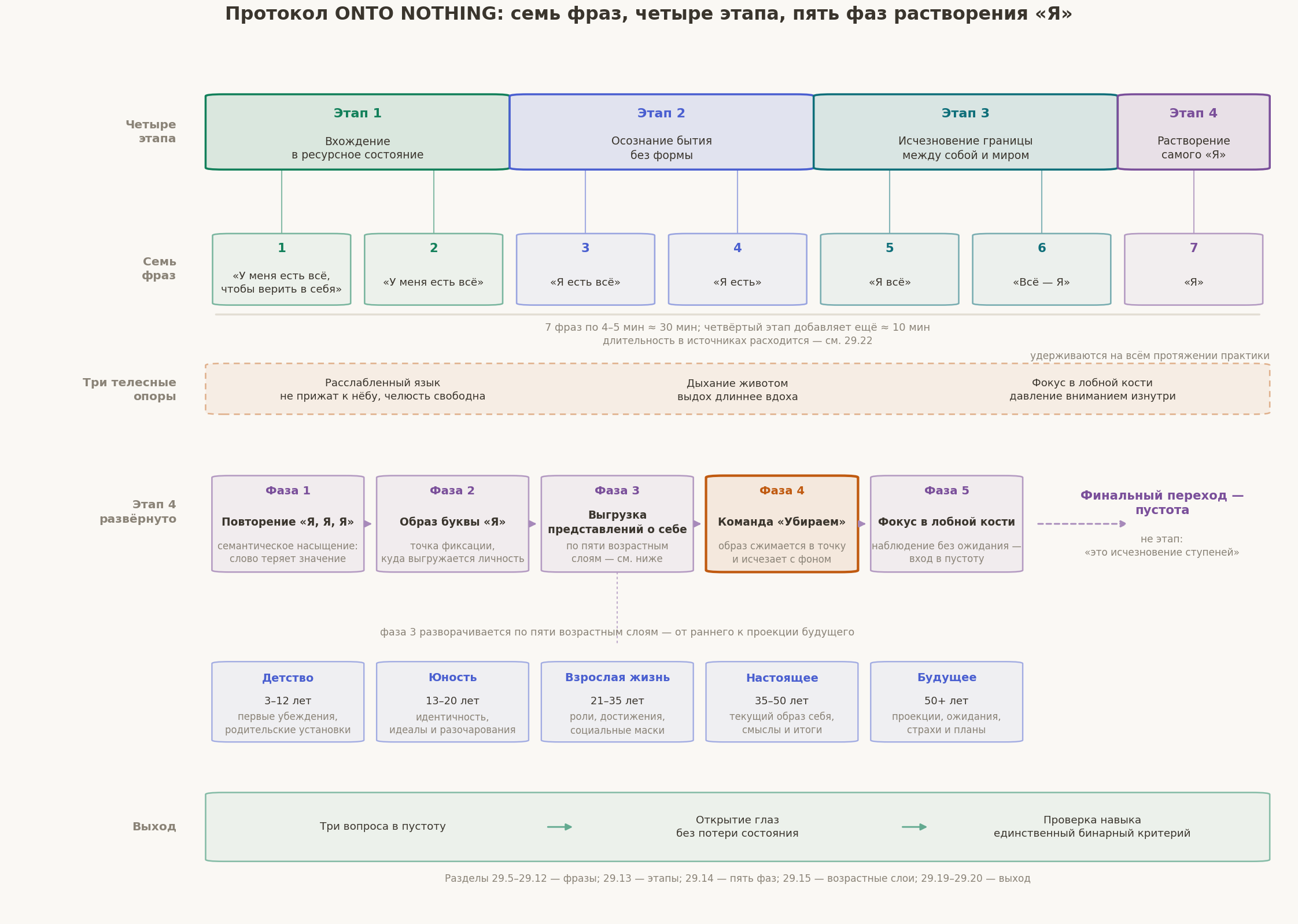
🧭 How each stage is described.The first is leveling the basic tone of the psyche: “You are no longer looking - you remember that everything already exists... It’s like a foundation: until it is laid, entering the silence of the mind is impossible.” Second - “It no longer matters what you have achieved, who you consider yourself to be or what you believe in... What was previously called “I” is losing its outline. Consciousness does not go away - on the contrary, it becomes even more alive, but without being tied to the image of itself.” Third - “The usual division disappears: inside/outside, I/they, subject/object. All that remains is perception. Not someone who perceives, but the fabric of perception itself.” Fourth - “even the subtle feeling of ‘I am’ disappears... You don’t renounce, you don’t fight - you just see that all this is not you.”
🔬 About the arithmetic of time.Seven phrases of 4–5 minutes each give 30 minutes; the four stages are stated to take "about 40 minutes." The numbers converge if we consider that 30 minutes is the time of phrases, and the fourth stage after the seventh phrase unfolds into a separate procedure (21.14–21.17) and adds about ten minutes to them. Thisa plausible reading, not a statement by the author: There is no such decomposition in the sources. See 21.22.
⚠️ Neurophysiological descriptions of the stages are not transferred into the book as statements.Each stage in the source is accompanied by a formulation such as “the activity of the left hemisphere decreases”, “the hemispheres are synchronized”, “suppression of language zones”, “activation of the anterior cingulate cortex”, “switching off the default system”. None of these statements can be obtained on the hardware that the method has (section 18.17: offloading distinguishes three groups of states, not eight; no channel gives either network or zone localization). Full analysis - Chapter 22, summary table - Section 22.9.
21.14. Dissolution of the Self: Five Phases#
📖 The fourth stage is the only part of the protocol that is described in the sources as a step-by-step procedure, and not as a condition. It goes "through several key phases":
1. Repeated repetition of “I”.
2. Creation of a visual image of “I”.
3. Unloading all ideas about yourself.
4. Physical and mental disappearance of the “I”.
5. Focusing in the frontal part and entering the void.
Phase 1 - repetition of “I, I, I.”“Consciousness is fixed on one word, which gradually displaces chaotic thoughts... After 1-2 minutes, the word “I” begins to lose meaning - this is the first step towards its dissolution.” The mechanism is named directly in the source:semantic richness- “repetition of the same word activates neural adaptation... the word loses its meaning and turns into an empty sound.” This is the only neuroscientific explanation in the entire protocol that has a reliable experimental basis (section 22.5). The function of the phase is described as "the first blow to the concept of personality": the word "I" ceases to automatically refer to the speaker.
Phase 2 - visualization of the “I”.“A person represents the letter “I” in front of him” - exactlyblock letter, not an abstract image. “This becomes an object of fixation - a point into which the personality can now be ‘unloaded’.” The rationale for the need for this phase is practical: “If you simply remove internal dialogue, the brain can begin to generate chaotic thoughts. A visual image provides a temporary fixation, allowing you to direct the energy of consciousness to one place before completely dissolving.”
Phase 3 - uploading ideas about yourself.“A person begins to fill the image of “I” with everything that he considers himself” - according to five age strata, see section 21.15. The key difference from psychotherapy is formulated in the source: “This is an analogue of psychotherapeutic awareness, only in an accelerated form. Humandoes not analyze, but justconveystheir concepts to the symbol.” You cannot parse the contents—parsing returns the subject who parses it.
Phase 4 - “Remove” command.“Now a person reduces the image of “I”, compressing it into a point. At some point, the “I” disappears completely. At the same time, the person stops saying the word “I” out loud.”. Not only the letter disappears: “Not only the letter disappears, but also the entire “context” around it (for example, a clearing, a background).” Logic is described as the removal of the last support: “Until this moment, the mind had a familiar anchor point - now it remains without it. This causes a brief moment of emptiness—a pause between self-awareness and the emergence of a new thought.” And further in the form of a syllogism, which is, in fact, the central thesis of the entire method:
The brain cannot hold on to emptiness. If there is no fixation point, there is no “I”. If there is no concept of "I", there is no one to talk to. And if there is no one to talk to, the internal dialogue disappears automatically.
Phase 5 - focusing in the frontal part and entering the void.“After the “I” disappears, attention is directed to the frontal part. A person simply observes, but does not expect anything... A person stops saying “I”, he remains silent with his eyes closed.” The purpose of the phase is safety: without a point of attention, “he can get lost and begin to look for support in his thoughts again.”
🧭 Note for the presenter.Phases 1–3 require active participation, phases 4–5 require withdrawal of participation. The transition between them is the most difficult place in the procedure, and it is here that a rollback most often occurs: a person “removes” the image and immediately begins to check whether it has been removed. Inspection is the work of the mind, and it brings back what has been removed.
21.15. Unloading by age strata#
📖 The third phase unfolds across five age layers. The order is fixed - from the earliest to the projection of the future.
| Layer | Age | What is uploaded | Why this layer |
|---|---|---|---|
| 1. Childhood | 3–12 years | First memories of myself; basic emotions - joy, fear, shame, resentment; parental attitudes (“You should...”, “You are so and so...”); attachment and security or lack thereof; first restrictions (“I can’t”, “I’m not worthy”) | “In childhood, the basic patterns of thinking are laid down” - the layer shows how primary beliefs shaped personality |
| 2. Youth | 13–20 years | Search for identity; rebelling against or following norms; the first strong emotions - falling in love, fear of rejection; ideals and dreams; first disappointments; environmental influence | A person “begins to become aware of himself,” but is attached to external assessments; The layer helps you see "which ideas have been accepted as 'truth' but may just be memes" |
| 3. Adult life | 21–35 years old | Career and professional identity; first victories and major failures; change of values from dreams to pragmatism; social roles - family, work, society; responsibility, pressure, status | “Personality becomes as fixed as possible”; layer shows "which self-concepts have been artificially created" |
| 4. Present | 35–50 years | Awareness of the path traveled; revaluation of values; sense of time and fear of aging; dissonance between expectations and reality; understanding the illusions that lived | The layer allows you to see “here and now” without reference to past settings: “it is not its own history” |
| 5. Future | 50+ / expectations at any age | Fantasies about the future, fears, hopes; programs imposed by society - pension, old age, “meaning of life”; illusion of control; expectations from oneself and the world; feeling of untapped potential | “The future is always a concept created by the mind”; the person sees that expectations are “based on past experience, but are not reality” |
🧭 Age here is not a biography, but a type of content.The fifth layer is explicitly labeled "at any age," and the same is essentially true for the rest: a thirty-year-old unloads the "Present" layer not because he is 35, but because he has a current image of himself. Age limits set the order of the rounds, not the criterion for admission.
📖 The result, as formulated in the source:“Each stage of unloading shows that the “I” is just a set of experiences, and not something permanent... After the final stage, the feeling of “I as a separate person” disappears - only perception without boundaries remains.”
⚠️ This is the most risky part of the protocol.Five layers is essentially a guided passage through the entire autobiographical memory, including its emotionally charged areas, without a therapeutic frame and without stopping for processing. Section 19.2 describes what happens when traumatic material is raised in a state of reduced control; here it risesaccording to instructions. Indicating the source “not to analyze, but to transmit” is both a methodological and protective instruction, but it is not enough.
✍️ [To the author - add]:what do you do if on the “Childhood” or “Youth” layer a person falls into the experience instead of unloading. A sign by which you notice this from the outside. Your stop criterion. Who are you not taking to the fourth stage at all? This is the only ✍️ mark in the entire chapter that concerns safety, and it takes precedence over the rest.
21.16. Breathing lock: inhale, hold, exhale#
📖 At the moment the image of “I” disappears, the source sets a short breathing sequence - the only strictly timed element of the entire protocol:
- “As soon as the image of “I” is reduced to a minimum, take a deep breath.”
- "Hold your breath for1–3 secondsat the moment of complete disappearance of the image of “I”.
- “Exhale slowly and allow yourself to completely relax.”
- “Remain in a state of observation: feel the silence inside, the feeling of time stopping, the space without words or explanations.”
🧭 Function.Delay puts a physiological mark on a moment that is otherwise spread out in time. The mind cannot determine exactly when the image disappeared; breathing can - and does - link disappearance to a bodily discernible event. In practice, this makes the moment reproducible: the second time a person is looking not for “the same experience,” but for “the same pause.”
🔬 Claimed mechanism“This pause is the key moment when the brain’s default system switches off.” As a statement about the DMN, it is unverifiable with available instrumentation (Chapter 22). Another and more modest thing is being tested: whether an arbitrary delay makes the moment of disappearance of the image reproducible from time to time. This is exactly what was brought up for review (section 23.5).
⚠️ There is no way to justify this approach.Work by Farrow and Hebert (Psychosomatic Medicine, 1982) about565 episodes of spontaneous respiratory arrestcannot serve as an indirect support for reception. Section 22.6 shows why this rationale would be inverted: in Farrow and Hebert, respiratory arrest occursherselfand serves as a sign of an already occurring state, but here the delay is madearbitrarilyand is offered as a way to induce the condition. “When X is observed, Y is observed” does not entail “do Y to get X.” The reception remains in the protocol asmarking- according to the function described in the paragraph above - and the coincidence of the place at which the breath stops remains a coincidence until verified (23.5; Question 67 of Appendix B).
⚠️ Restriction and security.A delay of 1–3 seconds after a normal inhalation is physiologically insignificant for a healthy person. However, any respiratory delays are excluded in case of cardiovascular diseases, epilepsy and convulsive conditions, pregnancy, uncontrolled hypertension and a history of panic disorders - not because of the delay itself, but because fixating attention on breathing triggers hyperventilation in some people.Categorically and without exception: never in the water and never while driving.This limitation applies to any breathing instruction of the method; it is repeated here intentionally, because the presenter is reading this chapter, and not chapter 22. If a person begins to “try” to breathe, the element is removed, the protocol works without it.
⚠️ Ceiling and stopping rule.An instruction without an upper limit tends to spread: a practitioner who “failed” extends the delay himself (22.6). There is no author's formulation of the ceiling in the materials - this is an open ✍️-clause of section 22.6. Until it is written, the book givesworking rule, which the presenter must use and which he must pronounce before the start of the session:the delay is no longer than three seconds; at the first appearance of effort - exhale without waiting for the count. This is the rule of the book, not the sources, and it must be replaced by the author's.
21.17. Entering the void: what to do when there is nothing to do#
📖 After exhaling, the procedure ends, and what it was for begins. The instructions here consist of one prohibition:don't expect anything.
Waiting = mind working. Any thought of “enlightenment” = an attempt by the ego to interpret the process. If a person simply stops and observes without interpretation, he remains in emptiness.
🧭 Why is the ban formulated this way?Waiting is the final form in which the subject returns after all obvious supports have been removed. It returns not as the thought “I”, but as the question “did it work out.” The source puts it precisely: “Any expectation can bring back the ego, so it is important to remain absolutely neutral.”. In practice, this means that signs of success for a personcannot be described in advance- otherwise he will look for them, and the search will replace the state.
⚠️ This coincides with the methodological requirement that the book already made for another reason. Section 18.5 warns abouttheory contamination: “If the participant is told in advance what they “should” experience, self-reports will adjust to the description.” There it was a requirement for research, here it was a requirement for practice itself. It is a rare case when scientific hygiene and methodological necessity literally coincide: both in a report and in an experiment, the description of the result spoils the result in advance.
📖 The state that remains is described in the source not through content, but through the absence of a center: “At this stage, the mind is completely silent. But awareness does not disappear - it remains pure, but without a center, without comments, without thoughts. You don’t turn into emptiness, you don’t disappear—you become pure presence.” And the final formula that ends both main documents: “perception without a filter, awareness without description, reality without an observer.”
21.18. If the thoughts come back#
📖 Instructions for returning internal dialogue are given in the source in three points:
- “Just watch your thoughts like clouds in the sky, without getting involved in them.”
- “Bring your attention back to the sensation in your frontal region and to the rhythm of your breathing.”
- “Allow thoughts to come and go while remaining in a state of mindful presence.”
🧭 What's not here and why it's important.There is no instruction to “drive away the thought”, “return to the phrase”, “start again”. The return of thoughts is not considered a failure and does not roll back the practice to the beginning: two bodily supports (forehead, breathing) always remain available and serve as a way back. This is quite different from many concentration techniques, where distraction requires a restart; here restarting is prohibited for the same reason that waiting is prohibited - it introduces the one who restarts.
⚠️ A separate case is “dry nothingness”.Section 18.5 describes a state that is subjectively similar to emptiness, but in fact is a failure into slumber or dissociation: theta increases without alpha coherence, after practice there is no clarity and rest, but there is stupor. Instructions to “observe without getting involved”doesn't workand, moreover, it disguises it. The sign of discrimination is not instrumental, but simple: after a real input, clarity remains, after “dry nothingness” - deafness. If after practice a person “falls out” for half an hour, the duration is reduced, and the fourth stage is temporarily removed.
21.19. Three questions into the void#
📖 In the state that remains, the source offers three questions - “without demanding an immediate answer”:
• “What are you if you don’t think?” • “What remains when there is nothing left to say?” • “What came before the thought?”
“Just stay with these questions without trying to resolve them—let them become the background of your awareness.”
🧭 How it works.All three questions have one feature: they cannot be answered without leaving the state in which they were asked. Any answer is a thought, and a thought cancels the condition of the question. The question, then, works not as a request for information, but as a hold: it occupies the space where internal dialogue would otherwise arise, and at the same time cannot be filled with it.
🔬 This is where the protocol comes closest to Chapter 14.The question “what came before the thought?” - this, in the language of phenomenology, is a question aboutgiven way, and not about the content: he does not ask “what”, he shifts the focus to “how”. Section 14.4 describes the microphenomenological interview as a procedure built precisely on this bias. The coincidence makes the three questions a natural point of interface between the practice and the phenomenological layer - and, perhaps, ready-made material for the post-session interview protocol.
⚠️ Questions are givenafterentrance, not instead of it. Given earlier, they turn into a philosophical task and start exactly the process that practice stops.
21.20. Exit and skill check: closed eyes → open#
📖 Practice does not end with emptiness - it endschecking, and this check is described in the sources as a separate mandatory step:
- A person comes out of the void and checks whether he managed to maintain a state of thoughtlessness.
- Reinforcing the skill: first he does it witheyes closed. Then he stops the internal dialoguewith open eyes.
🧭 Why is the second step needed?Source wording: “The mind remembers the process: first stopping with your eyes closed, then with your eyes open. This breaks the illusion that the state of emptiness depends on external factors.” While entry is possible only with closed eyes, the state remains tied to conditions - that is, it remains not a skill, but a circumstance.
🧭 This is the criterion for mastering.In the entire protocol, only here is there a checkable sign of the result:input with eyes open is played or not played. Everything else is a self-report about the quality of the experience. This is more important for research than it seems: the criterion is binary, observable from the outside and does not require the participant to describe the experience in words, and therefore is not subject to contamination from 21.17.
🧭 Connection with the mode map.In the language of Chapter 18, this is exactly the fork that Section 18.19 talks about: with eyes closed, the deepening goes to V‑MPE and ATS, with open eyes, the same zero level turns outward into OP and FP. Testing with eyes open, therefore, does not just reinforce the skill - it isthe first step to the second branch of the route, for which there are no login protocols yet.
21.21. Transferring the state to life#
📖 The source insists that mental silence is not the goal: “the silence of the mind itself is not an end goal, but a tool.” The skill test is followed by the transfer stage, described as “bringing this state into life” and including specific tasks - looking at the world without thoughts, moving in emptiness, acting without thinking.
🧭 What does "skill" mean?Source wording: “Now a person does not depend on practice - he can stop thoughts in any situation... A mantra is not needed. No meditation needed. It’s enough just to switch to this state.” In other words, thirty to forty minutes of protocol istraining procedure, and not a form that must be completed for life. Its task is to make entry instant, after which the procedure itself becomes optional.
🔬 How does this relate to the architecture of the book?The statement "login becomes instantaneous" is, in Chapter 27 terms, a statement abouttransition speed(primitiveSp), and it is verifiable: the time from the command to the change of dominant is measured. The statement “a skill persists beyond practice” is a statement aboutretentionand refers to horizons U1/U2/U3 section 27.23.1. Both are measurable by existing means. This makes section 21.21 not a declaration, but a hypothesis with a ready-made test plan - see Chapter 23.
⚠️ And at the same time, this is a place where the protocol goes beyond the boundaries of what the book can confirm. Between “a person reproduced the input with his eyes open at the end of the session” and “a person can turn off his thoughts in a second at any moment in his life” lies a distance that has not been measured for any participant. The second statement is found in the sources as a fact; the book records it aspurpose of the method and open hypothesis, included in Appendix B.
21.22. Discrepancies within sources: what is not summarized#
⚠️ The protocol materials were written at different times and in different ways: partly as working notes, partly as a speech by the presenter, partly in dialogue with the language model. In four places they contradict each other. The book does not choose a version: the choice changes the procedure, and the procedure belongs to the author. Below are all four discrepancies as they exist, with an indication of what exactly depends on the decision.
Discrepancy 1. Duration of practice.Sources give three different values, and one more number from the book is not included in this count.
| Source | Meaning | How received |
|---|---|---|
| "Phrases of Practice" | 30 minutes | 7 phrases × 4–5 minutes, amount indicated in document title |
| “How the ONTO NOTHING practice works” | about 40 minutes | Claimed to last for four stages |
| "Materials from AI" | 5 minutes per phrase | 30 or 35 minutes depending on the number of phrases (see discrepancy 2) |
| This book, section 18.5 | 5–20 minutes | Not about the procedure: it's the durationretentionstatus after login |
The first two values are reduced if we assume that 30 minutes is the time of phrases, and the fourth stage adds about ten minutes to them (21.13). The author confirms the third meaning as a working norm:five minutes for each phrase, that is, thirty-five minutes of phrasal part with seven phrases (21.5). The fourth, “5–20 minutes,” is not included in the duration of the procedure at all - this is the time of holding the state after entering (18.5), and it cannot be added to the duration of phrases.
✍️ [For the author to decide]:how long does the shortened procedure last and in what cases is it permissible; and separately - how long the retention lasts, which is considered successful in the first session.
Discrepancy 2. The order of phrases is three options.
| Option | Source | Subsequence |
|---|---|---|
| A | “Phrases of practice”, “Speech instructions” | 1 “I have everything to believe in myself” → 2 “I have everything” → 3 “I am everything” → 4 “I am” → 5 “I am everything” → 6 “I am everything” → 7 “I” |
| B | “Materials from AI”, detailed analyzes | 1 “I have everything to believe in myself” → 2 “I have everything” → 3 “I am everything” → 4 “I am everything” → 5 “I am everything” → 6"I am"→ 7 “I” |
| IN | “Materials from AI”, block “🟢 New sequence” | 1 “I have everything to believe in myself” → 2 “I have everything” → 3 “I am” → 4 “Everything is I” → 5 “I am everything” → 6 “I” -six phrases, "I am everything" is missing |
🧭 What's behind the difference?In optionAthe subject is removed early (“I am” in the fourth step), and the subject/object boundaries are resolved later. In optionBfirst the boundary is completely dismantled, and the bare “I am” comes penultimately - like the little that has survived after the removal of all relations. These are two different routes to the same point, and they feel different:Agoes from completeness to simplicity,B- from expansion to remainder. OptionINone step shorter and removes exactly the phrase that is inAAndBholds the transition from having to being.
The book provides an option in section 21.5A— it is recorded in two out of three documents and coincides with the text according to which practice is actually carried out. But the option is marked “🟢 New sequence”INmeans it may have been a later revision rather than a draft. It is impossible to determine this from the documents.
✍️ [For the author to decide]:which sequence is canonical; isINlater version; is “I am everything” necessary at all?
Discrepancy 3. The correspondence of stages and phrases is restored, but not stated.The breakdown in section 21.13 (Stage 1 → phrases 1-2, Stage 2 → 3-4, Stage 3 → 5-6, Stage 4 → 7) is derived from the Speech Instructions structure, where each stage ends with a listing of the phrases included in it. There is no such table explicitly in the sources, and with the optionBorINthe breakdown will change.
✍️ [To the author - confirm]Table 21.13 or give your own.
Discrepancy 4. Conflict with Section 18.5.Section 18.5 describes entering mode 1 in one line - “phrase → “I” → dissolution → silence” - and indicates the duration at the start of “a few seconds”. This chapter describes the same procedure as thirty to forty minutes. There is no contradiction here, but there is a confusion of words: in 18.5 we are talking about durationretentionmode, here - about the durationentrance. The book separates these two concepts: version 1.1 added a link here to section 18.5, version 1.2 - a direct indication that “from a few seconds” refers to holding, and not to entry, and the duration of the entry itself is named.
⚠️ The fifth discrepancy is not within the materials, but between the materials and the book.The sources contain statements about what happens in the brain at each stage, stated as facts. The book translates them into hypotheses. This is not a discrepancy between the sources, but the decision of the book, and it is justified in chapter 22.
21.23. What remains to be written about this chapter?#
✍️ [To the author - add]:
- Decisions on four discrepanciessection 21.22 - canonical duration and order of phrases. These are the only points without which the chapter cannot be considered a protocol: now it documents the practice, but does not define it unambiguously.
- Stop criteria and contraindications for the fourth stage(21.15). Priority is higher than all other items on the list.
- Conditions(21.3): posture, time, environment, what to do with interference.
- Verbatim text of reference- what you say out loud between sentences. Now the chapter restores the content, but not the intonation or connectives; the presenter who took this chapter will be forced to invent them.
- Signs of “hit/miss”for each stage - what you see from the outside: breathing, face, posture, micromovements. This is something that is not in any document and that only you have.
- Common mistakesand your answers to them. One or two per stage is enough.
- Short versionprotocol - for those who have already mastered the entrance, and for field conditions. The sources state that once mastered, entry is instantaneous, but there is no description of what “instant entry” looks like as a procedure.
- How the lead changes from meeting to meeting.The full procedure of this chapter is completed once (25.6), then a short entry and state transfer work, but how exactly the conduct of the second, fifth and twentieth meetings differs is not described in the sources.
- Transfer tasks(21.21) - complete list with wording. They are named in the materials, but not expanded.
22. What is confirmed in the protocol and what is speculation#
22.1. Why is this chapter immediately after the protocol?#
🧭 The protocol of chapter 21 does not come alone. Along with it, the sources bring a story about what happens in the brain: the default system is turned off, language areas are suppressed, the hemispheres are synchronized, the anterior cingulate cortex is activated. The story is coherent, confidently told, and explicitly called “scientifically proven” in several places. This chapter takes it apart piece by piece.
⚠️ The main thing you need to understand before starting the analysis:If the neurobiological story turns out to be completely wrong, the protocol will not stop working. These are two independent statements. “A sequence of seven phrases followed by a dissolution procedure brings a person to the described state” is testable and does not require knowledge of the mechanism. “This happens because the default system is turned off” is a separate statement that requires equipment that the method does not have. It is harmful to mix them in exactly one direction: if the mechanism is refuted, and the protocol was submitted as a consequence of the mechanism, the protocol is canceled along with the mechanism - although there is no reason for this. Therefore, the book separates them harshly.
📖 Three classes into which all statements are divided.
- Confirmed (📖)— there is a published study that measured exactly what we are talking about, and the result was reproduced. Class does not mean "proven for our protocol": it means that the phenomenon referred to by the protocol exists and is described.
- Hypothesis (🔬)- the mechanism is plausible, there is related data, but there is no direct measurement on this protocol, this duration and this population. This is the most populated class, and there's no shame in it: almost everything a method does is here.
- Outside the device resolution (⚠️)- the statement, in principle, can neither be confirmed nor refuted by the equipment that the method has. Section 18.17 has already established the boundary: the upload of a consumer device distinguishesthree groups of states, not eight, and not a single channel of it provides either network or zonal localization. Anything that is formulated as “such and such a network turned off” or “such and such a cortex was activated” falls here automatically - regardless of whether it is true or not.
🧭 The rule the book uses in this chapter.A statement does not rise in class because it is useful, beautiful, or consistent with the presenter's experience. The only thing that increases the class is measurement. This is a continuation of the rule from section 27.26: any number that is not in the sources does not appear in the book; here the same applies to mechanisms.
⚠️ Separately, about the wording “scientifically proven method”.It appears in the materials and should not appear in the book, in program descriptions, or in conversation with the participant. The method is based on confirmed phenomena, but the method itself has not yet undergone tests that would give the right to this phrase: there is no control group, no pre-registration, no independent reproduction, the sample is small and not random. Chapter 20 describes what kind of design would give such a right; Until then, the correct formulation is “a method built on confirmed effects and tested in an ongoing study.” The difference is not cosmetic: the first statement will crumble when tested and drag everything else down with it, the second will survive.
22.2. Tongue relaxation: a mechanism, one confirmation and one neat negative result#
📖 What's behind it?The instruction “relax your tongue” is based on the motor theory of inner speech: inner speech is not an ethereal flow, but a reduced, suppressed articulatory action at the output. This has a direct electromyographic basis: when silently speaking a text, activity of the speech muscles is recorded, which is not present at rest (Livesay et al., 1996). The speech apparatus occupies a disproportionately large part of the motor cortex (Penfield's homunculus), and the tongue is innervated by a separate cranial nerve - the hypoglossal (XII). That is, anatomically, inner speech and the muscles of the tongue are really connected.
📖 Direct research supporting instruction.Nalborczyk et al (2017) induced verbal rumination in 71 participants (mean age 20.58 years; SD = 4.99) and recorded EMG from perioral muscles. After induction of rumination, the amplitude isorbicularis oris inferiorincreased by approximately 64% relative to the initial level (α = 163.89; 95% HDI [145.24; 184.14]; d = 0.77) - despite the fact that the participants were silent. The second experiment compared three ways to stop rumination: relaxing the perioral muscles, relaxing the arm muscles, and listening to a story. Perioral relaxation produced the lowest signal level (≈71.05; 95% HDI [52.67, 90.71]) versus ≈100.43 for hand relaxation and ≈89.94 for listening. This is exactly what the protocol expects: working specifically with the speech muscles, and not with the body in general.
⚠️ And direct verification, which did not confirm the strong version.Nalborczyk et al (2022) conducted an experiment testing the main point: if inner speech relies on articulation, then articulatory activity should suppress rumination more than a comparable non-speech activity. Participants (n = 106 of 184 recruited) either silently articulated or tapped a rhythm with their fingers during induced rumination. Rumination has decreasedin both conditions, and after articulatory suppression - only slightly stronger. The authors call the findings “suggestive rather than compelling evidence” and explicitly note that the results “did not strictly confirm the original hypotheses.”
🔬 The final class is a hypothesis.The connection of speech muscles with inner speech was confirmed as a correlation and confirmed in one direction of intervention (relaxation reduced the EMG signature more than control relaxation). But the strong version - “a relaxed tongue prevents the mind from starting the flow of thought,” that is, a mechanism, not an accompaniment - has not passed direct test. It's a fair picture: one hit and one neat negative.
🧭 What does this mean for practice?Save the instructions. It costs zero, has no harm, is supported by half and works at least through the general tone. Change the wording: not “a physiological hack to reduce mental activity”, but “relaxing the tongue removes part of the muscular accompaniment of internal speech; How much this reduces speech itself has not been fully established.”
22.3. Belly breathing#
📖 The strongest of the three bodily supports.Slow diaphragmatic breathing is one of the best documented non-pharmacological interventions in autonomic regulation. A meta-analysis by Shao et al (2024) found an effect of slow breathing on heart rate variability with a standardized mean difference of 1.11duringpractice and 0.37afterher; work by Kromenacker et al (2018) shows that the increase in HRV during slow breathing reflects the vagal contribution, and not just the mechanics of respiratory sinus arrhythmia. Both works are already present in the book's bibliography and are discussed in Chapter 28 in relation to wearable devices.
🧭 Why is this important here?Of the three pillars of the protocol, only this one gives a signal that the methodalready knows how to measure: HRV is written by the wearable device in the background, without a separate procedure. This means that the respiratory support is the only part of the Chapter 21 protocol for which the pass/fail check can be automatic. Section 23.2 uses this.
⚠️ What this doesn't prove.It has been confirmed that diaphragmatic breathing calms the autonomic system. That exactly this calming is a condition for entering mode 1 has not been verified. Between “the person is physiologically calm” and “the internal dialogue has stopped” lies the entire subject of the method, and the first obviously does not guarantee the second: a calm person continues to think perfectly well.
⚠️ Important discrepancy between protocol and literature.The effects in question aredepends on breathing rate: These are obtained by breathing slowly around the resonant frequency, usually around six cycles per minute, and not by “belly breathing” at all. The protocol of Chapter 21 does not set the frequency at all - it only sets the direction (to the stomach) and that the exhalation is longer than the inhalation. As written now, the instructions do not reproduce the conditions under which the cited effects were measured.
✍️ [For the author to decide]:Is breathing frequency set in practice? If yes - which one and at what stage; if not, the book should say explicitly that breathing support is used as general calming, and not as resonant breathing, and remove the reference to resonant effects.
22.4. Frontal focus and resting network suppression#
📖 What the source says.After the image of “I” disappears, attention is directed to the frontal part - as a “soft center of observation”, without images and words; Without this point, “a person can get lost and begin to look for support in his thoughts again.” Physically, the instructions are given precisely: apply pressure with attention to the bone of the forehead from the inside.
🔬 Plausible mechanism.Maintaining attention on a nonconceptual goal refers to task-oriented attentional performance; the resting network (DMN) and attention networks are negatively correlated, and the involvement of one is accompanied by the suppression of the other. Josipovic et al (2012) report anticorrelation coefficients of −0.41, −0.58, and −0.22 across conditions; Brewer et al (2011) show reduced activity in major nodes of the resting network in experienced practitioners. Hence the assumption: the attention point in the frontal region prevents the resting network from restarting immediately after the object of attention is removed. This is also consistent with the functional description of the source: insurance against the return of thoughts, and not an independent exercise.
⚠️ Three caveats that make this remain a hypothesis.Firstly, the cited works describe a class of contemplative practices, not this instruction: they do not have a frontal focus. Secondly—and more significantly—Josipovic's work itself contains a complicating result: in nondual awareness, networks are anticorrelateddecreased, but not growing. If the state to which the protocol leads is closer to this description, then the simple scheme “involve the attention network - suppress the rest network” describes at best entry, but not retention. Third, “frontal region” is not the name of a network or the name of a zone: it is the place on the skull where attention is directed. The connection between the direction of attention to a point on the skull and the activity of the underlying cortex has not been established by anything and, most likely, is not at all the same as intuition suggests.
⚠️ What is excluded from the wording.Some of the materials describe the frontal focus in esoteric language: ajna chakra, kundalini, “energy shield against thought viruses.” These formulations are not transferred to the book - not because of the label “unscientific”, but on an operational basis: they cannot be used to check whether the instructions have been followed or not. “The pressure of attention on the bone of the forehead from the inside” can be checked - a person either answers “yes, I feel it” or no. This is the same selection rule that the book used in section 18.14.
22.5. Semantic saturation when repeating “I”#
📖 The only explanation is in the protocol, which has a direct experimental basis.The phenomenon referred to in Phase 1 of the fourth stage is called semantic saturation and has been described in psychology for over sixty years: when repeated many times, a word loses its subjective intensity of meaning and turns into sound. The classic work is Lambert and Jakobovits (1960); Contemporary confirmation with localization of the effect is Kounios, Kotz, and Holcomb (2000): in this study, repeated repetition of the prime word reduced the relatedness effect on the N400 component, that is, saturation occursat the semantic level, and not reduced to sensory adaptationfrom repeated perception of the same stimulus. It is this distinction that is important for the protocol: if the effect were sensory, the repetition of “I” would simply tire the ear without affecting the meaning.
🧭 The correspondence between the description in the source and in the literature is good.The source says: “After 1-2 minutes, the word “I” begins to lose meaning - this is the first step towards its dissolution,” and calls the mechanism by its name. This is a rare case when the explanation in the materials is not only plausible, but also accurate.
⚠️ Three restrictions you can't miss.
First -"I" is not an ordinary word. Semantic saturation was studied on nouns and adjectives, in which the meaning is specified by the concept. “I” is an indexical: its referent is determined not by the concept, but by the very act of utterance. Whether an indexical is saturated in the same way as a noun is an open question and, as far as we have been able to establish, not experimentally resolved. This makes the protocol not less meaningful, but more interesting: it does something that is not in the literature.
Second -time scale. Laboratory saturation occurs in seconds and does not last long; The protocol counts on an effect that will survive the rest of the procedure and, in the long term, will be transferred beyond its boundaries. Nothing follows from the cited works about such a retention.
Third, and most important -gap between word and self. Losing the meaning of the word “I” and losing the sense of self are different events. The second does not follow from the first; a person whose word “I” has turned into a sound usually continues to be himself. The protocol, judging by its design, understands this: it does not stop at repetition, but adds visualization, unloading and compression to a point - that is, saturation is used asa tool that removes the automatism of a word, and not as the dissolution mechanism itself. But in the text of the materials these two events are glued together in places, and the book separates them.
🔬 The only place in the method where an inexpensive, clean experiment is possible now.Testing “whether “I” is saturated in the same way as a regular word” does not require either an EEG or a sample of hundreds of people: what is needed is a procedure for assessing the intensity of the meaning before and after repetition, a control word, and randomization of the order. This amounts to one session per person. Hypothesis formulation and minimal design are in Section 23.5; in the Annex E roadmap, this is the first priority added by version 1.2.
22.6. Holding your breath at the moment of dissolution#
📖 What does the protocol require?At the moment when the image of “I” shrinks and disappears, inhale, hold for one to three seconds and exhale slowly. The technique is short and is presented in the sources as a way to “fix” the moment of disappearance.
📖 What is known from the literature.Farrow and Hebert (1982) described cessation of breathing as a physiological correlate of episodes of “pure consciousness” in transcendental meditation: 565 recorded episodes, associated with subjective report at the levelp< 10⁻¹⁰. This is one of the most statistically powerful works in all the literature on meditative states, and it has long been included in the book's bibliography.
⚠️ And here is the most important methodological error in the entire protocol.Farrow and Hebert go into respiratory arrestspontaneous: it occurs itself when the condition occurs, and serves as a sign of it. The protocol does the opposite - it prescribes an arbitrary delay as an input reception. This is the inversion of the inference: “when X, observe Y” does not entail “do Y to get X.” Voluntary holding of breath is another physiological event: it contains a motor command, there is control, there is a growing feeling of lack of air, that is, exactly that active participation that the protocol removes at this step. The technique may work - for another reason, such as as a marker to mark a moment - but the rationale through Farrow and Hebert is incorrect and should be removed.
🔬 A class is a hypothesis, with a reservation about the direction of the conclusion.A delay of one to three seconds is short, does not pose a risk in itself and may well serve as a marking function. But it cannot be presented as “the same breathing phenomenon that has been recorded in meditation studies.”
⚠️ Safety.Any instruction with breath holding requires obvious restrictions: cardiovascular diseases, epilepsy and convulsive conditions, pregnancy, panic disorder; categorically - never in the water and never while driving. General Admission Criteria - Chapter 19 and Section 18.16; they are in full effect here. One to three seconds is a small amount, but instructions without an upper limit tend to spread: a practitioner who “didn’t succeed” lengthens the delay himself.
✍️ [To the author - add]:a clear delay ceiling, a stopping rule (“if effort appears, exhale”) and formulation for those for whom delay is contraindicated: whether they do this step without delay or skip it entirely. While this is not the case, the working rule of the book applies in section 21.16 - no longer than three seconds, when an effort appears, exhale - and it must be replaced by the author’s.
22.7. Unloading an autobiographical story: “I” as a construction#
🧭 The third phase of the fourth stage - unloading personal history across five age layers (21.15) - is accompanied in the materials by two statements of different nature that need to be separated.
📖 The first is not empirical, but philosophical, and the book already carries it.That the Self is a construct and not a discoverable entity is a position with a long pedigree: the Humean bundle of perceptions, in which, when turned inward, only experiences are discovered and never their possessor; Metzinger's modern model, where the self is the content of the model, and not what the model builds. Chapter 14 lays this out in detail. The position is strong and internally consistent, but it is not an experimental result and cannot be cited as “proven by science.” For the record, it is important in another way: it explainswhy is uploading possible at all?. You can disassemble what you have assembled.
⚠️ The second, the empirical claim “autobiographical memory suppression,” is at least directionally incorrect.The unloading procedure does not suppress autobiographical memory, but systematicallyextracts: a person consistently evokes childhood memories, youthful identifications, adult roles, and an image of the future. There is no suppression here at any step. What is actually done is that the memory is moved from the position of “this is me” to the position of “this is the observed form” and released. In non-method terminology, this is closer to decentering and cognitive separation than to suppression. The wording should be replaced not for the sake of politeness, but because the current one describes the opposite operation.
🔬 Closest measured analog.The only area where self-dissolution has been measured instrumentally and reproducibly is in psychedelic research: Lebedev et al. (2015) linked subjective ego dissolution to resting network disintegration. This is relevant and is already cited in the book, but with an obvious caveat: pharmacological dissolution and procedural dissolution are different events with possibly different mechanisms, and the result cannot be directly transferred. For now, this is the best available point of comparison, not confirmation.
⚠️ Clinically, this is the riskiest part of the protocol.Purposeful deconstruction of self-image works with exactly the material that depersonalization consists of; the difference is described in section 14.8 - in the manner of giving, not in content, and this difference is subtle. Section 19.4 describes the risk, section 21.15 notes it in place. There are no stop criteria for this phase in the sources.
✍️ [To the author - add, highest priority]:signs at which the fourth stage is interrupted; what the presenter says and does when interrupted; who is not allowed into this stage at all; what to do if unloading reveals traumatic material. This is the only point in the entire Part VI, the absence of which makes publication of the minutes premature.
22.8. What the device can't do: claims and resolution limits#
⚠️ Below are statements found in the materials in an affirmative form thatcan neither be confirmed nor deniedavailable equipment. This is not about their truth: some of them may turn out to be true. The point is that they cannot be obtained on a consumer EEG headband, and therefore they cannot appear in the book as measurements.
“The default network was completely shut down.”The resting network is a concept defined through the coordinated activity of spatially separated nodes, including deep nodes. Its state is inferred from functional MRI or from high-density EEG with the solution of the inverse problem. The download available to the method contains powers in frequency bands and derived manufacturer indices; it does not contain the number of channels, editing, or source models required for network output. The wording “the default network went offline” on these data does not make operational sense.
“Activity of the posterior cingulate cortex is almost zero,” “activation of the anterior cingulate cortex,” “suppression of language areas.”All this is zonal localization. Dry frontotemporal electrodes produce a signal that is mixed across the cortex and contaminated by muscle artifacts; The cingulate cortex is located medially and is, in principle, poorly accessible to surface recording. None of the three statements are derived from the available output.
“The activity of the left hemisphere decreases, the hemispheres synchronize.”A claim about interhemispheric relationships requires at a minimum a symmetrical bilateral montage and an explicit measure—coherence, phase synchronization, or the like. There is nothing of this in the upload. And even if there is: coherence between two electrodes is not equal to “synchronization of the hemispheres” as whole - these are statements of different scale, and the second is not usually used in neurophysiology.
“People with twenty years of experience in meditation could not show better results on the EEG.”This is not a measurement at all. There is no described protocol, no age- and gender-matched sample, no blinding, no adjustment for the number of comparisons, and—crucially—the manufacturer's index is not comparable across sessions and devices enough to support human-to-human comparisons. Section 29.8 documents four discrepancies between the book indexes and the platform product indexes; With such instability, interpersonal comparison has no support. The method costsintra-individual dynamics- ΔMNPI and RCI on repeated measurements of one person - and this is where his results are defensible.
🧭 What can we say honestly?Section 18.17 sets the real limit: unloading distinguishesthree groups of states, not eight, and this is sufficient for the purposes of the method. Achievable and defensible statements are formulated as follows: “in the record there is a transition between distinguishable groups of states”; “this person's transition time was reduced by so much with |RCI| above 1.96"; “holding on horizon U2 has been maintained.” None of them require networks, zones, or hemispheres—and none will fall apart on the first test.
⚠️ Rule for public communication.Network and zone vocabulary is not used in materials for participants, on the website and in oral explanations. Not because it scares the regulator, but because it creates a false model in the participant: he begins to wait for a “network shutdown” and evaluate his experience based on a criterion that no one measures. This directly contradicts the instructions of the protocol itself - “do not expect anything” (21.17).
22.9. Summary table: statement → class → what it’s based on#
🧭 All analyzed statements are collected below. Designations: 📖 - the phenomenon is confirmed by published studies; 🔬 — the mechanism is plausible, there is no direct measurement on this protocol; ⚠️ — outside the permission of the existing equipment; “—”—the statement is not empirical and therefore not classified.
| Source Statement | Class | What is it holding on to or what is missing? | Chapter |
|---|---|---|---|
| Internal dialogue is associated with micro-movements of the tongue | 🔬 | EMG correlation has been confirmed (Nalborczyk et al., 2017); direct testing by articulatory suppression did not confirm the strong version (2022) | 22.2 |
| Relaxing the tongue is a “physiological hack” for reducing mental activity | 🔬 | Direction of intervention supported, effect size not established | 22.2 |
| Diaphragmatic breathing reduces nervous system arousal | 📖 | Meta-analysis by Shao et al. (2024): SMD 1.11 during, 0.37 after; vagal contribution - Kromenacker et al. (2018) | 22.3 |
| Belly breathing helps you enter silence faster | 🔬 | Physiology confirmed; the relationship with entry into mode 1 was not measured; respiratory rate is not specified in the protocol | 22.3 |
| Focus in the frontal region prevents the mind from returning to thoughts | 🔬 | Anti-correlation of the resting network and attention networks (Josipovic et al., 2012: −0.41; −0.58; −0.22), but not on this instruction; in the same place - a complicating result on non-dual awareness | 22.4 |
| Ajna chakra, kundalini, “energy shield against thought viruses” | — | Not operational: based on the wording, it is impossible to check whether the instruction has been executed or not | 22.4, 21.4 |
| Repeating “I” leads to loss of meaning of the word | 📖 | Semantic saturation: Lambert and Jakobovits (1960); Kounios, Kotz and Holcomb (2000) - effect at N400 level, i.e. semantic, not sensory | 22.5 |
| The loss of the meaning of the word “I” is the dissolution of “I” | 🔬 | The transition from the meaning of a word to a sense of self is not shown in any of the cited works; “I” is an indexical in which saturation has not been studied | 22.5 |
| Hold your breath for 1–3 s as an entry technique | 🔬 | Farrow and Hebert (1982) have respiratory arrestspontaneous(565 episodes,p< 10⁻¹⁰); the "do Y to get X" output is inverted | 22.6 |
| "I" is a construct, not a discoverable entity | — | Philosophical-phenomenological position (Hume; Metzinger), outlined in chapter 14; not an empirical result | 22.7 |
| Suppression of autobiographical memory | ⚠️ | Outside the resolution of the device; In addition, the procedure retrieves memory rather than suppresses it - the formulation describes the reverse operation | 22.7 |
| Disabling the brain's default system | ⚠️ | Network output for unloading a consumer headband is impossible: there is no installation, density and source models | 22.8 |
| Suppression of language areas; activation of the anterior cingulate cortex; posterior cingulate cortex “almost zero” | ⚠️ | Zone localization is not available; medial structures of surface registration are practically not given | 22.8 |
| Decreased activity of the left hemisphere; hemisphere synchronization | ⚠️ | A symmetrical two-way installation and an explicit measure of coherence are required; the coherence of two electrodes does not equal “synchronization of the hemispheres” | 22.8 |
| People with twenty years of meditation experience did not perform better | ⚠️ | Non-measurement: no protocol, matched sample and blinding; producer index is not comparable between people (29.8) | 22.8 |
| "Scientifically proven method" | ⚠️ | No control group, pre-registration, or independent replication; the required design is described in Chapter 20 | 22.1 |
🧭 How is this table read?Of the sixteen lines, two fall into 📖, six into 🔬, six into ⚠️, two are not classified. This is a normal distribution for the method at the current stage, and it is not a verdict: exactly those two phenomena on which the mechanics of the protocol are based were confirmed - diaphragmatic breathing and semantic saturation. The problem is not that little is confirmed, but that in the source materialsall sixteen lines are stated equally confidently. This chapter redistributes this confidence.
22.10. What remains to be written about this chapter?#
✍️ [To the author - add]:
- Decision on wording in public materials.Table 22.9 applies not only to the book: the same statements appear in program descriptions and are heard in explanations to participants. We need a passage through all external texts with replacement of ⚠️ wording. This is a one-night job and it removes the main reputational risk of the method.
- Your own frontal focus position.The book retained the physical formulation and removed the esoteric. If there is a distinction behind the excluded words that is lost in the physical formulation, describe it in such a way that it can be used to check the implementation.
- What did you observe for yourself?for each of the sixteen lines. The class 🔬 is shifting towards confirmation not only by publications, but also by systematic observation - if it is recorded. Your observations on a sample that has already completed practice are more valuable here than references.
- Priority of checks.Section 23.5 suggests starting with semantic saturation on “I.” If you think that another line should be checked first, indicate which one and why.
- What to do with a discrepancy in breathing rate(22.3): whether you ask it or not.
23. Protocol and measurement#
23.1. Seven phrases as seven windows of measurement#
🧭 The published protocol has a property that has not been used in the book so far and which is more expensive than it might seem: ittimed by design. Seven phrases of four to five minutes are seven adjacent windows with known boundaries, and the fourth stage is divided into five more phases with obvious transitions between them. The usual record of contemplative practice is one undivided block, within which you have to look for events a posteriori, with the risk of finding what you are looking for. The boundaries are set heretorecords, and not derived from it.
📖 What does this give formally?The five dynamic primitives of Section 27.7 cease to be characteristics of the entire session and become characteristics of windows:
- Sp (speed)— time from the window border to changing the group of states. Now the book counts it for the session; from the windows you can ask,in which window?transition occurs, not just whether it has occurred.
- Dp (depth)- inside the window.
- Mn (hold)- on the plateau of the fourth stage, that is, after the “Remove” command, and not on the entire recording.
- Rc (recovery)- on returns: section 21.18 describes that thoughts return, and this event can be detected.
- Sb (stability)— spread between windows within one session and between sessions of one person.
🔬 Why does this change the question.Until now, the method answered the question “has the state changed during the session.” Window marking allows you to ask “where exactly,” and this is the first question, the answer to which may refute the very architecture of the protocol. If the transition systematically does not occur where the four-stage scheme assumes it, the scheme must be changed. The protocol in its current form cannot receive such an answer, because there is nothing to ask.
⚠️ A limitation that removes half of the enthusiasm.Windows are only known when someone marks them. In a guided session, they are noted by the leader; in the application - a timer or audio track. In independent practice, there are no windows without markings, and the entire structure of this section is not applicable to it. Section 23.2 describes what you need to do this.
23.2. Post markup: what should a bot log?#
🧭 Chapter 29 describes the platform as it works now. Below is a minimal list of events that are missing in it to make the markup of section 23.1 possible. The list is deliberately short: every extra event is either an action of the practitioner or the work of the leader, both of which are expensive.
| Event | When | What does it give? |
|---|---|---|
| Beginning of the session | Before the first phrase, with your eyes closed | Baseline: Section 28.2 requires it for the moving baseline Aᵥ(t) |
| Beginning of phrase 1... phrase 7 | Seven marks | Seven windows of section 23.1 |
| Beginning of the fourth stage | Immediately after phrase 7 | The boundary between a script and a procedure |
| Transition between five phases | Four marks inside the fourth stage | Localization of the main event |
| Team "Remove" | Phase 4 | The only precise point in the entire protocol: the moment at which the support is removed. Most Valuable Record Mark |
| Entering the Void | Phase 5, start of frontal focus | Start of hold window for Mn |
| Return of thoughts | Every time marked | Events for Rc; frequency is an indicator in itself |
| Three questions | Section 21.19 | The difference between silence and working with a question |
| Eye opening | Section 21.20 | Skill Test: The Only Binary Observable Protocol Criterion |
| End of session | After release | Record closure |
🧭 A design constraint that cannot be violated.Tags should not require action from the practitioner. Pressing a button is an act of the very subject whom the procedure is analyzing at this point; asking a person to note the moment of disappearance of the “I” means asking him to be at that moment. Therefore, the source of the cues is the presenter's side, the audio track, or the timer, but not the participant. The only exception is the “return of thoughts” label, and it is better to put it after the fact, according to the output report, than in the moment.
📖 What is already collected and should be tied to the same tags.The wearable device writes HRV continuously (chapter 28) - binding to windows is free and immediately gives a respiratory support check (22.3). The output voice message is the material of the semantic layer: chapters 13 and 14 describe how units of meaning and the structure of experience are extracted from it; tied to labels, it turns from a general impression into a report about a specific window.
⚠️ Personal data.The combination of “EEG recording + voice + precise time stamps + age” is more sensitive than each of its elements separately, and requires a separate basis in consent. Requirements - Chapter 31. Separately: the fourth stage works with autobiographical material, and the voice report after it may contain something that the participant did not intend to report. Section 31.8 already states that consent and naming decisions belong to the author; this adds the question of whether the fourth stage audio is stored at all.
✍️ [For the author to decide]:whether the audio associated with uploading personal history is stored, or whether only derived features are stored from it. The answer determines the storage architecture, and changing it later is expensive.
23.3. Expected trajectory by stages: a hypothesis formulated so that it can be refuted#
🔬 Below are predictions, not results. None of this has yet been measured in the manner described. The point of this section is to set expectations.tomeasurements: a hypothesis formulated after the data is obtained does not test anything.
| Stage | What is expected under the protocol | Which subindex should move | Why |
|---|---|---|---|
| 1 (phrases 1–2) | Removing the background of lack, vegetative calming | PhC- physiological component | Resource phrases and breathing support work; there is no state group change yet |
| 2 (phrases 3–4) | Loosening attachment to self-image | StD— depth of state | The first change in quality, not tone |
| 3 (phrases 5–6) | Removing the subject/object boundary | SwE- switching efficiency | The transition itself: the speed Sp should appear here |
| 4 (phrase 7 and five phases) | Dissolution and retention | StDat maximumRgR- regulation range | The “Remove” command is the sharpest point of the recording; RgR is tested by the ability to stay rather than return |
🔬 Three predictions, each of which may not come true.
First.PhC change is comingearlierStD changes. This is a direct consequence of the source’s thesis that the resource state is the foundation without which entry is impossible. If StD moves first, the thesis is incorrect and the first two phrases can be shortened or rearranged.
Second.The largest change per minute in the entire record occurs in the windowimmediately after the command “Remove”, and not to any of the seven phrase boxes. This is a consequence of the description of the fourth stage as a meaningful core. If the maximum occurs during phrases, then the core of the protocol is the script, not the dissolution procedure, and the entire chapter 21 has the wrong emphasis.
Third.Alpha Gravity (Section 27.27) calculated in Step 4 is greater than that calculated in Steps 1–3. This is the weakest of the three hypotheses - and therefore the most informative: it checks whether the final part of the protocol differs from the preparatory part in the only relation that the method considers to be its own.
⚠️ A condition without which the check is not valid.All three predictions must be recorded in writing before data collection, indicating the criterion and method of calculation. Pre-registration requirements - Chapter 20. Without this, any outcome will be explained in hindsight, and this is not a hypothetical danger, but the most likely development of events.
23.4. What this part covers in section 18.19#
🧭 Section 18.19 inventoried login protocols for eight modes and ended with the statement: exactly one out of eight has a complete login protocol. Part VI does not cancel this statement - itperforms: The only existing protocol is now published in its entirety, with durations, verbatim statements, stage four procedure, bodily supports, verification criteria and a list of discrepancies.
What is now available for mode 1:complete sequence of phrases (21.5–21.12); four-stage structure with matching phrases (21.13); step-by-step five-phase dissolution procedure (21.14); five age layers of unloading (21.15); breathing lock (21.16); instructions for entering the void (21.17); what to do when thoughts return (21.18); three questions (21.19); binary skill test criterion (21.20); analysis of all accompanying statements into three classes (Chapter 22).
⚠️ Which is still not the case for mode 1.Stop criteria of the fourth stage are the main thing and this is a condition for safe publication (22.7). Signs of “hit/miss” visible to the presenter from the outside. A shortened version for those who have mastered it. Verbatim connections between phrases. Solutions to four discrepancies (21.22). While these points are open, Chapter 21 remainsdocumentation of practice, and not a reproducible protocol: it can be used to understand what is being done, but it cannot be guaranteed that the two presenters will do the same thing.
⚠️ For modes 2–7 nothing has changed.There are still no entry protocols for V‑MPE, ATS, OP, FP, TIS and TFS, and the item “entry protocols for each of the eight modes” remains in the roadmap of Appendix E. Part VI shows how much work is behind one such protocol: three chapters, of which one is only about what is missing in the statements.
🧭 An honest statement of the outcome.The one in eight ratio remained the same. The quality of this unit has changed: it ceased to be a line in a table and became a text that can be worked on and which can be challenged. The second is more important than the first - you cannot challenge a line in the table.
23.5. Minimum testing protocol for one person#
🔬 Below are two experiments that you can doNow, without new equipment and without a large sample. Both were chosen according to the same criterion: the result in either direction changes something.
Test one: is “I” saturated in the same way as an ordinary word?(justification - 22.5).
Within-subjects design, twenty to thirty people, one session per person, no equipment required. Three words: “I,” a neutral noun of comparable length and frequency, and a non-first-person pronoun such as “he.” Procedure: Rating the intensity of the meaning on a semantic differential scale, then sixty to ninety seconds of repetition aloud, then re-rating. Word order is randomized and conditions are counterbalanced.
🔬 The prediction is formulated in both directions, and both are informative.If “I” is saturated as a noun, the effect sizes will coincide, and the protocol relies on a common mechanism, which simplifies the explanation. If the "I" is saturatedweaker- the indexical restores the referent with each utterance, and repetition works not through saturation, but through something else; then the explanation at 21.14 needs to be changed. Ifstronger— indexicals have their own vulnerability to repetition, and this is an independent result that is not found in the literature. Three outcomes, none empty.
Check two: where is the maximum change in the record?(justification - 23.3, second prediction).
Single-person repeated measures design: ten sessions using the labeled protocol of Section 23.2, interrupted time series analysis with segmented regression—the same apparatus that Chapter 28 applies to the 8 + 12 week protocol. The break point being checked is the “Remove” command. Regression to the mean and least significant change (SWC) are required, as described there.
⚠️ Both checks without pre-registration are not considered.This is not a formality: both hypotheses have an obvious explanation in hindsight for any outcome, and without a criterion fixed in advance, they do not test anything. Requirements - Chapter 20.
🧭 Why these two?The first is the only place where the method can give results that are interesting beyond its boundaries, and it costs one evening. The second is the only check that can disprove the architecture of the protocol itself, and is done on data that the platform can almost collect. Everything else from Chapter 22 requires equipment that is not available.
23.6. What remains to be written about this chapter?#
✍️ [To the author - add]:
- Stage 4 Audio Storage Solution(23.2). Defines the architecture and must be accepted before the next group.
- Who tagsin a slave session: you manually, assistant, timer in the application. This determines how many sessions will be included in the analysis.
- Your own expectations for the trajectory(23.3) - if they diverge from the three predictions, record yours: the discrepancy between the author's expectation and the book's expectation is itself informative.
- Priority of two checks(23.5) and who conducts them.
- The threshold at which you consider the practice mastered.Section 21.20 gives a binary open-eye criterion, but does not say how many sessions or with what consistency are needed to score a skill. Without this, retention horizons Y1/U2/U3 (section 27.23.1) have nothing to associate with.
Part VII. Connections, protocols and format of passage#
The previous parts described the layers separately and one session as a whole. This one is about how a course is put together from them: links and protocols as the language of the method (Chapter 24) and the format of passage on the time axis - from a ten-minute check-in to eighteen weeks of the program and twelve weeks of observation (Chapter 25).
24. Connections and protocols as a language of method#
🧭 Ligaments are, in essence,method language: protocols for a specific task are collected from a limited set of “anchors” (brain areas, organs, states). To make the method reproducible and researchable, it is useful to introduceunified notation.
🧭 Suggested working notation (edited by the author):
- We denote anchors briefly:
Forehead,L,P(left/right lobe),Poppy(top of the head),Center,Neck,Face,Language; organs:Heart,Lungs,Kidneys,Liver,Intestines,Pelvis; plusMuscles,Leather. - Simultaneous hold - via “+”:
Forehead + Tongue. - Sequence - through “→”:
Silence → Forehead → Tongue → (Forehead+L+R) → Poppy → Face. - Parameters - in brackets: duration, eyes (o/z), target. Example:
Heart (3 min, s, interoception). - Target Mode(Chapter 18) - numbered in square brackets:
[4],[1]. Example of a complete entry:Silence → Forehead → (Forehead+Heart) → [1] (5 min, h)- “stop the internal dialogue, forehead, then forehead along with the heart, go to mode 1 (MPE) and hold for 5 minutes with eyes closed.” - Switching between modes- arrow between numbers:
[1] → [4] → [7].
This notation allowsclearly record protocols, reproduce them, compare them between individuals, and relate them to EEG/HRV data. The key addition is the indication of the target mode: without it, the entry describesactions, but does not describeresult, which is being checked.
✍️ [To the author - add]:a library of ready-made connections with the purpose of each (for calmness / clarity / energy / sleep, etc.); safe combination rules; “contraindicated” combinations, if any.
25. Passage format: practice on the time axis#
Chapter 24 gave the language for recording the protocol, but did not sayWhenwhat is being done. This chapter puts the method into perspective: what happens in the minutes of one procedure, what happens in the hours of the starting block, what happens in the weeks of the program, and what remains on the horizon of months. Two rules are fixed here, without which the schedule makes no sense:order “theory → tests → practice”Andone-time use of the complete phrase procedure.
25.1. Four time scales#
🧭 The method unfolds simultaneously on four scales. Confusing them with each other is the source of almost all misunderstandings about timing: the same word “practice” means either a forty-five-minute procedure that a person goes through once, or a ten-minute entrance that he does daily, or an eighteen-week course.
| Scale | What's going on in it | Order of magnitude | How many times |
|---|---|---|---|
| minutes | one procedure: check-in, meeting, practice | 10 40–44 ~45 min | according to its own rules for each |
| Watch | starting block: theory → two check-ups → first practice | one or two days | once per person |
| weeks | a program of 27 meetings in four blocks, then a segment of states (10/25) | ~18 weeks + period of conditions (condensed version of the program - 10–12) | one pass |
| Months | skill retention, repeated measurements, horizonsU1–U3 |
+12 weeks of observation and beyond | repeatable |
🧭 The chapter then proceeds along these scales from bottom to top: 25.2–25.8 — the starting block and its procedures, 25.9–25.11 — weeks, a segment of states and the arrangement of one meeting, 25.12–25.13 — a long horizon and the origin of deadlines.
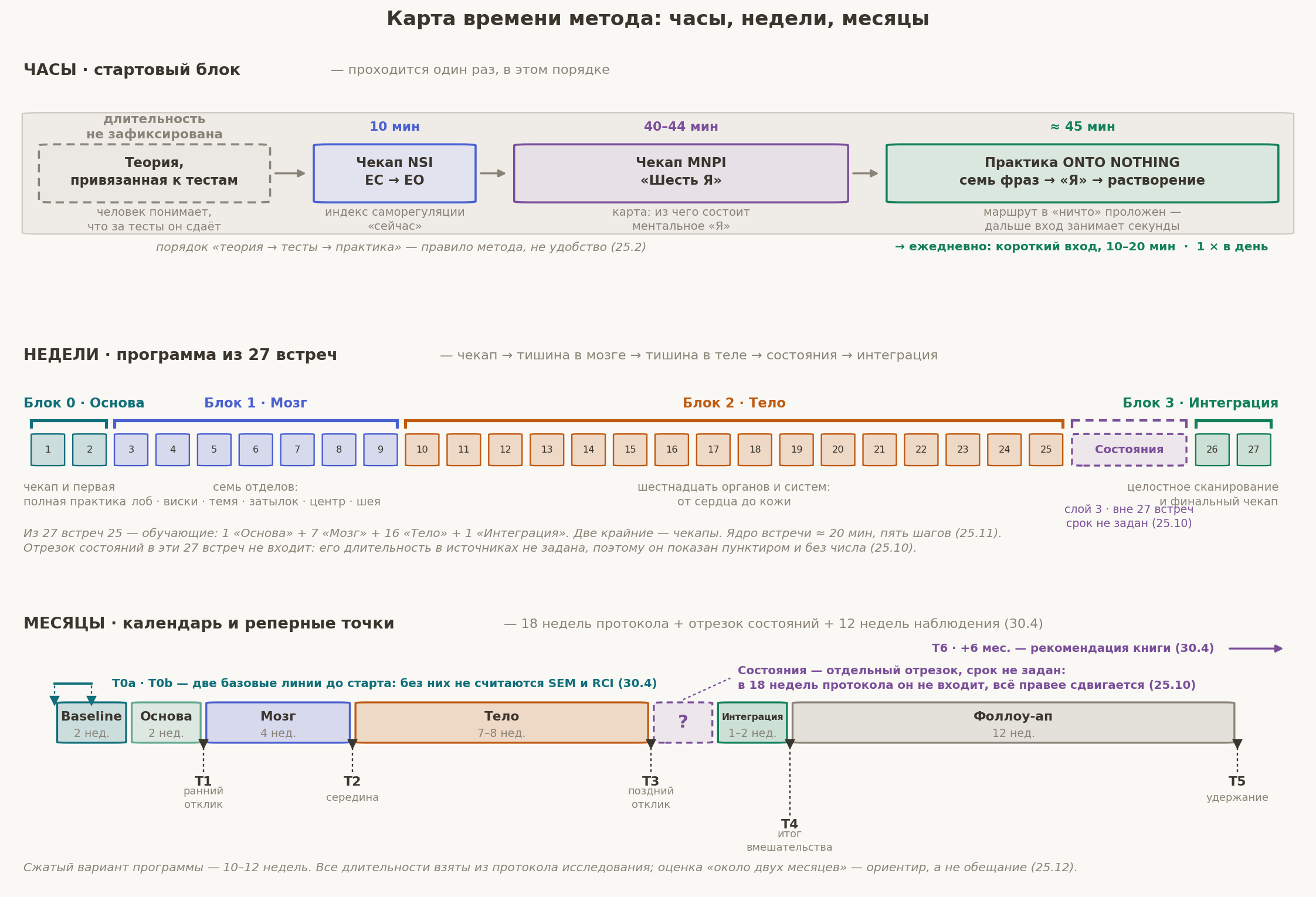
25.2. An order that cannot be rearranged: theory → tests → practice#
🧭 Rule of method.A person does not enter practice as the first action. It goes through three steps, and their order is not an organizational convenience, but a condition for the result:
- Theory tied to tests.A person must understandwhat kind of tests does he take?: what exactly is being measured, what the result means and what the result does not mean.
- Tests.He rents them out. The result is not an assessment or a diagnosis, butmap: what his mental “I” consists of.
- Practice.Only after that. The full ONTO NOTHING procedure works not with abstraction, but with exactly the material that a person has seen and named by that moment.
📖 Why is this so, in the words of the source.The practice is described in the working materials as “the annihilation of the mental self - the very memeplexes that you unloaded and saw at the previous stages.” The order here is built into the definition itself: you can only dissolve what was previously laid out and identified.
⚠️ What breaks when rearranged.If a person enters the practice before unloading, the fourth stage (21.15, unloading by age strata) remains without content: he visualizes the image of “I”, but there is nothing to fill it with - he still does not know what this image is made of. In this case, the procedure is externally performed completely, but there is nothing for it to work with. If a person takes tests without passing the theory, something else happens: the result is read as a score (“I have 62 out of 100”), and not as a map, and the very first consequence becomes exactly the overclaim that Section 27.17 prohibits—“my neuroplasticity was measured.”
🧭 Connection with the architecture of the book.This order is not a new requirement, but the name of what is already called a sequence of layers in Chapter 11: Stage 0 (Baseline, Chapter 12) and Layer 0 (Semantics, Chapters 13–15) gotolayer 1. This chapter adds two things to this that were not there: the specific composition of the starting block test battery (25.4–25.5) and the time that each part of it takes.
25.3. Step 1 - theory: what a person should understand before taking the tests#
🧭 The theoretical block starts the program and has exactly one task: to ensure that the checkup results are read correctly. The minimum composition is four points.
The first is what is being measured.What's happenedNSIand what isMNPI, how an index differs from a separate indicator, why indices are collapsed by a geometric mean, and not by a sum (27.9), and why one measurement gives the ability “now”, and plasticity is visible only from a series of measurements (27.14, 27.17).
The second is what the mental “I” consists of.Six constructs that are used for unloading: conscious, irrational, role, historical, projective, existential (25.5). This is the very answer to the question “what are we going to dissolve?” without which the third step turns into an exercise.
The third is the boundary of statements.What can and cannot be said based on the checkup results. The division is fixed rigidly and is given to the participant in the same form:
| ✅ You can say | ❌ Can't say |
|---|---|
“your self-regulation index is now:NSI = N/100» |
“we measured your neuroplasticity” |
| “that’s how you enter into peace and hold it with your eyes open.” | «NSI- this is your plasticity" |
| “We will see growth based on a series of measurements - this will be a marker of plasticity” | absolute plasticity from one checkup |
Fourth, what happens to the data.What is recorded, where it is stored, who has access, how consent is revoked. Requirements - Chapters 19 and 31; All that matters here is that this conversation is happeningtofirst entry, not after.
✍️ [To the author - add]:duration of the theoretical block and its form - live meeting, recording or text; who leads it; Is there a test of mastery before admission to check-in? These parameters are not recorded in the sources, therefore in the summary table of section 25.15 the theoretical block is without a number.
25.4. Step 2, test one - checkupNSI: 10 minutes#
📖 Quick screening using the classical paradigm of EEG reactivity: when the eyes are closed, relaxation increases, when the eyes are opened it decreases (alpha blocking). According to the form of this transition it is consideredNSI- how much a person knows how to enter peace, maintain it and maintain it with open eyes.
| Phase | Condition | Duration | What does a person do |
|---|---|---|---|
| EC | eyes closed | 5 min | calmly relaxes, does nothing |
| transition | opens eyes on cue | t = 5:00 |
the moment is precisely marked in time |
| EO | eyes are open | 5 min | tries to maintain calm, soft gaze at one point |
🧭 Conditions required for comparability of measurements:same time of day, same device, same seating and lighting, quiet room; without caffeine and nicotine in ~2 hours; sleep and stress are recorded as covariates; the minute of eye opening is excluded from both phases as a transient artifact.
⚠️ Recording quality requirements:no less80% valid minutes in each phase, otherwiseNSIis not issued and re-measurement is suggested. Control - cross-validation: the contrast EC→EO should be reproduced in both the relaxation index and alpha; if not, the measurement is suspicious for an artifact.
⚠️ Honest design limitation.With two phases without a separate pre-base, depth and stabilitynot independent: RgR = 1 / (1 + Dp_rel)- this is one knowledge from two perspectives. This means that from 5 + 5 it is impossible to say “deep, but did not hold it.” The upgrade that removes the limitation is known and costs one or two minutes: protocolEO → EC → EOwith a short pre-base with open eyes. Until then, checkup is interpreted asreactivity screening, not as a full profile.
🧭 What does this test give to a person?One number and one picture: a ten-minute transition curve with marked levelsL_ecAndL_eo, entrance slope and hold bar. Calculation model - section 27; here, only the place of the test in time is important: it is the first because it is short, reproducible and suitable as a repeatable “ruler” at all reference points.
25.5. Step 2, test two - checkupMNPI"Six Me": 40–44 minutes#
🧭 The second check answers the question for which he stands before practice:what does the mental “I” consist of?. The six constructs are grouped into three blocks of two, and after each block there is a silence mode corresponding to the type of load just raised. Unloading everywhere from the first person, in a stream; questions are presented as a single block, the person answers everything at once.
| Tact | What's happening | Time |
|---|---|---|
| Introduction | rule: talk without stopping | ~2 min |
| Block A - cognitive | Self 1 Conscious | 3 min stream |
| Self 2 Irrational | 3 min stream | |
| ↓ mode 1, ONTO NOTHING - EEG 1 | 6 min | |
| Block B - social-physical | I 3 Role-playing | 3 min stream |
| I·4 Historical | 3 min stream | |
| ↓ mode 2, ONTO VISCERAL - EEG 2 | 6 min | |
| Block B - existential | I 5 Projective | 3 min stream |
| Self 6 Existential | 3 min stream | |
| ↓ mode 3, ONTO GENESIS - EEG 3 | 10 min | |
| Return | one question to go | ~1 min |
📖 Transitions are specified in one phrase and without pause.After block A: “Everything that was is already there. Now there is silence.” After block B: “History has been told. The body knows the rest." After block B: “Everything has been said.” The sharpness of the transition here is functional: it is measuredswitching, and any blurred border devalues the measurement.
📖 Logic of three EEG measurements.EEG 1 is taken after a purely cognitive load - this is a basic switch without emotional weight, a starting point. EEG 2 - after socio-historical material with moderate limbic load: comparison with the first shows how the body under load affects the speed of switching. EEG 3 - after maximum existential load: how deep the brain is able to go into depth after everything has been lifted. Three points do not give three separate values, butcurve: how the speed and depth of switching changes as emotional stress increases. This curve cannot be obtained with just one measurement.
🧭 The solution is one question:“What do you know about yourself now that you didn’t know an hour ago?” The answer is one word or image, recorded.
🧭 Why is it worth it here?Six constructs are the operationalization of the “mental self”: not a philosophical concept, but six blocks of material, each with its own recording time and its own type of load. A person who has passed this checkup enters the practice, having already named out loud what he has to dissolve. The connection with the semantic layer is direct: chapters 13–15 require differentiation of units of meaning to neurotechnology, and this check is its procedural form.
⚠️ Limitation.The material of this check is self-report, and it carries everything that is inherent in self-report: the effect of social desirability, differences in verbal fluency, dependence on the state on the day of recording. It is valuable as a map and as a load before measuring the EEG, but is not a measurement in itself. The measurement here is three blocks of EEG, not six blocks of speech.
25.6. Step 3 - ONTO NOTHING practice: once, about forty-five minutes#
🧭 The complete phrase procedure is completed once.This is the rule of the method, and it removes the main misunderstanding around the protocol of Chapter 21: seven five-minute phrases, unloading by age strata and dissolution of the “I” - thistraining procedure, not a form that needs to be done daily. One pass, from the first phrase to the “click” of silence.
| Part of the procedure | Time | Chapter |
|---|---|---|
| Seven phrases, 5 minutes each | 35 min | 21.5–21.12 |
| Visualization of “I” and uploading by age strata | inside the last step | 21.14, 21.15 |
| Compression to a point and dissolution | ~10 min | 21.14 |
| Skill Check: Eyes Closed → Eyes Open | enters the exit | 21.20 |
| Total | ~45 min |
🧭 Why is once enough?The goal of the procedure is not to “stay in silence for forty-five minutes,” butget directions: show the body and attention exactly how the transition occurs. After the route has been completed and the entrance has been reproduced with open eyes (21.20), there is no need to repeat it in its entirety - then a short entrance works, which takes seconds and does not require any phrases or unloading. The wording of the source is direct: “Now a person does not depend on practice - he can stop thoughts in any situation... A mantra is not needed. No meditation needed. It’s enough just to switch to this state.”
🧭 What is repeated and what is not.The full procedure is not repeated: seven phrases, unloading, dissolving. A short entry into the state and transfer of this state to zones, organs and activities are repeated - this is what all other meetings of the program are devoted to (25.9). In other words, chapter 21 describesdoor, not a room; The door is opened once.
🔬 The verifiable form of this statement.“One pass is enough” is not rhetoric, but a hypothesis with an observable criterion, and the criterion is already in the book: whether the entrance is reproduced with open eyes (21.20). Formally: the proportion of participants whose eyes-open entry is reproduced in the next meeting after a single complete pass. If this share is high, the rule is confirmed; if not, the rule requires clarification by subgroups, and the first candidate subgroup is named in the next section.
⚠️ What this rule does not cancel.Repetition refers to the procedure of phrases, not to practice in general. Daily short practice remains (25.8), program meetings remain (25.9), check-ups are repeated at reference points (25.12). The rule removes exactly one thing: the obligation to go through the forty-five-minute protocol every time.
25.7. Age: the only reason to undergo the full procedure more than once#
🧭 The exception to the one-time rule is age.For an older person, it makes sense to go through the full procedure several times. The basis formulated by the author: the older a person is, the more he hasthoughts in my head- the denser and more stable the material collected over a lifetime, and the more strongly this affects the final result of one pass.
📖 The same idea is in the working materials of the method.“The older a person is, the more stable the memeplexes collected over his life. They last longer, are more tightly woven, and have more weight. Annihilation is possible at any age, butdepth and dynamics will be different" The illustration given by the source: the same person who completed ONTO NOTHING at 18 years old and at 45–50 years old results in two different results.
🧭 How does this affect the procedure?It is not the content of the procedure that changes, but the number of passes: the same sequence of phrases, the same unloading, the same dissolution - but not just once, but several times, at intervals. The age layers of unloading (21.15) work in favor of the rule: the older person has all five layers filled, and not all of the material has time to be laid out in one pass.
⚠️ Age here is not a biography, but the density of the material.Section 21.15 already captures this distinction for the discharge layers: the fifth layer is explicitly labeled "at any age". The same is true here: the basis for a repeat pass is the volume and coherence of the self-narrative, and not the number in the passport. In practice, this means that the decision is made by person, not by date of birth - a thirty-year-old with a dense, detailed self-description may be closer to "several passages" than a fifty-year-old with a sparse one.
✍️ [To the author - add]: age threshold(at what age does the conversation about multiple passes even begin),number of passesAndinterval between them, as well as a sign by which you decide on the spot that one pass was not enough. These numbers are not in any document in the sources, and the book does not print numbers that are not in the sources. This is probably the most practically important omission of the entire chapter: without it, rule 25.6 applies, but exception 25.7 does not.
🔬 How this is verified by data.The hypothesis is formulated in terms of Chapter 27 and is refutable: afteronefull passage gainΔMNPInegatively associated with age, and afterseveralpassages this connection weakens or disappears. The test requires neither new equipment nor a new battery - only recording the number of passes in the log and age as a covariate. A separate disclaimer: section 27.26 already states that age and gender adjustments are not included anywhere in the index model today, despite the fact thatIAFand HRV depend strongly on age (27.27 and 28.2). While these corrections are not available, part of the age effect isΔMNPIwill be instrumental, not methodological, and it is impossible to distinguish them without corrections.
⚠️ Restriction of the opposite property.The lower limit is set not by the density of the material, but by safety: the strictest age limit in the book is a relative contraindication for mode 3 (18.7), where children are allowed only from 12–14 years old and with a duration of 10–15 minutes. General admission criteria - Chapter 19 and Section 18.16. The “older - more passages” rule does not apply to children and adolescents in any form.
25.8. What is done daily after a single pass#
📖 Home dose specified by study protocol:once a day, 10–20 minutes. This is a short entry into the state and retention, and not a repetition of the phrase procedure.
🧭 Daily task in the programconsists of two parts: an audio practice and a short practice with an emphasis on one area or skill - the one that was discussed at the last meeting. This way, homework turns out to be a direct continuation of the meeting, and not a separate exercise.
📖 How often is not self-evident, and the data shows this.The case study in Chapter 31 provides the first empirical observation about frequency: intervals of 2–3 days appear optimal in the early stages, and once the relaxation index is consistently above ≈ 3.0, daily practice becomes reinforcing rather than depleting. There is also a phase recorded where daily classesworsenedmetrics—and this is the most valuable piece of the case because it goes against the “bigger is better” expectation.
🔬 In terms of Chapter 27, this is a hypothesis aboutchange of sign of dose dependence: before the threshold and after the threshold, the same frequency of practice gives a different effect. Checked forn= 1 with repeated measurements—the same interrupted time series apparatus that Chapter 28 applies to the 8+8 protocol.
⚠️ One observation on one person is not a basis for a recommendation. Until this dependence is reproduced, the daily dose remains what the protocol specified: 1 × per day, 10–20 minutes, with the right to reduce the frequency if indicators worsen.
25.9. Twenty-seven meetings: block program#
🧭 Program logic in one line:check-up → mastering silence → transferring silence across parts of the brain → transferring silence to every organ of the body → states → integration. Each meeting is a separate session with its own purpose; the segment of states of 27 meetings is not included and is analyzed separately (25.10).
| Block | Meetings | What is being mastered |
|---|---|---|
| 0. Start | 1–2 | check of the initial state; first practice ONTO NOTHING |
| 1. Silence in the brain | 3–9 | silence as a state; frontal lobe; temporal; parietal; occipital; brain center; cervical region |
| 2. Body by organs | 10–25 | heart, lungs, intestines; spinal cord and spine, muscles; liver, gall bladder, stomach, pancreas, spleen, kidneys, bladder; adrenal glands, thyroid; reproductive organs, skin |
| States segment | outside 27 meetings | modes 3–7 - ATS, OP, FP, TIS, TFS; separate segment after the body (25.10) |
| 3. Integration | 26–27 | whole body scan; final checkup |
🧭 Internal structure of the second blockis not random and is read along four axes: the central axis (heart, lungs, intestines), the structural basis (spine, muscles), metabolism and filtration (liver - bladder), endocrine regulation (adrenal glands, thyroid), reproduction and the border of the body (reproductive organs, skin). The sixteen meetings of this block are more than half the program, and this is a direct consequence of the architecture: layer 2 in Chapter 17 is set as the most voluminous.
📖 Two independent method documents give the same number.The meeting framework contains 27 sessions, two of which are check-ins (the first and last). The scientific protocol of the longitudinal pilot lists25 training meetings: “Base” - 1, “Brain” - 7, “Body” - 16, “Integration” - 1. This is exactly 27 − 2. The coincidence of the decomposition, and not just the result, is a rare case in the materials of the method, and you can rely on it.
⚠️ Discrepancy in the timing of the “Brain” block.The author’s estimate, given in earlier materials, is about a week to master working with brain zones. The scientific protocol calendar is allocated to the same blockfour weeks. Numbers are incompatible if we assume that they are about the same thing; the book reads them as different statements: a week is the period for whichreceptionbecomes feasible, four weeks is the deadlineseven meetingsblock with fastening between them. At two meetings per week, seven meetings give approximately four weeks, so the second figure is internally consistent with the framework.
✍️ [To the author - confirm]read this or give your own - and at the same time record itfrequency of meetings(how many times a week), which is not directly named in any document and is now counted backwards from the calendar.
25.10. States: separate segment after the body#
🧭 Entire method order.First, mental preparation: removing excess self-narrative and unloading representations (Baseline and layer 0). Then the first neurotechnology: the complete ONTO NOTHING procedure, in which the mental "I" is collected and annihilated (25.6). Then - work with the brain and its parts. Then - work with the body and its organs. And only after that -access to transcendental states. This last segment is neither a continuation of work with the body nor part of integration: it islayer 3architecture of Chapter 11, and it is based onseparate timeafter the body is worked out.
🧭 Why does he stand after the body?The mode transition route (18.19) answers this directly:
DMN → (close eyes, stop thoughts) → MPE → V-MPE → ATS
                                            ↓ (open your eyes)
                                    OP → FP → TIS / TFS
The “Brain” block is the development of mode 1 (MPE, pure nothingness), the “Body” block is the development of mode 2 (V-MPE, visceral nothingness). That is, twenty-five training meetings bring a person exactly to the second position of the route. Everything further along the route—modes 3–7—begins where the body ends and is not included in the program of 27 meetings. The same is repeated by the dosing rule (18.16):a beginner does not enter modes 3 and 6 without first becoming stable in 1, 2 and 4.
⚠️ Why is this section difficult?Three reasons, and all three are already recorded in Chapter 18.
The first is depth.Modes 3 (ATS) and 6 (TIS) are theta-dominant, and according to the theta rhythm they are adjacent to two non-target states: drowsiness and “dry nothingness” (18.5). Instrumentation of ATS and TIS with each otherindistinguishable, and it is possible to distinguish the target mode from the non-target mode only by the second channel - falsifying rule 18.12: theta increases, and HRV falls → this is not the target mode.
The second is permission.Mode 3 is marked as requiring separate approval, with absolute contraindications:epilepsy, recent TBI, active psychosis, mania(18.16). For mode 6 - active psychosis and mania. The admission criteria themselves are not specified in the sources.
Third, there are almost no login protocols.Of the eight modes, exactly one has a complete login protocol - the first (18.19). On this segment:
| Mode | What is being mastered | Login Protocol (18.19) |
|---|---|---|
| 3 · ATS — ONTO GENESIS | eyes closed, theta dominant; working with memory reconsolidation | ❌ no; in addition - a separate permit (18.16) |
| 4 · OP — ONTO PRESENCE | eyes open; bringing silence into action | ❌ no |
| 5 · FP — ONTO FOCUS | effortless focus on the task | 🔬 fragmentary: the symptom is described, but not the procedure |
| 6 · TIS — ONTO INSIGHT | eyes open, theta dominant; insights | 🔬 fragmentary: the conditions for appearance are described, but not the entrance |
| 7 · TFS — ONTO ENGAGE | holistic flow in activity | ❌ no |
🧭 The route and the order of exploration are not the same thing.Route 18.19 says,through whatpasses the entrance to each mode; dosing rule 18.16 says,in what ordermodes are being mastered. Along the route, ATS is located immediately behind V-MPE, but according to the dosing rule, stability in mode 4 is first needed. This means that within the segment, mode 4 is mastered first, and only then theta modes 3 and 6 are opened. The place of modes 5 and 7 in this order is not specified.
⚠️ Discrepancy: this segment is not in the meeting frame or in the calendar.The framework of 27 meetings ends with the body and integration, and the calendar of the scientific protocol (25.12) consists of the blocks “Base”, “Brain”, “Body”, “Integration” - there is no separate segment of states in either. The book reads this as an incomplete schedule, not as the absence of a stage: the stage is given by the architecture (chapter 11) and the route (18.19), but no one put it in time. From here there are three consequences for all terms of this chapter:
- eighteen weeksis the duration of the programwithoutstate segment;
- full duration of the method = eighteen weeksplusthis segment, the duration of which is not specified in the sources;
- in Fig. 25.1 the segment is shown with a dotted line and without a number, and in the summary table (25.15) it appears without duration.
🧭 Integration does not replace it.Meetings 26–27 – full body scan and final check-upT4— close the program and relate to the body, not to the states. The segment of states goes after the body and before this closure; the final checkup thereby measures the result already with it, and not before it.
✍️ [To the author - add]:
- Length of segment- how many meetings and how many weeks are planned for it. This is the only number that is missing for the method to no longer be incomplete.
- The procedure for mastering modes 3–7inside the segment, including the place of modes 5 and 7.
- Criteria for admission to theta modes 3 and 6— which shows that stability in modes 1, 2 and 4 has been achieved.
- Sign of readiness for cutting- which shows that the body has been worked out enough to move on to states.
25.11. One encounter from within: a single five-step arc#
📖 All training meetings, regardless of the goal - brain lobe, organ or integration - follow the same arc:
| Step | What's happening | Time |
|---|---|---|
| 1 | landing, posture, setting | 2 min |
| 2 | silence induction | 3 min |
| 3 | transferring silence to the purpose of the meeting | 8–12 min |
| 4 | integration | 2–3 min |
| 5 | log: what happened, how it ended | 1 min |
🧭 Content part - third step, and only it changes from meeting to meeting. The first two are a short entry, the same one that replaced the full procedure after a single pass (25.6). The fifth step is not a formality: without a recording, the meeting is not included in the data, which means it did not exist for the study (23.2).
📖 What is written in the journal for each session(26.9): start time, ONTO mode by chapter number 18, eyes open or closed, posture, subjective depth rating 0–10, breathing rate by separate field. Chest strap - from start to finish, including three minutes before and three minutes after.
⚠️ A session without a chest strap provides only class II data and only on the daily horizon (26.3). This is not a quibble with the design: without a belt, a statement of what has changedin the session itself, not defensible.
25.12. Eighteen weeks: calendar and reference points#
📖 Scientific protocol calendar:
| Segment | Duration | What's in the end |
|---|---|---|
| Baseline | 2 weeks | T0aAndT0b- two baselines |
| Block "Base" | 2 weeks | T1- early response |
| Block "Brain" | 4 weeks | T2- middle |
| Block "Body" | 7–8 weeks | T3- late response |
| States segment | not specified in sources | — (25.10) |
| Block "Integration" | 1–2 weeks | T4- outcome of the intervention |
| Follow-up | +12 weeks | T5- retention |
📖 Total approx.eighteen weeks program plus twelve weeks of observation. The compressed version of the program is 10–12 weeks. These eighteen weeks are countedwithout state segment: its duration is not specified in the sources, and everything that stands to the right of the “Body” block (25.10) is shifted to it. A complete description of reference points and why they are neededtwobaselines instead of one, - section 30.4; the book also recommends addingT6for +6 months, otherwise horizonU3(27.23.1) is not covered by anything.
🧭 What is filmed at each reference point.The EEG block follows a fixed order: eyes closed 5 minutes → eyes open 5 minutes → recording during practice 10–12 minutes → rest after 5 minutes. The first two phases are exactly a check-inNSIfrom Section 25.4, which is why it is chosen as the starting test: the same procedure works both as a first introduction and as a repeated ruler on all seven points.
⚠️ Estimated “about two months for full results”, which is found in earlier materials, is almost half as long as the protocol eighteen weeks. The book presents it asa guideline, not a promise: actual deadlines are individual, subject to measurement, and that is why there are seven points in the protocol, not two.
25.13. Where did these terms come from?#
📖 The duration of the program was not chosen arbitrarily - in the protocol it is justified by three independent lines:
Intervention threshold.Programs such as MBSR, which have a core evidence base, last at least eight weeks; shorter interventions systematically produce weaker and less reproducible effects. Hence the requirement: active phase -at least 8 weeks.
Skill automation.According to Lally et al. (2010), the formation of automatic behavior takes on average about66 dayswith very wide variation between individuals. This is a guideline for the length of the entire program, not for an individual block.
Dosage per target.For each new target of transfer - a brain area or organ - the protocol lays down5–7 days of daily practice. With sixteen organs in the second block, this gives seven to eight weeks.
🧭 Three lines converge: eight weeks as the lower limit, sixty-six days as the average automation, five to seven days per goal as a step - together they give eighteen weeks, not eight and not forty.
⚠️ All three landmarks are external. None of them have been verifiedon this method: the scatter in Lally’s work is huge, the MBSR threshold was obtained in other practice, and the “5-7 days per goal” norm in the method sources has no measurement behind it at all. The timing in this chapter is a construct collected from literature and practice, and it is subject to verification in exactly the same way as everything else.
25.14. Work formats and lifestyle#
🧭 Formats:
- Individually with EEG— the practitioner observes the electrophysiology and provides feedback in real time.
- Group— group practices using the author’s technology and narrative; It is separately noted that with people who already know how to stop internal dialogue, work proceeds differently than with beginners.
🧭 Lifestyle as part of the method:sleep, routine, introspection; fitness trackers to monitor factors that interfere with sustainable “good” rhythms. Minimum diary - one line per day: sleep time, alcohol, illness, intense exercise, caffeine after 16:00 (26.9). This is not a disciplinary requirement, but a condition of interpretability: without these marks, night HRV is not readable, because any of them shifts it more than practice.
⚠️ Seven nights of continuous recording before the first session- the minimum without which there is no baseline. Nighttime indicators are averaged over a seven-day rolling window; single nights are not interpreted.
25.15. Pivot table: what, when and how many times#
| Procedure | Duration | When | How many times |
|---|---|---|---|
| Theoretical block | ✍️ not recorded | before check-ups | once |
CheckupNSI (EC→EO) |
10 min | start and each reference point | 7 times (T0a…T5 + T6, if added) |
CheckupMNPI"Six I" |
40–44 min | Baseline and summary points | according to the scheme of chapter 30 |
| Complete practice ONTO NOTHING | ~45 min | after checkups, meeting 2 | once; at an older age - several (25.7) |
| Short entry | seconds - minutes | further everywhere as the beginning of any session | constantly |
| Home practice | 10–20 min | daily | 1× per day |
| Training meeting | ~20 min core (5 steps) | according to the block calendar | 25 training meetings |
| States segment | ✍️ not recorded | after the “Body” block | one pass (25.10) |
| Entire program | ~18 weeks without condition period | — | one pass |
| Follow-up | +12 weeks | afterT4 |
toT5(AndT6, if added) |
25.16. What remains to be written about this chapter?#
✍️ [To the author - add]:
- Age threshold, number of passes and interval between them(25.7) - priority above other points: without these numbers, the exception to the one-time rule is not applicable.
- Duration of the state segment(25.10) - how many meetings and weeks are planned for modes 3–7 after the body; Without this number, the total duration of the method remains incomplete.
- Duration and form of the theoretical block(25.3), including who conducts it and whether there is a check of mastery before admission to check-in.
- Frequency of meetings- how many times a week; Now it is counted down from the calendar, rather than set.
- Live meeting scenarios: What is said out loud in each of the twenty-five training meetings. The arc of five steps (25.11) defines the form, but not the content, of the third step.
- Regulations for the EEG session and group format- what exactly does the practitioner do while looking at the screen, and how the same is done in a group without equipment.
- Sign “ready for next block”— why the decision is made to move from the brain to the body and from the body to integration: according to the calendar, according to an indicator or according to the observation of a practitioner.
Part VIII. Measurement and Evidence#
Up to this point the book describedWhatis being done. This part is about how to check that it works: what is measured and with what (Chapter 26), what indices the method builds on top of the measurements (Chapter 27), what changes over weeks and months (Chapter 28), how the platform both helps and hinders the research (Chapter 29), how the correct verification design works (Chapter 30) and what has actually been accumulated to date (Chapter 31).
26. What and how we measure#
26.1. Four groups of measurements#
🧭 The construction method is measurable - this is its strong point. Measurements are divided into groups:
- EEG (brain).Three key parameters of the beta→alpha transition:speed(mode change latency),depth(alpha power relative to individual norm/IAF) andretention(time of stable stay in the state). Additionally - alpha/theta power relativeindividual alpha frequency (IAF); always record conditions (eyes open/closed), editing, cutting off artifacts (EMG/EOG). This is where the thesis “improvement by approximately 2 times” (speed/depth/retention) is operationalized.
- HRV (heart/vegetative).RMSSD, HF-power, etc. - as an index of self-regulation (the most evidence-based objective outcome, Chapter 10). Detailed analysis - sections 26.2–26.9.
- Questionnaires (psyche/interoception).For example,MAIA-2(interoceptive awareness), mood/anxiety screeners (PHQ-9, GAD-7) and other valid scales.
- Advanced biomarkers.The author mentions 60–70 indicators “from physiology to clinical tests.”
🔬 Separately - indicators by modes.The ONTO system (Chapter 18) sets for each mode its own set of guidelines: OP_Index and OI for mode 4, crossover criterion for mode 3, HEP and SMR integrity for mode 2, Fz-Pz coherence and microstate fraction D for mode 1, theta/alpha and theta-gamma coupling for mode 6, Engagement Index for mode 7.All composite indices are proprietary, non-standardized(Section 18.15). They are included in the measurement protocol asexploration indicators, subject to validation, and not as ready-made criteria for success. The physical equivalent of this card is section 18.18.
📖/⚠️ It is important to know about 60–70 biomarkers.A large number of simultaneously measured indicators createsmultiple comparison problem: Some of the “significant” results will appear by chance. Therefore, in research design these indicators are interpreted asexploratory (hypothesis-generating), adjusted for multiplicity, while for confirmatory inference it is chosen1 primary hypothesis and 1–2 primary outcomes(Chapter 30).
26.2. Two devices, two horizons#
🧭 EEG headset and wearable device (bracelet, watch, ring, chest strap) respondto various questions. This is not a “precise versus approximate” hierarchy or an acknowledgment of the weaknesses of wearables. Thisdivision of construction tasks: each device covers its entire horizon, and none can cover someone else’s.
The EEG answers the question “what is happening right now” - and within the session this is enough.She sees the moment of transition beta → alpha, the depth of alpha, disruptions of attention, the duration of the plateau. Its horizon is seconds and minutes within the recording. All five dynamic method primitives (Sp, Dp, Mn, Rc, Sb, section 27.7) are consideredonly by EEG; Neither the NSI nor the four subindices of the MNPI require a single wearable device for calculation. The data needed to evaluate the session is already in the standard download of the device - it is sorted into columns in sections 27.21–27.22. The wearable device in this window is not a “weak device.” It simply doesn't answer that question.
The wearable device answers the question “what happens to the body over weeks and months.”It sees not the state, buttrajectory: how the nocturnal autonomic balance shifts, what happens to the breathing rate during sleep, to the regularity of sleep, to the resting pulse - not after one session, but over the course. Its horizon is nights, weeks and months, and it is there that something appears that is not visible at all in the session: after a month of practice, the indicators become different, not because “the session was a success,” but because the very base in relation to which we read them has shifted (section 28.2).
📖 The separation of horizons is not a methodological agreement, but a consequence of the physics of measurement. The time resolution of the methods differs by orders of magnitude: a correct estimate of RMSSD requiresminimum 5 minute window(in ultrashort versions - no shorter than 1 minute), HF power - no less than 1 minute, LF power - no less than 2 minutes (Shaffer & Ginsberg, 2017). EEG works with windows of 1–4 seconds. A wearable device cannot physically “see” the beta→alpha transition, which lasts 40 seconds; this transition is entirely contained within one HRV count.
⚠️ Hence the rule of symmetrical caution.Each device speaks only within its own window, and here you can make a mistake in both directions.
Wrist tracker or ringdon't see the session. A statement like “during practice, HRV increased according to the ring data” is technically impossible: the ring at this moment does not calculate HRV second by second, and if it does, it does so with an error exceeding the expected effect. The only wearable device that allowsthe session itself, — ECG chest strap(see 26.4).
But the converse statement is also untenable: EEGhasn't seen for a month. A statement like “once in a session alpha doubled, which means after three months the person became more stable” is not a conclusion, but an extrapolation beyond the window of the device. Intra-session shift and long-term realignment are two different quantities that are inconsistent across studies (horizon gap hypothesis, Section 28.5).
🧭 Separation of concerns in a method:
| Question of method | Device | Window | What does it give? |
|---|---|---|---|
| State transition rate | EEG | 1–4 s | Latency beta→alpha |
| Depth of state | EEG | 4–30 s | Alpha power to IAF |
| Intra-session retention | EEG + chest strap | 30 s – 20 min | Proportion of time in mode; RMSSD plateau |
| Physiological cost of the condition | Chest strap | 1–5 min | Heart rate, RMSSD, respiratory rate |
| Retention between sessions | Ring/bracelet/watch | Night | Night HRV, resting heart rate, temperature |
| Skill Durability | Ring/bracelet/watch | Weeks–months | Change in trend slope, not difference between two points |
| Coverage of body systems | Ring/bracelet/watch | Weeks–months | Breathing during sleep, sleep regularity, temperature, resting heart rate |
The method closes the first four lines today - with the device it has and the data it is already uploading. The last three lines are what the wearable device is introduced into the protocol for, and what Chapter 28 examines separately.
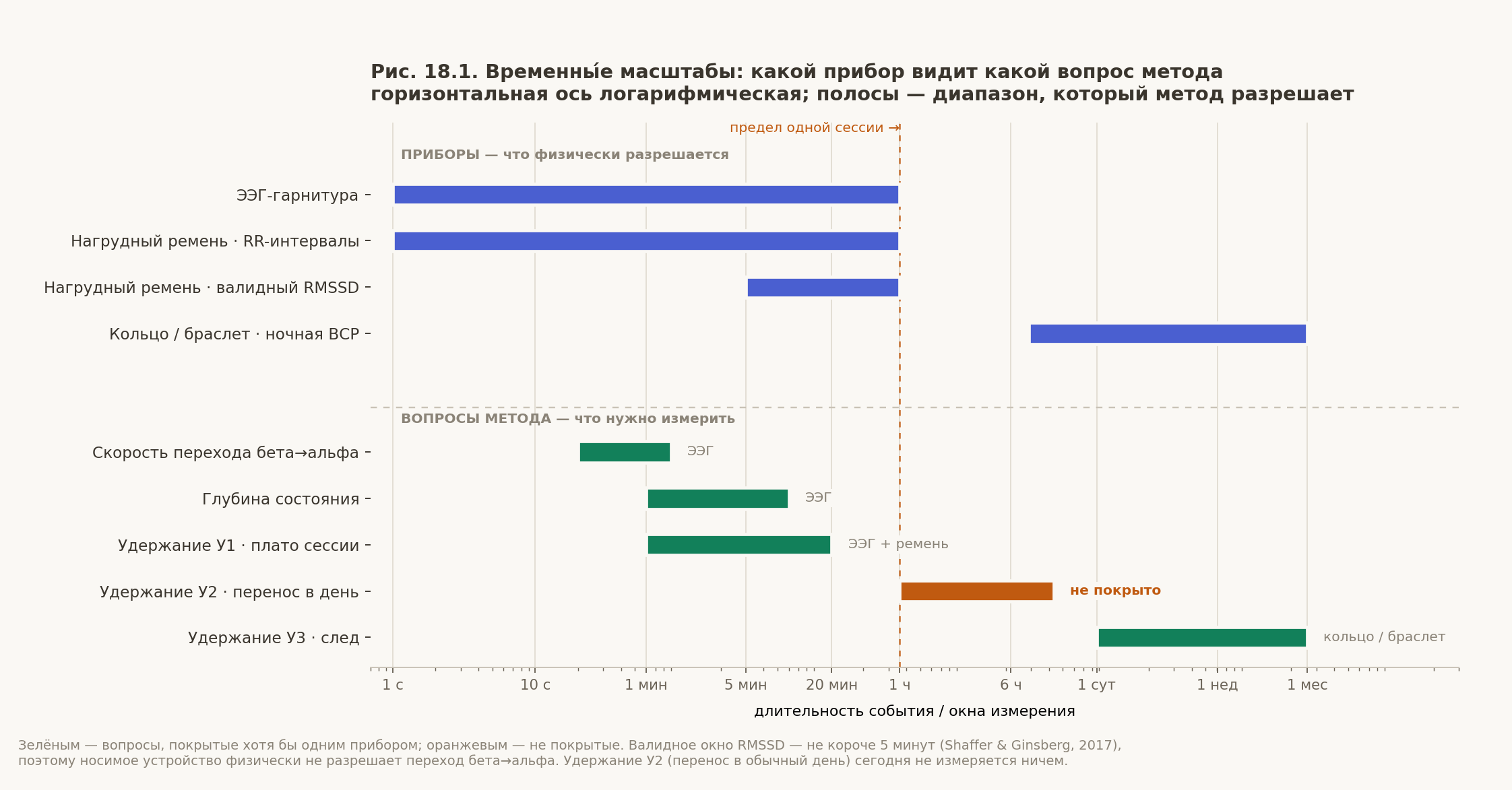
🔬 The key hypothesis of the method in this framework.If the claim of an “approximately twofold” improvement refers tospeed, depth and retention, then the first two parameters are checked completely by the EEG, and the third -on three horizons(section 27.23): intrasession retention (EEG), post-session carryover (eyes-open EEG and chest strap), and weeks-long trace (wearable device). The first two horizons are closed instrumentally. The third one is not.
🔬 And the second hypothesis, for the sake of which a long horizon is generally needed.The method assumes that over the course of months it affectsmore body systems than can be seen from the session: not only the cortical rhythm and heart rate at the moment, but also the breathing pattern, sleep structure, regulatory load. This is a claim, not a fact: part of it is confirmed by the available literature, part is refuted by it, and these parts have to be distinguished for each system separately. What exactly should change, in what week, in what system, how proven this has been in others - and how to distinguish a real shift from baseline drift - is sorted out inchapter 28.
26.3. What the wearable device actually measures: three reliability classes#
⚠️ The wearable device gives out dozens of numbers, and theyradically different quality. Mixing them into one table means jeopardizing the entire measurement protocol: one unverified composite can invalidate a conclusion based on ten reliable values. Therefore, the method sorts all available indicators bythree reliability classes.
Class I - directly measured, verifiable, comparable between instruments.Electrical signal of the heart and interbeat intervals derived from it. There is a reference (the clinical ECG), a published validation, and a clear unit of measurement. You can build only on class I indicatorsconfirmingstatements.
Class II - measured indirectly, depends on the manufacturer's model, but has been independently validated.Optical pulsometry (PPG) and everything that is derived from it: nighttime HRV, resting pulse, respiratory rate, SpO₂, skin temperature deviation, sleep/wake division. Numbers make senseinside one device and one person, but are not transferable between brands. Suitable for trackingspeakers, not for absolute statements.
Class III - proprietary composites with a closed algorithm.Body Battery, Recovery, Readiness, Stress Score, Sleep Score, WHOOP Age, Training Readiness. The formula has not been published, changes with firmware updates, is not reproducible and cannot be compared with anything.The method does not base any statements on class III indicators.They can be used as a “household thermometer” for the practitioner himself - and nothing more.
📖 Wearable Devices Scorecard
| Indicator | What is physically measured | Class | What can you say about it? |
|---|---|---|---|
| RR/NN intervals | Electrical heart signal (ECG strap) | I | Everything, including intra-session comparisons |
| Heart rate instant | ECG or PPG | I / II | Dynamics within person and device |
| RMSSD night | PPG, windows in a dream | II | Trend by week (one device!) |
| SDNN | PPG (Apple - opportunistic windows) | II | Trend; sensitive to window length |
| pNN50 | Derivative of RR | I / II | Like RMSSD, but less stable |
| LF / HF / LF-HF | RR spectrum | II | ⚠️ See 26.5 - interpretation controversial |
| Resting heart rate (RHR) | PPG at night | II | Trend; one of the most reliable class II |
| Respiration rate | PPG/accelerometer | II | Trend +required covariate (26.5) |
| SpO₂ | Reflection pulse oximetry | II | Only rough trends |
| Skin temperature (deviation) | Thermistor | II | Trend; highly dependent on the environment |
| Stages of sleep (4 phases) | PPG + accelerometer | II ⚠️ | Almost nothing (see 26.7) |
| Sleep/wake | Same | II | Total sleep time is acceptable |
| Steps, distance | Accelerometer | II | Rough activity estimate |
| Energy consumption | Manufacturer model | III | Nothing |
| VO₂max (estimate) | Model based on heart rate and pace | III | Nothing |
| ECG single lead | Electrodes on the body | I | Presence/absence of arrhythmia |
| Skin conductance (EDA) | Electrodes | II | Exploration |
| Pressure without cuff | PPG model | III ⚠️ | Nothing (see 26.8) |
| Body Battery / Recovery / Readiness | Closed formula | III | Nothing |
| Stress Score | Closed formula for HRV | III | Nothing |
| Sleep Score | Closed formula | III | Nothing |
| WHOOP Age / Healthspan | Composite of nine metrics | III | Nothing |
🧭 Method rule: Any NSI/MNPI formula (Chapter 27) includes only Class I and II indicators. Class III is never included - neither as a term, nor as a criterion for selecting participants, nor as “confirmation” in a case.
26.4. Accuracy: numbers, not promises#
📖 The accuracy of wearable devices has been measured independently and the results provide good expectations.
ECG chest strap.Polar H10 versus three-channel ECG on 60-second recordings while lying down:MAPE by RMSSD 2.16%, systematic bias 0.4 ± 1.9 ms, limits of agreement −3.3...4.0 ms, ICC 0.90 (Frontiers in Physiology, 2025). At rest, agreement of RR intervals with the standard r = 0.95, ICC 0.95, offset 0.1–0.2 ms (Sensors, 2022). For comparison: an application on a smartphone that records the pulse with a camera givesMAPE 17,49 %with limits of agreement −29.7...23.7 ms - that is, unsuitable.
Nocturnal HRV from wrist and finger.Largest comparison - 13 participants,536 nights, Polar H10 reference at 1000 Hz (Physiological Reports, 2025):
| Device | MAPE night RMSSD | MAPE nighttime resting heart rate |
|---|---|---|
| Oura Ring 4 | 5,96 % | 1,94 % |
| Oura Ring 3 | 7,15 % | 1,67 % |
| Whoop 4.0 | 8,17 % | 3,00 % |
| Garmin Fenix 6 | 10,52 % | — |
| Polar Grit X Pro | 16,32 % | 2,71 % |
📖 How to read it.Nighttime resting heart rate is measured perfectly (2-3% error). Night HRV is acceptable for rings (6–8%) and worse for watches (10–16%). The expected effect of an intervention on RMSSD is typically 5–15%—i.e.comparable to the instrument error. Hence there are two mandatory requirements: to average over at least 7 nights andnever compare people on different devices.
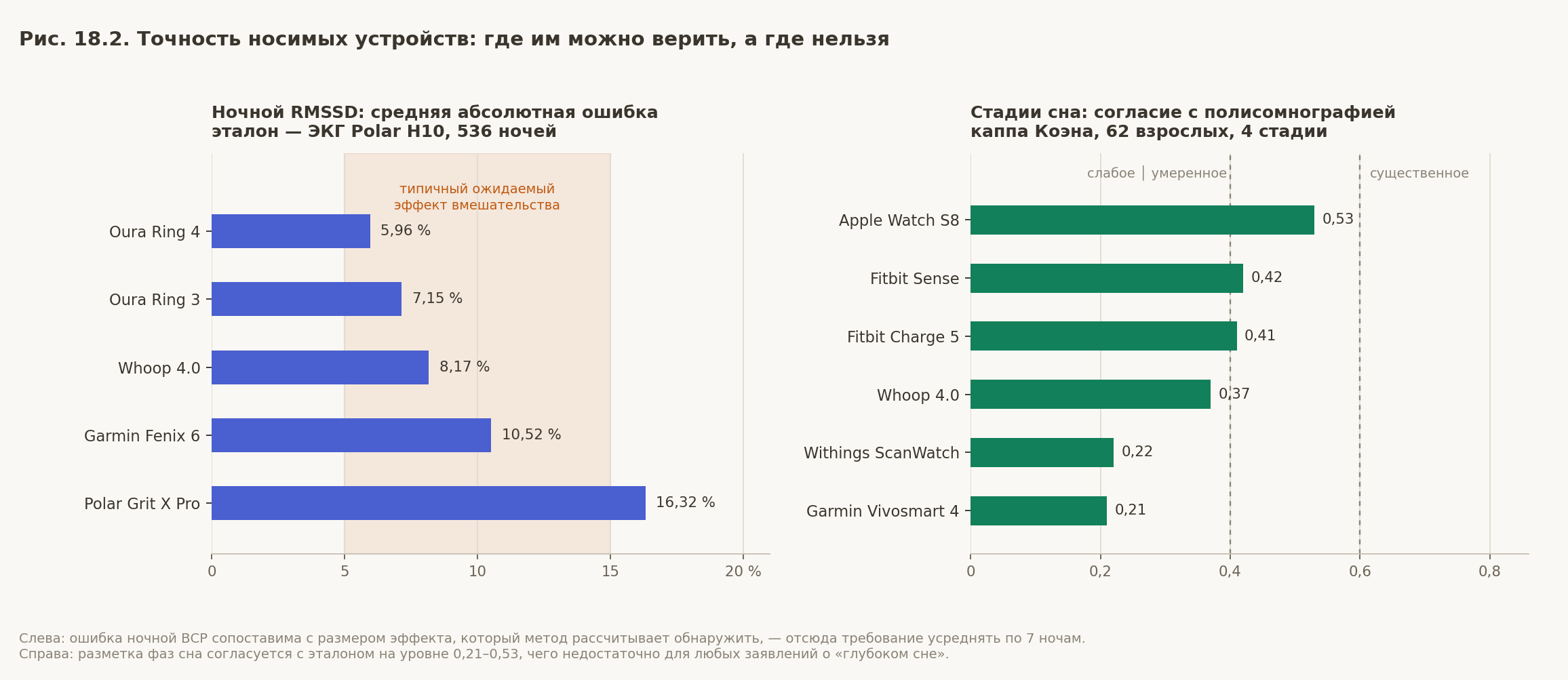
⚠️ The numbers of different brands are incomparable by definition, because each manufacturer calculates “HRV” in its own way:
| Brand | What is "HRV" called? |
|---|---|
| Garmin | RMSSD overnight, 7-day moving average; baseline is gained ~19 nights |
| Whoop | RMSSD in deepest sleep |
| Oura | RMSSD in 5-minute windows all night; "HRV Balance" - against the 28-day average |
| Apple | SDNN, opportunistic measurements during the day |
| Fitbit / Pixel | RMSSD for longest period of sleep over 3 hours |
🧭 Practical conclusion:The device is fixed at the entrance to the study and does not change until the end.Changing the bracelet in the middle of the course breaks the time series as irreversibly as changing the EEG montage.
📖 Overnight reproducibility.With standardized exercise the day before, internight variability was 2.4–3.3% for HR and 2.1–3.8% for HRV (IJSPP, 2022). This is the lower limit of noise - the real spread in everyday life is higher.
26.5. Breathing: the confound that breaks half of the statements#
⚠️ This is the most important section of the chapter, and it is written against the intuition of practitioners.
📖 Slow breathing mechanically increases HRV values.Respiratory sinus arrhythmia - modulation of the heart rate by breathing - at a frequency of about 6 breaths per minute (0.1 Hz) resonates with the baroreflex and gives a multiple increase in the amplitude of rhythm fluctuations. Formally, this looks like an “increase in HRV”, but it reflectsresonance rather than change in tonic vagal tone.
📖 The mechanism was disassembled by pharmacological blockade (Kromenacker et al., 2018): six participants breathed at a rate of 4.0–9.0 breaths per minute against the background of blockade of the parasympathetic system (glycopyrrolate), sympathetic (esmolol) or placebo. Power at respiratory rate was 69.5 (8.1) on placebo,4.1 (2.1) with vagal blockade(p = 0.016) and 70.2 with sympathetic blockade (p = 0.671). That is, the effect is truly vagal along the pathway - but itcaused by breathing itself, not condition.
⚠️ Practical consequence for the method.If a person breathes more slowly during practice, then an increase in RMSSD and HF powerguaranteed arithmeticallyand says nothing about the condition. Any statement “HRV increased after our sessions” made without monitoring the respiratory rate is incorrect.
🧭 Here the method has a structural advantage.Layer 2 principle - “attention is directednot on the breath, but on the organ itself"(Chapter 17). The method is not a breathing practice and does not set the pace of breathing. This means that the observed HRV shiftmore likelyreflects a change in state rather than an imposed resonance.
⚠️ But you need an advantageprove, not assume. Breathing can and usually does slow down spontaneously. That's why:
- Respiration rate is always recorded- chest strap, belt sensor or PPG.
- Comparisons are made at comparable respiratory rates.If the “before” was 14 breaths/min, and the “after” was 8, the RMSSD cannot be compared.
- Respiratory rate is included in the modelas a covariate, and not as a result.
- In the case report, the respiratory rate is givennearwith HRV, always.
📖/⚠️ About LF power and LF/HF.The LF/HF ratio is often referred to as the “balance of sympathetic and parasympathetic.” This is incorrect: “LF power is not a pure index of sympathetic activity—half of the variability in this range is due to the parasympathetic system” (Shaffer & Ginsberg, 2017). With slow breathing the situation gets worse: respiratory wavemoves from the HF range to the LF range, and LF/HF increases for a purely arithmetic reason.The method does not use LF/HF as an outcome.The main value is RMSSD; HF power is secondary, always indicating the respiratory rate.
📖 Regulatory guidelines(population summary of 21,438 adults, Shaffer & Ginsberg, 2017): SDNN - median 50 ms (range 32-93), RMSSD - 42 ms (19-75), LF - 519 ms², HF - 657 ms², LF/HF - 2.8 (1.1-11.6). The spread is huge, soThe absolute value of HRV says almost nothing about a person— only its own dynamics have meaning.
26.6. What the evidence says about HRV as an outcome#
📖/⚠️ Here the method must be honest against its own interest.
Increasing HRV seems like a convenient outcome: it is objective, cheap and well measured. ButThe best available evidence does not support that contemplative-type practices reliably increase resting HRV.A meta-analysis of 19 randomized controlled trials of mindfulness-based interventions yielded a standardized effect size of g = 0.38 with a confidence interval of −0.014 to 0.77—i.e.not significant; after removing the outlier g = 0.19 (CI −0.02...0.39) with heterogeneity I² = 89.12%.
🧭 What does the method make of this?
- HRVnot designated as primary outcome. The primary outcome of the method lies in the EEG layer (speed/depth/retention of the transition) - there the effect is declared to be large and we check it there.
- HRV is used assecondary but mandatoryoutcome: she answers the question “does anything remain in the body after the session,” and a negative answer here is as informative as a positive one.
- The literary background is described honestly: “the data are heterogeneous and show no effect on average; we are testing whether our protocol is different from this background”—not “practitioners are known to increase HRV.”
🔬 Testable difference.The method differs from typical MBI in two ways, each of which can explain the discrepancy with the background if it is detected: (1) the work is done with the organ, and not with the breath, which means less resonance artifact; (2) states are divided into eight distinct modes (Chapter 18), whereas in MBI studies “meditation” is a single undifferentiated category, which can give I² = 89%. Both signs are verifiable (Chapter 30).
26.7. Dream: what to believe and what not to believe#
📖 Sleep is the most attractive and most unreliable thing that trackers offer.
Comparison of six polysomnography devices (62 adults, one night in the laboratory, SLEEP Advances, 2025):
- Sleep sensitivity - 91.68–96.27%.The devices perfectly determine that a person is sleeping.
- Specificity for wakefulness is 29.39–52.15%.Theyvery badsee awakenings: half to two-thirds of wakefulness within the night is marked as sleep.
- Time spent awake after falling asleep (WASO) is underestimated by12.38–47.94 minutes; sleep efficiency is overestimated by 2.20–10.19%.
📖 Agreement for the four sleep stages (Cohen's kappa):
| Device | κ | Interpretation |
|---|---|---|
| Apple Watch S8 | 0,53 | Moderate |
| Fitbit Sense | 0,42 | Moderate |
| Fitbit Charge 5 | 0,41 | Moderate |
| Whoop 4.0 | 0,37 | Weak |
| Withings ScanWatch | 0,22 | Weak |
| Garmin Vivosmart 4 | 0,21 | Weak |
⚠️ Conclusion for the method.Statements like “after practice, the proportion of deep sleep increased”are not reinforcedwearable device: the stage marking is consistent with the standard at the level of 0.2–0.5, which is not enough even for descriptive conclusion. Acceptable use:total sleep time, time to go to bed and get up, regularity of the regime. Invalid: phase fractions, “deep sleep”, “REM sleep”, Sleep Score.
🧭 At the same time, sleep remains important for another reason: itchief confounder of night HRV. A short night, a late night out, alcohol the night before, and illness shift RMSSD more than any practice. Therefore, sleep duration and alcohol consumption are recorded in a diary.Necessarily— not as an outcome, but as covariates.
26.8. What a wearable device can't do#
⚠️ A list of restrictions is provided so that you can refer to it when analyzing cases.
- Doesn't see the mode.No wearable device distinguishes between the eight ONTO modes. It does not distinguish mode 1 (NOTHING) from mode 4 (PRESENCE) - both correspond to calm vegetation.
- Doesn't see a short event.A beta→alpha transition of 30–60 seconds is not permitted by any HRV reading below the 5-minute window.
- Does not distinguish the state from breathing.Without recording the respiratory rate, the increase in HRV is uninterpretable (26.5).
- Does not distinguish state from pose.Transitioning from a sitting to a lying position raises RMSSD more than most interventions. The pose is always fixed.
- Not comparable between brands.See 26.4.
- Does not provide a diagnosis.A separate cautionary tale: In July 2025, the FDA issued a warning letter to Whoop for promoting a blood pressure assessment feature without premarket approval; the letter was closed on June 24, 2026. Independent testing of cuffless devices showed that only8 out of 16of the devices studied produce a systematic displacement of less than 5 mmHg. Art. Chapter 19 (“The Ethics of Claims”) uses this case as an example of what the method avoids.
- Does not measure energy consumption.No brand falls within ±3% more than 13% of the time; Garmin underestimates in 69% of measurements, Polar overestimates in 69%.
- Measures SpO₂ to a limited extent.The limits of agreement are −2.7…5.9% with individual outliers up to 15%.
📖 For contrast - what is being measuredFine: Resting heart rate (mean absolute error about 2 bpm), nocturnal respiratory rate (RMSE 1.13 breaths/min), total sleep time, and - when using a chest strap - clinical quality RR intervals.
26.9. Skin Layer Recording Protocol#
🧭 A minimal protocol that ensures data interpretability. It's deliberately strict: without these conditions, wearable device numbers don't add up to proof.
Before the course (baseline, chapter 12):
- One device for the entire course; The model and firmware version are recorded.
- 7 nights of continuous recording before the first session.Less than 7 nights - no baseline. (Garmin's own baseline takes around 19 nights to form, which is a guide to how noisy the metric is.)
- Morning 5-minute measurement lying down with a chest strap: RR intervals, posture, breathing rate.
Each session:
- The chest strap is on from start to finish,including 3 minutes before and 3 minutes after.
- To the log: start time, ONTO mode (number, chapter 18), eyes open/closed, posture, subjective depth rating 0–10.
- Respiratory rate - from the belt recording, as a separate field.
Daily:
- Night HRV and resting heart rate are uploaded automatically.
- One-line diary: sleep time, alcohol (yes/no), illness (yes/no), intense exercise (yes/no), caffeine after 16:00 (yes/no).
Analysis:
- Night values are averagedsliding window 7 days; single nights are not interpreted.
- Before/after comparisons are made at comparable breathing rates and postures.
- A deviation is considered significant only throughRCI(section 27.14), and not by the fact that the number has increased.
⚠️ Points 4 and 6 are what distinguishes research from collecting numbers. A session without a chest strap provides only class II data and only on a daily horizon.
26.10. Minimum and extended set#
🧭 Minimum set (mandatory).
- EEG headset already used in the study (Chapter 18.17).
- ECG chest strap(reference class; in validation work this is Polar H10) - the only device that allows the session itself.
- Any ring or bracelet with nightly RMSSD release is for the intersessional horizon.
- Paper or digital session log and daily diary.
This is sufficient for all the claims the method makes today.
🧭 Advanced kit (for the research branch).
- Breathing belt/sensor with direct recording (instead of PPG estimate) - covers the main confounder.
- Actigraphy or polysomnography in a subsample to verify that sleep tracker assessments are generally applicable in this group.
- Skin conductivity sensor (EDA) - exploratory, for modes 6 and 7.
- Thermal sensor - deviation of skin temperature as a marker of recovery.
⚠️ What is not and will not be included in the kit:cuffless pressure measurement, “stress scores”, Body Battery, WHOOP Age and any other proprietary composites as an outcome.
✍️ [To the author - add]:what devices are actually already in use in current research and practitioners; Is there access to the chest strap? Is there a daily diary? what downloads have already been accumulated (for what period, for how many people); whether participants agree to transmit nightly data.
🧭 Move to next chapter.All of the above israw materials: signals, scales, indicators. Raw materials by themselves do not answer the question “is it getting better” - this requires a convolution rule and a threshold for reliable change. These are the ones that are set by the author's indexesNSIAndMNPI(Chapter 27).
27. NSI and MNPI indices: measurement model of the method#
27.1. Why does a method need its own indexes?#
🧭 Chapter 26 answers the question “what are we recording”: alpha and theta relative to IAF, HRV, questionnaires, indicators by mode. But a list of signals is not yet a measurement. To say “a person has become better,” you need two things that are not in the list of signals:
- convolution rule— how to get one comparable score from dozens of numbers;
- change reliability criterion- at what increase in this score do we have the right to say “changed” and not “noisy”.
🧭 Both problems in the method are solved by two author’s indices -NSIAndMNPI. They have three purposes, and it is important to distinguish between them:
- status verification— whether the person has actually entered the target state or is just reporting it;
- verification of self-regulation skills- to what extent he generally knows how to enter, go deep, hold and let go (the ability to “here and now”);
- attempt to capture neuroplasticity— is there a reliable increase in this ability over time under the influence of the program.
⚠️ The wording of the third paragraph was taken literally:attempt to fix, rather than “measuring neuroplasticity.” This is not caution for the sake of decency - this is the design of the model. Plasticity is not measured here, butis displayedfrom a change in measured capacity, and only if the conditions of Section 27.14 are met. Everything else in the chapter is subordinated to this boundary.
27.2. Authorship, sources and legal status#
🧭 NSI and MNPI - author's developments of Konstantin Shel, created as part of the ONTO NOTHING Research Program. The chapter draws on two method documents:
| Document | Version | Role |
|---|---|---|
| “MNPI: scientific measurement methodology. Neurodynamic self-regulation and its longitudinal change as a functional marker of neuroplasticity" | 1.0 (final), June 2026 | canonical measurement model— construct, operationalization, psychometrics, calculation |
| “NSI check · 10 minutes · EC → EO” | 1.0, June 2026 | operational screening-measurement protocol, subject to the canonical model |
The canonical document itself determines its status in the method archive:
“The document defines the canonical MNPI measurement model and takes precedence over earlier working descriptions in the event of discrepancies.”
This is an important rule, and this book follows it: where working materials differ from each other, revision 1.0 is taken as a basis, and the discrepancies are placed in a separate section 27.19, rather than smoothed out.
⚠️ The legal status at the time of the draft is not formalized.In the internal checklist for depositing and fixing intellectual property (06/14/2026):
- NSI does not appear at all— it is not declared as an object of rights;
- MNPIclassified as priority 2 with the mark “gray zone” and the author’s own comment:“Fix your version/contribution with the date (since the MNPI materials state “together with Neiry and the ONTO team” - you need to record what you did and when)”;
- the register of objects is empty, deposition has not been carried out, trademarks have not been filed;
- the copyright holder is indicated in all materialsShel Konstantin Sergeevich(individual).
📖 The legal framework recorded in the same checklist is simple:the idea and method as such are not protected - their expression is protected(text, diagrams, graphics, calculation code). The practical takeaway for the book is that this chapter itself, the v1.0 specification, and the pipeline code are protectable objects; “Self-regulation index along the transition curve” as a concept - no.
✍️ [To the author - add]:record the share and chronology of the MNPI contribution relative to Neiry and the ONTO team; deposit version 1.0 of both documents with the date; decide whether NSI is reported separately; check whether the current contract with Neiry binds rights to derivative indicators.
27.3. What is measured directly and what is inferred#
📖/🧭 Key distinction throughout the chapter. The device records the dynamics of EEG metrics at standardized transitions. The device does not record neuroplasticity - it appears only as an interpretation of the change.
| We measure directly | We output | |
|---|---|---|
| What | dynamics of EEG metrics at transitions | neuroplasticity |
| When | one measurement | ≥ 2 measurements separated in time |
| Status | ability (state-regulation capacity) | ability change (experience-dependent plasticity) |
| Statement | "self-regulation index" | "functional marker of neuroplasticity" |
🧭 A position statement is one that can be given to the reviewer verbatim:
“MNPI quantifies the neurodynamic self-regulation of cortical states. We do not advocate direct measurement of synaptic or structural plasticity. Longitudinal training-induced gains in MNPI are interpreted as a functional behavioral-electrophysiological marker of experience-dependent neuroplasticity, similar to how heart rate recovery (HRR) serves as a marker of trained autonomic adaptation without directly measuring the myocardium.”
The analogy with restoring the pulse was not chosen for beauty: it shows that such a movelegitimate in physiology. The rate of heart rate recovery after exercise is a generally accepted marker of the fitness of the autonomic system, although no one measures the myocardium. MNPI claims exactly the same logical status, no more.
27.4. Formative rather than reflective model#
📖 This is a technical place, but without it the chapter falls apart at the first examination.
In psychometrics there are two types of composite measures. INreflectiveindicator models are interchangeable manifestations of one latent variable (anxiety test items “reflect” anxiety), and they are required to have high internal consistency; quality is checked through Cronbach's α and factor analysis. INformativemodel indicators do not reflect the construct, butconstitutehim: they are different facets, and one cannot be replaced by another.
🧭 NSI and MNPI are built asformativeindexes. Entry speed, depth, retention, return and consistency are not five ways to measure the same thing, but five different things, each of which is needed. From here there are three consequences that need to be discussed in advance:
- from subindexesnot requiredhigh internal consistency -Cronbach's α is not applicable here as a quality criterion, and its absence in the report is not a defect;
- aggregation -multiplicative(geometric mean), not the sum of factor loadings;
- validation goes throughtest-retest reliability, convergent/discriminant and criterion validity, rather than through factor analysis of a reflective model.
⚠️ If this is not explained, the first reviewer will ask “where is α?” - and will be formally right out of habit, but essentially wrong. The answer should be ready and in the text, and not in a verbal comment.
27.5. Hierarchy: parameter → index#
🧭 When talking with scientists, this hierarchy must be kept strictly - confusion is the most expensive thing here.
- Parameter- one measurable number. The method's parameters areprimitives (
Sp,Dp,Mn,Rc,Sb), each of which is a characteristic of the transition curve. - Index— convolution of several parameters into one score.NSI and MNPI are indices (composites), not parameters.You cannot call NSI a “parameter”.
MEASUREMENT (1 transition / 1 session) → NSI - self-regulation “now”
   × battery of sessions → MNPI - full profile “now” [cross-section]
PROGRAM (training, separately) [impact]
   repeat battery → MNPI₂
MNPI₂ − MNPI₁ (significant according to RCI) → ΔMNPI - neuroplasticity [longitudinal]
🧭 Two invariants on which the entire structure rests:
- Measurement ≠ impact.The battery is a diagnostic tool; during measurement to a persontechnology is not transferred. The change is made by the program as a separate entity. This is specifically done so that the “within-instrument learning effect” cannot be mistaken for adaptation.
- Plasticity ≡ time.Any statement about plasticity requires a minimum of two points separated in time and control of confounds (Section 27.15).
27.6. Unit of Analysis: Disturbance Response Curve#
🧭 The unit of measurement is not a “state” as such, butresponse curve to standardized disturbance(perturbation-response). We're not asking "what's your alpha," we're asking "how does your alpha behave when the condition changes."
peak ┐ ┌──── hold ────┐
            │ / \
   depth │ / ← speed return → \
            │/ (τ↑) (τ↓) \___
   base A ──┴────────────────────────────────────
            t0 input plateau release
📖 The standard “challenge” is the transition between the conditions “eyes closed ↔ eyes open.” This is not the invention of a method, butvalidated EEG reactivity paradigm(alpha desynchronization / alpha blocking), known since the time of Berger and used for decades as a neuromarker of regulation. The method takes the classical paradigm and adds its own convolution to it.
⚠️ Which primitives are generally measurable is determined by the protocol, not by desire.Without the release phase, the return primitive is undefined, and cannot be included in the formula.
27.7. Five dynamic primitives#
🧭 For metricsx(t)on one transition, relative to the personal baseA:
| Primitive | Designation | Grade | Edge of Ability |
|---|---|---|---|
| Base | A |
mean(x)on the baseline window |
reference |
| Speed | Sp |
1/τ↑, Whereτ↑- time untilA + 0.63·D |
entrance |
| Depth | Dp |
D = P − A, WhereP— 90th percentile of target phase |
amplitude |
| Hold | Mn |
mean(x−A)/Don a plateau or normalized AUC |
shear stability |
| Return | Rc |
1/τ↓, Whereτ↓- 63% decay time after release |
reversibility |
| Dispersity | Sb |
1 − std/meanon the plateau |
control |
A = mean(x[baseline])
P = percentile(x[target], 90) # robust to spikes
D = P - A
τ↑ = first t, where x ≥ A + 0.63 D # linear interpolation
Mn = clip( mean(x[plateau] - A) / D, 0, 1 )
AUC = Σ max(x_i - A, 0) Δt by plateau
τ↓ = time from release to 63% drop to A
Sb = clip( 1 - std(x[plateau]) / mean(x[plateau]), 0, 1 )
📖 τ(time constant) is a standard measure of the speed of a dynamic system: the time it takes to travel 63% of the way to a plateau. Lessτ- faster regulation. Formally, this is the same logic as in restoring heart rate after exercise.
🧭 It's worth stopping here.The promise of the method from Chapter 3 - “speed, depth, retention of the beta→alpha transition is improved by approximately 2 times” - this is exactly
Sp,DpAndMnfrom the table above. Until this chapter, the promise was quality. Now each of the three words has a formula, a calculation window and a unit of measurement, which means a way torefute. For more information on how to correctly formulate “2 times”, see section 27.18.
27.8. Normalization#
🧭 Three levels of normalization ensure comparability between people and between metrics.
1. Personal database.The depth is taken relative to its ownA: D_rel = (P − A)/A. This eliminates the individual level-shift - the fact that one person has a “background” twice as high as another ceases to influence the result.
2. Individual alpha anchor.📖 Stripes are attached toIAF/IAPFspecific person, and not to a fixed 8–12 Hz. The individual frequency of the alpha peak varies significantly (in the observed data of the methodIAPF ≈ 7.4–10.5 Hz), and fixed boundaries introduce a systematic error: for a person with a peak of 7.6 Hz, a significant part of his alpha will fall into the “theta” of the standard range. Support - individual alpha-frequency approach (Klimesch).
3. Reduction to scale [0,1]saturating functions:
Sp' = τ0/(τ0 + τ↑) # reference τ0 (eg 60 s); quick login → 1
Dp' = D_rel/(D_rel + d0)
Mn' = Mn # already [0,1]
Rc' = τ0/(τ0 + τ↓)
Sb' = Sb # already [0,1]
⚠️ Constantsτ0Andd0- not free parameters.They are fixed according to the reference sample anddo not change between measurements of the same protocol. If they are corrected between “before” and “after”, ΔMNPI becomes invalid: the index will catch the change in the ruler, not the person. The version of the constants must be stored along with the result.
27.9. Aggregation: geometric mean and four sub-indices#
🧭 Primitives → subindex:
Subindex = ( Sp' · Dp' · Mn' · Sb' · Rc' )^(1/k)Wherek— the number of primitives available to this protocol (without the release phaseRc'is excluded, andkdecreases).
Why geometric mean and not sum.Self-regulation abilityconjunctive: deep entry without retention - not regulation; retention without entry is also not regulation. The geometric mean goes to zero if any edge fails, which the arithmetic sum does not do: it allows you to “gain points” with one edge at the expense of the other. For a formative construct, this is fundamental - the amount would allow compensation where compensation is meaningless.
🧭 Subindices → MNPI:
MNPI = Π (Subindexᵢ)^(wᵢ) , Σ wᵢ = 1
MNPI_score = round(MNPI · 100) # scale 0–100
Four MNPI subindices- four formative facets:
| Subindex | Designation | Edge | Support primitives |
|---|---|---|---|
| Switching efficiency | SwE (Switching Efficiency) | state change rate | Sp, Rc |
| Depth of state | StD (State Depth) | achievable amplitude | Dp, Mn |
| Regulatory sustainability | RgR (Regulatory Resilience) | holding under load (eyes open, real context) | Mn, Sb |
| Phenomenological consistency | PhC (Phenomenological Concordance) | correspondence between self-report and EEG state | cross-channel correlation |
📖 PhCimplementsneurophenomenological principle(Varela, 1996): first-person data (structured verbal self-report during a session) is compared with electrophysiology. This is a separate methodologically significant facet, and it is what distinguishes the method profile from purely hardware scoring: the device, without self-report, does not know what the person has entered into; We do not check self-reports without a device. PhC is their intersection.
⚠️ Weightswᵢequal by default; their final fixation is a roadmap item (section 27.24). Until then, any ranking of people on the MNPI depends on an arbitrary choice of weights and should not be published as a result.
27.10. NSI: check-in 10 minutes (EC → EO)#
🧭 Screening measurement is the easiest entry into the measuring circuit: ten minutes, one transition, one point.
| Phase | Condition | Duration | What does a person do |
|---|---|---|---|
| EC | eyesclosed | 5 min | calmly relaxes, does nothing |
| transition | opens eyes on cue | t = 5:00 | the moment is accurately marked in the data |
| EO | eyesopen | 5 min | tries to maintain inner peace, soft gaze at one point |
Standardization of conditions is mandatory, otherwise the measurements are incomparable:same time of day, same device, same seating and lighting, quiet room; without caffeine and nicotine in ~2 hours; sleep and stress are recorded as covariates; the moment the eyes open is given by a standard signal.
🧭 Protocol primitives (R(t) — relaxation indexby minute):
# Levels (robust - medians)
L_ec = median(R, minutes 2..5) # closed plateaus (1st minute is excluded for “draft”)
L_eo = median(R, minutes 7..10) # open level (transition minute excluded)
R_eo0 = R(minute 6) # first point after opening

# Input inside EC (regardless of contrast)
start_ec = median(R, minute 1)
Sp_raw = (L_ec − start_ec) / 2 # average input slope for ~2 min
Sb = 1 − std(R[2..5]) / mean(R[2..5]) # EC plateau stability

# Transition EC→EO (main signal)
ρ = (L_ec − L_eo) / L_ec # reactivity: drop fraction (0..1)
drop_speed = (L_ec − R_eo0) / L_ec # drop sharpness in the 1st minute EO
RgR = L_eo / L_ec # maintaining rest with eyes open

# Re-stabilization in EO
ReS = 1 − std(R[7..10]) / mean(R[7..10]) # whether it was put back together
Convolution:
Sp' = clip(Sp_raw / s0, 0, 1)
Dp' = clip(ρ / ρ0,      0, 1)
Sb' = clip(Sb,          0, 1)
RgR'= clip(RgR,         0, 1)
ReS'= clip(ReS,         0, 1)

NSI       = ( Sp' · Dp' · Sb' · RgR' · ReS' )^(1/5)
NSI_score = round(NSI · 100)          # 0–100
⚠️ Be careful with the designationRgR.In the working materials it is used in two different senses: here, in checkup,RgR = L_eo/L_ec- Thisone number, level ratio; in the full model (section 27.9)RgR- ThissubindexRegulatory Resilience, convolution of primitivesMnAndSb. The coincidence of designations is random and already creates confusion when comparing reports. In the book they differ in context, but when preparing for publication, one of them should be renamed (for example, Chekapov’s - toHold). ✍️ [For the author to decide]
🧭 How to read reactivityρand sustainabilityRgR:
| Painting | ρ |
RgR |
Interpretation |
|---|---|---|---|
| deep rest in EC, falls heavily in EO | high | low | brainreacts, but peace is still “tied” to closed eyes |
| peace lasts even with open eyes | low | high | trainedvoluntary regulation is the target result of the program |
| there is almost no rest or fall | ≈ 0 | ≈ 1 | suspected drowsiness, low engagement, or artifact—Notcount as "sustainability" |
⚠️ Hence the important:ρ ≈ 0by itself -Notgood sign. A healthy picture - achievable peace in the ECAndincreasing retention with eyes open over time.
⚠️ A design limitation noted by the author himself.With two phases without a separate pre-base, “depth” and “stability” are not mathematically independent:RgR = 1/(1 + Dp_rel)- this is one knowledge from two perspectives. So, from the 5+5 schemeit is forbiddento say “entered deeply, but did not hold it”: the contrast EC↔EO givesoneindependent indicator. What is truly independently measurable from 5+5 is (1) the dynamics of the input within the EC, (2) the magnitude and sharpness of the reactivity at the transition, (3) the re-stabilization within the EO. The upgrade recommended by the author is to add 1–2 minutes of EO at the beginning as a pre-base, turning the protocol intoEO → EC → EO; then the depth and stability are separated, and the checkup becomes a complete analogue of the 2/5 battery session. The practical consequence of this limitation on the formula is discussed in Section 27.20.
⚠️ Permission.Uploading Neiry gives 1 line per minute - that's 5 points per phase. Enough for levels and rough slopes, butNotfor fitting exponentialτ. Therefore, in checkup the speed is considered as a slope at minute points, and not as a τ-fit. If export in steps of 1–5 s is available, you must enable it: then full-fledgedτfrom section 27.7.
🧭 NSI - cross-sectional screen. On his own heNotinterpreted as plasticity under any conditions.
27.11. MNPI: Multi-session battery#
🧭 The full profile is compiled from six sessions; each isolates its primitives with a standardized transition.
| Session | Structure | Target transition | Subindex |
|---|---|---|---|
| 1. Base | EO 20′ | — (reference) | anchorA |
| 2. Switching | EO→EC→EO | input and return reactivity | SwE |
| 3. Depth | EO→EC 35′→EO | depth and retention | StD |
| 4. Contrast | EC→EO (body→attention) | shift between active states | SwE |
| 5. Holding under load | EO→EC→EO 15′ | peace with open eyes | RgR |
| 6. Flow | rest→movement→rest | spontaneous action | StD/RgR (motor) |
Self-reporting of all sessions forms a channelPhC.
🧭 Pay attention to the battery structure: session 1 does not provide a subindex - it is only needed to set an honest baseA. This is a rationing fee and cannot be reduced “to make it faster.”
27.12. Reliability#
📖 Without assessing reliability, the index has no right to longitudinal conclusions: it is not known where the noise ends.
| Type | Method | Criterion |
|---|---|---|
| Test-retest reliability | ICC(2,1)based on two measurements on one day without exposure | ICC ≥ 0.7 acceptable; ≥ 0.8 good |
| Standard error of measurement | SEM = SD·√(1 − ICC) |
change threshold basis (section 27.14) |
| Scale stability | sustainabilitywᵢon bootstrap subsamples |
weights should not “jump” |
⚠️ Internal consistency (α/ω)Notused as a criterion - the formative model (section 27.4). Reproducibility is ensured by deterministic calculation (same input → same output), not by expert agreement.
27.13. Validity#
📖 Five lines of verification, each with its own refutable hypothesis.
| Type of validity | Testable hypothesis |
|---|---|
| Constructive | primitives reflect the dynamics of the reaction, not the level-shift; EC→EO alpha reactivity reproduces the literary pattern |
| Convergent | The MNPI and subindices correlate with validated interoception and self-regulation scales (MAIA-2, IAS) and with independent EEG measures of reactivity |
| Discriminant | indexNotcomes down to signal quality, general excitement or fatigue |
| Criteria/predictive | baseline MNPI and ΔMNPI predict program response and target outcome |
| Ecological | open-eye conditions increase transfer to real context |
🧭 Discriminant validity here is not a formality, but the main source of objections: a movement artifact or poor electrode contact can imitate “dynamics” no worse than real regulation.
27.14. ΔMNPI and Reliable Change Index#
📖 Changes in MNPI are interpreted as plasticityonlyif it is reliable according to the Jacobson–Truax criterion (1991):
SE_diff = √2 SEM
RCI = (MNPI₂ − MNPI₁) / SE_diff
Reliable change: |RCI| > 1.96 (p < .05)
🧭 In addition to the significance, it is reportedeffect size(standardized increase), and in the presence of a control group - the difference effect “program vs control”. Without this, it is impossible to separate the training effect from natural dynamics.
⚠️ Conditions for validity of ΔMNPI(violation of any will reset the output):
- between measurements passed andprogram, Andtime;
- identical baseline condition, device, installation, time of day;
- normalization constants
τ0,d0(Ands0,ρ0for NSI)haven't changed; - the primitive extraction windows are the same as in the first measurement.
🧭 What exactly is happening here logically.RCI doesn't prove neuroplasticity—it just cuts out the noise. The statement “MNPI gain = a functional marker of experience-dependent plasticity” isinterpretation, the validity of which is ensured by: (1) reliability of the change, (2) the presence of effects between points, (3) control of confounding, and (4) if possible, a control group. Without point (4), the conclusion remainsassociative rather than causal- that’s what it should be called.
27.15. Confound control#
⚠️ Five sources of false growth. Each must be addressed explicitly, otherwise the result is contestable.
- Regression to the mean.Low initial values statistically “grow” on their own. Control - RCI and, preferably, a control group.
- Familiarization / practice effect.Improvement comes from habituation to the device and protocol, not from plasticity. Control is a starting familiarization measurement, whichexcluded from analysis.
- Circadian and state-dependent factors.Time of day, caffeine, sleep, stress. Control—standardization of conditions plus covariates.
- Signal quality.Impedance and motor artifacts can simulate dynamics. Control - strict QC (section 27.16) and discriminant validity testing.
- Condition vs trait.A single MNPI carries a component state; trait assessment requires averaging over repetitions.
🧭 Point 2 explains why the “measurement ≠ impact” invariant is in the model (section 27.5): if a person were taught something during the measurement, it would be impossible in principle to separate learning from adaptation.
27.16. Signals, quality control and what is not included in the scientific core#
🧭 The device unloading is divided into three levels, and they are not equivalent:
| Layer | Fields | Application |
|---|---|---|
| Physiology | alpha, beta, theta, iaf, iapf |
calculation kernel |
| Derived indices | relaxation index, concentration index, fatigue score, reverse fatigue, alpha gravity |
main axes |
| Derived shortcuts | cognitive score, focus, chill, stress, self-control, anger |
excluded from the scientific core; client layer only |
⚠️ Why are labels excluded?The interpretation of the stripe attitude as a discrete emotion (“angry”, “relaxed”) does not have construct validity. In the client interface they are acceptable as a metaphor; in the calculation of indices and in any scientific statements - no.
Mandatory quality control:
- strict physiological boundaries for each metric; rows outside the range are discarded. Non-physiological outliers were observed in real data:
concentration index≈ 10⁵–10⁶,reverse fatigue≈ 10⁵, saturation at 0/100, lines of zeros (loss of contact); - requirement≥ 80% valid minutes per phase; otherwise the measurement is not counted and a re-measurement is proposed;
- cross-validation: the contrast EC→EO should also be reproduced in
relaxation index, and inalpha. If it is not reproduced, the measurement is suspicious of an artifact; - the minute of transition is excluded from both phases;
- the primitive extraction windows are fixed and the same between measurements.
⚠️ A separate limitation that needs to be mentioned out loud:Neiry derivative indexes - “black box”regarding internal formulas. While they are not tied to physiology or are not duplicated by their own calculation of bandpass power, some of the conclusions depend on a proprietary third-party algorithm.
27.17. Statement discipline#
🧭 A table against which any text about the results is checked - from a client report to an article.
| Context | ✅ Acceptable | ❌ Unacceptable |
|---|---|---|
| Single NSI | “self-regulation index now: NSI = N/100”; “neuroplastic potential” - only as a proxy and with a reservation | “we measured your neuroplasticity” |
| Single MNPI | “multi-session profile of self-regulation” | absolute plasticity from one point |
| ΔMNPI, significant by RCI | “reliable growth is a functional marker of neuroplasticity” | “the device measures synaptic or structural plasticity” |
Method invariant: MNPI is a measure of ability; neuroplasticity is its reliable change over time under the influence of the program.
🧭 This line is consistent with the ethics statements of Chapter 20 and is a special case of it for the measuring circuit. Practically: in the caption of any NSI graph, the word “neuroplasticity” does not appear at all; it appears only next to two points and the calculated RCI.
27.18. How indexes relate to the ONTO system and method promise#
🧭 Link to Chapter 18.Eight ONTO modes answer the question "Whatwe measure” - what state a person enters. NSI and MNPI answer the question "how well he manages it» - how fast, deep, sustainable and reversible. These are two orthogonal slices, and they cannot be replaced with each other: you can confidently enter one mode and not be able to switch at all, and vice versa.
🔬 Estimated compliance of battery and modes (for nowdeclarative, requires verification):
| Battery session | Upcoming ONTO modes |
|---|---|
| 3. Depth (EO→EC 35′→EO) | modes 1–2 (MPE / V‑MPE) |
| 5. Hold with eyes open | mode 4 (OP) - including "Berger effect cancellation" check |
| 6. Flow (rest→movement→rest) | mode 7 (TFS) |
| 2 and 4. Switching and contrast | transitions between modes as such |
⚠️ Compliance not determined by measurement. For now, this is a hypothesis that the battery session and the map mode are about the same thing; it is tested by the same classifier as hypothesis 4 in Appendix B.
🧭 PhC is like a bridge.It is the phenomenological consistency subindex that links the mode map to the device: it verifies that the client state name matches the physiology. Without PhC, the ONTO system remains a dictionary, not a measurement.
🧭 Association with a method promise.Chapter 3 claims an improvement of approximately twofold in three parameters of the beta→alpha transition. Now these parameters are formalized:
- speed →
τ↑: "2 times faster" meansreductionτ↑doubledwith the same protocol and the same windows; - depth →
D_rel = (P − A)/A: "2 times deeper" meansdoublingD_rel; - retention →
Mn(or normalized AUC): “2x longer/lasting” meansdoublingMn.
⚠️ An important caveat about how not to count.Statement "2 times"it is forbiddenpresent through the final score: andMNPI_score, AndNSI_scoreobtained by geometric convolution of components normalized by saturating functions. Doublingτ↑ Notgives double the score - saturating functionτ0/(τ0+τ↑)by design it compresses the edges of the scale. That's why:the thesis “about 2 times” is formulated in primitive terms (τ↑, D_rel, Mn) indicating the protocol, windows and constants,and indexes serve something else— for comparability, screening and assessment of the reliability of changes. Confusing the two is the most likely mistake when publishing data for the first time.
27.19. Three inconsistent definitions of MNPI in working papers#
⚠️ This needs to be recorded honestly, just like the contradictions in section 18.15. In the method archive, the abbreviation MNPI is used in three different meanings with three different formulas.
| Source | Decoding | Structure | Status |
|---|---|---|---|
| “NSI-MNPI METHODOLOGY (FULL)”, v1.0, June 2026 | Multidimensional Neurodynamic Plasticity Index | 4 subindices (SwE, StD, RgR, PhC),geometricaggregation | canonical— priority in case of discrepancies |
neuroplasticity_indices.md, April 2026 |
Meta-Neuroplasticity Index | MNPI = VB × TE × CF(Voluntary Baseline × Transition Efficiency × Consolidation Factor), powered by AL / SI / RE indicators |
early review version |
MNPI_calculation_prompt.md(pipelinephase1.v1) |
Multidimensional Neuroplasticity Index | 5 axes,additiveweighted sumw = [0.20, 0.25, 0.20, 0.25, 0.10] |
design prototype |
Additionally, in the materials on the modes there is a fourth breakdown - MNPI throughSI / DI / RI / PI; The existing case numbers were also calculated using it.
⚠️ Three practical consequences:
- The numbers are not comparable."MNPI=59" from pipeline
phase1.v1and “MNPI = 72.1” from the case report are calculated according todifferent formulas with different aggregation(additive vs. geometric) andnot comparableneither among themselves, nor with the canonical MNPI. You cannot publish them side by side without a note. - Additive and geometric convolution are not variants of one thing, but different models.Additive allows edge compensation, which the canonical model specifically prohibits (Section 27.9). Choosing between them is a meaningful decision, not a matter of convenience.
- A retrospective revision is needed.All already calculated values should either be recalculated according to the canonical model, or explicitly marked with a version of the formula (
mnpi_version), as has already been done in the pipeline.
✍️ [To the author - add]:decide the fate of earlier versions - declare them obsolete or save them as separate indicators under different names (the current name collision is worse than both options); recalculate Victor's case and resultsphase1.v1according to the canonical model or mark them with a version.
27.20. What's stopping you from calculating indices right now?#
⚠️ Two obstacles. Both are solvable, but numbers cannot be returned until they are removed.
First: the constants are not calibrated.The formulas includeτ0, d0(full model) ands0, ρ0(checkup), and alsoSEMAndICCfor RCI threshold. None of these quantities were assessed using a reference sample. Consequences:
NSI_scorenumerically uncertain: withouts0Andρ0normalizationSp'AndDp'impossible;- threshold for reliable change is unknown: without
SEMthe RCI formula does not count, which meansnot a single change can yet be called reliable; - Moreover, the “statement discipline” section already prescribes the client formulation “NSI = N/100” - that is, the interface is ready before the line.
This is the first point on the roadmap and, in fact, the only thing that separates the model from a working tool.
Second: in the 5+5 scheme, depth and stability enter the formula twice.The author notes their inseparability in the section “Key Design Limitation,” but the convolution formula does not yet take this into account. Formally:
ρ = (L_ec − L_eo) / L_ec = 1 − L_eo/L_ec = 1 − RgR
Dp' = clip(ρ / ρ0, 0, 1)
⇒ Dp' and RgR' are the same quantity with opposite sign
Substituting it into a packageNSI = (Sp'·Dp'·Sb'·RgR'·ReS')^(1/5), we find that the productDp'·RgR'behaves like a parabola: it grows with growthRgRto the valueRgR = 1 − ρ0(orRgR = 0,5, Ifρ0 ≥ 0,5), and thenfalls and goes to zero atRgR → 1.
⚠️ Practical meaning:“peace lasts even with open eyes” was declared the target result of the program, and growthRgRfrom measurement to measurement - with a trained signal. But according to the current formula, starting from a certain level,The better a person is at maintaining peace, the lower his NSI. The requirement of the longitudinal section is “sustainable growthRgR And Dp'above noise" - in a two-phase design is impossible in principle: these two quantities are related by identity and cannot grow simultaneously.
🧭 Three ways, any one solves the problem:
- Protocol upgrade to
EO → EC → EO- what the author already recommends himself. An external pre-base appears, depth and stability receive independent references, the formula of five factors becomes correct. This is a clean solution and should be preferred. - Remove one of two multipliersin version 5+5 (leave
RgR'as a trainable edge, andρreport separately as a descriptive indicator of reactivity). Fast, but depletes the index. - Abandon the scalarin the checkup and produce a two-dimensional profile “reactivity × stability” - it is already read according to the table in section 27.10, where both axes are interpreted separately.
✍️ [For the author to decide]:which of the three paths is accepted. This is a fork that cannot be closed for the author: it changes the meaning of already collected checkups.
27.21. Analysis of real unloading: session 2026-07-19#
This section closes the item from the “to be added” list:an example of a complete calculation on real data - from CSV to score, with all intermediate values. One real unloading was taken from the equipment on which the research is being carried out, and exactly the model described above was applied to it - the primitives of section 27.7, normalization 27.8, convolution 27.9, checkup 27.10.
⚠️ What this section doesn't do.Thisn = 1, one session of one person, no control condition and no repetition. From herenothing followsabout the effectiveness of the method - neither in favor nor against. The task of analysis is different and purely engineering: to check whetherdoes the model even count?on what the device actually produces, and where it comes down to the data. The answer is that it is partially considered, and what is not considered turns out to be more important than what is considered.
27.21.1. What's in the file#
📖 Filemt_metrics_20260720_IDc7b0.csv: 59 lines, 18 columns, one line = one minute.
| Parameter | Meaning |
|---|---|
| Recording window | 2026-07-19, 22:36 → 23:31 |
| Duration | 56 minute counts (first mark 22:36, last mark 23:31) |
| Live lines | 55 |
| Empty lines (all zeros) | 4 - minute 22:37 and three after the session (00:06, 00:08, 00:08) |
| Proportion of valid minutes | 98,2 %(55 of 56 minutes of recording window) - quality control threshold of 27.16 (≥ 80%) passed |
| Permission | 1 value per minute |
| Phase marking (EC/EO, task/rest) | absent |
iaf / iapf |
10.06 Hz / 10.60 Hz - constants on all lines |
alpha + beta + theta |
0,940 ± 0,020 |
⚠️ Four comments to the unloading itself, each has consequences:
- The empty minute did not appear anywhere, but at minute 1- that is, exactly at the moment of entry. The value at minute 0 and minute 2 is known; what happened between them, there is no file.
- Three empty lines after 23:31refer to the moment when the session had already ended, and the device was still writing; one timestamp (00:08) is duplicated. This is not a measurement error, but you need to clean such lines with a rule, not with your eyes.
iafAndiapfpermanent- this means that this is one assessment per session, and not a minute-by-minute measurement. Individual alpha anchor from 27.8 is applicableto the entire session, but it is impossible to track its displacement within the session using this upload. At the same time:iafAndiapfdiverge by 0.54 Hz, and which of the two quantities serves as an anchor must be fixed explicitly, otherwise the normalization of the two analysts will diverge.- The sum of the bars is 0.94, not 1.0- this means that these are relative powers within an incomplete set of bands (without delta and gamma or with a remainder). For α/β ratios this is not important, for any “rhythm beat” it is important.
27.21.2. What is measured here and what is recalculated from what has already been measured#
🔬 Before counting indices, it is worth finding outhow much independent information is in the file. The answer is sobering.
Exact identities.The two columns are not independent dimensions at all:
| Ratio | Accuracy | What does it mean |
|---|---|---|
reverse fatigue = 1 / fatigue score(round to 2 digits) |
coincidence55 out of 55lines | The column does not contain a single bit of new information |
self-control + anger = 110 |
49 of 55lines,r = −0,96 |
One number shown as two |
Regressions on spectral bands.Three more “exponents” turn out to be smooth functions of α and β:
log(relaxation index)     = +0,70·log α − 0,57·log β + 0,84      R² = 0,868
log(concentration index)  = −1,42·log α + 1,26·log β + 0,36      R² = 0,949
fatigue score             ≈ 1,07 × relaxation index               r  = 0,951
The contribution of theta to both formulas is negligible (coefficients −0.007 and −0.034). That isrelaxation indexis the ratio α/β,concentration index- the same relation is upside down, and the column with the titlefatigue scorebehaves not like fatigue, but like renamed relaxation: It increases with α/β with a correlation of 0.95. However the manufacturer defines "fatigue", it does not contain separate fatigue information in this file.
How many independent dimensions are there really?Principal component method for 15 numerical columns of live minutes:
| Component | Variance share | Cumulative total |
|---|---|---|
| PC1 | 43,3 % | 43,3 % |
| PC2 | 24,0 % | 67,3 % |
| PC3 | 10,0 % | 77,3 % |
| PC4 | 6,5 % | 83,9 % |
| PC5 | 5,1 % | 89,0 % |
| PC6 | 3,7 % | 92,6 % |
The six components explain 90% of what is shown by the fifteen “indicators.”The first two are two thirds.
⚠️ This is chapter 27.20 seen from the outside.Section 27.20 addresses collinearity as an inherent problem in the NSI formula:Dp'AndRgR'in the scheme 5+5 is one quantity with a different sign, and they cannot be multiplied. The download shows thatthe same trap is at the entrance. If we assemble a “multidimensional” index from four columns of this file, selected by name -relaxation index, concentration index, fatigue score, self-control- then it will be multiplied, in fact,one measurement taken four times. The index will appear multidimensional, its variance will narrow, and any shift will seem more convincing than it is.
🧭 The rule that follows from this and which should be included in the calculation regulations.Before a column is included in the convolution, it goes through two filters: (1) checking for algebraic identity with columns already included; (2) check for|r| > 0,85with them too. If it does not pass, it is either excluded or declared descriptive and displayed next to the index, and not inside it. The composition of the columns and the version of this check are recorded along with the constants (see 27.24, step 2).
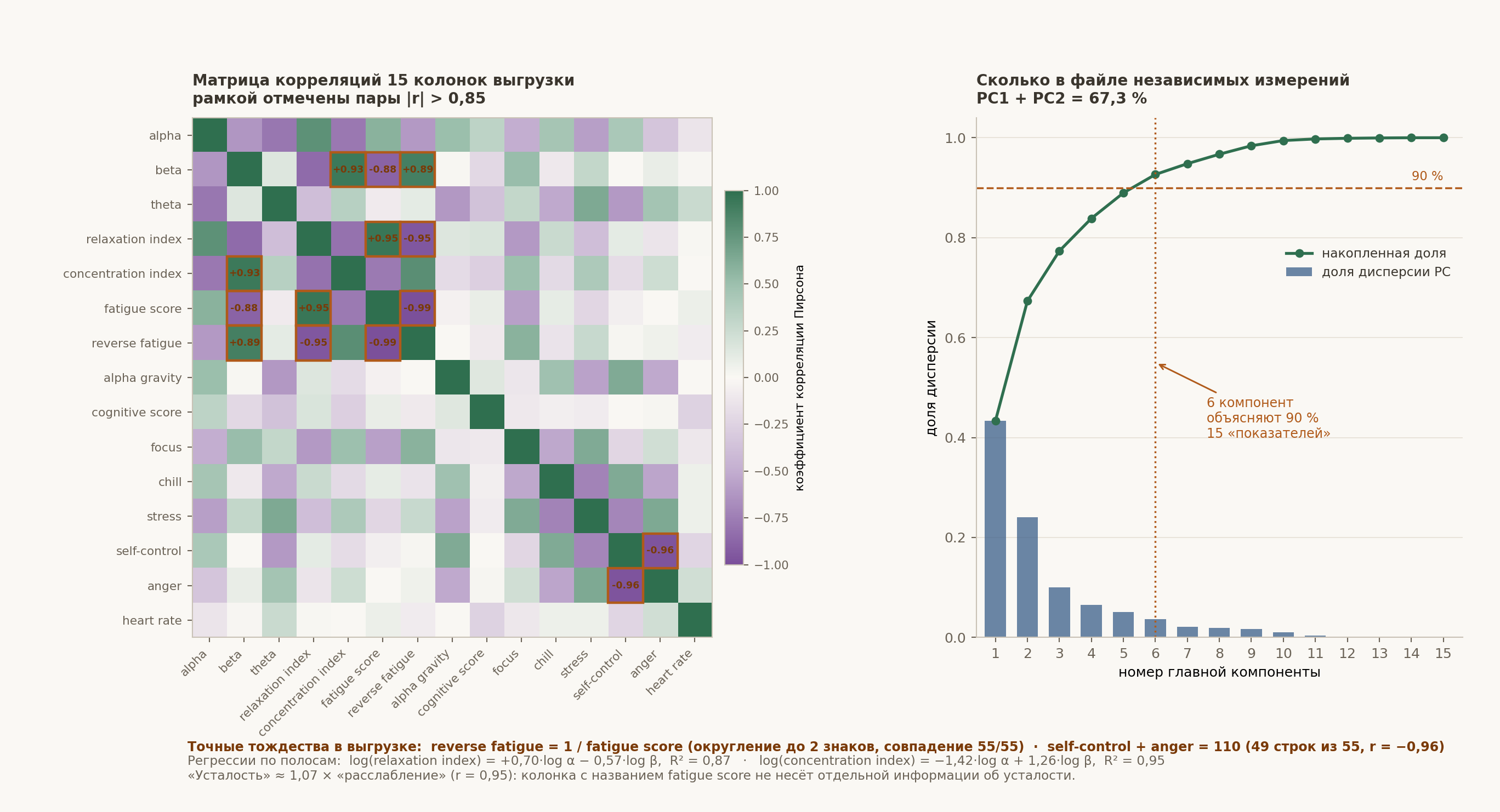
27.21.3. Primitives of Chapter 27 on this data#
🧭 Section 27.7 specifies five primitives:A(base),P(plateau),D = P − A(depth),τ↑(entry speed),Mn(hold),Sb(scatter). We count them like this:A— value at minute 0;P— 90th percentile along the plateau (10th for decreasing values); plateau -minutes 3…54, 52 counts, that is, without entry (minutes 0–2) and without exit minute (55);Mn— fraction of minutes after entry (53 counts) on the right side of the thresholdA + 0,5·D; Sb— standard deviation along the plateau.
| Variable | A |
P |
D |
Time untilA+0,5D |
Mn |
Sb |
CV |
|---|---|---|---|---|---|---|---|
| alpha (relative power) | 0,51 | 0,77 | +0,26 | ≤ 2 min | 0,98 | 0,039 | 0,054 |
| theta | 0,21 | 0,04 | −0,17 | ≤ 2 min | 1,00 | 0,014 | 0,286 |
relaxation index (α/β) |
4,81 | 6,33 | +1,52 | ≤ 2 min | 0,43 | 0,698 | 0,128 |
alpha gravity |
0,84 | 5,29 | +4,45 | 4 min | 0,96 | 0,721 | 0,165 |
self-control |
46 | 90,0 | +44,0 | 6 min | 0,89 | 10,23 | 0,123 |
chill |
46 | 92,9 | +46,9 | 5 min | 0,85 | 10,61 | 0,131 |
stress |
38 | 8,0 | −30,0 | 5 min | 0,87 | 8,24 | 0,566 |
cognitive score |
37 | 89,9 | +52,9 | ≤ 2 min | 0,58 | 19,85 | 0,289 |
| Heart rate, beats/min | 81 | 73,1 | −7,9 | ≤ 2 min | 0,60 | 2,82 | 0,037 |
Three out of five primitives were considered normal:A, P/DAndMn. ScatterSbwas considered and turned out to be the most interesting (see 27.21.4). Butτ↑was not calculated for any of the variables for which it was introduced, and this is the main technical result of the analysis:
Fitting y(t) = P − (P − A) exp(−t/τ) by alpha gravity:
  window 10 min → τ = 5.04 min window 15 min → τ = 3.83 min
  12 min window → τ = 11.98 min 20 min window → τ = 3.30 min
  scatter of estimates 3.3–12.0 min - 3.6 times, only from the choice of fitting window
For alpha, theta and α/β, even such a fit does not work: the input ended by minute 2, that is, it fit withinone or two grid points. A stable estimate of the time constant requires a minimum of five points in the growth region; at a step of 1 minute this means thatonly measurable τ ≥ 5 minutes. And minute 1 in this file also fell out.
⚠️ Hence, a proposal worth accepting before any further data collection.The method claims to accelerate the transition beta → alpha. The speed of this transition lies in the range of seconds and tens of seconds.Per-minute unloading of derivative indexes physically cannot measure it.No number of such sessions solves this problem: increasingn, we refine the average by a quantity that is not resolved at the level of an individual measurement. You need to either upload derived indicators with a frequency ≥ 1 Hz, or access to the raw signal with subsequent calculation of the alpha envelope in a window of 2–4 s. This is not a desire for precision, but a condition that the central statement of the methodin principle verifiable.
27.21.4. What the session showed#
📖 Three observations, in descending order of reliability.
First: entry is fast, retention is almost perfect.Alpha rose from 0.51 to a plateau of 0.74–0.77 and remained above the half threshold52 minutes out of 53after login:Mn = 0,98. Theta symmetrically dropped from 0.21 to 0.04 and did not rise above the thresholdnever: Mn = 1,00. The minute of exit is clearly visible - alpha 0.60, theta 0.12, α/β drops from ~5.5 to 3.75. That is, the state is really achieved, really maintained and really abandoned; at the “there is a transition - there is no transition” level, the device records it confidently.
Secondly, and this is the main result of the session: it is not the depth that changes, but the spread.Comparison of the first third of the plateau with the last:
| Variable | Level: 1st third → 3rd | p(Welch) |
SD: 1st third → 3rd |
SD₃/SD₁ |
p(Brown - Forsyth) |
|---|---|---|---|---|---|
| alpha | 0,71 → 0,73 | 0,139 | 0,048 → 0,031 | 0,63 | 0,219 |
relaxation index |
5,29 → 5,49 | 0,428 | 0,768 → 0,616 | 0,80 | 0,247 |
alpha gravity |
4,15 → 4,26 | 0,660 | 0,935 → 0,477 | 0,51 | 0,043 |
| theta | 0,064 → 0,042 | < 0,0001 | 0,014 → 0,007 | 0,52 | 0,055 |
stress |
18,7 → 11,7 | 0,035 | 11,98 → 4,04 | 0,34 | 0,059 |
self-control |
74,1 → 86,1 | 0,003 | 13,39 → 4,84 | 0,36 | 0,003 |
cognitive score |
54,7 → 83,5 | 0,0001 | 22,53 → 8,09 | 0,36 | 0,012 |
| Heart rate | 78,6 → 75,9 | 0,004 | 2,65 → 2,36 | 0,89 | 0,482 |
chill |
78,4 → 83,2 | 0,218 | 12,15 → 9,83 | 0,81 | 0,643 |
| beta | 0,171 → 0,159 | 0,203 | 0,032 → 0,018 | 0,56 | 0,056 |
focus |
28,7 → 26,0 | 0,459 | 11,35 → 9,63 | 0,85 | 0,475 |
Alpha and α/β levels in 55 minutesdid not increase statistically significantly (p= 0.14 and 0.43). But the spread has decreasedfor all 11 tested variables without exception(all of them are in the table). Sign test:p = 2⁻¹¹ = 0,0005in one-sided reading and0,001in two-way. But these 11 variablesnot independent- according to 27.21.2, they contain about six independent measurements. With the Nyholt correction (M_eff= 9.2 according to the correlation matrix of the same 11 rows)p ≈ 0,002; with a conservative conversion of only six degrees of freedomp = 2⁻⁶ ≈ 0,016. The conclusion is consistent in all three readings. Permutation test based on the scatter trend in a sliding window of 10 minutes (10,000 permutations, grain size 20260720):alpha gravity r = −0,82 (p = 0,012), alphar = −0,71 (p = 0,051), α/β r = −0,63 (p = 0,085).
🔬 This essentially reformulates the expectation.Intuitively, it is assumed that over a long session the state “deepens”. Here it did not go deeper - itstabilized: the depth was taken in the first two minutes and then only kept more and more even. If this is confirmed in the sample, then the main intra-session marker becomes not the level, butSb- the same fifth primitive, which in model 27.7 looks auxiliary. This is exactly the case when the data suggests a shift in emphasis in the model itself.
Third: heart rate confirms the picture regardless of the EEG.Heart rate is the only channel in the file that is not removed from the spectrum. Linear regression by session: slope−0.086 beats/min per minute (SE 0,022, p= 0.0003), that is−4.7 beats/min in 55 minutes; the first third of the plateau versus the last - 78.6 → 75.9,p = 0,004, d= −1.06. This is convergent evidence: two independent channels (cortical and vegetative) move in concert.
⚠️ And immediately - competing explanations, which this entry does not exclude.The session lasted from 22:36 to 23:31: the evening decrease in heart rate occurs on its own. Fifty-five minutes of sitting still also lowers your heart rate. Without a control condition (same person, same time of day, same body position, no practice), the 4.7 beat reduction cannot be attributed to the method. The effect size is modest and fully consistent with both alternative explanations.
🧭 The drowsiness test - and it passes.The first objection to any 55-minute recording with eyes closed and high alpha: the person simply dozed off. Tested directly: when falling asleep alphafalls, and thetagrowing. Here the opposite is observed - alpha 0.712 → 0.733 (+3.0%), theta 0.064 → 0.042 (−34.3%), theta/alpha ratio −36.7% (d= −1.69). Based on theta level aloned= −1.94 — the largest effect in modulus in the file. This is a calm wakefulness, not a transition to sleep. The objection is addressed by data, not by reassurance—and in this sense the section is a working example of how alternative explanations should generally be responded to.
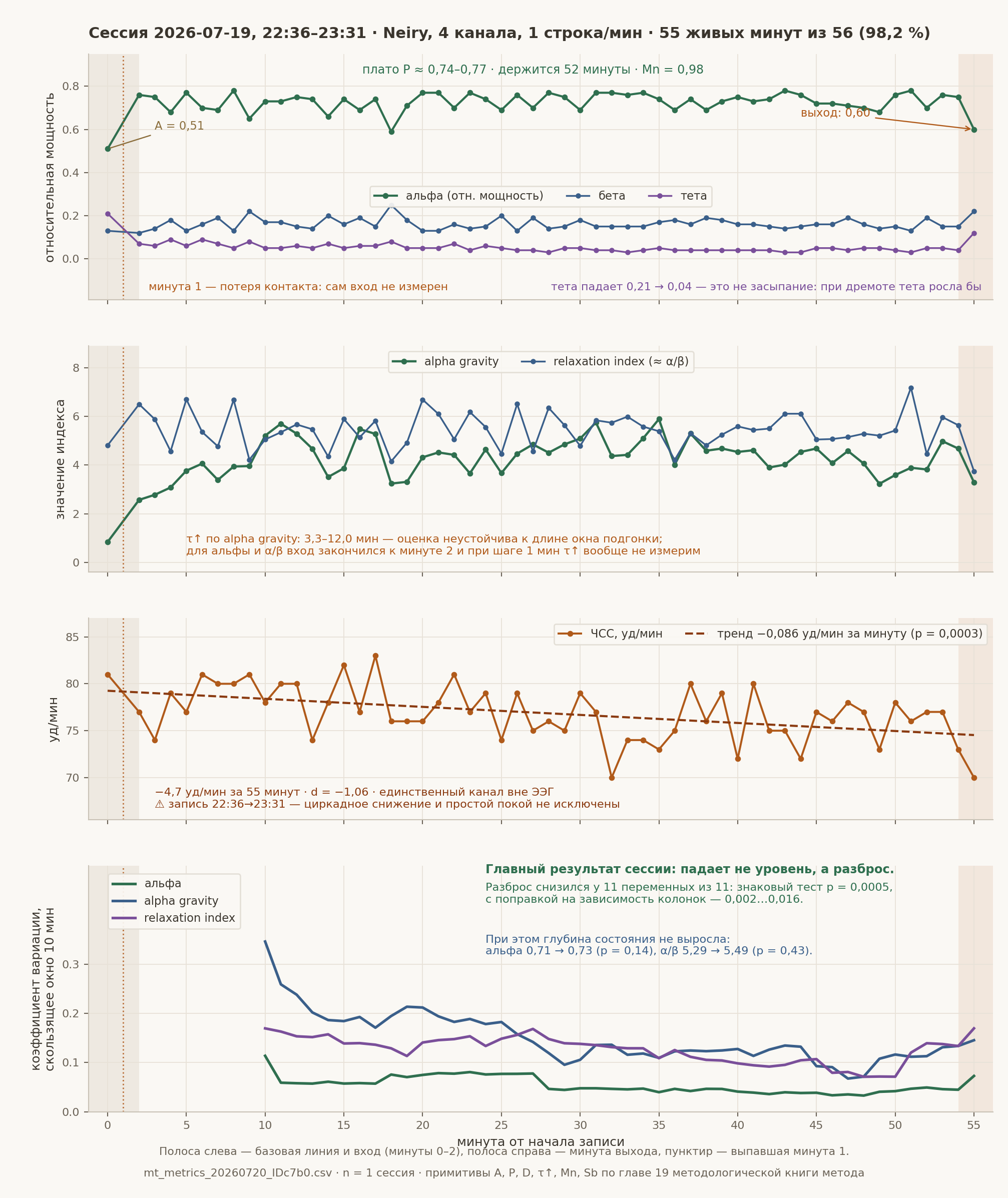
A side observation about which speakers are generally worth watching.Autocorrelation at a lag of one minute shows whether there is a slow structure in the series or whether it is noise around the average:
| Row | ac₁ |
Row | ac₁ |
|---|---|---|---|
cognitive score |
+0,87 | Heart rate | +0,09 |
self-control |
+0,78 | concentration index |
−0,11 |
| theta | +0,42 | alpha | −0,14 |
alpha gravity |
+0,41 | beta | −0,17 |
chill |
+0,21 | relaxation index |
−0,33 |
stress |
+0,19 | focus |
−0,35 |
⚠️ In alpha, α/β andfocusautocorrelationnegative- that is, at minute-by-minute resolution, these series behave like noise around a stable average, and not like a slowly changing state. Practical Takeaway: Per-Minute Alpha Valuescannot be interpreted individually(“at the 34th minute it was deeper”) - you can only aggregate by windows. And the opposite warning: the smoothest and most pleasing to the eye curves arecognitive score (ac₁= 0.87) andself-control(0.78) are highly smoothed derivative indicators with a closed formula. Their connection with the instantaneous spectrum is weak and opaque:cognitive scoremaximum |r| with any stripe -0,29, yself-control — 0,63, and then due to theta (with α/β both columns correlate by 0.14 and 0.19). Smoothness here does not mean the quality of the measurement, but the depth of processing. Drawing conclusions on them is tempting and wrong.
27.21.5. What this upload can't answer#
⚠️ The list of restrictions is more important than the list of results, because it sets the protocol for the next collection.
| Question | Why doesn't he answer? |
|---|---|
PointNSIby checkout 27.10 |
In fileno EC/EO markings. The formula requires a contrast of two phases; there is one continuous recording here. NeitherSp', norDp', norRgRare not extracted from it |
Entry speedτ↑ |
A grid step of 1 minute versus a transition lasting seconds; minute 1 also fell out |
| "Does the brain speed up?in focusing» | On recordno focus block. focushas no trend (r(t)= −0.05 on the plateau) and has no structure (ac₁= −0.35); atconcentration index r(t)= −0.13 for the plateau and 0.00 for the entire session. This is one continuous session of rest; the second half of the application is simply not affected by this upload method |
RecoveryRc (τ↓) |
Exit takesoneminute of recording. It is clear that the transition has taken place; the time constant is not estimated from one point |
ICC, SEM, thresholdRCI |
A minimum of two measurements are required in a stable window. Heren = 1 |
ΔMNPIand neuroplasticity |
By definition, 27.14 requires longitudinality. One session does not even provide a starting point until the playback conditions are fixed |
| Assignment to ONTO mode | The recording is not matched by mode and the phenomenological report is not matched. SubindexPhC(27.9) is not considered at all |
🧭 What does this mean for the phrase “about twice as much.”The statement concerns three things at once: speed, depth and retention of the beta → alpha transition. Analysis shows thatthis download measures them with very different reliability: retention is good (Mnstable, noise on a minute scale does not spoil it), depth is acceptable (Dcounts, but depends on the definition of the baseA, and the base here is one single minute 0), the speed isdoesn't measure at all. This means that before switching to high-frequency uploading, it is correct to present a quantitative statement about accelerationonly in retention and depth, but about the speed we can say that it is still fixed qualitatively and requires a different hardware circuit. This is not weakening the claim, but bringing it into line with what it is supported by.
27.21.6. Unloading requirements that follow from the analysis#
🧭 Eight points. Each is derived from the specific problem above, rather than from general considerations.
- Phase marking is required.At least a column
phasewith meaningsbaseline / EC / EO / task / recoveryand an exact switching time stamp. Without it, half of the Chapter 27 model is unusable - and this, more than anything else, is the main flaw of the current format. - Frequency ≥ 1 Hz for derived indicatorsor saving the raw signal. Measurability condition
τ↑Andτ↓. - Pre-base to entry: 2 minutes of open eyes.Provides external reference
Aand at the same time closes fork 27.20 - the protocol becomesEO → EC → EO, depth and stability cease to be one quantity. - Explicit exit markerand at least 3 minutes of recording after it - otherwise
Rcwill never appear. - Signal quality flag per line(impedance/artifact), rather than restoring it from zeros retroactively. The cleaning rule is formulated in writing and versioned.
- Fixing the composition of columns with checking for collinearitybefore calculation:
reverse fatigue,concentration indexAndfatigue scorein their current form should not be included in the package. - Session metadata in the file itself: time of day, caffeine, last night's sleep, body position, session number, device firmware version, calculation code version. All confounds from 27.15 - otherwise they are remembered after the fact and are not checked.
- Phenomenological report with the same timestamp— 3–5 points immediately after the session. Without it subindex
PhCremains an empty cell in the formula.
⚠️ Points 1–3 change the collection protocol. This means that the already accumulated records in the old formatretain value as descriptive material and as a basis for noise calibration, but will not retroactively become material for calculationNSIAndΔMNPI. It is better to admit this right away than to discover it while preparing for publication.
27.21.7. What does analysis change in the chapter itself?#
📖 The result of one session for the measurement model is four amendments:
Sbrises in status.The fifth primitive, introduced as an auxiliary one, was the only one that showed consistent change over the session. The hypothesis should be reformulated explicitly:within a session, it is not the depth of the state that is trained, but its stability; the depth is taken in the first minutes and then maintained.- The check for collinearity is transferred from the convolution stage to the column selection stage.The problem described in 27.20 as a formula defect also exists at the input, in the upload itself, and is detected in three lines of code.
- The measurability of the three components of the statement differs.Retention and depth are measurable now; speed requires hardware change. Before it, the statement about speed is not made in quantitative form.
- Focusing is not covered at all by the available data.The method statement includes both relaxation and focus; There are uploads only for the first one. The task block with markings is needed not “for completeness”, but so that the second half of the statement ceases to be unconfirmed.
✍️ [To the author - add]:
- conditions for this particular session- what ONTO mode was performed, whether there was an instruction, how it is assessed subjectively, what happened before and after. The analysis is carried out blindly using only numbers, and this is its main limitation as an example;
- second session of the same personin comparable conditions - the minimum step after which
SEMAndICC, and with them the right to speak “has changed reliably”; - session with marked phasesaccording to the protocol from 27.21.6 - for the first time it will be possible to count on it
NSIentirely and replace this section with a calculation with a real score; - decision on discrepancy
iaf/iapf- which of the two quantities serves as an individual anchor in normalization 27.8.
📖 Reproducibility.All numbers in this section are obtained from the filemt_metrics_20260720_IDc7b0.csvno manual edits; usedpandas, numpyAndscipy(regression, Welch test, Brown-Forsythe test, permutation test for 10,000 permutations with fixed grain 20260720). The plateau is defined as minutes 3…54 (52 counts), the entry window is minutes 0–2, the exit minute 55 is excluded. To repeat the calculation, the file and the definitions described here are sufficient. If you change the row cleaning rule or the plateau boundaries, the numbers will change - so both rules are named explicitly and must be versioned along with the code (see 27.24, step 2).
27.22. Dictionary of unloading parameters and state vectors#
Section 27.21 looked at what can and cannot be counted in one session. This section answers the previous question:what each upload column actually means, what you can trust in it, and how much independent information there is in these eighteen columns.
The question is not technical. As long as the state is described with the words “deep”, “even”, “entered”, the method remains descriptive. As soon as each word has a column, a number, and an acceptable precision, the method becomes measurable. But the opposite is also true:if we take the columns as they are, by their names, the method becomes measurable only by appearance. Columncognitive scoredoes not measure cognitive functionfatigue scoredoes not measure fatigue, and the four “indices” from the upload are, according to this session, the same value, shown in four ways.
📖 Below is a dictionary of all eighteen columns, the numbers of this session for each of them, and an analysis of how many are in the filetruly independent state axes. The instrument translation of these findings into the language of the eight modes is in section 18.17.
27.22.1. Three classes of speakers#
The first thing to do with any upload issplit columns by origin. Confusing the measured with the calculated is the most common and most subtle mistake when working with consumer instruments: it results in the derived quantity being cited as a fact along with the raw measurement.
| Class | Columns | Status in calculations |
|---|---|---|
| I. Measured by the device | time, alpha, beta, theta, heart rate, iaf, iapf |
support. Only these values can be used in the formulas of Chapter 27 and in the definitions of modes |
| II. Recounted from stripes, reproducible | relaxation index, concentration index, fatigue score, reverse fatigue |
convenience. Recovering fromalphaAndbetawith R² = 0.82–0.95. There is almost no independent information |
| III. Black box | cognitive score, focus, chill, stress, self-control, anger, alpha gravity |
manufacturer's interpretation. Formulas are closed, validation unknown. Good as an auxiliary signal, not good as a measurement |
⚠️ Practical consequence.Of the eighteen columns, the scientific text includes without reservationsseven. The remaining eleven are either redundant or require the wording “according to the device, the column named X showed ...” - with an explicit indication that the name of the column belongs to the manufacturer, and not to the method.
🔬 Class II can be proven directly.Three of the four values are restored by regression on the logarithms of the stripes for the entire session (55 lines):
log(relaxation index)= +0,70 · log α − 0,57 · log β, R² = 0,87log(concentration index)= −1,42 · log α + 1,26 · log β, R² = 0,95reverse fatigue= 1 /fatigue scoreup to rounding to two digits -match 55 of 55 lines, that is, this is an identity, not a correlation
(The coefficient on log θ in both regressions is negligible—−0.01 and −0.03—and is omitted from the entry.)
The four “indices” are connected to each other like this (for the entire session):fatigue score ↔ relaxation index r = +0,95, fatigue score ↔ reverse fatigue r = −0,99, relaxation index ↔ reverse fatigue r = −0,95. At a plateau, all six pairwise correlations between these four columns lie in absolute value in the range0,77…0,99. Attitudefatigue score / relaxation indexlasts on average1,07(median 1.06).
⚠️ This literally means the following:column with titlefatigue scoredoes not contain specific information on fatigue.It is equal to relaxation multiplied by a constant. A person who sees that “relaxation has increased and fatigue has increased” sees the same number twice.
27.22.2. Vocabulary: what each column means#
📖 The table is built so that it can be read at the device. The column “What is according to the data” is not a paraphrase of the title, but the result of testing at this session.
| Column | Class | The title promises | What is according to the data |
|---|---|---|---|
time |
I | timestamp | minute mark; step exactly 1 minute - this is the main limitation of the entire unloading (see 27.21.5) |
alpha |
I | alpha band power | relativestripe share:alpha + beta + theta= 0.940 ± 0.020. Absolute power is not |
beta |
I | beta band power | Same; always grows due to alpha or theta |
theta |
I | theta band power | Same; the noisiest of the three bands (CV = 0.29), but also the most inertial (ac₁ = +0,42) |
heart rate |
I | heart rate | smoothest column of the file (CV = 0.037). Variability (RMSSD, LF/HF) in unloadingNois a separate loss, see 18.17.4 |
iaf |
I | individual alpha frequency | session constant: 10.06 in all 55 lines. This is a calibration parameter, not a minute measurement |
iapf |
I | alpha peak frequency | session constant: 10.60. Discrepancy fromiafnot explained by the manufacturer - open question 27.21.7 |
relaxation index |
II | relaxation | ≈ function α/β: r with α/β =+0,93. The release axis in its purest form |
concentration index |
II | concentration | ≈ inverse function α/β: r =−0,92. The same axis with the opposite sign |
fatigue score |
II | fatigue | not tired:r srelaxation index= +0.95 for the entire session. Relaxation multiplied by an average of 1.07 |
reverse fatigue |
II | reverse fatigue | identically 1 / fatigue score. Zero information |
cognitive score |
III | cognitive productivity | the most inertial column of the file (ac₁= +0.87) and almost unrelated to stripes (r with alpha +0.19). Behaves like a slow internal counter rather than a state response |
focus |
III | focusing | associated withconcentration indexonly by r = +0.47 - that istwo “columns about concentration” measure different things. Without task markup it is not interpreted |
chill |
III | calmness | r withrelaxation index= +0.28. It almost does not coincide with the “relaxation” of the device; closer toself-control (r = +0,53) |
stress |
III | stress | the only column with a strongpositiveconnection with theta (r =+0,62on the plateau); the relationship with alpha is weaker and with the opposite sign (−0.53) |
self-control |
III | self-control | self-control + anger= 110 V49 lines out of 55, r = −0.96. Thisone column shown on both sides |
anger |
III | irritation | see above |
alpha gravity |
III | "alpha pull" | the only class III column with its own axis— analysis at 27.22.5 |
⚠️ Three duplicate pairs in one file: (fatigue score, reverse fatigue) is an exact identity; (self-control, anger) — constant sum; (relaxation index, concentration index) - one axis with different signs. Any calculation where these columns appear side by side as independentartificially inflates the consistency of the result. This is the same defect that in 27.21.7 moves the check for collinearity from the convolution stage to the column selection stage.
27.22.3. Numbers for this session in each column#
📖 Fifteen informative columns (withouttime, iaf, iapf). Plateau - minutes 3...54, 52 counts; input - minute 0; exit - minute 55.ac₁— correlation of neighboring minutes: how much the column “remembers” the previous value.
| Column | Entrance | Plateau: median (Q1–Q3) | Exit | SD | CV | ac₁ |
|---|---|---|---|---|---|---|
alpha |
0,51 | 0,74 (0,70–0,76) | 0,60 | 0,039 | 0,054 | −0,14 |
beta |
0,13 | 0,16 (0,15–0,18) | 0,22 | 0,025 | 0,153 | −0,17 |
theta |
0,21 | 0,05 (0,04–0,05) | 0,12 | 0,014 | 0,286 | +0,42 |
alpha gravity |
0,84 | 4,45 (3,89–4,72) | 3,29 | 0,721 | 0,165 | +0,41 |
relaxation index |
4,81 | 5,43 (5,05–5,88) | 3,75 | 0,698 | 0,128 | −0,33 |
concentration index |
0,27 | 0,25 (0,20–0,29) | 0,48 | 0,078 | 0,303 | −0,11 |
fatigue score |
6,64 | 5,72 (5,36–6,21) | 4,57 | 0,701 | 0,122 | −0,32 |
reverse fatigue |
0,15 | 0,18 (0,16–0,19) | 0,22 | 0,022 | 0,123 | −0,31 |
cognitive score |
37 | 78 (51–86) | 39 | 19,85 | 0,289 | +0,87 |
focus |
32 | 26,5 (19–35) | 43 | 11,04 | 0,405 | −0,35 |
chill |
46 | 83,5 (73–88) | 73 | 10,61 | 0,131 | +0,21 |
stress |
38 | 12 (9–17) | 29 | 8,24 | 0,566 | +0,19 |
self-control |
46 | 87 (83–89) | 90 | 10,23 | 0,123 | +0,78 |
anger |
41 | 23 (21–27) | 20 | 9,35 | 0,349 | +0,75 |
heart rate |
81 | 77 (75–79) | 70 | 2,82 | 0,037 | +0,09 |
🧭 How to read this table - three things.
First: columnCVtells you how much noise there is in the speaker. heart rate(0.037) andalpha(0.054) are so stable that a change of 5% is already meaningful.stress(0.566) andfocus(0.405) jump in such a way that an individual minute in them does not mean anything - they can only be read as a median across the window.
Second: columnac₁tells whether a quantity has inertia.Values around zero and below (alpha, beta, concentration index) mean: adjacent minutes are independent, the column reflects the current minute and does not remember anything. Values above +0.7 (cognitive score, self-control, anger) mean the opposite - the column changes slowly andlags behind. Practically: if you come out of the state,alphawill show it right away, andcognitive score- in a few minutes.
Third: the direction of entry and exit is not symmetrical.Byalpha, stress, chillthe output returns values towards the input, andbetaeven jumps over the input level (0.13 → 0.16 →0,22) — the state ends. Aheart rate (81 → 77 → 70), self-control (46 → 87 → 90) Andanger (41 → 23 → 20) at the exitcontinuemove in the same direction as during the plateau. The spectral picture has returned to activation, but the vegetative and “emotional” ones have not yet. For one session, this is an observation, not a fact; checked by three minutes of recording after exit (27.21.6, clause 4).
27.22.4. Four state vectors#
📖 If fifteen columns are strongly interconnected, then there are obviously fewer than fifteen independent axes in them. The principal component method answers the questionhow much exactlyAndwhich.
Calculation: z‑normalization of fifteen columns on a plateau (52 counts), singular value decomposition, loads = correlations of columns with components.
| Vector | Scatter share | Cumulatively |
|---|---|---|
| 1 - spectral shift | 47,4 % | 47,4 % |
| 2 - emotional evenness | 18,7 % | 66,0 % |
| 3 - slow session drift | 11,2 % | 77,2 % |
4 — alpha gravitylike its own axis |
6,4 % | 83,6 % |
📖 Checking stability.The same calculation for the entire live session (55 lines instead of 52) gives shares of 43.3 / 24.0 / 10.0 / 6.5%, and the load vectors coincide with the plateau almost completely:|r| = 0.997 for the first, 0.976 for the second, 0.975 for the third.The structure is not created by the choice of plateau boundaries - it is in the data. Six components are enough to restore each of fifteen columns with a generality h² ≥ 0.79.
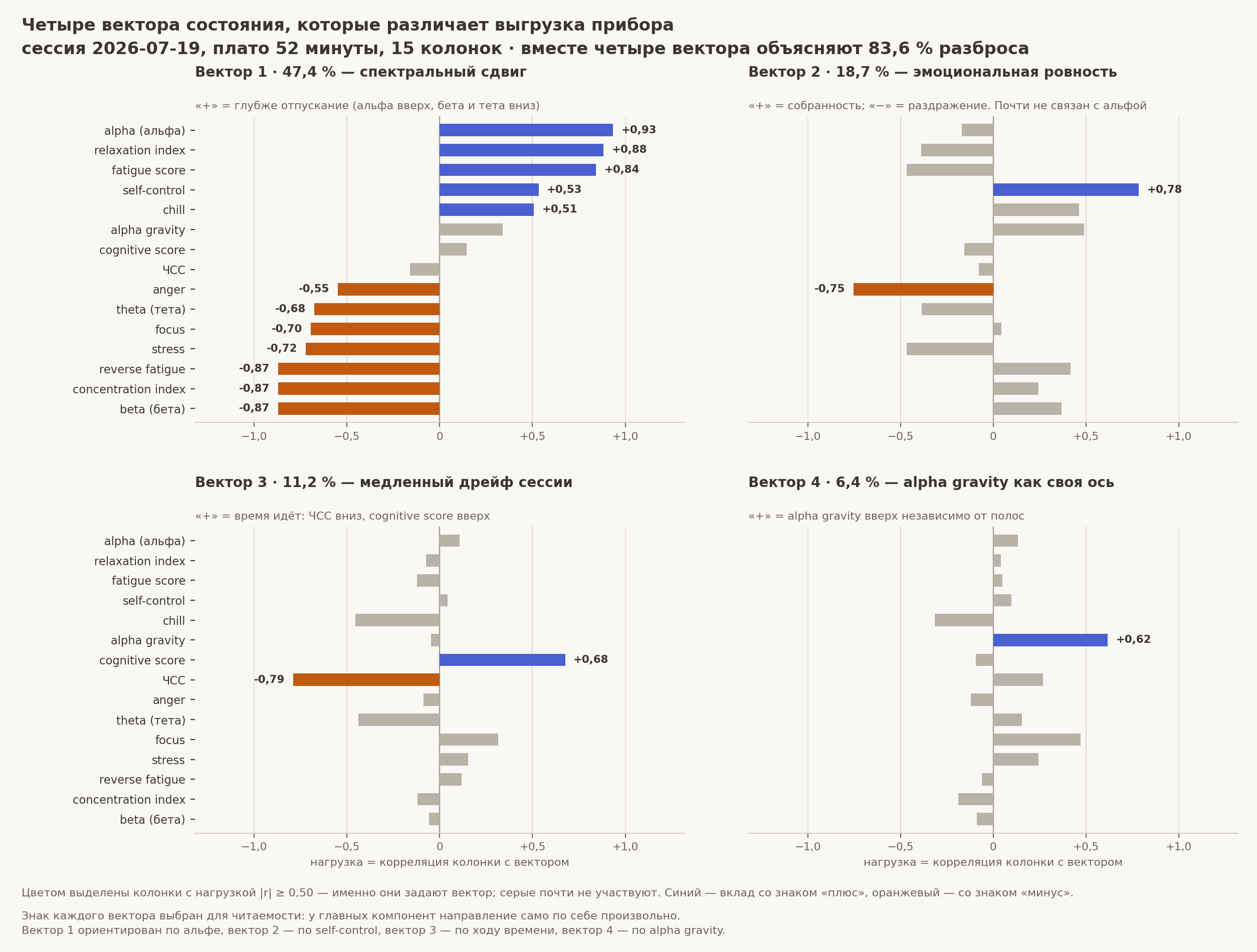
Vector 1 · 47.4% - “release ↔ activation.”Main axis of the file. On the plus side:alpha (+0,93), relaxation index (+0,88), fatigue score(+0.84). On the minus side:beta (−0,87), reverse fatigue (−0,87), concentration index (−0,87), stress (−0,72), focus (−0,70), theta(−0.68). Total12 columns out of 15have a load |r| ≥ 0.50.
🧭 This is what the method calls the depth of state. Half of everything that happens in unloading is movement along this one axis. And that’s why looking at ten columns at once is pointless:twelve of the fifteen columns are one axis shown in twelve ways.
Vector 2 · 18.7% - emotional evenness.It is set practically in two columns:self-control(+0.78) andanger(−0.75). Key:its load onalphaequal to −0.17- that is, this axis is almost orthogonal to depth.
🔬 In terms of content, this is the most interesting result of the section.The depth of the state and its evenness are two different things, and the device distinguishes between them.The condition can be deep and at the same time uneven (high alpha,angertoo), and vice versa. In the language of the method, these two dimensions are usually merged into the single word “good”; the data says there are two of them, and they do not replace each other. If this is confirmed in other records, the method will have a second independent scale of state quality - and it should be explicitly introduced into the terminology.
Vector 3 · 11.2% - slow session drift. heart rate(−0.79) andcognitive score(+0.68). Of the four vectors he hasthe strongest connection with time: r(vector value, minute) =+0,55versus +0.28 for the first one. This is not a condition, but its temporary background: the pulse slowly decreases,cognitive scoregrows slowly no matter what the spectrum does.
⚠️ Practically, this means that the “improving during the session” part is simplytime, not a practice effect. Any beginning versus end comparison must take this into account; otherwise, the effect of the method will be the result of forty minutes of sitting in a chair.
Vector 4 6.4% —alpha gravity.One column, +0.62 load, and almost nothing else. Discussed separately below.
27.22.5. alpha gravity- the only column with its own axis#
🔬 Titlealpha gravityencourages us to read it as “the force of attraction to alpha,” that is, as a measure of depth.The data doesn't support this.
| Examination | Result |
|---|---|
| r with ratio α/β | +0,10(on a plateau; +0.11 throughout the session) |
r withalpha |
+0,30 |
r withtheta |
−0,29 |
r withrelaxation index |
+0,13 |
r withself-control |
+0,50- the strongest connection of the column in general |
r withchill |
+0,28 |
r withheart rate |
+0,08 |
r withcognitive score |
+0,03 |
Inertiaac₁ |
+0,41— noticeably higher than alpha itself (−0.14) |
⚠️ alpha gravityis not α/β by another name.A correlation of +0.10 means almost complete independence. At the same time, the column behaves meaningfully: it has grown significantly over the session (0.84 at the input → 4.45 plateau median), it is inertial, and its generality in the six-component model is h² = 0.99 - that is, it is not noise.
🔬 Three possible readings, and you cannot choose between them in one session:
- The magnitude actually reflects something specific—for example, the persistence of alpha dominance over time, rather than its instantaneous level. Then she is close to primitive
Mn(retention) from 27.7, and it's valuable. - It contains normalization to the individual frequency (
iaf/iapf) and is therefore “shifted” relative to the rough α/β. - It reflects a slow drift in the quality of the signal or the contact of the electrodes - then its growth over the session is not about the condition at all.
⚠️ While the formula is closed,a third reading cannot be excluded, and therefore the column should not be included in the calculationNSIAndMNPIin no way. But it is also wrong to ignore it: this is the only class III column that carries information that is not found anywhere else in the file.
✍️ [To the author - add]:ask the manufacturer for a definitionalpha gravity— or check reading No. 1 directly by calculating from the raw signal the proportion of time with α above the threshold and comparing it with this column. If it matches, the value receives an operational meaning and can be included in the model as a retention meter.
27.22.6. Minimum sufficient set of columns#
📖 Practice question:How many columns do you need to record so as not to lose information?It can be checked directly: we take a subset of columns, use linear regression to restore all fifteen z‑normalized columns and look at the average R².
| Kit | Columns | Average R² for all 15 |
|---|---|---|
alpha, beta, theta |
3 | 0,573 |
+ alpha gravity |
4 | 0,650 |
+ self-control |
5 | 0,738 |
+ heart rate |
6 | 0,797 |
+ cognitive score |
7 | 0,851 |
+ stress |
8 | 0,902 |
for comparison:four "indexes" -relaxation, concentration, fatigue, reverse fatigue |
4 | 0,612 |
🧭 Eight columns restore all fifteen by 90%.At the same time, four “index” columns together give 0.612 - less than three bars together withalpha gravity(0.650), and only slightly more than the three bars themselves (0.573). An entire class of columns occupying a quarter of the file adds less than one column to the original three stripesalpha gravity.
🧭 Hence the recommended working composition for method calculations:
time · alpha · beta · theta · heart rate · iaf
+ marking: phase (EC/EO/task) mode (ONTO mode number) output label
+ separately, as researched: alpha gravity · self-control · stress
⚠️ Please note what is not here:relaxation index, concentration index, fatigue score, reverse fatigue, chill, anger, focus, cognitive score. This does not mean that they should not be preserved—everything should be preserved. This means thatthey should not be included in the formulas of Chapter 27, because they duplicate each other and rely on closed formulas.
27.22.7. What does this dictionary bring to the rest of the book?#
📖 Four consequences, each addressed to a specific place:
- Chapter 18 - instrument language of modes.Two axes (α/β and θ/α), constructed only from class I columns, make it possible for the first time to formulate which modes the device distinguishes and which it does not. This is done in section 18.17, and the answer there is three groups instead of eight.
- Chapter 27 - the rule for selecting columns before convolution.IN
NSIAndMNPIonly class I columns plus clearly justified derivatives are included. Checking for collinearity is a mandatory step before the calculation, and not after (27.21.7, clause 2). - The method has a second quality scale.Vector 2 shows that the evenness of a state is measurable separately from its depth. There is currently no term for this in method language; the data says it is needed.
- The entire book is subject to naming discipline.Not a single column from the upload is cited by its title.
fatigue score- not fatigue,cognitive score- not a cognitive function,alpha gravity- not alpha depth. Each usage is accompanied by either an operational definition or a disclaimer as to the origin.
✍️ [To the author - add]:
- Manufacturer's definitionsfor seven class III columns. While they are not there, the entire class remains auxiliary by definition, and this limitation is not our decision, but a consequence of the closedness of the formulas.
- Checking four vectors on the second and third records.If the structure is repeated, the method will have its own state coordinate system, calculated from the data, and not assigned. This is perhaps the most valuable of all the open items in Chapter 27.
- Term for the second axis.What is what is called here “emotional evenness” called in the language of the method? If there is no such word, you should enter it.
- Your observations about
alpha gravity.You've seen this column in many sessions. What does it track, in your experience?
📖 Reproducibility.All partition numbers are obtained from the filemt_metrics_20260720_IDc7b0.csvno manual edits; usedpandasAndnumpy. Rows with zeros in eleven key columns were excluded as a recording artifact (4 rows out of 59); the plateau is defined as minutes 3...54. The principal components are calculated by the singular value decomposition of the z-normed matrix; component signs are chosen for readability (the direction of the main components is arbitrary) and are oriented according toalpha, self-control, the passage of time andalpha gravityrespectively. If you change the purge rule or plateau boundaries, the numbers will change—both rules must be versioned along with the code (see 27.24, step 2).
27.23. Retention: three horizons and a solid layer in the measurement model#
27.23.1. One word, three different values#
⚠️ The promise of the method (chapter 3) is “speed, depth andretentionimprove by about a factor of two." Analysis of section 27.7 assigned a formula to each of the three words. But upon careful reading, it turns out that the word “retention” is used in the materials of the methodin three divergent senses— in much the same way that MNPI has three divergent definitions (Section 27.19). This is not a quibble: what kind of device is needed and whether the promise is confirmed at all depends on which of the meanings is meant.
| Meaning | What's being held | Horizon | Device | Formalized? |
|---|---|---|---|---|
| U1. Plateau | state within one transition | 1–20 minutes | EEG | Yes- primitiveMn (27.7) |
| U2. Transfer | state when returning to normal context | watch | EEG (eyes open) + belt | partially - subindexRgR (27.9) |
| U3. Track | vegetative aftereffect of practice | nights and weeks | ring/bracelet | No |
🧭 A conclusion that is unpleasant for a promise.Of the three meanings of “retention”, one is formalized, the second is partially formalized, and the third has never been measured. When a practitioner hears “retention improves twice,” he is highly likely to understand this as U3 - “the condition remains with me.” The method measured Y1 - “the plateau within a session lasts twice as long.” These are different statements, and confirmation of the first is not confirmation of the second.
📖 The requirement for statement discipline (27.17) is applied literally here:every retention statement must carry a horizon index.“Retention (R1) has approximately doubled” - correct if data is available. “The retention has doubled” without clarification is incorrect, because the reader will complete the horizon himself, and will complete the strongest one.
27.23.2. Good news: NSI is already set up correctly#
🧭 NSI protocol (10/27) is 5 minutes with eyes closed, transition mark, 5 minutes with eyes open. The minimum window for correct RMSSD estimation is5 minutes(26.2). Exact match:the NSI structure already contains exactly two valid HRV windows and does not require any protocol changes.
It is enough to put on the chest strap for the same ten minutes. No additional procedure, no lengthening of the measurement, no burden on the person. From this we get the second half of the checkup:
| Magnitude | Window | What does it show |
|---|---|---|
RMSSD_EC |
5 min, eyes closed | vegetative depth of rest |
RMSSD_EO |
5 min, eyes open | Is peace maintained under the strain of open eyes? |
ΔRMSSD = RMSSD_EO − RMSSD_EC |
— | vegetative analogue of RgR |
HR_EC, HR_EO |
5 min each | shift direction confirmation |
RR_EC, RR_EO(breathing rate) |
5 min each | covariate, without which the first three lines are not readable (26.5) |
🔬 Testable hypothesis.If the method really trains “rest with open eyes” (facet RgR, 27.9), then practitionersΔRMSSDshould be less negative than that of the control group. This is a cheap, fast and refutable check of one of four sub-indicesindependent channel- exactly what the MNPI validity lacks (27.13, convergent line).
⚠️ Disclaimer required: comparisonRMSSD_EOWithRMSSD_EClegal only whencomparable respiratory rate in both windows. If a person breathes 6 breaths per minute less with eyes closed than with eyes open, the RMSSD difference will be created by breathing rather than by regulation (26.5).
27.23.3. Body Layer Primitives#
🧭 By the same logic as the five dynamic EEG primitives (27.7), five quantities are determined for the bodily layer. Everything is relativepersonal baseline, all in terms that can be refuted.
| Primitive | Designation | Grade | What does it mean |
|---|---|---|---|
| Vegetative base | Aᵥ |
average nightly RMSSD for 7 nightstofirst session | reference |
| Vegetative depth | Dᵥ |
(RMSSD_plateau − RMSSD_baseline)/RMSSD_baselinein session, belt |
cost/benefit state |
| Return | Rvᵥ |
time for heart rate to return to baseline after exiting the state | reversibility |
| Track | Cr |
(RMSSD_night after session − Aᵥ)/Aᵥ |
aftereffect - U3 |
| Trace stability | Cs |
proportion of nights per course where nightly RMSSD ≥Aᵥ |
transfer stability |
Aᵥ = mean(RMSSD_night[-7:]) # 7 nights before the start of the course
Dᵥ = (median(RMSSD[plateau]) - median(RMSSD[pre])) / median(RMSSD[pre])
Rvᵥ = time from exit to return of heart rate to the corridor ±1 SD from pre-baseline
Cr = (mean(RMSSD_night[7-night window]) - Aᵥ) / Aᵥ
Cs = |{nights: RMSSD_night ≥ Aᵥ}| / |{all nights of the course}|
⚠️ CrIt is calculated only according to a sliding window of 7 nights.The reason is not a matter of caution, but of arithmetic: a single night physically cannot give a reliable answer. Below is the minimum change in overnight RMSSD that passes the reliability criterion (RCI > 1.96, Section 27.14) at a baseline of 42 ms:
| Device | Threshold 1 night | Threshold at 7 nights | Threshold at 14 nights |
|---|---|---|---|
| Oura Ring 4 | 7.8 ms (18.5%) | 2.9 ms (7.0%) | 2.1 ms (4.9%) |
| Oura Ring 3 | 9.0 ms (21.5%) | 3.4 ms (8.1%) | 2.4 ms (5.7%) |
| Whoop 4.0 | 10.1 ms (24.1%) | 3.8 ms (9.1%) | 2.7 ms (6.4%) |
| Garmin Fenix 6 | 12.7 ms (30.3%) | 4.8 ms (11.5%) | 3.4 ms (8.1%) |
| Polar Grit X Pro | 19.3 ms (46.0%) | 7.3 ms (17.4%) | 5.2 ms (12.3%) |
📖 How are these numbers obtained?Instrument uncertainty is based on independent comparison with reference ECG (26.4), internight biological variability is 3% (upper range 2.1–3.8% under standardized conditions, IJSPP 2022). Two sources are added quadratically, averaging overnat night reduces error in√ntimes, then - standard formulaSE_diff = √2·SEMand threshold1,96·SE_diff.
⚠️ These thresholds are optimistic.Biodiversity 3% measured atsame load the day before; in ordinary life the spread is higher, because sleep, alcohol, illness and stress are added. Actual thresholds should be considered a lower bound rather than a working value.
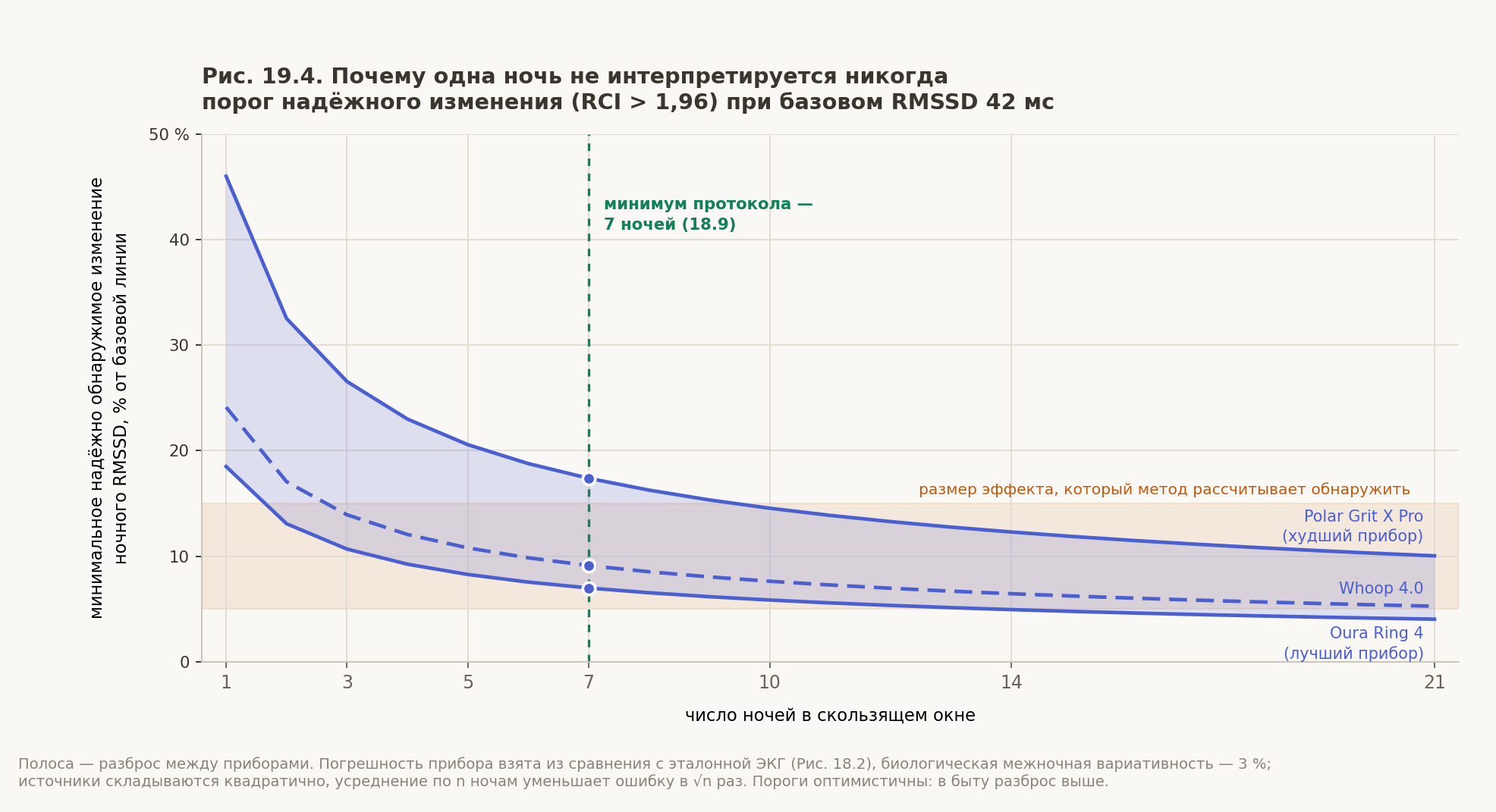
🧭 Three conclusions that follow directly from the table:
- One night is never interpreted.Even the best device requires a one-night shift of 18.5% - no one claims an effect of this magnitude in practice.
- Seven nights is the minimum, not reinsurance.The requirement from Protocol 26.9 (clause 9) receives a numerical justification here.
- The choice of device changes the sensitivity by half.A 7 percent shift is reliably detected on a ring, 11 percent on a watch, and only 17 percent on some devices. This makes the choice of devicemethodological decision, and not a matter of convenience.
27.23.4. RI - retention index, separate from MNPI#
🧭 It is collected from bodily primitivesRI (Retention Index)— index of state transfer outside the session:
RI = ( Cr' · Cs · Rvᵥ' )^(1/3)
RI_score = round(RI 100) # scale 0–100

where Cr' = clip( Cr/c0, 0, 1 ) # c0 - reference shift, e.g. 0.15
      Rvᵥ' = τ0ᵥ/(τ0ᵥ + Rvᵥ) # quick return → 1
      Cs - already at [0,1]
Geometric mean - for the same reason as in 27.9: the transfer is conjunctive. A trace that appears once and is not repeated is not a transfer; stability without amplitude is also not transfer.
⚠️ Constantsc0Andτ0ᵥnot yet determinedand should be fixed according to the reference sample before the first use, and not selected based on the result (the same discipline as forτ0Andd0at 27.8).
27.23.5. Why is the skin layer not included in MNPI?#
🧭 The obvious solution is to add a fifth subindex to the MNPI formula.The method refuses it,for four reasons, each of which is sufficient in itself:
- Different time bases.MNPI meets in six sessions over several days (11/27);
Crrequires a minimum of 7 nights before and 7 nights after. An index, part of which is measured in minutes and part in weeks, cannot be recalculated at one point in time. - Destruction of comparability.The validity condition ΔMNPI (27.14) requires that between measurementsneither the constants nor the composition of the primitives changed. Adding a fifth subindex makes all previously calculated MNPI incomparable with subsequent ones - that is, it destroys the already accumulated data.
- Different levels of evidence.The MNPI subindices are based on EEG, a Class I measurement according to classification 26.3.
CrAndCsrely on night-time optical HRV - class II, with an error comparable to the expected effect. To mix them into one geometric mean means to spread the worse reliability to the entire index. - Different constructs.MNPI answers the question “what does a personcapablewhen he tries". RI answers the question “what happens to him when hedoesn't try" These are not two sides of one thing, but two different things; the formative model (27.4) requires that the index have a single construct being defined.
🧭 The report format is two numbers, not one:
MNPI 63 · RI 41- the ability is expressed noticeably more strongly than transference.
📖 Such a discrepancy in itself is informative and expected in practice: a person can perfectly enter the state during a session and have no trace in everyday life. One mixed score would hide this discrepancy, and would hide exactly what interests the practitioner most.
🔬 Profile hypothesis.If the method works as the author claims, then over a long distance a characteristic sequence should be observed: first MNPI (ability) grows, then, with a delay of weeks, RI (transfer). A reverse order or increase in MNPI with a stationary RI would mean that the skill of taking a measurement is being trained, rather than self-regulation.This is the most stringent internal check that a method can assign to itself., and it becomes possible only if there is a second index.
27.23.6. What is needed for RI to work#
⚠️ Now RI cannot be calculated for any participant: the bodily layer was not recorded instrumentally. List of conditions - in ascending order of cost:
- One device per person for the entire courserecorded in the protocol. It costs zero.
- 7 nights before the first session.It costs one week of waiting and cannot be replaced by anything.
- Daily diary in one line(sleep, alcohol, illness, stress, caffeine) - otherwise
CrIt is impossible to clear the confounds, and here they are larger than the effect. - Chest strap for session and NSI measurement- opens
Dᵥ,Rvᵥand all check from 27.23.2. - Reference sample for
c0Andτ0ᵥ— at least 20 people with complete records; prior to this, RI is considered but not compared between individuals (same limitation as for MNPI scales, 27.9). - Control group- without her
Crremains associative: season, vacation, and changes in sleep patterns move nighttime HRV no worse than practice.
✍️ [To the author - add]:
- Which of the three meanings of “retention”do you mean when you say "about twice"? The answer will determine the wording of the promise in Chapter 3, and it may need to be clarified.
- Any sightings of the trail?— whether practitioners report that the condition “lasts” after the session, and for how long, according to them.
- Are the participants ready?give nightly data and keep a daily diary for seven weeks in a row. This is the main practical obstacle, and it is organizational, not technical.
- Your rating
c0:What increase in nocturnal HRV would you consider a “noticeable footprint” - 10%, 15%, 20%? The number must be namedtodata collection.
27.24. Validation Roadmap#
🧭 Five steps in order of dependence - each next one requires the previous one.
- SEM / ICC.Two measurements on one day without exposure → reliability assessment → RCI threshold. Without this step, longitudinal is meaningless.
- Normalization constants
τ0,d0(Ands0,ρ0) and weightwᵢ— evaluation based on the reference sample, fixing the version of the constants along with the code. - Operational definitions of target states— linking each ONTO mode to the fields and upload thresholds: client name on top, physiology below it.
- Convergent and discriminant validity— correlations with MAIA-2 and IAS, signal quality control as a competing explanation.
- Longitudinal with control group— pre/post programs, pre-registration of hypotheses and analysis plan → firstcausal ΔMNPI.
📖 Step 5 follows the study design from Chapter 30: this is the same pilot, only with MNPI as one of the outcomes. It is wise not to separate them into two different studies.
27.25. Restrictions that will remain#
⚠️ Even with a fully implemented roadmap, some of the restrictions will not go anywhere, and it’s more honest to name them right away:
- Consumer EEG limited montage(4 channels): spatial specificity is low, conclusions are at the level of global dynamics, not localization. No “brain zones” follow from such a montage.
- Closed formulas for derivative indexesdevice - dependence on a third party.
- component-statein a single MNPI: trait level requires averaging over repetitions.
- Causalitygrowth without a control group is unprovable; ΔMNPI remains associative.
- State names - client layer.Each requires an operational EEG definition for publication, otherwise the reviewer will rightly read them as marketing.
27.26. Revision of sources: ten documents and what doesn’t add up between them#
🧭 Everything described in this chapter is collected from the working materials of the method. The materials were written at different times, using different approaches and for different tasks, and theydisagree with each other- not in details, but in determining central values. This section brings the discrepancies out into the open. The reason is simple: until they are named, any person reading the formulas will sooner or later stumble upon them himself, and then the entire chapter will lose confidence. Once named, they turn into a clear list of decisions that the author has to make.
📖 Map of sources.Ten documents showing the measuring circuit of the method:
| Code | Document | Status |
|---|---|---|
| A | "NSI-MNPI Methodology (Complete)" | Canonical.Declares himself a priority in case of discrepancies |
| B | Preprint, definition paper (draft) | Agreed with A |
| C | “NSI checkup, 10 minutes (EC→EO)” | Protocol; subordinate to A, but the formulas diverge |
| D | “7 modes: calculation formulas” | Billed as "the source of truth for code" |
| E | «Indices and Scores» | Analysis of proprietary device metrics and their ranges |
| F | «Neuroplasticity indices» | Review of "Forty Ways to Measure Neuroplasticity" |
| G | «Team MNPI formula» | Command index |
| H | “MNPI is the core of the description, the basis of the standard” | ⚠️ The file is empty.One navigation line; there is no regulatory framework included in the title |
| I | "Phenomenology - text analysis indices" | Reference by text indexes |
| J | Archival "MNPI Scientific Document", version 1.0 | Archive, March 2026 |
⚠️ Central contradiction: the canonical document prohibits what the working code is built on.Source A expressly excludes derivative instrument labels—cognitive score, focus, chill, stress, self-control, anger- from the scientific core, with the wording:“interpretation of the streak attitude as a discrete emotion lacks construct validity”. Source D builds on the same labelsAllmode formulas, and their weight is large: 0.45 total weight in the Pure Nothing mode evaluation, 0.45 in Active Presence, 0.45 in DMN, 0.45 in Quantum Genesis and0,80in Visceral Mind. Consecutive application of priority A devalues the entire computational mode layer; consistent application of D means that the canonical document is not canonical. The fork is real, and there is no way around it.
🧭 Book solution.Priority A is accepted, but not as a ban, but as a separation of layers. Derived shortcuts remainclient layer— they can be shown to the participant, internal product navigation and preliminary assessments of modes can be built on them, butNSIAndΔMNPI, that is, they are not included in what is presented as a scientific result. The mode formulas from D are saved as a working tool with the explicit mark “preliminary, on proprietary indexes.” Practical consequence:the scientific circuit needs raw bandwidth, not manufacturer's indexes, and is a separate clause in the unloading requirements (section 27.21.6).
⚠️ Three incompatible formulasNSI.All three have the same name and give different numbers:
A:  NSI = ( Sp' · Dp' · Mn' · Sb' · RgR' )^(1/5)
B:  NSI = ( Sp' · Dp' · Mn' · Sb' · Rc'  )^(1/k)
C:  NSI = ( Sp' · Dp' · Sb' · RgR' · ReS' )^(1/5)
It is not the normalizations that differ, butface composition. A and B diverge at the fifth facet: holding with eyes open (RgR') vs return (Rc'). C eliminates holdMn'and adds re-stabilizationReS'. There is also a more subtle discrepancy: in A, depth is taken through the 90th percentile of the target phase, in C - through the same EC/EO contrast as reactivityρ; Level estimator in A is the phase average, in C is the median of the truncated window; C additionally excludes the first minute of closed eyes and the minute of transition, A does not stipulate this. Separately: in A valueρ defined, but not included in the formula itself.
🧭 The book uses the A entry as the main one (it is canonical and covers entry, depth, retention, stability and stability with eyes open) and treats C asten-minute check-in procedure, and not as an alternative definition of the same index. This means that the checkup score and the full session score aredifferent quantities and not directly comparable; they need to be called differently, for exampleNSI‑10AndNSI. The same should be done with all future shortened protocols.
⚠️ Three incompatible formulasMNPI.
| Source | Formula | Aggregation type |
|---|---|---|
| A, B | MNPI = Π (Subindexᵢ)^(wᵢ), Σ wᵢ = 1 |
weighted geometric mean |
| J | MNPI = 0,30·SI + 0,35·DI + 0,20·RI + 0,15·PI |
arithmetic weighted sum |
| F, G | MNPI = VB × TE × CF |
product of three factors |
This is a direct clash with the rationale given in A itself:“aggregation is multiplicative (geometric mean), and not the sum of factor loadings”. The rationale is meaningful and worth preserving: the ability to self-regulateconjunctive— deep entry without retention is not regulation, just like retention without entry; the geometric mean is reset to zero if any edge fails, the arithmetic sum is not. The book accepts geometric aggregation (section 27.19) and fixes the arithmetic version of J as archival. I would like to note separately: the archival document itself recognizes a circular reasoning - the weights are selected from the expected importance of the edges, and the importance is justified by the fact that they have large weights; Before factor analysis on a real sample, any weights, including equal weights, are an agreement, not a result.
⚠️ Two incompatible sets of subindexes.A and B operate on a setSwE / StD / RgR / PhC(see section 27.9), J, G and D - setSI / DI / RI / PI. Partial intersection (SwE ↔ SI, StD ↔ DI, RgR ↔ RI), ButPhCAndPIare defined differently, and the weights in the first set are equal by default, in the second - 0.30 / 0.35 / 0.20 / 0.15.
⚠️ Abbreviations clash.It looks like a trifle until the moment when two people start counting using different documents.
| Reduction | Value 1 | Value 2 | Value 3 |
|---|---|---|---|
SI |
Switching Index - switchability (J) | somnological index, sleep (G) | State Integration (F) |
RI |
Resilience Index (J) | "life rhythm index" (G) | — |
DI |
Depth Index (J) | desynchronization (G) | — |
MNPI |
Multidimensional Neurodynamic Plasticity Index (A) | Multidimensional Neuroplasticity Index (J) | Meta‑Neuroplasticity Index (F) |
VB × TE × CF |
Voluntary Baseline × Transition Efficiency × Consolidation Factor - Neurophysiology (F) | Vital base × Task Efficiency × Commercial Factor - command and commercial indicators (G) | — |
The last line is the most dangerous:the formula matches letter for letter, but means completely different things. In one document it is an index of the brain's ability to voluntarily modulate state, in another it is a summary indicator of team performance, including sales. When read out of context they are indistinguishable. All this violates A's own requirement:“One source of truth. Each abbreviation has the same meaning in all method documents.".
🧭 The book uses a setSwE / StD / RgR / PhCAnddoes not use SI / DI / RI / PIat all; The command index has been renamed for its meaning and is not included in the measuring circuit. DecodingMNPIaccepted according to A.
⚠️ What is not in the sources at all.Below are not quibbles, but a list of empty spaces without which indexes are not considered:
- numerical values of normalization constants
τ0,d0,s0,ρ0- in all documents they are indicated by letters and never given a number; - numerical weights
wᵢ— it says “equal by default,” but there is no calibration report; - subindex formula
PhC— the subindex is named and justified, but the method of calculation is not given; - measured
SEMAndICC- doesn't count without themRCI(section 27.13), that is, the change cannot be said to be reliable; - age and gender adjustments- are not mentioned anywhere, despite the fact that
IAFAndHRVdepends greatly on age; - pilot numbers in preprint— in place of the results there are blanks:
n ≈ [N],[__ %],[M ± SD].
⚠️ Separately: thresholdICCin the sources it is named three times and differently - 0.7 in A and B, 0.75 in J. The book accepts0.7 as acceptable, 0.8 as good(by A) and requires that the selected threshold be fixedtodata collection, not after.
🧭 The priority rule that the book applies next.Four points, in order of application.
- In case of divergence of definitions, A applies, except in cases where A is internally inconsistent.
- The calculated mode layer (D) is saved as a product layer, but is marked as built on proprietary indexes and is not included in the scientific circuit.
- Any quantity that has more than one definition in the sources receives a clarifying name in the book (
NSIagainstNSI‑10) - overriding the old name is not allowed because it silently breaks the data already collected. - Any number that is not in the sources does not appear in the book.The empty space is indicated by ✍️ rather than being filled with a plausible value.
27.27. Individual alpha:IAF, IAPFand personalization of stripes#
📖 The entire chapter is based on the alpha rhythm, and the alpha rhythm is at different frequencies for different people. The fixed band of 8–12 Hz is a population average, and for a particular person it is systematically shifted: for one person the peak is at 9.0 Hz, for another at 10.8, and the same band covers different parts of the spectrum for them. The method declares a binding to an individual frequency from the very beginning - source A formulates this directly:“individual alpha peak frequency varies significantly... and fixed boundaries introduce systematic error”. This section outlines the procedure and its boundaries.
📖 Two quantities that are often confused.Individual alpha peak frequency:
IAPF = argmax PSD(f), f ∈ [7; 13] Hz
IAF_CoG = Σ (fᵢ aᵢ) / Σ aᵢ
The first is the frequency of the maximum spectral density in the alpha window. The second is the center of gravity of alpha power, a weighted average over frequencies. They do not match when the peak is asymmetrical or double-humped, and in the sources of the methodthe center of gravity is determined in two incompatible ways; The book uses the notation above - a weighted average over the entire alpha band. The center of gravity value is more robust to noise, the peak value is more interpretable; to personalize the stripes the book takesIAPF, AIAF_CoGuses as a control value: their strong discrepancy is a sign that the recording is bad or the peak is not expressed.
📖 Procedure.Eyes closed; occipito-parietal leads; Welch spectrum; at least two minutes of clean recording after removing artifacts; the search band is 7–13 Hz, not 8–12, otherwise low-frequency peaks will be cut off by the boundary. In the program data, the observed rangeIAPF — approximately 7.4–10.5 Hz, that is, the spread between participants is more than three hertz; with a fixed band of 8–12 Hz at the bottom of this sample, some of the alpha simply does not make it into the measurement.
📖 Stripes according to Klimesh.Personalization consists in the fact that the boundaries of the stripes are counted fromIAF, and not from round numbers:
| stripe | Borders | What is it connected with |
|---|---|---|
| Alpha-1 (lower) | IAF − 4 … IAF − 2 |
general vigilance, nonspecific activation |
| Alpha-2 | IAF − 2 … IAF |
attention to stimulus |
| Upper alpha | IAF … IAF + 2 |
semantic and working memory |
⚠️ There are no personalization rules for theta and beta in the method sources.The theta band is fixed everywhere (4–7 or 4–8 Hz in different documents - a discrepancy in itself), although the lower limit of alpha in a person withIAPF= 7.4 Hz enters the territory that the fixed grid gives to the aunt. This is not a small thing: the separation of modes 1 and 3 (see section 18.19) rests precisely on theta. While there are no rules, the book requires at least reporting: for each calculation, indicate which grid of stripes was used and from whichIAFit is counted out.
📖 Alpha Gravity— the only already personalized device index.Its definition through the individual alpha band looks like this. Individual alpha band width (IABW) is the interval around the peak where the power exceeds half the peak.A1— power from the lower limit of this interval toIAPF, A2- fromIAPFto the top. Then
Alpha Gravity = A2 / A1
that is, an indicator of where the center of gravity of alpha is shifted relative to a person’s own peak. In the documentation of the device there is a direct warning next to it:"without calibration is not interpreted", and there is no good range indicated - only “individually”.
⚠️ Hence it is important for reading any cases. Alpha Gravity — attitude, and it has no upper bound. When lower alphaA1goes to zero, the ratio grows without limit, and values in the tens and hundreds do not mean “the state is a hundred times deeper,” but “there is almost nothing left in the denominator.” AtA1order of noise, the index ceases to be a measurement. Rule of thumb:peak valuesAlpha Gravitynot used as an indicator of achievement— the median by phase is taken, and the next one is necessarily givenA1in absolute units. That is why the record values in the case of Chapter 31 (up to 126.75) are analyzed there as an artifact of division, and not as a phenomenon.
📖 Age dynamics. IAFfalls with age: about 10 Hz in childhood, 10.5–11 Hz in young adulthood, 9–9.5 Hz after age 65. Clinically relevant reference point from the literature:IAFBelow 8.5 Hz in older people with amyloid accumulation is associated with an increased risk of conversion to dementia within two years. For the method, one thing follows from this:in a study with participants of different agesIAFmust be included in the model as a covariate, otherwise the age composition of the groups will be read as an intervention effect.
⚠️ Three restrictions to keep in mind.
First:IAFfixed once per participant- at the initial measurement, under standard conditions, - and then all derivative calculations proceed from it. Error in definitionIAPFjust 0.5 Hz shifts all three bands and, therefore, all the relationships built on them. RecalculateIAFat each session it is impossible: then the ruler changes, and the dynamics will become indistinguishable from the drift of the meter (the same logic as in section 28.5).
Second:IAF- basically a trait, not a condition.It is highly heritable and very stable across repeated measurements. Its trainability, according to available data, lies within fractions of a hertz. Methoddoesn't stateand should not claim to shift the individual alpha peak frequency: it claims to changepower distributionwithin personally defined bands and the speed of transition between modes. These are different statements, and the second is much more defensible.
Third:personality is not removed from the spectrum of peace.Attempts to predict personality traits based on the power of resting rhythms are poorly reproduced; direct testing (Korjus et al., 2015) did not support the predictability of the Big Five traits across the resting spectrum. Anything that looks like “determination of psychotype using EEG with an accuracy of 80–90%” should not appear in the materials of the method. Hence the attitude towards product archetypes of the “Creator/Manager/Geek” type: as a metaphor for a conversation with a participant they are acceptable, but as a result of measurement they are not, and they have a price. A person who has been “typed” by the device begins to behave in accordance with the label; at worst it is a nocebo (“I have a bad alpha”). If archetypes remain in the product, they must be explicitly called a metaphor in the same text where they appear.
⚠️ A ban that applies throughout the entire book.There are no fabricated references in the book: it does not include non-existent publications in journals of the same levelNature Communications, nor numbers derived from such publications. The prohibition also applies to any spectacular correlations found in popular retellings and not verified from the original source; they are not transferred to the book. This applies, among other things, to the numbers found in the materials about the connection between HRV and self-regulation indicators (coefficients of the order of 0.7–0.8 with reference to unspecified works from 2019–2023) and to “prediction accuracies of 78–92%.” Until the original source is opened and read, the number does not appear in the book - even if it is very useful.
27.28. What remains to be written about this chapter?#
✍️ [To the author - add]:
- calibration report:
τ0,d0,s0,ρ0,SEM,ICC, weightswᵢ— with a description of the reference sample and the date of recording; - decision on the fork from 27.20(protocol
EO→EC→EO/ formula abbreviation / two-dimensional profile); - revision of early MNPI(section 27.19): what is deprecated, what is renamed;
- calculation code versionand the rule for indicating it in each report;
- ~~an example of a complete calculation based on real data— from CSV to score~~ —done in part in section 27.21(session 2026-07-19): primitives
A,P,D,Mn,Sbcountedτ↑,Rcand scoreNSI- no, because unloading doesn’t allow it. The item is finally closed at the first session with phase markings; - regulatory guidelines(if they appear): what is considered low, medium and high NSI - currently there is no such data and the 0–100 scale remains relative;
- regulations for issuing results to the participant: what exactly a person sees, in what words and with what reservations.
28. Long-term restructuring of physiology: what changes over weeks and months#
28.1. Thesis: it is not the session that trains, but physiology#
🧭 The previous two chapters answered the question“how to measure one session”. This chapter answers another:what happens to the body if there were dozens of such sessions, and not just one.
The difference here is not in scale, but in subject. Within a session is measuredstate: a person entered alpha mode, held it, exited. Measured after three monthsno longer a condition, but a changed organism— the one whose baseline has shifted, nocturnal autonomic behavior has changed, and the rhythm of sleep has leveled out. The session is a stimulus. The long-term layer is a response to a stimulus.
🧭 Hence the distribution of tasks between devices, which runs throughout Part VIII.It is not a compromise or a consequence of poor equipment, but a conscious design:
- There is enough EEG inside the session.It gives everything you need: the moment of transition, depth, retention, breakdowns, plateau duration. The wearable device in this window is not a “weak device”, it simply does not answer this question (26.2). Demanding that the ring allow a forty-second beta→alpha transition is as pointless as demanding that the EEG show what will happen to a person in a month.
- Outside the session, the EEG does not give anything.It turns off along with the headset. Here the only available tool is a wearable device, and its horizon (nights, weeks, months) exactly coincides with the horizon of the question.
📖 Formally these are differenttime bases of measurement, rather than different levels of quality. EEG operates in windows of 1–4 seconds and has no memory longer than the recording. The night HRV indicator is a 4-8 hour aggregate, and it exists precisely because there is a whole night behind it. Neither of the two devices can be replaced by the other in either direction.
🔬 The long-horizon method application consists of two parts, and they must be checked separately:
- Sustainability.The change obtained in a session does not disappear by the next day, but accumulates: the baseline shifts. This is the horizonU3in terms of section 27.23.
- Extension.Regular change of rhythms affectsmore body systems than initially visible- not only “the brain has become calmer,” but also breathing, nocturnal autonomic balance, sleep regularity, reactivity to stress, and, with initially elevated blood pressure, blood pressure.
⚠️ Immediate restriction to the second part.The statement “affects many systems” is very easy to turn into irrefutable: unless stated in advance,which ones exactlysystems,in what orderAndwhat week, then any shift in any indicator is retroactively declared a confirmation. With 60–70 biomarkers measured simultaneously (26.1), something will always “improve”—this is pure arithmetic of multiple comparisons, not a property of the method.
Therefore, the chapter is structured so that the expansion thesis can befail. Section 28.5 specifies the chronology by week. Section 28.6 collects what the evidence saysagainstapplications. Section 28.7 lists statements that the methodwill not do under any circumstances. Section 28.9 records three predictions with numerical thresholds—before the set begins, not after.
28.2. Why are the indicators different after a month: the baseline itself moves#
🧭 This is the central fact of the entire chapter, and it is counterintuitive:If after a month of regular practice, nighttime HRV becomes different, the most likely explanation is not practice.A person's baseline drifts on its own, and the amplitude of its own drift is comparable to any expected intervention effect.
📖 Seasonality.In a sample of 92,457 Fitbit users (about 33 million daily values, median 320 observation days per person), resting heart rate exhibits an annual pattern with a peak in the first week of January and a trough in late July;amplitude - about 2 beats/min (Quer et al., 2020, PLOS ONE). Oura data reproduces the same picture with the same amplitude, and in the Southern Hemisphere the seasonal cycle is inverted, which excludes an explanation through calendar habits (Koskimäki et al., 2020 - conference abstracts, evidence below).
📖 Own noise.In the same Quer study, the average intra-individual variation in daily resting heart rate was3.03 beats/min, median fluctuation from week to week -3 beats/min, And20% of people had at least one week where their resting heart rate shifted by 10 beats/min or morewithout any interference.
📖 Menstrual cycle.According to 11,590 women and 45,811 cycles (1.24 million days of observation, Whoop): intra-cycle amplitude of resting heart rate -2.73 beats/min, RMSSD — 4.65 ms; minimum resting heart rate on the 5th day of the cycle, maximum on the 26th (Jasinski et al., 2024,npj Digital Medicine). By comparison, the entire expected effect of an eight-week intervention on resting heart rate in the best studies is 2.8–5 bpm (28.5).The cycle phase and the effect of the method are values of the same order.
📖 Age.According to 24-hour Holter monitoring of 260 people aged 10–99 years: by the sixth decade, pNN50 drops to24 %, and RMSSD - up to47 %from young adult values, after which the curve plateaus (Umetani et al., 1998,JACC). On the horizon of one course this is insignificant, on the horizon of many years of observation it is significant.
⚠️ Practical consequence for the method.Determination of the vegetative baseAᵥfrom section 27.23.3 - average overnight RMSSD seven nights before first session - correct asstarting point, but incorrect asconstant. Seven nights in March and seven nights in July are two different seasons, and the method did not create part of the difference between them.
🧭 A correction to the model introduced by this chapter. Aᵥceases to be a number and becomesline:
Aᵥ(t) — expected value of night RMSSD at time t
         in the absence of intervention

Cr(t) = (RMSSD_night(t) − Aᵥ(t)) / Aᵥ(t) # trace relative
# moving basePracticallyAᵥ(t)assessed in one of three ways, in descending order of preference:
| Way | What do you need | When to apply |
|---|---|---|
| Control group | parallel dialing without intervention | control pilot (chapter 30) |
| Own long pre-period | ≥ 8 weeks of recordingtofirst session | N-of-1, introspection |
| Seasonal adjustment according to the population curve | only calendar | the last frontier; removes displacement, does not remove noise |
⚠️ None of the three methods work whenseven nightspre-period. Seven nights gives a starting point, but no slope, and without a slope there is nothing to distinguish an “effect” from a “continuation of an existing trend.”
📖 Regression to the mean.A separate mechanism that gives a false effect even with an ideal device. If a person comes to the method at a bad moment - high stress, low HRV - then the repeated measurement will be higher simply because the first one was in the tail of the distribution. Artifact size:RTM = σ_w·√(1−ρ)·φ(z)/Φ(z) (Barnett, van der Pols & Dobson, 2005, International Journal of Epidemiology). In a simplified form: if the selection is based on a value separated bykstandard deviations from the mean, the expected shift during repetition isr·kSD. With reliabilityr = 0,5and selection by −2 SD “improvement” by1 SDoccurs when there is a zero true effect.
🧭 Three remedies against regression to the mean, all mandatory:randomized control, several basic measurements instead of one(averaging raisesρand compresses the artifact) andBaseline-adjusted analysis of covariance. The pilot's first requirement (Chapter 30) is derived from this as well.
📖 How dangerous is this in practice?Let's simulate one personwithout any interference: only seasonal variation with an amplitude of 2 bpm and diurnal noise with an SD of 3.03 bpm, both parameters from Quer et al. Let’s compare the average resting heart rate for the week “before” with the average for the week “after” after 12 weeks.In 29.5% of runs there is an imaginary improvement of 2.8 bpm or more- exactly the effect size that the method expects to detect. The “week before - week after” scheme in approximately every third case produces the full expected effect of the course with zero true effect.
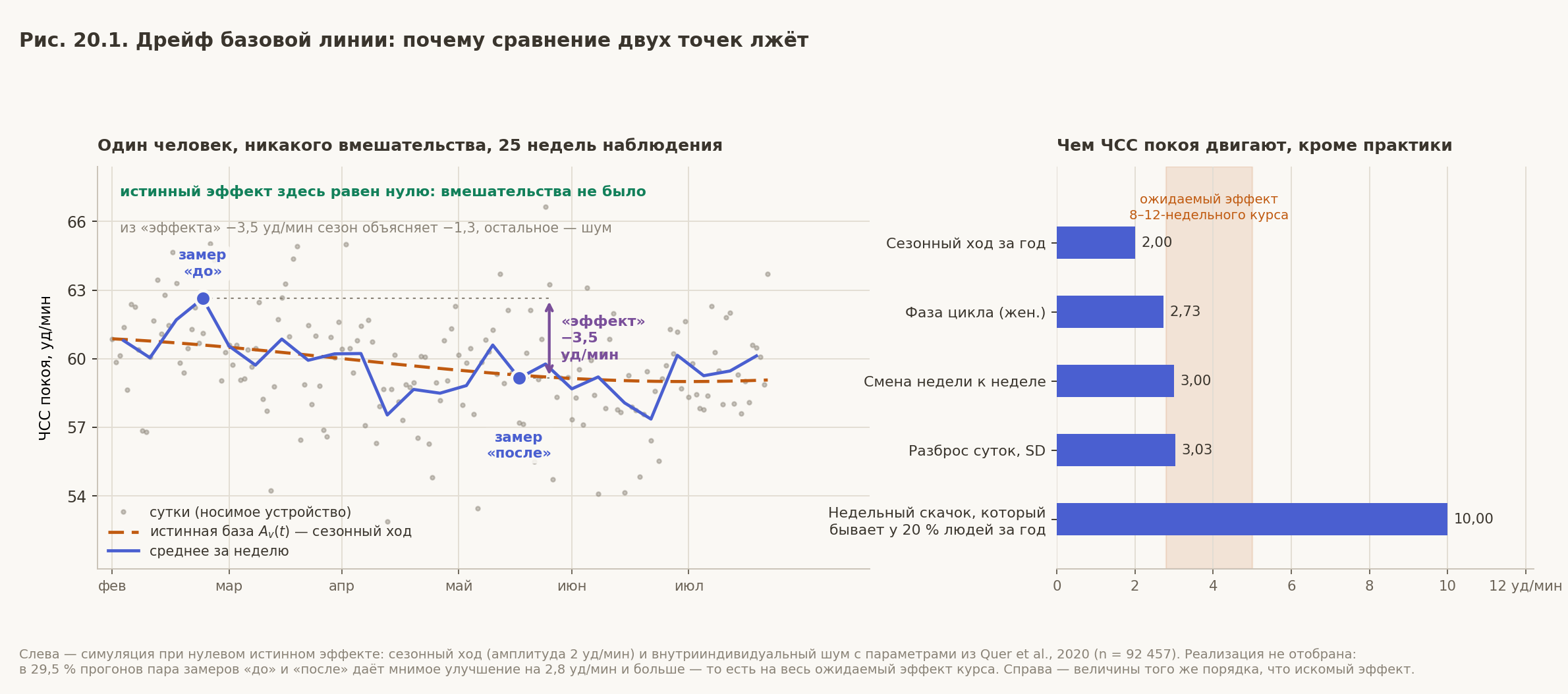
28.3. A trajectory, not two points#
🧭 From section 28.2 the design conclusion follows:comparing “before” and “after” over a long horizon is not just a weak design, but a systematically biased one.It doesn't test the method claim, it tests the difference between two seasons, two phases of a cycle and two random nights. Replacement design -trajectory: many measurements distributed over time and evaluationtilt, not differences.
📖 Why one night won't do.Intraclass correlation (ICC) of nighttime RMSSD from wearable device data in five longitudinal cohorts:0,68(Garmin, n = 717, average 25.6 nights), 0.70 (n = 108), 0.62 (Polar H10, n = 55),0,55(Polar H7, morning measurements, n = 25, 60 am) - against0.89 for weekly averages (Oura, n = 525) (Hernandez et al., 2025, Sensors). Laboratory records give about 0.80.
⚠️ This is the key number of the chapter. With one night ICC 0.55–0.70the difference between two separate nights is even worse reliable than each of them separately— mistakes add up. Averaging seven nights raises the reliability to 0.89 at virtually no cost because the nights are already recorded.
📖 How many nights are needed?For a stable weekly valueLn rMSSDenoughthree valid days a week; then the gain quickly plateaus (quadratic fits r² = 0.92 and 0.97). The correlation of weekly performance with changes in performance increases from −0.02 ± 0.23 for one day to −0.25 ± 0.22 for seven days (Plews, Laursen, Kilding, & Buchheit, 2014,IJSPP). A similar estimate on a sample of 212,048 people: three days gives an ICC ≥ 0.80 for a weekly estimate, five days for a monthly estimate (Yao et al., 2021,Scientific Reports).
📖 What is considered a significant shift?Used in sports physiologyleast worthwhile change(smallest worthwhile change), equal to0.5 interindividual SDand superimposed on the moving averageLn rMSSD (Plews et al., 2013, Sports Medicine). Order of magnitude of the actual trend: an overtrained elite triathlete has a seven-day rollingLn rMSSDdecreased by0.65% per week (−0.17 ms per week)for 77 days, while the control athlete had +0.04% per week (Plews et al., 2012,EJAP). ⚠️ The generally accepted threshold for the minimum detectable change in nighttime RMSSD in milliseconds in the literaturenot found; the lower limit is set by the instrument error - the Oura offset against the ECG according to rMSSD is 2.50–3.79 ms (Liang et al., 2024,Sensors, n = 114).
📖 How many points in time are needed?Interrupted time series is a standard design for evaluating an intervention without a control group. The methodological manual directly states thatthere is no hard minimum number of points (Lopez Bernal, Cummins & Gasparrini, 2017, IJE), but simulation work gives specific figures (Linden, 2025,Evaluation & the Health Professions):
| What to discover | Autocorrelation ρ | Periods required |
|---|---|---|
| Trend change by 50% | 0,50 | 20 |
| Trend change by 30% | 0,50 | ≈ 30 |
| Trend change by 15% | 0,50 | 60 |
| Level change by 30% | 0,50 | 30 |
⚠️ Ibid: research with10 periods "consistently produced unreliable estimates", and the effect sizes in them reachedquadruplerelative to studies with 20 periods. Single case standards requireat least 5 points per phasefor full compliance and at least 3 - with reservations (What Works Clearinghouse, Single-Case Design Standards).
📖 Autocorrelation.Adjacent nights are not independent, and conventional regression on such data underestimates the standard errors, that is, it overestimates significance. Standard tools are Prais–Winsten, Cochrane–Orcutt, Newey–West errors, ARIMA, generalized OLS with AR(1). ⚠️ Rateρimpossible on a short series: with ten points, the predicted 95% confidence interval of first-order autocorrelation occupies the rangefrom −0.53 to +0.93 (Shadish, Rindskopf, Hedges & Sullivan, 2013, Behavior Research Methods). In other words, in a short series, not only the magnitude of the effect is unknown, but also how much to believe it.
🧭 The minimum long-term protocol of the method is the following from these numbers:
| Parameter | Requirement | Where |
|---|---|---|
| Pre-period | ≥ 8 weekscontinuous night recording | inclineAᵥ(t); ≥ 8 week points before intervention |
| Course period | ≥ 12 weeks | 20 weekly points in total ⇒ detectable trend change ~50% |
| Unit of Analysis | weekly average, not a separate night | ICC 0.89 vs 0.55–0.70 |
| Minimum nights per week | 3 valid nights, otherwise the week is thrown away | Plews 2014 |
| Model | segmented regression adjusted for autocorrelation and season | Lopez Bernal 2017 |
| Primary quantity | change in slope, not the difference of means | 28.2 |
⚠️ This is more expensive than “measuring before and after”, but not more expensive in terms of human effort: the ring is already on the finger every night. The road is only herediscipline began- eight weeks of recording before the first session. To date, this pre-period has not been collected from any participant, and this is the main practical break of the entire chapter.
✍️ [To the author - add]Indicate which current members have continuous wearable device recordingtostart working with the method and what depth. Even one person with six months of Oura/Garmin history before the first session closes the pre-period retrospectively and costs more than ten new participants without history.
28.4. Body systems to which the effect reaches#
🧭 Below is a map of what can generally change over the horizon of weeks and months, with an honest assessment of the evidence for each line. Reliability classes (I / II / III) - according to the classification of section 26.3. The “status” column reflects the statusexternalthe evidence base for practices of this type, not the results of the method.
| System | What is supposedly changing | What the device shows | Class | Horizon | Evidence status |
|---|---|---|---|---|---|
| Autonomic regulation | resting vagal tone | night RMSSD, resting heart rate | II | 4–12 weeks | ⚠️ controversial: Two meta-analytic papers report null |
| Breath | decreased resting breathing rate | night breathing rate | II (good) | 8 weeks | moderate: −0.88 breaths/min, d = −0.41 |
| Dream: continuity | Fewer awakenings, faster fall asleep | sleep efficiency, sleep time | II | 2–8 weeks | moderate (subjective ≫ objective) |
| Sleep: regularity | stable departure and rise times | SRI, sleep time range | II | 6–10 weeks | ⚠️ method assumption, no direct data |
| Blood pressure | decrease with initially increased | cuff tonometer (not wearable!) | I (tonometer) | 2–8 weeks | moderate in hypertension, zero in normal |
| Hypothalamic-pituitary axis | reduction of chronic cortisol load | hair cortisol (laboratory) | I | 3–6 months | good is the best proof of a long horizon |
| Stress reactivity | smaller rise in cortisol in response to an acute stressor | laboratory test (TSST) | I | 3–9 months | good, but with an important caveat about modules |
| Inflammation | decrease in IL-6, CRP | laboratory | I | 8 weeks – 6 months | ⚠️ weak / inconsistent |
| Thermoregulation | night skin temperature deviation | ring sensor | III | — | ⚠️ not installed— see 28.7 |
| Body composition, metabolism | — | — | — | — | ⚠️ not installedfor sitting practice |
📖 Autonomic regulation is the most controversial line, and it is also central.The honest picture is this:
- Against.Meta-analysis of 19 RCTs: pooled Hedges g = 0.38 (95% CI −0.014...0.77),insignificant; after excluding the outlier, g = 0.19 (−0.02...0.39), also insignificant; I² = 89% (Brown, Rando, Eichel, Van Dam et al., 2021,Psychosomatic Medicine). The authors' conclusion: "there is insufficient evidence that mindfulness practices increase vagal-mediated HRV." Second meta-analysis (Rådmark et al., 2019,J Clin Med, 10 studies, n = 607): RMSSD g = 0.02 (p = 0.92), SDNN g =−0,55, HF g = −0.21 - all insignificant.
- For.Meta-analysis of slow breathing practices (31 studies, n = 1,133): RMSSDduringpractices SMD = 1.11, RMSSDafterSMD = 0.37 (0.16…0.58, p < 0.01), SDNN after SMD = 0.77 (Shao, Man & Lee, 2024,Mindfulness). In cardiac patients, vagal HRV d⁺ = 0.27 (0.01...0.52), in the biofeedback subgroup d⁺ = 0.31 with I² = 11% (Gathright et al., 2024,J Behav Med).
🧭 How does the method read this discrepancy?Positive results are concentrated where practice includescontrolled slow breathing, negative - where heterogeneous mindfulness programs without a breathing component are compared. This is not an excuse, but a specific indication of where to look: if a method has an autonomic effect, its source is most likely to be the respiratory pattern, and not the “condition itself”. This is precisely why respiratory rate in the method protocol is a mandatory covariate, and not an option (26.5).
📖 Breathing is the most reliable line on the instrument and the weakest in magnitude.An eight-week MBSR program reduced breathing rate by0.88 breaths/minregarding waitlist (Cohen's d = −0.41, p = 0.02, n = 245;Scientific Reports, 2023). Wearable devices measure nighttime breathing rate well: MAE =0.46 breaths/min, r = 0.95 vs. PSG (Natarajan et al., 2021,npj Digital Medicine). ⚠️ But the effect (0.88) is less than double the instrumental error (0.46) and lies within the normal night-to-night variation (CV 4–6% in people under 60 years of age).The group effect is detectable, the individual effect is not.This should be stated directly to the participant.
📖 The hypothalamic-pituitary axis is the best evidence available for a long horizon.Project ReSource (Singer, Max Planck Institute): 332 participants, 9 months, three modules of 13 weeks. Hair cortisol and cortisone decreased over the course offirst 3–6 monthsAnddidn't decline any further- plateau by 6 months. Significance was replicated across all three cohorts (p = 0.010 / p < 0.001 / p = 0.002; ω² = 0.104 for cortisol, 0.036 for cortisone). Critical Details: Effectdid not depend on the content of the moduleAndwas not associated with change in subjective stress, but was associated withfrequency of practice (χ² = 4,46, p = 0,035) (Puhlmann et al., 2021, Psychosomatic Medicine).
🔬 For the method, this is the most informative result in all external literature, and for three reasons. Firstly, it shows thatthe effect horizon is months, not weeks. Secondly, it shows that the effectcannot be read by self-report— a person does not feel a decrease in cortisol load, which means the questionnaire will not catch it. Thirdly, it showsplateau: The effect does not grow indefinitely, and the claim of continuous improvement is patently false.
📖 Stress Responsiveness - This is where ReSource provides something even more useful: selectivity.In the social stress test, the rise in cortisol decreased by32 %after the Affect module, on48 %after the connection Presence→Affect and on51 %after Presence→Perspective.After the Presence module alone - no effect on cortisol, only for self-report. Did not change at all: alpha-amylase, heart rate, HF-HRV, IL-6, hsCRP (Engert et al., 2017,Science Advances, n = 313).
🔬 This is an example of what an honest result of “influencing many systems” looks like.Not “everything improved,” but: one system changed, four did not, and the change depended onwhich one exactlywere engaged in practice. The map of eight ONTO modes (Chapter 18) asserts exactly this selectivity - which means it should be confirmed in the same form: different modes → different systems → different terms. If the method “everything gets better for everyone”, this is not a sign of strength, but a lack of control.
📖 Dream.There is an effect against neutral control: ES = 0.33 (0.17...0.48), I² = 0%, 11 RCTs, n = 939; at a delayed control of 5–12 months it is even higher - 0.54 (Rusch et al., 2019,Annals NYAS). Againstactivecontrol (cognitive behavioral therapy for insomnia) -ES = −0.03 (−0.49…0.43), that is, zerono advantage. ⚠️ And the main thing for the instrument layer: subjective improvement in sleep systematically exceeds objective improvement by 2–4 times. In Ong et al. (2014,SLEEP) the diary showed a decrease in waking time by45.3 minutes, and polysomnography -no intergroup differences. In an eight-week Fitbit RCT (n = 51), the only objective change wasResting heart rate, not a dream.
📖 Sleep regularity- an indicator that the method considers promising, but for which there is no direct data. Sleep Regularity Index (SRI) is the probability of coincidence of the sleep/wake state at two points separated by 24 hours. UK Biobank (n = 60,977, median SRI 81.0; 6.3 years of follow-up, 1,859 deaths) SRI top quintile versus bottom: overall mortalityHR = 0,70(0.59…0.83), cardiometabolic HR = 0.62, oncological HR = 0.76;SRI predicted mortality better than sleep duration (Windred et al., 2024, SLEEP). ⚠️ Two caveats. First:no connection between practice and SRI was found in the literatureis a hypothesis of the method, not an established fact. Second: a stable assessment of regularity requires41–65 consecutive nights(Whoop, > 10,000 people, 3.7 million nights); one week underestimates the range of sleep time by more than 75 minutes. An eight-week course is a minimum sufficient, not a comfortable, horizon for SRI.
📖 Blood pressure.Slow breathing in hypertensive patients: SBP−7.68 mm Hg. Art.(−9.87…−5.49), DBP −4.02, 13 RCTs, n = 1,097 - but I² = 82%. Adapted MBSR in the MB-BP RCT (n = 201): between-group difference in SBP at 6 months−4.5 mmHg Art., p = 0.045, with p = 0.056 in the adjusted post hoc analysis and p = 0.26 in the sensitivity analysis for COVID attrition (Loucks et al., 2023,JAHA). AHA position (Brook et al., 2013,Hypertension): hardware slow breathing - class IIA, transcendental meditation - IIB,all other meditative practices - class III, “not recommended”. ⚠️ Pressure is measuredcuff, and not a wearable device: see 26.8, paragraph 6.
📖 Inflammation.The honest answer here is “unproven.” Preregistered three-level meta-analysis of RCTs only (k = 33, n = 2,880): Hedges g =−0.11 (−0.23…+0.001), p = 0.053 - insignificant; Egger's test p = 0.011 (small study effects); only 16% of works with a low risk of bias, andthe effect was smaller, the lower the risk of bias (Int J Mol Sci, 2023). A broader meta-analysis (48 RCTs, n = 4,683) gives CRP SMD = −0.14 and IL-6 = −0.35, but trim-and-fill compresses CRP (Sanada et al., 2022,Brain Behavior and Immunity). And in direct contradiction: in an RCT of 190 elderly living alone, eight weeks of MBSR versus a matched active controlraisedstimulated with IL-6 (Lindsay, Irwin et al., 2022,BBI).
⚠️ A general pattern that the method must name out loud:in all sections aboveeffect size decreases systematically as the control group is tightened and the risk of bias is reduced. This is the most reliable observation about the entire region, and it is also the most unpleasant. Any application of a method must be based on the assumption that with good active control the effect will be less than in the pilot.
28.5. Chronology: what changes in which week#
🧭 Below is a summary chronology collected from external research. It is needed not as a promise, but asgrid of expectations: if something happens fundamentally earlier or in a different order for a method, this is a result in itself that requires explanation.
| Term | What's changing | Magnitude | Evidence class |
|---|---|---|---|
| Inside the session | Heart rate, RMSSD during practice | RMSSD +4.68 ms (95% CI 2.96...6.38); Heart rate d = 0.45 | 🟢 reliable, reproduced |
| Weeks 1–2 | subjective sleep quality | B = 0,48, p < 0,001 | 🟡 moderately |
| Weeks 3–4 | breathing rate; first intergroup differences in HRV during biofeedback | significance appears in the 3rd–4th week, not in the 1st–2nd week | 🟡 moderate, one RCT (n = 64) |
| Weeks 5–8 | Resting heart rate | −2.8 beats/min (n = 324, 12 weeks) … −5 beats/min (n = 30, 8 weeks) | 🟡 moderately |
| Weeks 5–8 | Blood pressure at baseline hypertension | SBP −4…−8 mm Hg. Art. | 🟡 moderate, strong heterogeneity |
| Weeks 6–10 | sleep regularity (SRI) | — | 🔴method hypothesis |
| Weeks 8–12 | resting night HRV | ⚠️ direct checks yielded zero | 🔴 debatable |
| Months 3–6 | hair cortisol | ω² = 0.104, plateau at 6 months | 🟢 reliable (n = 332) |
| Months 3–9 | reactivity to stress | −32…−51% rise in cortisol | 🟢 reliable, but depends on the type of practice |
| After 6–9 months | plateau | no further decline | 🟢 reliable |
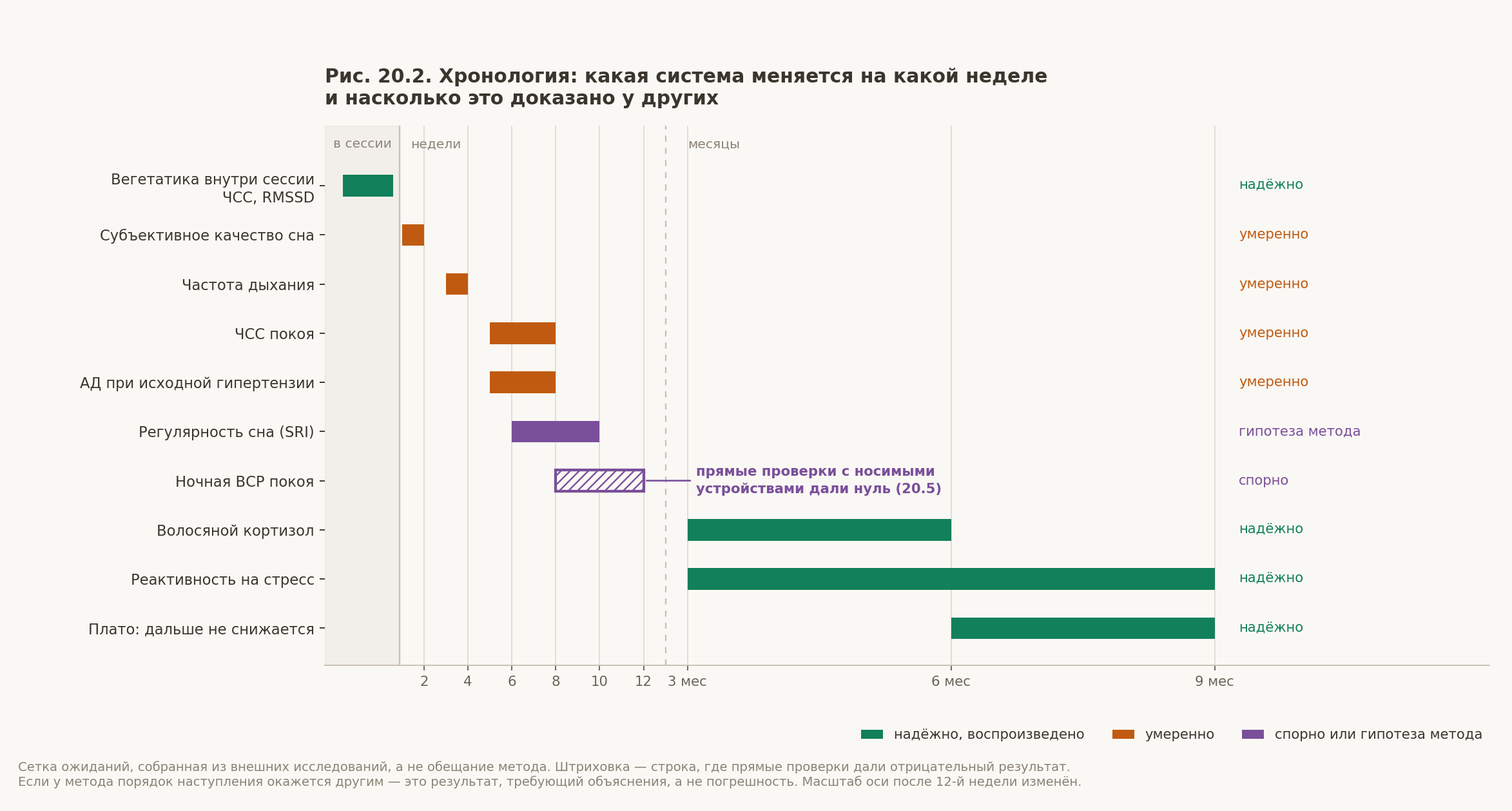
⚠️ The line that requires special attention is “weeks 8–12, nighttime resting HRV.”It is precisely the value on which the entire body layer of the method rests in direct tests with wearable deviceshasn't changed:
- n = 81, Oura Gen3, 10 days of digital practice:duringsession RMSSD increases (d = 0.38), heart rate decreases (d = 0.45) -nocturnal resting HRV and resting heart rate did not changeneither immediately after nor after 4 weeks. At the same time, sleep efficiency increased (Kirk, Hovgaard et al., 2026,Scientific Reports).
- n = 90, Garmin, 3 weeks, 632 labeled sessions:duringpractice RMSSD +4.68 ms (2.96…6.38) with persistence ≥ 30 minutes after;in everyday lifeRMSSD for practitioners is 40.8 (IQR 35.5...44.4) versus 42.0 (34.2...47.8) for controls -no differences, no longitudinal changes over three weeks (Takezawa et al., 2026, JMIR).
- n = 80, 4 weeks, 20 min/day, resonant breathing vs. fixed 0.1 Hz vs. wait list: “the intervention did not lead to significant changes in resting HRV”; RMSSD and HFdecreased in all groups, including control (Sumińska et al., 2026,Scientific Reports).
🔬 What does this mean for the method - and this is perhaps the main conclusion of the chapter.The gap between “in-session” and “at rest” is reproduced so consistently that it should be taken asthe original hypothesis, and not for interference. Formulation:
The horizon gap hypothesis.The state achieved within the session reliably changes the vegetative systemin sessionand doesn't change itat rest- at least on the horizon up to 12 weeks and at a typical dose. The value that is transferred to the long horizon is not HRV, butregulatory burden(cortisol) andbehavioral regularity(sleep, breathing).
⚠️ If this hypothesis is correct, then expecting an increase in nighttime HRV after eight weeks of practice is a mistake, and its absencedoes not refute the method. But then this growth cannot be promised. Section 28.9 makes predictions from the gap hypothesis rather than from the naive expectation that “everything will grow.”
✍️ [To the author - add]Do the existing observation cases include nighttime HRV before and during the course - at least in the form of screenshots of the application? Even anecdotal evidence allows us to see whether the reality of the method fits or contradicts the “weeks 8–12” line.
28.6. What the evidence says against the method claim#
🧭 The section is compiled specifically in this form - as a list against a method, and not as “restrictions”. This fulfills the requirement in Chapter 20 (Ethics of Claims): the opposing side's arguments are presented in their strongest version and in the same text in which the claim is made.
📖 1. Direct tests of HRV give zero.Discussed in 28.5: Three independent studies with wearable devices (n = 81, n = 90, n = 80) did not find a long-term shift in resting HRV. Two meta-analyses (Brown 2021, Rådmark 2019) found no effect in the pooled data.
📖 2. Dose does not predict outcome.Meta-regression of 203 RCTs (n = 15,971): for depression, anxiety and stressthere is no evidence that a higher dose has a greater effect (Strohmaier, 2020, Mindfulness). In a meta-analysis of 58 RCTs on HRV biofeedback, the number of sessions and number of weekswere not significant moderators(Lehrer et al., 2020). The same in the meta-analysis by Goessl et al. (2017,Psychological Medicine, 24 studies). ⚠️ Experimental: in RCT for 71 people5 minutepractice had a greater effect than 20 minutes (d = 2.17 vs. stress d = −1.18)—that is, the relationship is more inverted-U-shaped than linear. This undermines the “more practice → more impact” intuition on which most recommendations are based.
📖 3. Active control eats up the effect.MBSR vs. dose-matched Health Enhancement Program (n = 63, both 8 weeks, 2.5 hours/week, 45 minutes × 6 days of home practice):no differenceson SCL-90-R, anxiety, hostility, somatic symptoms (MacCoon et al., 2012,Behaviour Research and Therapy). Moreover, the initial preference of the participants: 64% for MBSR versus 15% for HEP - that is, the expectation was highly asymmetrical, but the result was not.
📖 4. Neurofeedback literature - direct action prevention.IN6 out of 7double-blind studies with sham feedback found no difference between real and sham neurofeedback (review by Thibault & Raz). In a crossover study in primary insomnia (n = 25, 12 SMR neurofeedback sessions and 12 sham), the trained parameter actually increased with real feedback (19.64 vs. 8.75, p < 0.001),but the improvements were the same in both conditions, and sleep architecture, sleep onset latency and spindles did not change at all (Schabus et al., 2017,Brain). In a meta-analysis of ADHD (13 RCTs, n = 520), the effects for unblinded raters are significant (SMD 0.36 and 0.26), and forprobably blinded - 0.06 and 0.17, both insignificant (Cortese et al., 2016, JAACAP).
📖 5. Structural findings are not reproducible.N=218 (MBSR 75 / HEP 73 / Waitlist 70), 8 weeks:no between-group differencesin the volume of gray matter, its density and the thickness of the cortex anywhere in the brain. A direct unsuccessful replication of the classic work of Hölzel 2011 (Kral et al., 2022,Science Advances).
📖 6. Condition of the area as a whole.Only about 30% of studies of mindfulness-based psychological interventions have progressed beyond the first stage of development, and only9% reached stage 2b(comparison with active control).Less than 25% of meditation studies actively evaluate adverse events— versus 100% in drug studies; spontaneous reporting underestimates the frequency by more than20 times (Van Dam et al., 2018, Perspectives on Psychological Science).
📖 7. Practice may make the condition worse.Prospective sample of 96 participants in an eight-week program83 %reported at least one side effect,58 %- about unpleasant valence,37 %- about disrupting functioning; at6,4 %negative effects lasted from one to five months or longer. Insomnia occurred in less than 5% of the sample, butincreased the risk of persistent negative effects by 6–14 times (Britton et al., 2021, Clinical Psychological Science). In a population sample (n = 434)19,4 %reported sleep disturbances, 10.4% reported symptoms lasting ≥ 1 month, and lifetime practice hourspositivelycorrelated with the presence of side effects (r = 0.14, p = 0.004) (Goldberg et al., 2022,Psychotherapy Research).
🧭 How the method responds to this list.Not a refutation - there is nothing to refute, all seven points are correct. The answer consists of three obligations:
- Active control of equal dose is not an option, but a condition for publishing any number(Chapter 30, paragraph 2). Points 3, 4 and 6 make this requirement unconditional.
- Systematic collection of adverse eventsat each session and in each weekly survey, with a mandatory question about sleep (point 7, chapter 19).
- Predictions are formulated before typing and include a failure condition(28.9). Points 1 and 2 show that “there will be an effect” is not a hypothesis, but a presumption, and it must be broken in advance.
28.7. What the method won't declare#
⚠️ The list is closed and must be followed. Each point statesWhythe statement is unacceptable so that the section can be referred to when analyzing other people's materials and when preparing public texts.
1. Telomeres and telomerase.The method will not claim any effect on telomere length or telomerase activity.
📖 A meta-analysis of 25 studies (n = 2,099) does provide positive pooled estimates - telomere length g = 0.23 (0.07...0.39), telomerase activity g = 0.37 (0.01...0.73), p = 0.046. But right there:only 3 out of 25 papers have a low risk of bias, median statistical power14 %And21 %accordingly, andexpected reproducibility index - 3% and 0%. The effect for telomere length is based on non-randomized retrospective case-control studies; for telomerase, it is based on the absence of active controls. The authors' own conclusion is that telomere length "may not be a useful outcome for assessing the effectiveness" of such interventions (Steinbach et al., 2023,Mindfulness).
📖 The best research in terms of power is zero: Age-Well,n = 128, 18 months, three groups (meditation / active learning of a non-native language / no intervention):no group effect, no time × group interactionby median telomere length, by 20th percentile and by the proportion of critically short telomeres; in all groups the length decreased equally.
📖 Deeper down is the measurement problem: the correlation between qPCR and reference TRF is only ≈ 0.75, the inter-tube CV of the qPCR method is3,97–15,9 %, that isof the same order as the claimed effect (Lai et al., 2021, PLOS ONE). Simulations show that realistic measurement error not only weakens but alsocapable of turning over a signlongitudinal telomere effects (Nettle et al., 2019).
2. Gene expression, NF-κB, “epigenetic changes.”
📖 Support work (Kaliman et al., 2014,Psychoneuroendocrinology) — not randomized: 19 experienced practitioners versus 21 beginners,one eight hour day, control - leisure. The authors themselves admit that the design “did not allow the effects of acute practice and long-term experience to be separated”; changes at protein levels could not be confirmed.There is no independent replication.Second reference work (Creswell et al., 2012,BBI) - n = 40 against a waitlist, and its indicator is bioinformatics statistics of motif prevalence across 256 genes, rather than a direct protein measurement;At the same time, the own CRP outcome in the same work was zero (p = 0,075).
3. Nighttime skin temperature deviation as an indicator of progress.
📖 The instrument sensor is good: Oura resolution is 0.13 °C/min, accuracy within 0.36 °C, r > 0.99 against the standard. But the signal that it catches is illness and the phase of the cycle, and not fitness: the difference between the luteal and follicular phases is0,30 °Cwith daily variation0,20–0,24 °C, that is, the noise is equal to two-thirds of the signal (Maijala et al., 2019,BMC Women's Health). ⚠️ No RCTs have been found showing a shift in baseline nighttime skin temperature with practice.Peripheral warming during relaxation - well documentedspicyeffect; Chronic baseline shift is not.
4. Minutes of deep and REM sleep as an outcome.Systematic shift of wearable devices in deep sleep reaches−25…+73 minutes, according to REM -−14…+15 minutes(six anti-PSG bracelets,SLEEP Advances, 2025). Specificity for wakefulness -0,18–0,54. Total sleep time is measured reasonably (usually 0–25 minutes offset), but stages are not. The indicator is classified as class III (26.3) and is not included in the reports.
5. Blood pressure from a wearable device.Disassembled in 26.8 (FDA warning letter, 8 of 16 devices with bias <5 mmHg). Additionally: even for a specialized controlled breathing device indouble-blind, placebo-controlledRCT (n = 48, 8 weeks) difference was+2.35 mm Hg. Art. in favor of control— that is, there is no effect (Landman et al., 2013,JAMA Internal Medicine); and in a meta-analysis, when excluding studies sponsored by the manufacturer, a significant effect on SBP and DBPdisappears (Mahtani et al., 2012).
6. Body composition and metabolic parameters.There are no data on sedentary practice. The results for yoga (waist circumference SMD = −0.35) do not carry over: there is physical activity involved, and the authors themselves indicate that the effects are “not robust to selection bias” (Cramer et al., 2016,European Journal of Preventive Cardiology).
7. LF/HF as an indicator of “sympathovagal balance”.Rejected earlier on other grounds - see 26.6.
🧭 A rule that summarizes all seven points.The application is valid only if three conditions are met simultaneously:(A)the effect exceeds the instrumental error by at least twice;(b)there is at least one active control study showing it;(V)the horizon on which it appears is known and named. If at least one condition is not met, the indicator can be measured and accumulated, but cannot be included in the result statement.
28.8. Long horizon confounds#
⚠️ There are more confounds over a long horizon than within a session, and they are larger than the expected effect. The table is intended for direct use when analyzing individual trajectories.
| Confound | Magnitude | How is it controlled? |
|---|---|---|
| Season | Resting heart rate ≈ 2 beats/min by year | pre-period ≥ 8 weeks; control group; seasonal member in model |
| Menstrual cycle | Resting heart rate 2.73 beats/min; RMSSD 4.65 ms | recording the day of the cycle; analysis by cycles, not by calendar |
| Disease | respiratory rate +3 breaths/min in 36.4% of symptomatic patients | mark “sick” → week excluded |
| Alcohol | suppresses nocturnal HRV for 1–2 nights | daily mark; exclusion sensitivity |
| Training load | the direction is opposite to the effect of the method | parallel load metering |
| Flights, time zone changes | knocks down both HRV and SRI | mark; week excluded |
| Weight change | systemically shifts resting heart rate | weight once a week |
| Changing the device or firmware | ⚠️ row break | record the date; do not glue the rows before and after |
| Regression to the mean | up to 1 SD when selecting “at the bottom” | control group + several basic measurements |
| Expectation | 64% vs. 15% original preference in MacCoon 2012 | active control of equal dose; measuring expectations at the entrance |
| Changing the recording behavior itself | “observation effect” on sleep and routine | pre-period with the device already on |
🧭 The last line is often missed: a person who starts wearing a ring for the sake of a course changes the regime already from the fact of observation. That's whythe pre-period must come with the device already on, and not start simultaneously with it.
28.9. Three falsifiable predictions for 12 weeks#
🔬 Predictions formulatedtodata set based on the horizon gap hypothesis (28.5). Each includes a condition under which it is considered refuted. All three are tested on weekly aggregates in segmented regression (28.3).
Prediction 1—order of effects.
EEG primitives (
Sp,Dp,Mn— 27.7) will begin to changeearlierthan any nightly indicator of a wearable device. The expected gap is at least 3 weeks.
Refuted if: overnight HRV or resting HR shows a significant change in slopeearlierthan EEG primitives, or simultaneously with them. This is the same criterion as the internal requirement “MNPI must grow before RI” (27.23.5), only transferred to a long horizon. ⚠️ The reverse order would mean that it is not what the method trains that changes: for example, the participants simply began to go to bed earlier.
Prediction 2 is selectivity rather than overall improvement.
By the 12th week will changeresting respiratory rateAndsleep regularity (SRI), Andwon't changenight RMSSD and skin temperature deviation.
It is refuted on both sides. If nothing changes, the application for expansion to other systems is incorrect. If it changeseverything including RMSSD and temperature, is not a confirmation, but a signal of an uncontrolled confound (season, weight change, change of device), and the result is sent for analysis according to table 28.8, and not for publication.
Prediction 3 - dose through regularity, not volume.
The slope of the weekly trajectory will be more strongly related toregularity of practice(proportion of weeks where practice was at least 4 days) than withtotal number of minutes.
Reason: In ReSource, the effect on hair cortisol was associated withfrequencypractices; meta-regressions do not find any dependence on the total dose (28.6, paragraph 2). Refuted if total minutes explain more variance in slope than regularity.
⚠️ What makes these predictions working and not decorative.All three are namedtodata collection and all threeare incompatible with the naive version of the application(“practice makes everything better, and the more practice the better”). If the naive version, rather than these three predictions, is confirmed, the honest conclusion will not be “the method was even stronger,” but “we measured something else.”
✍️ [To the author - add]Check the wording to ensure it matches your understanding of the method. Prediction 2 in its current formrefusesfrom an increase in nocturnal HRV is a conscious choice in favor of what external literature says. If your experience with participants shows otherwise, the prediction needs to be rewritten, but then you will need to explain why the method does something that three independent studies with wearable devices failed to do.
28.10. How this layer is integrated into the report#
🧭 Long lasting layernot includedneither in MNPI nor in NSI and does not mix with them - for the same four reasons as stated in section 27.23.5 (different time bases, destruction of comparabilityΔMNPI, different classes of evidence, different constructs). The report format expands from two numbers to two numbers and one line:
| Component | What is this | Horizon | Form |
|---|---|---|---|
MNPI_score |
neurodynamic plasticity | session | number 0–100 |
RI |
transferring state outside the session | nights to weeks | number 0–100 |
| Trajectory | long-term restructuring | weeks–months | graph with confidence bar, not a number |
⚠️ Why is the trajectory not intentionally collapsed into a score?A single number here would hide exactly the information for which the long horizon is measured:what system changed and when. A "long-term progress" score of 68 is indistinguishable from a season-long score. A graph with a marked start of the course, a confidence band and marked excluded weeks is distinguishable.
🧭 The rule for issuing a result to a participant on this horizon:Until the 8th week, no trajectory numbers are shown at all.Before this date, there are not enough points in the series to distinguish the trend from the noise (28.3), and the number shown will already create anticipation and change behavior. Until the 8th week, the participant sees only the results of the sessions.
28.11. What remains to be written about this chapter?#
✍️ [To the author - add]
- Is there any retrospective data?The key question of the entire chapter is: which of the participants has continuous recording of a wearable device?tofirst session and what depth. One person's six-month history closes the pre-period retroactively.
- Observations on systems.What did you actually see in the participants over the months: did their sleep, breathing, daily routine, and how they felt in the morning change? Even unsystematic observations dictate which rows of Table 28.4 are checked first.
- Adverse events over the long term.Have there been any cases of worsening sleep, anxious activation, or “overtraining” conditions. Section 28.6 (clause 7) shows that in the absence of active questioning, such cases are underestimated by more than 20 times, which means they must be asked explicitly.
- Plateau.Have you observed a stop in progress among long-term practitioners and for how long? External data shows a plateau at 6 months; coincidence or discrepancy with your experience is a meaningful result.
- Different modes - different systems.The selectivity hypothesis (28.4, ReSource parsing) requires that different ONTO modes produce different body traces. Your observations about which regime “leaves behind” what are the material for turning Table 18.18.2 into a long-term version.
- Prediction Solution 2(see note in 28.9).
29. Platform: research tool and intervention part#
29.1. Why does the method need its own platform?#
🧭 The method has a working software platform: telegram bot@Konstantinshel, built-in web application (“Mirror”), generated personal pages, database and automatic interpretation layer. This is not supporting infrastructure or a storefront. Platform -part method and part research at the same time, and it is this duality that requires a separate chapter.
The first role is obvious and does not raise questions: the platformcollects data. Without it, research into the method would be reduced to what the presenter remembers about the participant and to scattered files. With it, something appears that the method would not have otherwise: a single participant identifier, dated records, machine-readable checkup results, repeatable index calculation procedures, a history of changes over time. Everything that is described as measurable in the modes chapter (18) and in the measurement chapters (24–28) is measurableHere- or nowhere.
⚠️ The second role is inconvenient, and the book must name it directly: platformitself is an interference. She writes a message to the participant, shows him an interpretation of his own measurement, sets tasks, reminds him about payment, gives him a rank (“master”, “beginner”, “red zone”), and tells the story of his week about him. All this influences what the participant will do next - and, therefore, the next measurement. An instrument that measures and at the same time influences does not cease to be an instrument, but requires a separate conversation about what exactly it measures.
📖 In clinical research methodology this is calledmeasurement reactivity: The very fact of observation changes the observed behavior. The classic answer is blinding (the participant does not know which group he is in or what the device showed). The platform is arrangedin exactly the opposite way: it exists so that the participant recognizes his result and reacts to it. This is not an implementation defect that can be corrected; it is a design decision built into the design. It follows from this that some of the claims of the method cannot be tested on this platform in principle, and Chapter 30 has to build a research design taking this limitation into account.
🧭 Hence the rule that this chapter uses to the end:describe the platform as it exists in code, and not as it is convenient to represent it. All numbers, formulas, thresholds and data volumes below are taken from the repository and from disk, and not from plans. Where the code diverges from the book, the discrepancy is shown rather than smoothed out (Section 29.8). Where what is stated does not work, it is said so (section 29.10).
29.2. The outline as a whole: what is collected, where it lies, how it is interpreted#
🧭 The platform is designed asfive-stage closed loop. Data enters from the participant, settles in storage, goes through calculation, receives a verbal interpretation and is returned to the participant - after which he takes the next step, and the cycle repeats. The fifth stage is connected to the first: it is not a flow, but a loop.
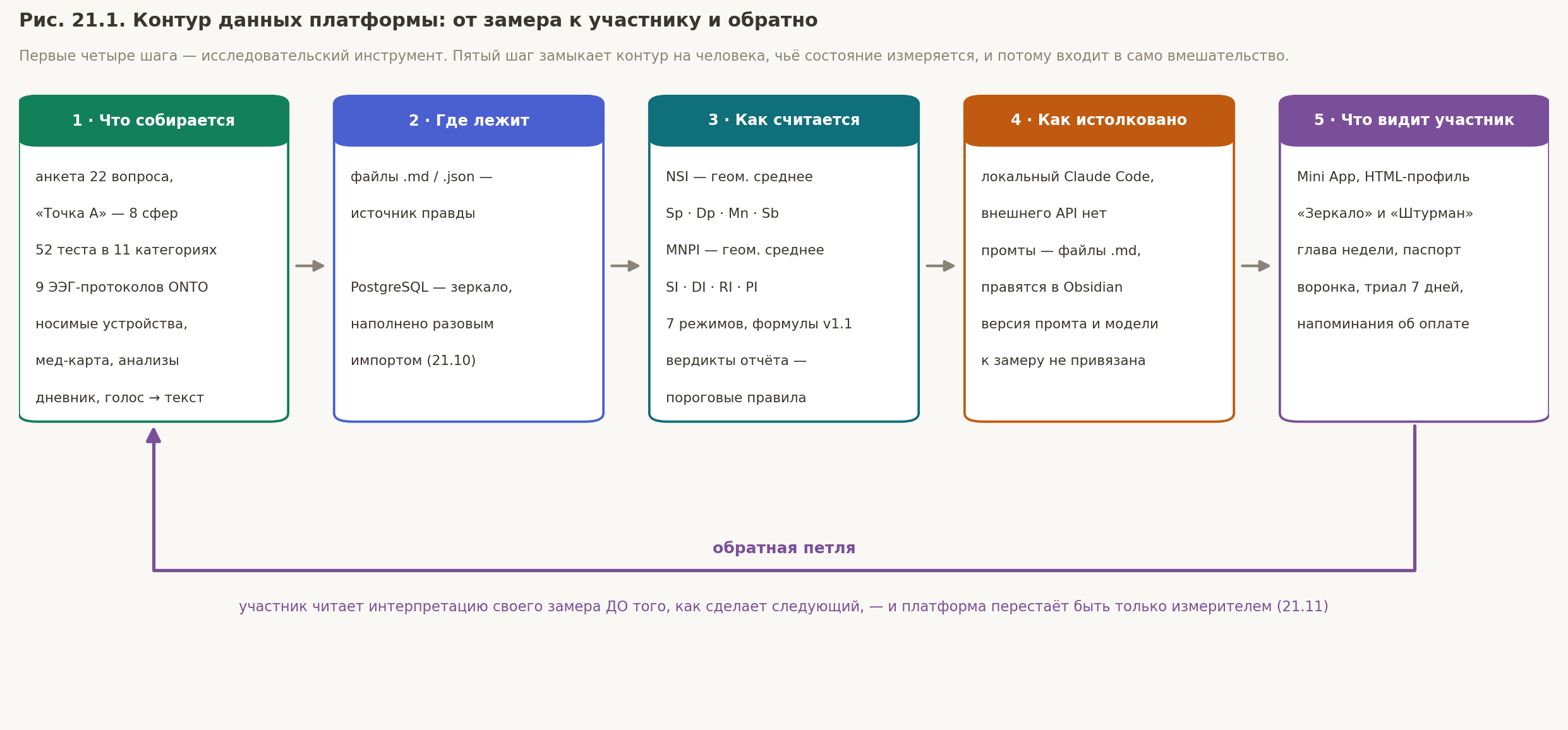
What's going on.Five independent streams: registration questionnaire of 22 questions; “Point A” - eight sources of the original slice (see 29.3); 52 check-ins in 11 categories (29.4); nine EEG protocols ONTO (29.5); wearable devices, medical records and tests (29.6); diary - text and voice with automatic transcription (29.7).
Where it lies.Source of truth -files: .mdfor text,.jsonfor structured,.csvfor device uploads, each participant has a separate folder with his telegram identifier. In parallel, the PostgreSQL database was deployed as a mirror. How full this mirror actually is is the subject of section 29.10; At the time of this edition of the book, the mirror is written and deduplicated correctly, with one small discrepancy in quantities, which section 29.10 explicitly calls out.
How is it considered?From the minute-by-minute data of the device, NSI is calculated - the geometric average of the four faces; from a set of sessions - MNPI as the geometric mean of three or four axes; each of the seven ONTO protocols hasmineformula set on top of general NSI; two MIX protocols (7+7 and 15+15) have a common formula set with Transfer Index - transfer of state between phases (29.5); the report produces verbal verdicts based on threshold rules.
How interpreted.A language model works on top of the numbers -local Claude Code on the author's machine, without accessing an external API(this is a decision in principle, not a temporary one; see 29.9). Promts are mainly stored in separate files and edited manually; the part for ONTO protocols is built directly into the handler code and is corrected along with it (29.9).
What the participant sees.A mini-application of five tabs - Mirror, Checkups, Planning, Profile, Market; personal HTML page; weekly “hero book chapter”; onboarding funnel, weekly or monthly trial and payment reminders. A separate advisor widget “Navigator” existed inside the Mirror and was removed on August 1, 2026: the AI reflection section now names facts in a logical-historical manner - what followed what and what coincided with what - but does not give advice or assign tasks using buttons (action buttons were removed earlier, on June 30, 2026). Below in the chapter, where the impact contour is discussed (29.11), this changes the wording, but does not remove the question: the platform still interprets the measurement to the participant until the next measurement, just by different means.
The sixth thread, not described above.In addition to five streams about the participant’s condition, the platform keeps track of hiswork/business sphere— eight categories (content, attraction, sales, product, research, development, operating system, personal), which include everything that a person uploads by voice or text about his affairs; the same contour builds from this a radar “where attention goes” and shows it to the participant. Separately from the circuit of one participant, the platform leadsexternal, partner circuit — network/: a summary table of check-ins for all participants, updated with each generation of profiles, and analysis of correspondence with project partners as a source of data about tasks and goals. This is exactly the automatic summary of completeness that the earlier edition of the book asked for (10/29) - it already exists, although not in the format of a scientific application, but in the format of a working team dashboard.
⚠️ Closing the loop is the main methodological feature of the circuit.The participant reads the interpretation of his measurementbefore thatas the next one will do. It is impossible to separate “change from practice” and “change from what the person was told about his previous measurement” using these data. The platform ceases to be just a meter at the moment when it first shows the result - but it always shows it.
29.3. “Point A”: eight sources of the original slice#
🧭 Before measuring anything in dynamics, the method recordsstarting positionparticipant - “Point A”. This is not one questionnaire, but eight sources, each of which covers its own side of life and is filled out separately:
| Source | What does it give? | Type |
|---|---|---|
| Large participant questionnaire (22 questions) | Context: who, where, why they came, what they want to change | sustainable |
| Fitness tracker | Accessing the Long Physiological Horizon (Chapter 28) | state |
| Psychological checks | Psychometric profile (29.4) | sustainable |
| Before photo (face and body) | External fixation of the starting point | state |
| Regular diet | Nutrition as a foundation and as a resource | state |
| Geolocation | Time zone, climate, rhythm of place | sustainable |
| Finance | Financial burden as a background to stress | state |
| Telegram channel of the participant | Public speech about yourself before starting work | sustainable |
📖 The meaning of such a set isnot completeness for the sake of completeness, but protection against false attribution. If after two months a participant's nocturnal HRV has increased, the question “is this practice or did he move, change jobs and sleep two hours more” should have an answer from the data, not from memory. The eight sources are eight places to catch a competing explanation.
⚠️ In practice, “Point A” is completely filled by units. The completeness of each source is analyzed separately in 29.10, and the picture there is “a wide funnel, a narrow dimension.” While this is the case, any claim of causality in method research relies on a small subsample rather than all participants.
✍️ [To the author - add]A decision is needed: what minimum set of “Point A” sources is considered sufficient to include a participant in the research sample. Now there is no threshold - anyone who has at least one EEG recording is included in the sample, and this weakens all conclusions.
29.4. Fifty-two checks in eleven categories: state and trait#
🧭 The psychometric part of the platform is built ascategory register, not as a list of tests. A category answers one question about a person, tests inside it look at this question from different angles, and a summary report for the category looks forgaps between them— a discrepancy between two optics is considered more informative than a coincidence.
| Category | Tests | Compound |
|---|---|---|
| Personality | 2 | Big Five (IPIP-50); "I'm Mental · Six Layers" (author's voice) |
| Psychophysiology | 4 | MEQ; MCTQ (social jet lag); ISI; MAIA-R |
| Anxiety | 7 | GAD-7; PHQ-9; PSS-10; FAS; CFQ-7; RRS; ATQ-30 |
| Consciousness | 2 | MAAS; MPE-92M |
| Productivity | 11 | HAKEMP-90; Grit-S; PsyCap HERO; GPS (procrastination); ZTPI; Career anchors; EOR; ASRS; CBI; “Rhythms of Life” Point A and Point B |
| NEIRY · eyes closed | 3 | Pure Nothingness; Alpha-theta crossover; Visceral presence |
| NEIRY · open eyes | 4 | Open presence; Receiving insights; Focused presence; Working mode |
| NEIRY · MIX | 2 | From nothing to presence 7+7 and 15+15 |
| Med card | 6 | DNA test; tests; medical history; medications and supplements; current complaints; more about health |
| Point A | 8 | See 29.3 |
| Express | 3 | PHQ-9; GAD-7; PSS-10 (repeat for quick measurement) |
| Total | 52 | of which49 different— the express kit duplicates three tests from “Alarm” |
📖 The state/trait division in the registry is not decorative.Each checkup is assigned a type. The state fluctuates: PHQ-9 and GAD-7 ask about the last two weeks, PSS-10 - about the month, ISI, CFQ-7, ATQ-30, PsyCap and CBI change from period to period. Trait changes slowly or not at all: Big Five, ZTPI, career anchors, Grit, chronotype, MAAS, MAIA-R.
🧭 This follows the reading rule built into summary reports:the “state ↔ trait” divergence is read differently than the divergence of two traits. A high trait in a low state is “the ability is there, but is not being realized now,” this is reversible. The divergence of two stable features is a structural gap, and it will not close so quickly. This is fundamental for the method: it claims to changeregulation of conditions, and not character, and therefore is obliged to wait for movement precisely on state scales, and not on trait scales.
🔬 Verifiable consequence.If the method works as it claims, then on the course horizonstate scales should move, but trait scales should not. The opposite pattern (the Big Five moved, the PSS-10 did not) would indicate either a measurement error or that something is happening that the method does not describe. It is a cheap and rigorous test: it does not require a control group and relies on instruments with known test-retest reliability.
⚠️ Half of the register -validated international questionnaireswith known norms and psychometrics (Big Five, GAD-7, PHQ-9, PSS-10, ISI, MEQ, MCTQ, MAAS, MAIA-R, Grit-S, ZTPI, ASRS, CBI). The other half isauthor's method tools(“I Mental · Six Layers”, “Rhythms of Life”, ONTO EEG protocols), which have neither norms nor published reliability. It is acceptable to mix them in one list; mixing them in one output is a no. Every statement in the book must be traceable to the specific instrument on which it is based.
✍️ [To the author - add]Russian adaptations: translations were used for some of the scales, whose validation on a Russian-speaking sample requires reference. You need to indicate for each which version you took.
29.5. Nine EEG protocols ONTO#
🧭 The eight modes of Chapter 18 are a state map. The nine platform protocols arerecording procedures: each has its own duration, its own instructions, its own set of formulas and its own separate report engine. The correspondence between them is incomplete, and they should not be confused.
| Protocol | Code | Eyes | Duration | Main metric | What counts as success? |
|---|---|---|---|---|---|
| Pure Nothing | MPE | closed | 25 min | CS Pure Nothing index | Objectless emptiness; separate detector “real MPE vs. snooze” |
| Alpha-theta crossover | ATS (GENESIS) | closed | 50 min | TAR = theta/alpha | Theta dominates over alpha with intact alpha substrate |
| Visceral presence | V-MPE | closed | 25 min | V-MPE Index, “Contact” | Silence of the mindWithmaintaining contact with the body |
| Open presence | OP | open | 20 min | OP Index, Openness Index | Alphasavedcontrary to the Berger effect |
| Receiving insights | TIS | open | 25 min | TIS Index, burst detector | Theta dominance with eyes open; receiving finished content |
| Focused Presence | FP | open | 25 min | FP Index, alpha_gap_pct | Alphasuppressed; frontal theta increases |
| Working mode | TFS | open | 30 min | EIS, TFS Index | Involvement in a task without loss of self-control; flow vs afterburner |
| From nothing to presence | MIX 7+7 | closed → open | 14 min | Transfer Index | Transferring the state through opening the eyes |
| From nothing to presence | MIX 15+15 | closed → open | 30 min | Transfer Index | The same for double the duration |
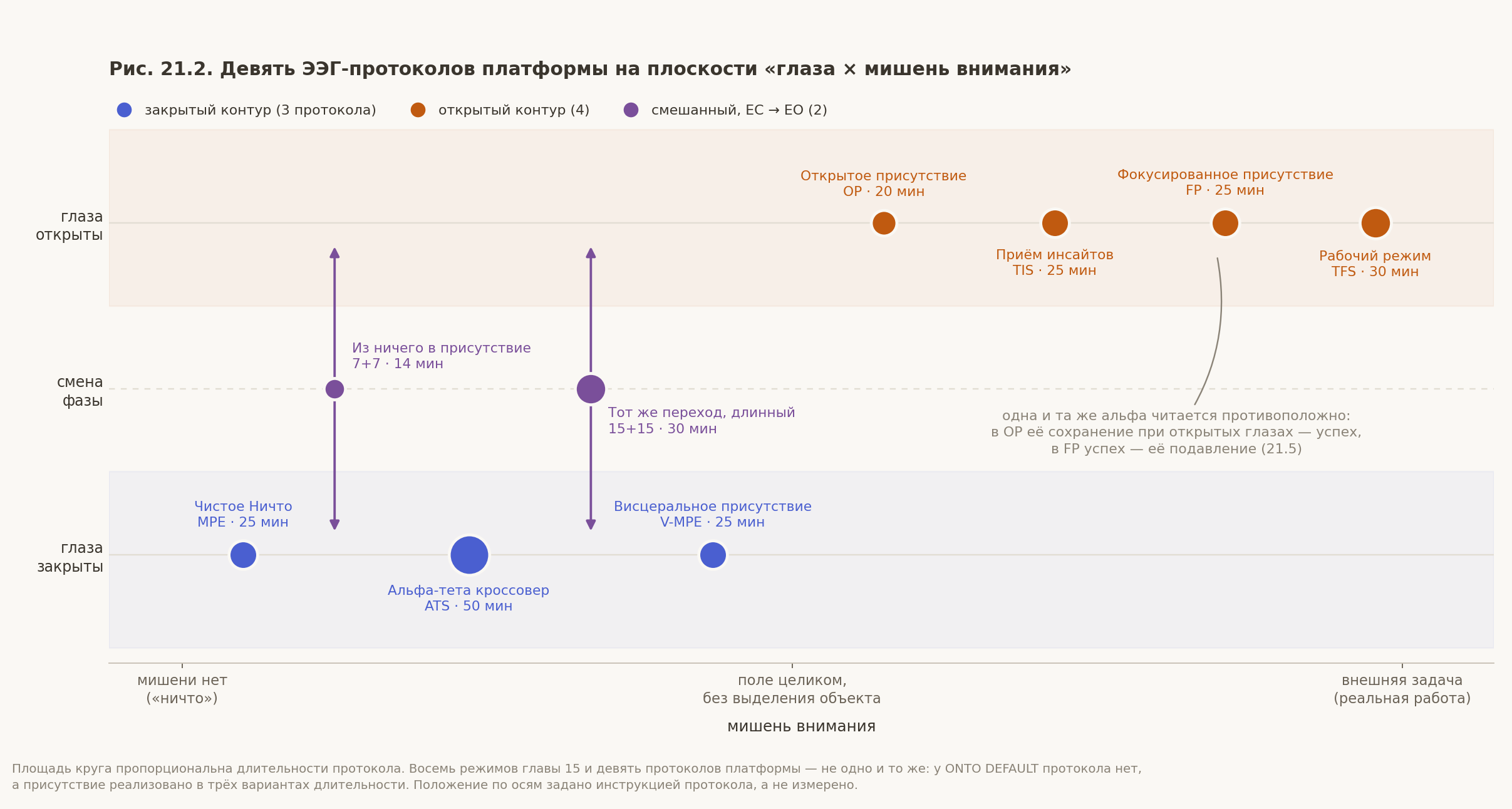
📖 The key principle of the system is protocol-dependent interpretation of the same column.The alpha rhythm is normally suppressed when the eyes are opened (Berger effect). In the OP protocol, saving it with open eyes issuccess; in the FP protocol, exactly the opposite is considered success - its suppression, because attention is held by an external object. Columnfocusin all protocols it reads as “internal dialogue” and the low value is readin plus- except for the only TFS protocol, where highfocusmeans “attention is kept on task” and that’s good. Theta in MPE should decrease, while in FP it should increase (the increase in frontal theta along with goal retention is described in Jensen & Tesche, 2002).
🧭 From here -a rule without which the entire system falls apart: the same number from the same column means different things in different protocols. Comparing “Ivanov’s alpha in OP” with “Petrov’s alpha in FP” is pointless. The only quantity comparable between all protocols isNSI, because it is calculated in one column (relaxation index) in the same way everywhere and describes not the quality of the state, but self-regulation as such (29.8).
⚠️ Honest restrictions fixed directly in the code.The mobile application of the device does not provide the SMR range (12–15 Hz) and channels C3/C4 - only aggregated alpha/beta/theta; therefore, in the visceral protocol the columnself-controlused asproxyvagal grounding, not as a measurement of it. The Alpha Gravity value is only available in the capsule version of the device; she's on her mobileapproachingHowrelax/2.5. The Openness Index is calculated from a fixed norm of 0.58, and not from a personal baseline, and is marked in the interface as an estimate. The insight burst detector works on minute-by-minute data, while the original source talks about a subsecond gamma-ray burst - this is also a proxy. All four reservations were made voluntarily by the developer and included in the interface; the book repeats them because they limit the power of the conclusions.
⚠️ Internal name discrepancy.The same protocol is called “Theta Dominance” in the check-in registry, and “Alpha-Theta Crossover” in the report engine; the old name "ONTO THRESHOLD" is declared non-canonical, but appears in history. For the book this is a small thing, for reproducibility it is not: if an external researcher receives an upload, he will need an unambiguous dictionary of protocols.
📖 The hypothesis for which MIX exists at all is already being measured.Two mixed protocols (7+7 and 15+15) check not depth, buttransfer: whether the state typed with the eyes closed is preserved after opening them, and whether the preservation depends on the duration of the typing. MIX has a formula set -Transfer Index: geometric mean of three phase 2 to phase 1 peak ratios - relaxation index, alpha and subjective feeling of calm - translated into percentages and verbal verdict on thresholds 80 / 65 / 50 (from “very smooth transition” to “hard”). The same calculation works for both durations, so the hypothesis can be tested directly on the data already collected: if participants with 15+15 have a consistently higher median Transfer Index than participants with 7+7, doubling the duration is justified; if there is no difference, “longer” does not mean “stronger”, and the 15+15 protocol is redundant. This analysis has not yet been carried out - this is the first thing that needs to be completed, and not the formula itself.
29.6. Wearable devices and medical card: long horizon inside the platform#
🧭 Chapter 26 divided the devices by horizon, chapter 28 described what happens over the weeks and months. The platform is where this long horizon becomesdata, not reasoning. There are four different ways that work. Three - manual file export: Garmin Connect and WHOOP via ZIP archive, Apple Health via XML upload; each is decomposed into daily indicators (recovery and sleep) and training, the procedure is idempotent - repeated import does not produce duplicates, but updates. The fourth, the NEYROX partner tracker, works differently: the participant enters the login and password for the device application once, and then the platform itself collects data via the API every fifteen minutes, without human intervention.
📖 The value here is not in the numbers themselves, but in what appearscontinuous base, relative to which any individual measurement is read. Without it, “RMSSD 46 ms” is a meaningless number; with it - “12% above the participant’s own moving baseline,” that is, the valueCr(t)from section 28.4. Baseline drift (28.6) can besubtractonly where the baseline is stored.
🧭 Medical card - six sources (DNA test, tests, medical history, medications and supplements, current complaints, additional health information) - closes another task:ruling out competing explanations and controlling for safety. Thyroid status, taking beta blockers, antidepressants or stimulants, iron deficiency - all this moves HRV, sleep, and subjective scales more strongly than practice. Without this section, any improvement remains unattributed, and any worsening remains indistinguishable from a side effect of the drug.
⚠️ That's how it's designed; The picture on the disc is mixed.Folderfitnesswith at least one filesevenparticipants out of 166, real machine-readable file export - fromtwo(Garmin and WHOOP one each), the other five have screenshots of the application. Separate from the file outline -twoparticipants on the NEYROX automatic survey: due to the fact that data is collected via API every fifteen minutes without human action, over 53,000 individual measurements have accumulated between two people. Clinical tests uploadedfiveperson out of 166. The medical card is filled out less than all other sections, and within it the section for current complaints is filled out least often - for one person; three indicated medications and supplements.
This is a direct consequence:Today the platform does not fulfill its function of confound controlaccording to the vast majority of participants, and the continuous physiological horizon of Chapter 28 rests on four - two with manual export and two with automatic polling. As long as this is the case, honest wording in research materials is “the pharmacological status of the participants is unknown,” rather than silence. The screenshot, by the way, is not useless: it confirms that the person is wearing the device, butCr(t)you can't count on it.
✍️ [To the author - add]A mandatory minimum medical card is required to participate in the research part: at least medications and known diagnoses. This is now an option; this should be a condition for research.
29.7. Diary, voice and transcript#
🧭 The diary stream is the platform’s largest and most underrated source. As of July 27, 2026, the participants’ folders contain1,011 entries from 39 people, the first dated March 30, 2026. Entries are marked by type: morning, evening, flow, “I am Mental”, rhythm check, rhythm training, unloading, practice.
📖 The main observation about this flow is not volume, but origin.From 1,011 entries819 (81%) - voice transcripts, not typed text. The de facto platform diary isvoice instrument, which an overnight process turns into text by automatic transcription. This changes what the data is:
- Oral speechnot editable. It contains reservations, pauses, self-interruptions, returns - things that a written record clears out. This is an advantage for phenomenological analysis.
- Decodingmakes its own noise: recognition errors, lost intonation, incorrect segmentation. For quantitative text analysis, this is a limitation.
- Duration and recording breaks -also data. A layer where a person has nothing to say is considered more informative in the author’s checkup “Six Layers” than a layer where he speaks for a long time.
⚠️ Hence the corollary for any text index that the method wants to build:it is impossible to calculate lexical metrics from transcripts in the same way as from written text, and you cannot mix in one calculation those 19% of records that were typed by hand with the 81% that were dictated. If such an index appears, the origin of the record must be a covariate in it.
🔬 Diary is the only source of the subindexPI (phenomenology)in the MNPI production formula: the language model reads the participant's texts and produces a number. This has a direct corollary, which is discussed in 29.8:for a participant without a diary, the phenomenology axis simply disappears from the calculation, and its index is calculated along a different number of axes than that of the participant with the diary.
29.8. NSI and MNPI: production versus chapter 27#
⚠️ This is the most awkward section of the chapter, and it's necessary.The formulas that work in the platform code are not the same as those described in Chapter 27.Below is a direct comparison; it cannot be smoothed out, because all the numbers that the platform has already shown to participants are calculated as the production version, not the book version.
NSI.Book (27.7) describesfivedynamic primitives: entry speedSp, depthDp, holdMn, return speedRc, stabilitySb. The code countsfour — Rcmissing from the production formula:
NSI = (Sp · Dp · Mn · Sb)^(1/4) · 100

A = average of first 3 minutes (baseline)
P = 90th percentile (working peak, not an outlier)
D = P − A ;  Drel=D/A
t↑ = first crossing of level A + 0.63 D
Sp = 8 / (8 + t↑)
Dp = Drel / (Drel + 4)
Mn = average elevation of plateau over A divided by D
Sb = 1 − SD(plateau) / average(plateau)
🧭 What should be recognized as strong here: the thresholdA + 0,63·Dis the level of one time constant for exponential output, that ist↑really estimates τ, not "time to maximum"; The 90th percentile, instead of the maximum, protects against a single artifact; geometric mean means that a dip on any edge pulls the index down and cannot be compensated for by another edge. Constants8And4 — free scale parameters, specifying what entry time is considered “average” and what relative depth is considered “full”; they are not brought out, but selected.
MNPI.Book (27.9) describes four subindices - SwE, StD, RgR, PhC - and aggregation by geometric mean. The code counts four others:SI(speed),DI(depth),RI(hold),PI(phenomenology) - and does the following with them:
| Step in code | What's happening | Methodological price |
|---|---|---|
SESSION_WEIGHTS = [1,0; 1,2; 1,5; 1,5; …] |
Late sessions weigh more than early ones | Weightsnot withdrawnout of nowhere; manually selected |
DI_final = max(di_vals) |
Depth = best session ever | Monotonous artifact: the more sessions, the higher the maximum - even with random data |
RI_final = RI_base + max(0; 15 − SD) |
Increase up to +15 for stability | Additive surchargeinsidegeometric scheme |
composite += min(12; (peak − 10) 1.5) |
Increase up to +12 for exceptional depth | Second additive over composite |
PIonly turns on if it is “real” |
Without a diary, the axis disappears | The composite is considered3 or 4 axesfrom different people |
⚠️From this table follow four specific defects, which the book must call by its proper name.
The first is a variable number of axes.The geometric mean of three axes and four isdifferent quantities on different scales. A participant without a diary and a participant with a diary receive numbers that cannot be put in the same table, much less subtracted from each other. The motivation (“the absence of a diary should not drag down the result”) is understandable and humanly correct, but the decision breaks comparability.
Second -maxas an estimate of depth.The sample maximum increases with sample size for any distribution. A participant who completes nine sessions will receive a higherDIthan a participant with three,even if neither of them learned anything. This is not a measurement of progress, but a measurement of the number of attempts. A correct replacement is a robust upper estimate (for example, the 90th percentile by session, as already done within NSI) or an explicit correction for the number of sessions.
The third is additive bonuses in a geometric pattern.The meaning of the geometric average is that failure on one side cannot be bought by success on the other. Two increases - up to +15 and up to +12 - return exactly this opportunity and make the final number not an average, but an average plus a bonus. If awards are meaningfully needed, they should beindividual declared valuesnext to the index, rather than disappearing into it.
The fourth is rank thresholds.Boundaries 75 / 60 / 45 / 30, giving the labels “master”, “experienced practitioner”, “practitioner”, “beginner”, “red zone”,not removed from the distributionand are not calibrated against external criteria. This kind of label sends a strong message to the participant; strong messages require reasons.
🧭 What to do about it.Do not rewrite history: the numbers already shown to people will remain as they are, they are versioned by the fact of time. But the book and the code needgeneral formula, and the discrepancy should close in the direction of the book - because the book is obliged to explain where each multiplier comes from, but the code does not have such an obligation. Until then, all MNPI figures appearing in Chapter 31 and in the platform materials should be read asproduction version v1.1, and not as an implementation of the formula from Section 27.9.
✍️ [To the author - add]The solution for each of the four points: (1) a fixed number of axes or clearly different scales for axes 3 and 4; (2) what to replace it withmax; (3) move bonuses outside or remove them; (4) on which distribution to calibrate the rank thresholds. After the solution, there is a single version of the formula in the code and in the book, with a version number in each saved entry.
29.9. AI layer: local model, industrial files, reproducibility#
🧭 A language model works on top of all numbers, and in the platform it is arranged non-standardly:there are no calls to external API at all. All generations are calls to the local Claude Code binary file on the author’s machine through the launch of a subprocess. This is a conscious decision of the current stage, and not a lack of integration.
📖 This architecture hasmethodological implications, and they go both ways.
Plus: personal data of participantsdo not leave the researcher's carwhen generating interpretations - for a project working with psychometry, diaries and medical records, this is essential; the cost of generation does not limit the volume of analysis, so long texts can be read in their entirety rather than cut; Prompts are stored as regular files and edited in the editor, not in the interface.
On the negative side - and this is more important:the reproducibility of this interpretation is not ensured. There are currently 49 industrial files in the project; they change as the method develops. Neither industrial version nor model versionare not saved with the result. This means that two interpretations of the same measurement, made in different months, differ for an unknown reason: the promt has changed, the model has changed, or the non-deterministic output of the model itself has changed.
⚠️ The rule that follows from this.All that the language model has produced isnot a measurement. This is an interpretation and should be labeled as such in research materials. Direct corollary to the MNPI formula: subindexPI(phenomenology) is considered a language model based on the diary texts, that isa non-deterministic value is built into the composite index of the method. Three of the four MNPI axes are arithmetic based on instrument data; the fourth is the judgment of the model. Putting them into one geometric mean is permissible only with this caveat taken out.
🧭 The minimum required editing is simple and does not require a change in architecture:save next to each generated result the model identifier, hash of the promt file and date. Then any discrepancy becomes understandable rather than mysterious. This is the first thing to do before publishing any data that relies onPI.
✍️ [To the author - add]The decision is whether to fix the model version for the research branch (that is, not update it in the middle of the data set) or update and consider it as a covariate.
29.10. What's actually in the database?#
🧭 Section separating what is stated from what is done. Below is a complete count of files on the disk and direct queries to the database as of August 2, 2026; The method for counting EEG recordings is recorded separately below so that the result is reproducible.
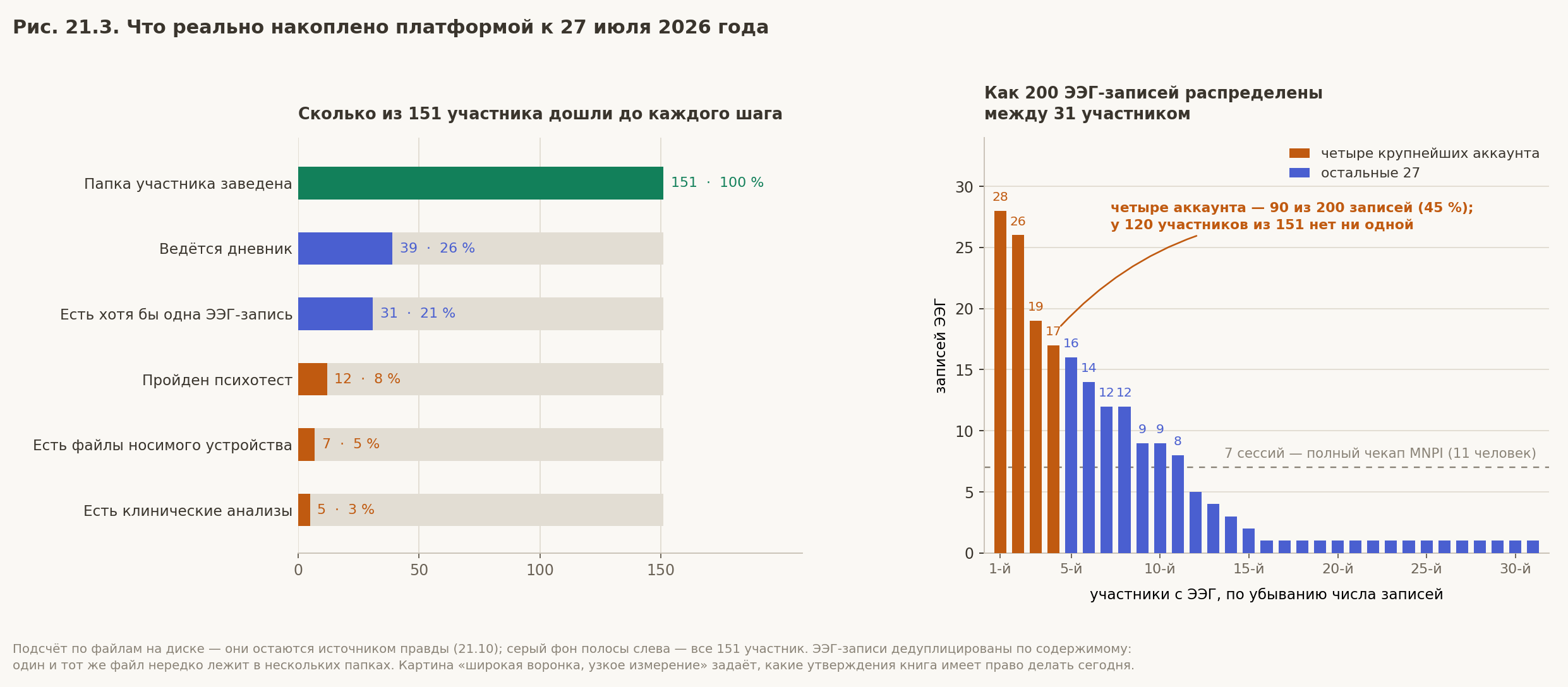
| Indicator | Meaning | Share from 166 |
|---|---|---|
| A participant folder has been created | 166 | 100 % |
| Keeping a diary | 41 | 25 % |
| There is at least one EEG recording | 32 | 19 % |
| Passed at least one psychotest | 12 | 7 % |
| There are wearable device files (file export) | 7 | 4 % |
| There are clinical tests | 5 | 3 % |
| Total valid EEG sessions, without duplicates or broken ones | 339 | — |
| Of these, the four most active accounts account for | 182 | 54% of sessions |
| Participants with seven or more sessions | 13 | 8 % |
| Total diary entries | 1 059 | — |
| Of these voice transcripts | 865 | 82% of entries |
⚠️ Zero caveat: you need to count by content, not by file names, and the counting method needs to be explicitly stated.A single document router places the received file in several places at once - in the inbox, in the session folder, in the checkout folder - so a simple bypass of files on the disk finds627 CSV, which is approximately twice the number of different sessions. The correct calculation is not traversal by name, but deduplication by content hash with rejection of broken files; there is a script for this in the repository (scripts/analyze_all_csv.py), and its output is the source of the number 339 above. An earlier edition of the book cited the number 200, calculated in a different way, not recorded in the text; when recalculating using the hash, it is not reproduced on any tested filter. The lesson is general: any figure about the completeness of data in this book must be accompanied by the command by which it was obtained, otherwise it is unfalsifiable in exactly the sense that is discussed in Chapter 13.
⚠️ The first thing that is visible on the merits is the shape of the sample.Out of 339 valid sessions182 (54%) belong to the four most active accounts; most participants have none. A full MNPI checkout requires seven sessions - this threshold has been crossed13 people. It's not "not enough data", it'sdifferent data structure: What looks like a study on 166 participants is, at the EEG level, a series of cases with several deeply measured participants, including the author of the method himself. In the week (July 27), the number of participants has grown by 15, but only two of them have started keeping a diary - the funnel expands faster than the measurement, and this worsens, rather than improves, the shape of the sample over time.
📖 This form does not devalue the material, butstrictly limits the genre of conclusions. For a dozen deeply measured participants, the following are correct: description of the phenomenon, assessment of reproducibility within one person, verification that the value is generally measurable and stable. Incorrect: any group averages, any percentages of “participants have improved,” any comparison with the population norm. Formally this is designN-of-1 with repeated measurements, and it has its own, rather strict rules of analysis - they are discussed in Chapter 30.
📖 The second is the state of the database: double entry is working.An earlier edition of the book cited an internal audit of the project dated 06/08/2026, which found the opposite - at that time this was true. All recording points listed there have since been eliminated. Direct query to the database on August 2, 2026:1020rows in the reflection table (40 people, last entry - July 30),2175AI reflections (last – August 1),203device sessions,862messages,48participant’s passports - all these tables have fresh records for the last two days. Deduplication has also been cleaned up: uniqueness restrictions have been placed on the reflection and AI reflection tables; repeated launches no longer produce duplicates.
⚠️ There is still a discrepancy with the files and deserves special attention:1020rows in the database vs.1059diary files on disk - 39 entries have been dispersed. The reason for this particular discrepancy is not understood; for the book, this is a more honest statement of the requirement than “double entry doesn’t work”:not “start”, but “check quantities and explain the balance”.
🧭 For the book, here follows one practical rule and one methodological one.
Practical:the numbers in this chapter are still referenced to the files on disk as the source of truth, and not to the database - not because the database is not written, but because the reconciliation of files and the database has not yet been formalized; Once the 39 record discrepancy has been explained, it is wise to move to the database as a faster source for regular reporting.
Methodological:reporting of data completeness should be part of any method publication. The table above is not an admission of weakness, but a required section. A reader who is not shown how many participants have a measurement cannot evaluate any outcome statements.
📖 The automatic summary of completeness that the previous edition of the book asked for already exists -network/checkups.jsonand adjacent partner circuit files, which the profile generator rebuilds each time it runs (see 29.2 above).
29.11. Platform as part of an intervention: threats to validity#
⚠️ This is the central section of the chapter. All of the following -not hypothetical risks, but properties of working code. Each line means that some portion of the participant's observed change is due to the platform rather than the method, and cannot be separated from the current data.
| Platform mechanism | How does it affect what is being measured? | Threat type |
|---|---|---|
| The participant sees an interpretation of his measurement before the next one | He knows “what needs to improve” and makes the next measurement differently | Blindness, reactivity |
| Master/Beginner/Red Zone ranks | The label changes motivation and self-esteem until the next measurement | Expectation effect |
| The depth of AI analysis increases with the level of profile fullness (L0–L4) | Beginner and experienced getsystematically differenttext - not by sales share, but by depth of analysis | Differential impact by length of service |
| Weekly or monthly trial, about 70 funnel cards, payment reminders on the 5th, 6th and 7th day, ten more cards after the trial expires | The peak of activity coincides with the payment pressure window; Those who paid and those who did not pay have different volumes of communication from the platform after the trial | Confound of Involvement |
| The tariff determines the scope of research opportunities | Those who pay the most are measured in depth | Selection based on solvency |
| Referral fees 20% / 10% for subscription and 10% / 5% for devices (two legs in both schemes), plus additional days of access for each referred friend | The participant has a material interest in a positive public assessment - and not only from those who receive monetary interest | Respondent's conflict of interest |
| Weekly "hero book chapter" | The participant is told a coherent story of his progress weekly | Shaping the narrative |
Fieldsyntheticin the sessions table |
Synthetic sessions are allowed in the database | Risk of confusion with real |
The completion of tasks is recorded asself_report |
Compliance with the protocol is not verified | Dose measurement error |
| The status of a master’s apprentice can be “unverified” | Some observations come from unverified observers | Source quality |
📖 The most serious point is the first one, and it cannot be eliminated by adjustments.Classic reactivity control - blinding - is impossible here by design: the point of the product is for a person to see his numbers. Hence the only correct conclusion:the platform in its current form cannot serve as a platform for confirmatory research into the effectiveness of the method. It is excellent for another purpose: developing and testing the measurements themselves: whether the indices are robust, whether they are reproducible within individuals, whether they correlate with external scales, whether the protocols discriminate what they are supposed to discriminate. This is a full-fledged and necessary research work, but it is work ontool, not proofeffect.
🧭 What can be done without breaking the product.Of the threats above, at least four are mitigated without loss of user value: (1) highlight the research thread where the interpretation is shownafterthe next measurement, and not before it; (2) decouple the depth of measurement from the tariff, at least for a small cohort; (3) exclude participants with referral income from the research sample; (4) mark everything that is generated by the language model as an interpretation - and do not allow it into those quantities that are presented as a measurement.
🔬 A verifiable consequence available now.If a significant part of the observed dynamics is generated by the platform, and not by practice, then for participants who interact a lot with the interface, the change in indices should bestronger with equal number of sessions. This is a direct test of existing data: it requires neither a new cohort nor a control group, just a comparison of the size of the interaction with the magnitude of the shift. A negative result would weaken the objection; positive - would show its scale. Both are valuable.
29.12. Ethics, consent, money and data#
🧭 The platform works with sensitive data: psychometry, diaries, medical card, tests, DNA test, photo, geolocation, finance. It already has some protection mechanisms.
What's done.Supervision by a master requiresexplicit consent of the ward: when attached, the participant receives a notification with a description of what exactly the observer will see and two buttons; if it fails, it disappears from the master's journal. There is an NDA agreement. Personal data does not go to external services when generating interpretations (29.9). The folder with participant data is excluded from service code scans.
⚠️ What has not been done and should be done.
Consent is askedafter a person is already involved- not at registration, but at the moment of attachment to the observer. Informed consent toresearchthe use of data is a separate procedure, and it does not exist now: the participant agrees to observation, but not to the analysis and publication of aggregates.
Not described: storage period, procedure for revoking consent, procedure for deleting data upon request, fate of data upon termination of participation. For a project collecting DNA testing and clinical tests, this is not a formality.
Money and exploration intersect in at least four places, and each requires disclosure. The tariff determines research capabilities, which means the depth of data depends on the ability to pay. The referral program pays the participant a percentage of the subscriptions and device purchases of invitees, which means that the respondent has a material interest in a positive review. The retention funnel and payment reminders operate within the same window in which the measurements occur. The fourth intersection is less obvious: each EEG measurement has a public short link with a preview for instant messengers, and clicking on it lands in the bot with the referral key of the person whose measurement it was - that is, the participant’s own result becomes his own marketing asset. None of the four facts is a violation;keeping silent about them when publishing the results would have been.
🧭 The minimum ethical standard that the platform must reach before any publication: separate informed consent for the study, formalizedtodata collection; declared shelf life and working removal procedure; disclosure of financial relationships with participants in each material; excluding from the sample those who have a material interest in the outcome; independent verification of the protocol by at least one external person without a stake in the project.
📖 It’s worth remembering the context: part of the scales in the register areclinical screenings(PHQ-9 includes a question about suicidal ideation, GAD-7 and ISI are used in diagnosis). Each of these tests already has a disclaimer in the code for the participant - “this is a screening tool, not a diagnosis, with alarming values, consultation with a specialist is needed” - and a categorical block with an explicit recommendation for action in case of severe scores. What is not in the code is a separate response specifically to the ninth item of PHQ-9, the question about suicidal thoughts: it is asked and taken into account in the overall score along with the other eight, but a non-zero answer to it does not generate either a separate message to the participant or an alert to the administrator. For a clinical screening platform, this response protocol is both a Chapter 19 requirement and a code requirement.
✍️ [To the author - add]Research consent text and separate protocol for responding to a non-zero response on item nine of the PHQ-9.
29.13. What should be in version 1.0#
🧭 Chapter summary - what is required of the platform in order for its data to be suitable for the claims the book claims to make. The order is in descending order of importance, not by difficulty.
| № | Requirement | Chapter | For what |
|---|---|---|---|
| 1 | Single NSI and MNPI formula in code and in book, with version number in each entry | 29.8 | Otherwise the numbers are not even comparable to themselves |
| 2 | Fixed number of MNPI axes or clearly different scales | 29.8 | Three axes and four - different sizes |
| 3 | Replacementmaxin the depth axis to the robust estimate |
29.8 | Remove the dependence of the index on the number of attempts |
| 4 | Model version and hash next to each AI result | 29.9 | Without this, the interpretation is irreproducible |
| 5 | Research informed consent prior to data collection | 29.12 | Condition of any publication |
| 6 | Working double entry with quantity reconciliation | 29.10 | Otherwise, uploading is possible only from files |
| 7 | Automatic summary of data completeness with cut-off date | 29.10 | Mandatory section of any report |
| 8 | Mandatory minimum medical card for the research sample | 29.6 | Control of drug confounds |
| 9 | Research thread with delayed display of interpretation | 29.11 | The only way to reduce blindness |
| 10 | Unambiguous dictionary of protocols and metrics for external upload | 29.5 | External verification condition |
| 11 | Formula set for MIX protocols | 29.5 | State transfer is not currently measured |
| 12 | Calibration of rank thresholds on a real distribution | 29.8 | “Master” and “red zone” are strong words |
| 13 | Clinically Significant Response Protocol | 29.12 | Requirement for clinical screenings |
⚠️ Not a single item on this list is a reproach to the platform. It did what it was created for: it collected heterogeneous data in one place, gave the method a reproducible calculation procedure, and brought the result of its own measurements to the participant. The list above is the difference betweenworking productAndresearch tool, and it is surmountable.
✍️ [To the author - add]Priorities and deadlines for thirteen points; who is responsible for each. It is useful to keep this list directly in the repository so that the book and code are distributed more slowly than they currently are.
30. How to prove: research design#
This section turns “I have cases” into defensible research. It is arranged in two layers: first - the requirements that the external methodology places on the pilot, then - whatactually spelled out in the method materials, with an honest indication of where the second falls short of the first. (A detailed critique can be found in the accompanying scientific review of the method.)
30.1. Minimum requirements for a pilot#
📖 Eight points without which research cannot be protected:
- Pre-registration.Fix one primary hypothesis and 1-2 primary outcomes in advance (eg: IAF-alpha upregulation; MAIA-2; RMSSD; PHQ-9/GAD-7).
- Control group.Active control of an equal “dose” (general relaxation/meditation or sham-neurofeedback), and not just a waiting list - otherwise the effect is indistinguishable from placebo and practitioner attention.
- Blinding of assessment.Electrophysiology and questionnaires are assessed by an independent person or an automatic pipeline, and not by the trainer himself.
- A strict alpha metric.Determine in advance: range (IAF), absolute/relative power, eyes o/z, installation, artifact criteria; and what does “2 times” mean, for how long.
- Effect sizes and non-responders.Report Cohen's d with confidence intervals andNecessarilyindicate the proportion of those for whom it did not work.
- Condition vs trait.Separate intrasession shift and sustained change (measured after 1–3 months).
- Baseline contribution accounting.To control that part of the effect is provided by the “unloading” itself, and not by neurotechnology.
- NSI/MNPI status in design.Author's indices (Chapter 27) at this stage are included in the pilot assecondary, exploratory outcomes, rather than as a primary outcome: their psychometrics (
ICC,SEM, normalization constants) has not yet been established, and until it is established, there is nothing to calculate the threshold for reliable change. The primary outcome is taken from the list of point 1 - from indicators with external validation. The pilot himself provides data for calibrating the indices (section 27.24), so dividing them into two different studies is irrational.
📖 Particular caution with placebos.In neurofeedback, there has been a long-standing debate about how much of the effect is specific and how much is nonspecific (Thibault & Raz, 2017, and responses from opponents). This is not a reason to abandon the method, but a reason to build control correctly.
30.2. Flagship testable hypothesis#
🔬 The flagship testable hypothesis of the method:The specific combination of “stopping VP + bodily attention + switching cords” provides a faster, deeper and more stable transition to the alpha mode (speed/depth/retention) and an increase in HRV (as well as an improvement in MAIA-2 / reduction in rumination) than an active control of equal duration.
🔬 Its formal notation through the primitives of Chapter 27:in the method group, compared with active control of equal duration, a decrease is expectedτ↑, heightD_reland growthMn— that is, the growth of subindicesSwEAndStD- at|RCI| > 1,96ByΔMNPIthe proportion of participants exceeding the control. ⚠️ The hypothesis is formulatedon primitives, and not on the composite score: saturating normalization functions compress the scale, and “2 times” at the levelMNPI_scoredoes not mean "2 times" at the physiological level (section 27.18).
🧭 The case of Chapter 31 gives this hypothesis the first approximate values: for one participant, depth increased by 2.2 times, retention by 2.5–3.7 times (depending on whether you count in absolute minutes or in shares), entry speed by 3–7 times. This is not a confirmation of the hypothesis, butbasis for calculating required sample sizeafter the pilot: even a four times smaller effect remains detectable in a group of one and a half to two dozen people.
30.3. Design stated in the method materials#
📖 A specific design is recorded in the working materials, and it is worth presenting it as is:single-group prospective longitudinal pilot with SCED elements(single-case experimental design - a plan with multiple measurements from one participant). There is no control group. There is no randomization. Blinding is provided only on the analyst's side.
⚠️ This directly contradicts paragraph 2 of section 30.1, and the book won't smooth it over. The single-group design does not allow us to separate method effects from attention, anticipation, test-retest, and natural history effects. However, this does not make such a pilot meaningless: he has a different task. The uncontrolled pilot answers the questions “how many people make it to the end”, “what is the range of the rates”, “what effect size to expect”, “does the data collection procedure work” - and these are the answers needed to design a controlled study. The wording that the book recommends to use in all materials:the pilot checks the feasibility and calibrates the instruments; he does not and cannot verify the effectiveness of the method.
⚠️ The sample size is mentioned twice and differently in the sources.The protocol saysN= 5–15 participants, the preprint mentions a “sample of 120 people.” These are inconsistent numbers for the same study. The book accepts5–15like the realistic size of the pilot; 120 is the size of the main controlled study for which the pilot is setting the stage and should not be cited as available.
🧭 There is no power calculation in the protocol - and rightly so.Power calculations require the expected effect size and its spread; neither one nor the other is up to the pilot. Power isresultpilot, not its premise. But for the main study, calculations are required, and the data for it will be provided by the pilot. The only thing that needs to be added to the pilot’s protocol now is an explicit disclaimer that the statistical comparisons in it are descriptive in nature and do not serve as confirmation of hypotheses.
30.4. Seven measuring points#
📖 Measurement scheme included in the protocol:
| Dot | When | For what |
|---|---|---|
T0a |
2 weeks before the start | first base line |
T0b |
1 week before the start | second base line |
T1 |
end of the "Base" block | early response |
T2 |
end of the “Brain” block | middle |
T3 |
end of the "Body" block | late response |
T4 |
end of program | outcome of the intervention |
T5 |
+12 weeks after graduation | retention |
📖 The total duration is about eighteen weeks of the program plus twelve weeks of observation.Two base points instead of one - the most powerful solution of this protocol, and it is worth protecting. It provides three things that are not available with one initial measurement: an assessment of a person’s own variability before any intervention (without it it is not consideredSEM, and thereforeRCI- Section 27.13); control of the effect of repeated testing; and the ability to see regression to the mean if the participant entered the study in an atypical state (sections 28.2 and 28.5). DotT5closes the requirement of paragraph 6 of section 30.1 - separation of condition and trait.
🧭 Book recommendation:addT6for +6 monthsat least for a subset of indicators that are collected automatically by the wearable device. The cost of such measurement is almost zero, and the horizonU3from Section 27.23.1 is otherwise not covered.
30.5. Outcomes: what exactly is measured#
📖 The protocol listseight primary EEG markers:
| Marker | What does it mean |
|---|---|
| Back alpha, 8–12 Hz | main method state marker |
| Frontal midline theta, 4–7 Hz (Fz) | attention control, conflict monitoring |
| Gamma, > 30 Hz | stated by analogy with studies of long-term practitioners |
IAF |
individual alpha peak frequency (section 27.27) |
| Microstates A–D | discrete dynamics of topography |
| Lempel - Ziv / sample entropy | signal complexity |
| Frontal alpha asymmetry | affective approach/avoidance vector |
⚠️ Eight primary outcomes are not one primary outcome.With eight independent tests at the 0.05 level, the probability of finding at least one “significant” difference by chance is greater than one-third. So the study is not pre-registered: the primary outcome must beone, everything else is secondary and exploratory, with a pre-announced correction for multiplicity.
🧭 Book proposal.Primary outcome -relative rear alpha power in personalized band(borders byIAF, section 27.27), in the contrast “target phase versus base phase.” Reasons: This is the only marker that directly corresponds to the central claim of the method; it is consistently measured by four-channel editing; and it has literary reference points for comparison (section 30.8). The remaining seven are promoted to secondary. Separately about gamma: in consumer editing, the gamma band is an order of magnitude more polluted by muscle activity than alpha, and any “gamma increase” is primarily read as tension in the facial muscles. Gamma can remain on the list, but conclusions cannot be drawn on it.
📖 Secondary outcomesaccording to protocol: HRV (RMSSD, HF), MAIA-2 (interoceptive awareness), heartbeat count (objective interoception), PSS-10 (perceived stress), WHO-5 (well-being), FFMQ (mindfulness), sleep measures, optional cortisol, and adherence (how many sessions are actually completed).NSIAndMNPIare for exploration purposes - according to clause 8 of section 30.1.
30.6. Analysis plan#
📖 What is provided in the protocol: linear mixed models with participant as a random effect; paired comparisonsT0againstT1…T5WithCohen's dzand confidence intervals;Tau‑Ufor single cases; dose response analysis.
⚠️ Neither an interrupted time series norRCInot named in the protocol, and without them this design loses two of its three strengths. Three required additions:
- Segmented regression with interrupted time series(Section 28.4) is the only way to draw causal inference from a single-group design. Data requirement: at least twenty points in each segment, before and after the start of the intervention. For wearable device metrics, this can be done automatically.
RCIat the individual participant level(section 27.13) - because the group mean hides how many people did not change. The share of non-responders is a mandatory line of the report (clause 5 of section 30.1), and can only be obtained by individual reliable change thresholds.- Multiplicity correction method, named in advance.The book offers: Holm-Bonferroni for the family of primary and key secondary outcomes, false rejection rate (FDR) control for exploratory ones. The choice is fixed in pre-registration, and not after viewing the results.
30.7. What is not in the protocol#
⚠️ Eight spaces. Each of them closes in a few hours of worktostart and never closes after.
| Space | Why is this critical? |
|---|---|
| Inclusion and exclusion criteria | without them, the sample cannot be described, and safety is not ensured (Chapter 19) |
| Stop rules | there is no predetermined condition under which participation or the entire study is terminated |
| Plan for dealing with missing data | with a dropout of 30–50%, which the protocol itself considers likely, the way gaps are processed changes the result |
| Multiplicity correction method | see section 30.6 |
| Informed consent form | the materials contain an NDA, but not consent (see section 19.8) |
| Ethics committee approval | required for publication in a peer-reviewed journal; not issued retroactively |
| Public pre-registration | the cheapest of the entire list and the most significant for the reviewer |
| Power calculation for the main study | not needed for the pilot, required for the next step |
30.8. What to compare with: literary benchmarks#
🧭 The question “is it a lot or a little?” without an external scale there is no answer. Below are guidelines from published works on contemplative practices to which the method can be classified. The table is needed not to promise the same numbers, but to understand where the bar is.
| Job/type of intervention | Term | Effect order |
|---|---|---|
| MBSR type programs, beginners | 8 weeks | alpha growth of about +16% |
| Same for effect size | 8 weeks | d≈ 0.57 (forehead), 0.60 (frontal median), 0.67 (vertex) |
| Isha Kriya, a short daily practice | weeks | spectrum shift in beginners |
| Saggar et al., Shamatha Retreat | 3 months | beta reduction andIAF, dose dependence |
| Shamatha, delayed observation | months - years | transition of an effect from state to trait |
| Lutz, Davidson et al., long-term practice | thousands of hours | Gamma synchrony is multiple times higher than control |
| Tang et al., IBMT | 5 days × 30 min | changes in the anterior cingulate cortex and insula |
| Schwerdtfeger et al., body scanning | 2 weeks | shift in interoceptive indicators |
| Nath et al., HEP | — | the amplitude of the evoked response to the heartbeat increases with depth |
🧭 How to read it.The Bar for the Eight Week Program - The Order Effectd≈ 0.6 according to EEG indicators. The niche that the method can realistically claim is:not the absolute value of the shift, but the value of the shift per unit of time: Tang's work shows that noticeable changes are achievable in five days, and it is in this zone that the method is located with its twenty-day intensive. Accordingly, the correct form of the statement is not “we provide more than meditation,” but “we provide one of the largest documented alpha to beta ratio shifts in a twenty-day intensive, with micro-sleep monitoring and independent confirmation through evoked heartbeat response.”
⚠️ Two warnings for this table. First:don't promise a range.Gamma synchrony among monks with tens of thousands of hours of practice is not an effect that can be reproduced in three weeks, and trying to claim it will invalidate everything else. Second:the result should survive the elimination of micro-fall asleep.Part of the rise in alpha and fall in beta in any prolonged eyes-closed session is due to dozing; Without an explicit screening criterion (section 27.21), comparison with the literature is not valid.
✍️ [To the author - add]:the numbers in the table above are given as order of magnitude guidelines from secondary sources. Before publication, each line must be checked against the original source and replaced with exact values with complete output data; lines that are not confirmed by the original source are deleted. This is exactly the work, the refusal of which in the past has already led to the appearance of non-existent links in the text (see version log, v0.5).
30.9. Two different studies with the same title#
⚠️ The method materials describe two programs, and they are incompatible in all respects except the name.
| Program A | Program B | |
|---|---|---|
| Volume | 27 meetings, approximately 18 weeks | 14 days |
| Content | sequence “brain → organs” | six ONTO modes and six “I-views” |
| Equipment | research EEG, 32–64 channels | consumer headset with proprietary indexes |
| Status | research protocol | paid product, 29,900 - 95,000 RUR |
📖 There is not a single cross-reference between these descriptions: neither is declared a version of the other, neither refers to the data of the other. The data in this caseincommensurable: 4 channels versus 64, proprietary indexes versus spectral powers, two weeks versus eighteen. You cannot add them into one sample.
⚠️ And separately - ethics.When a participant pays for the program and at the same time is a participant in the study, three requirements arise that are not recorded in the materials: consent to the study is formalizedseparatelyfrom the service contract; refusal to participate in the studyshouldn'tinfluence the volume and quality of services; a conflict of interest (the researcher is also a seller) is declared in any publication.
🧭 The book separates these two tracks and then talks about them separately:research(Program A, Chapter 30 in its entirety) andapplied(Program B, where most of the material in Chapters 18 and 31 comes from). The case of Chapter 31 concerns the application track - with all the hardware restrictions that follow from this.
30.10. What remains to be written about this chapter?#
✍️ [To the author - add]:
- Inclusion and exclusion criteria— agree with the table in section 19.2 and record it in the protocol.
- Informed consent formseparately from the NDA and separately from the service agreement.
- Selecting a pre-registration siteand the date by which it will be published.
- Single primary outcome- Confirm or modify the sentence in Section 30.5 and write down the entire wording, including band, montage, contrast, and window.
- Checking the benchmark tableaccording to primary sources (see ✍️ in section 30.8).
- Control condition decisionfor the main study: active control of equal dose - which one, who administers it, and how equal attention is ensured.
31. Current data and cases#
🧭 At the time of writing, the method hastwo quantitatively analyzed cases: a single session on 2026‑07‑19, which tested the computability of the Chapter 27 model, and a longitudinal observation of one participant over sixty-four days. The stated goal is to increase the number of documented cases with reproducible results to 30–40. This chapter describes what exists, exactly to the extent that it exists, and separately what is called a result in the available materials, but is not yet a result.
31.1. What has already been analyzed quantitatively: session 2026‑07‑19#
📖 One session -2026‑07‑19, 55 minutes of recording— went through a full analysis using the model of Chapter 27: section27.21. Briefly, so as not to retell the section:
| What | Result |
|---|---|
| Entering the state | fixed confidently: alpha 0.51 → 0.77, theta 0.21 → 0.04 |
HoldMn |
0.98 alpha and 1.00 theta at 53 minutes after entry |
| Major shift during the session | not the level, butspread: SDdecreased in11 variables out of 11(sign testp= 0.0005; adjusted for column dependencyp = 0,002…0,016) |
| Independent confirmation | Heart rate −4.7 beats/min per session (p= 0.0003) - the only channel not from the spectrum |
| Napping as an explanation | rejected: theta/alpha drops by 36.7% (d= −1.69); when falling asleep it would be the other way around |
PointNSI |
not counted— there is no EC/EO marking in the upload |
Entry speedτ↑ |
not measurableon a minute grid |
| Focusing | not covered: there is no task block in the entry |
⚠️ This isn= 1 without control condition: session shows thatthe model is consideredand where it comes down to the data format, butNotserves as evidence of the effectiveness of the method. Evening recording time and 55 minutes of sitting still cannot be ruled out as an explanation for the heart rate shift.
🧭 A practical consequence for collecting cases.Records taken before the transition to the format from the section27.21.6(phase markings, frequency ≥ 1 Hz, pre-base EO, output marker, session metadata), remain valid descriptive material and the basis for noise assessment, but will not retroactively become material for calculationNSIAndΔMNPI. The sooner the upload format changes, the fewer sessions will fall into this category.
31.2. Victor's case: eleven sessions in thirty-five days#
📖 This is the first and only one todaylongitudinalmethod case: one participant, eleven sessions from 12/03/2025 to 01/07/2026 (35 days, about eight hours of recording), then four more sessions until 02/05/2026 - a total of sixty-four days of observation. All measurements were made with one headset with proprietary indices (see section 27.20), long-term physiology - with a wearable tracker (chapter 28). Below is the summary matrix as it appears in the original report; an analysis of what can and cannot be read in it is included in the next section - this is important, because the numbers and their interpretation here diverge more than in any other material of the method.
| № | Date | Duration, min | Cognitive Score | Focus | Chill | Stress | Relaxation Index | Alpha Gravity | Heart rate | Holding ATS |
|---|---|---|---|---|---|---|---|---|---|---|
| 1 | 03.12.2025 | 40 | 39,5 | 51,2 | 61,4 | 47,8 | 2,05 | 0,43 | 63,4 | 23 % |
| 2 | 21.12.2025 | 39 | 55,1 | 47,7 | 68,5 | 33,0 | 2,38 | 0,64 | 54,8 | 41 % |
| 3 | 24.12.2025 | 77 | 32,9 | 48,5 | 66,9 | 40,0 | 2,11 | 6,33 ⚠️ | 51,1 | 35 % |
| 4 | 25.12.2025 | 60 | 42,5 | 55,8 | 66,0 | 41,8 | 1,75 | 0,42 | 51,3 | 28 % |
| 5 | 26.12.2025 | 45 | 54,3 | 56,9 | 66,9 | 42,2 | 1,54 | 0,53 | 46,7 | 22 % |
| 6 | 29.12.2025 | 72 | 50,1 | 51,2 | 67,3 | 42,8 | 2,07 | 0,55 | 55,6 | 39 % |
| 7 | 03.01.2026 | 63 | 40,1 | 46,3 | 65,5 | 42,9 | 2,16 | 0,73 | 55,0 | 43 % |
| 8 | 04.01.2026 | 36 | 37,2 | 37,4 | 68,1 | 40,3 | 2,49 | 19,48 ⚠️ | 60,6 | 58 % |
| 9 | 05.01.2026 | 32 | 62,8 | 29,9 | 73,3 | 33,1 | 4,10 | 0,83 | 64,5 | 78 % |
| 10 | 06.01.2026 | 35 | 62,9 | 27,1 | 71,5 | 35,3 | 4,76 | 0,74 | 52,3 | 89 % |
| 11 | 07.01.2026 | 27 | 73,9 | 27,6 | 66,4 | 38,5 | 4,60 | 0,95 | 57,3 | 85 % |
⚠️ Sessions with anomalous peaks are markedAlpha Gravity— 24.12 to 17.29 and 04.01 to 46.88. The author of the original report himself left them questionable: “perhaps it was interference that produced such high numbers, or perhaps there was a condition... if there are no repetitions of this before the end of January, then we will chalk it up to an error.” Analysis - in section 31.3.
📖 Three phases.The report breaks the dynamics into three segments, and this division is meaningful, because the middle segment goesagainstexpected direction.
Phase I, “groping for silence” (03.12 – 29.12).Two sessions with a break of 18 days.Relaxation Index2.05 → 2.38, stress 47.8 → 33.0, heart rate 63.4 → 54.8. The report interprets the long break as consolidation - that is, as a condition for growth, and not as an obstacle to it.
Phase II, “system resistance” (12/24 – 12/26).Daily activities and all key indicatorsroll back: Relaxation Index2.11 → 1.75 → 1.54, retention 35% → 28% → 22%. This is the most valuable part of the case: it contradicts the naive model of “more is better” and coincides with what Chapter 28 says about dose and recovery.
Phase III, “quantum leap” (01/05 – 01/07).Daily exercises - and now they give growth: retention 78% → 89% → 85% when reducing the session to 27 minutes.
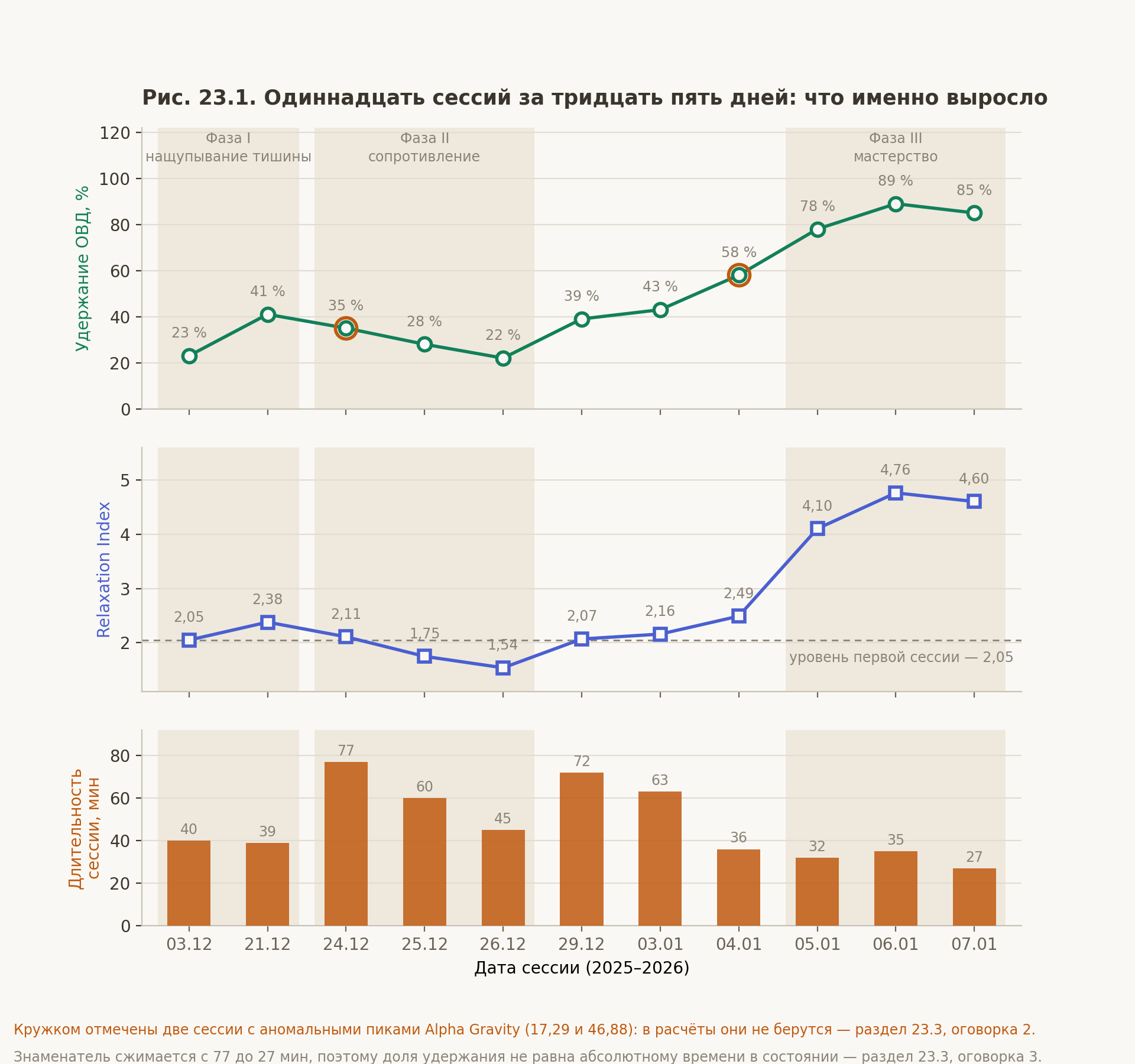
⚠️ Figure 31.1 is deliberately constructed as three separate panels with a common date axis, rather than as one graph with two vertical scales. Combination of percent retention and dimensionlessRelaxation Indexon one picture with two axes allows you to adjust the slopes to each other by arbitrarily choosing a scale - and create the appearance of a connection that may not exist in the data. The three panels force the reader to compare the shapes of the curves rather than their superposition.
📖 Effect of interval between sessions.The report summarizes the observation in a separate table; she is interesting in what she describesnonlineardose dependence.
| Transition | Interval | Effect for the next session |
|---|---|---|
| 03.12 → 29.12 | 18 days | growth of all indicators |
| 29.12 → 24.12 | 3 days | deep but uncontrollable trance |
| 24.12 → 25.12 | 1 day | start of rollback |
| 25.12 → 26.12 | 1 day | continuation of rollback |
| 03.01 → 07.01 | 1‑1‑1‑1 | exponential growth |
🔬 Report insight: intervals of 2–3 days are optimal in the early stages; afterRelaxation Indexconsistently exceeds ≈ 3.0, daily practice becomes reinforcing rather than depleting. In terms of Chapter 27, this is a hypothesis aboutchange in the sign of the dose dependence when passing through the skill threshold— and it is verifiable: on a sample of 15–20 people, it is enough to compare the slope of the dynamics before and after crossing the threshold. Until such verification, this remains a description of one person.
📖 How does this relate to the central assertion of the method.The book, in the introduction and in chapter 27, talks about an “approximately twofold” increase in three parameters of the transition beta → alpha: speed, depth, retention. The case gives a measured value for each of them - and all three are greater than two:
| Parameter | Chapter 27 Primitive | Start | Final 35 days | Multiplicity |
|---|---|---|---|---|
| Depth | Dp |
RI = 2,05 |
RI = 4,60 |
×2,2 |
| Hold | Mn |
23 % | 85–89 % | ×3,7 |
| Entry speed | Sp |
20+ min | 5–7 min | ×3…×7 |
🧭 Hence it is important for the formulation of the method.“About twice” it turns outthe most carefulof three measured values, and not the average and not the maximum. This is a good position: a statement that is weaker than its own data is immune to criticism, whereas a “3.7 times” statement would have to be defended on every point of section 31.3. Book recommendskeep the wording “about twice”and support it with the lower limit of the observed, and not with the peak. If, after recruiting the sample, the median turns out to be higher, the formulation can be strengthened, based on the group.
📖 Continuation: strength test (12.01 - 14.01).Five days after the peak, three sessions took place in a row, and they gave the case what it was missing -variability.
| Date | Condition | Hold | Alpha Gravity, max | Relaxation, max | Focus, min |
|---|---|---|---|---|---|
| 12.01 | with a mentor, after 5 days of pause | 31 % | 19,48 | 5,01 | 9 |
| 13.01 | solo | 21 % | 1,22 | 3,27 | 7 |
| 14.01 | with a mentor | 47 % | 126,75 ⚠️ | 6,48 | 8 |
📖 Here you can see the discrepancy between two different things, which in everyday language are called by one word “it turned out.”Depthlasts in all three sessions: minimalFocus— 9, 7 and 8, that is, the dive remains maximum even in a failed solo session. Butshare of timein a state drops threefold. This is exactly the distinction for which the primitives are separated in section 27.7Dp(depth) andMn(hold), and section 27.21 concludes that it is not the level that is being trained, butstability: Victor’s case is the first independent confirmation of this conclusion using data from another person and another device.
📖 Intrasession volatility.The solo session on January 13 is scheduled minute by minute, and the picture is this: in 29 minutes the indicators go fromFocus18 under stress 18 toFocus75 under stress of 94 - the report itself calls it a “roller coaster.” This is a direct illustration of a primitiveSb(stability) from section 27.7 and the argument that judging a session by its average means missing the point.
📖 Dual-mode session 02/05: first instrumental evidence of route branching.The last documented session is for the first time divided into two blocks based on the “eye” feature.
| Block | Hold | Key indicators |
|---|---|---|
| Closed eyes | 64 % | Alpha Gravity 5,93, Focus 5, Relaxation 7,68 |
| Open eyes | 67 % | Concentration Index 0,86, Alpha Gravity 1,42 |
🔬 This is the first case in the materials of the method when both branches of the transition route from the section18.19- closed-eyed (MPE → V‑MPE → ATS) and open-eyed (OP → FP) - measured in one session with one device. Two observations deserve testing in a sample: retention in the open-eyed branchnot lowerthan in the closed-eyed group (67% versus 64%), and the profiles of indicators in this casedifferent- highAlpha Gravityand extremely lowFocusin the first versus moderateAlpha Gravityand highConcentration Indexin the second. If this is reproduced, the eight modes will have a first instrument fork, which currently does not exist (see the limitation of section 18.17: the upload distinguishes three groups of states, not eight). Physiology of the session: heart rate -17%, stress -48%, HRV -15% - the last report interprets the latter as “optimal load”, and there are questions about this interpretation (section 31.3).
31.3. Victor's case: what the numbers say and what they don't say#
⚠️ This section was not written to devalue the case. The case is valuable: this is the only longitudinal observation of the method, and there are shifts in it that are difficult to explain by chance alone. The section is needed for something else - tothe list of objections was compiled by us, not by the reviewer. Everything below is what any methodologist will ask when he picks up the table from section 31.2.
⚠️ 1. “ATS retention” was calculated according to three incompatible criteria.This is the most serious problem of the case, and it is not striking, because in all reports the value is called the same.
| Report | Criterion “minute counted” |
|---|---|
| Summary of 11 sessions | Relaxation Index ≥ 2,0 And Stress ≤ 40 And Focus ≤ 45 |
| 13.01 (solo) | Focus < 30 And Stress < 35 And Alpha Gravity > 0,80 |
| 14.01 (with mentor) | Focus ≤ 30 And Stress ≤ 35 And Relaxation ≥ 3,5 |
Three different sets of variables and three different sets of thresholds. The consequence is harsh:the number 23% from the first session and the number 21% from the solo session were measured with more than one ruler, and they cannot be compared with each other. The trajectory of 23% → 89% → 21% → 47% → 64–67%, which looks like a meaningful plot, is partly an artifact of a shift in definition. What to do about it: recalculateAllsessions based on one criterion from the initial minute-by-minute uploads - there is data for this, the work is mechanical. Before the recalculation, it is correct to talk about an increase in retentioninsideconsolidated series of 11 sessions (there is a single criterion) andNotstitch it with the January and February sessions into one curve.
⚠️ 2. Alpha Gravity= 126.75 is not a “neuro-laser”, but a division by almost zero.The original report interprets the peaks as a "hyper-synchronized state" and estimates the likelihood of a "real phenomenon" at 70%. Another thing follows from the definition of the index itself. In the section27.27shown:Alpha Gravity = A2 / A1, WhereA1- power in the lower half of the individual alpha band,A2- at the top. Thisattitude, and when the lower alpha goes far to zero, the denominator tends to zero, and the quotient tends to infinity. The value of 126.75 does not mean “126 times stronger than the masters”, but “lower alpha at this moment was practically absent”; atA1order of noise, the ratio ceases to be a measurement and becomes a division of one noise by another. Three consequences. First:peak valuesAlpha Gravitycannot be used as an indicator of achievement- only the median for the session and only indicatingA1. Second: the comparison “the norm for masters is 1.0–1.5, Victor has 126” is arithmetically incorrect, because values from different areas of the index are being compared. Third: they themselves are near-zeroA1meaningful - but as a sign of what is happening with the lower alpha, and this should be looked at in absolute powers, and not in their ratio.
⚠️ 3. The denominator changed along with the numerator.The session duration was reduced from 77 minutes (December 24) to 27 minutes (01/07) - by 65%. Retention is measured inpercentage of duration. Part of the increase in share is explained by the fact that exactly those minutes that were not previously counted were removed from the session - the entry and the “rework” at the end. The check is simple and needs to be done: recalculate the deduction inabsolute minutes. For session 1 it is 0.23 × 40 ≈ 9 minutes, for session 11 it is 0.85 × 27 ≈ 23 minutes. The increase remains (≈ ×2.5), but it is significantly more modest than the stated ×3.7 and, more importantly, closer to “about two times” - that is, to the wording that the book already uses.
⚠️ 4. n= 1, without control, without blinding, with combination of roles.One participant; no control condition and no randomization; the person who conducted the sessions also interpreted the results. This is not a flaw of the case - it is its genre: the case is not intended to prove the effectiveness, it is intended to show that the phenomenon is reproducible, measurable and what its dynamics are like. Another thing that is incorrect is wording like “confirmed the effectiveness of the Onto Nothing methodology,” which is in the original report. Caseillustratesmethod andnourishesChapter 30 hypotheses; he cannot prove anything, and this must be written directly.
⚠️ 5. The mentor effect is equally compatible with the effect of situational demands.The report shows a contrast: with a mentor, retention is 47–89%, solo – 8–21%, “an improvement in all indicators by 2–4 times.” The observation is real and practically important. But it has at least three explanations, and the data do not distinguish between them: (a) the mentor actually leads the person deeper; (b) in the presence of a mentor, the participant manages attention differently and approaches the task differently - classic demand characteristics; (c) sessions with and without a mentor differed systematically in time of day, fatigue, and setting. This has a direct implication for chapter 30:blinding in this study is not a formality, but a way to separate (a) and (b), and section 30.3 should refer to this case.
⚠️ 6. The table of “world norms” has no published basis.The report includes a comparison with “beginners”, “experienced (500 hours)” and “masters (1000 hours+)” in terms ofRelaxation Index, Alpha Gravity, retention and entry time, citing “research by Davidson, Lutz (2008–2020), data from Vipassana centers, monasteries in Tibet.” The problem is not integrity, but the fact thatproprietary indices of a specific typeface were not measured in any of these studies— published standards forRelaxation IndexAndAlpha Gravityfor meditation masters does not exist, because these values are determined by the equipment manufacturer, and not by literature. Until the table is reassembled using published values (e.g. the ratio of alpha to beta power in standard bands - see section 30.8), the statement "master level with 1000+ hours in 8 hours of practice" cannot be made outside the method. Inside the book it remains marked as ✍️ and 🔬.
⚠️ 7. Derivative health claims are not defensible.In the report, from the values of HRV and resting pulse, “biological age −4 years”, “life expectancy +2.3 years”, “risk of cardiovascular events −18%” are derived. These values were obtained by transferring group epidemiological dependencies to one person over two months of observation. This cannot be done for two reasons at once: epidemiological coefficients describe differencesbetween people in a population, not changesinside one person; and none of these relationships were tested over a two-month horizon. Bookdoes not playthese numbers are the result of the method and recommends removing them from any outward-facing materials: they do not add credibility, but make vulnerable everything else that is measured honestly in the report.
⚠️ 8. The entire matrix is built on columns, which the materials of the method themselves exclude from the scientific core. Cognitive Score, Focus, Chill, Stress, Relaxation Index- these are exactly those derived indices about which the canonical source of the methodologyNSI/MNPIwrites (section27.26) that “the interpretation of the streak ratio as a discrete emotion does not have construct validity,” and excludes them from the calculation core. It turns out that there is a fork in the road that needs to be named out loud: either the priority of source A is applied sequentially - and then Victor’s case is descriptive, but not included in the calculationNSI; or these indexes are allowed as working proxies - in which case section 27.26 should be softened. The book chooses the first:Victor's case is descriptive material and a source of hypotheses, not input data forNSI. For it to become input data, raw spectral powers by band are needed, not manufacturer indices; they, unlike indexes, are available in the upload.
🧭 What remains after all the reservations.Quite a lot. Shift direction byRelaxation Index(2.05 → 4.60) is robust to changing criteria because it is a direct index value and not a derived proportion. A reduction in login time from 20+ to 5–7 minutes was observed by both participant and mentor and is consistent with the reduction in session lengths. The phase II pullback is a meaningful and unexpected observation that no one pushed forward because it was contrary to expectations. The depth and retention discrepancy in the 12–14.01 triad reproduces the finding of section 27.21 obtained on a different person and a different instrument. It is these four points that are worth carrying forward - they will survive the review.
31.4. Victor's case: long-term trace in wearable device data#
📖 The case is the only material of the method that containsboth horizonsChapter 28: intra-session acute reactions and monthly averages using a wearable tracker. Let's look at them one by one, because trust in them varies.
📖 Acute reaction: before and after the session.For three January sessions, there are paired tracker measurements immediately before and immediately after.
| Date | Pulse | Breathing, /min | Stress (device index) | HRV, ms | SpO₂ |
|---|---|---|---|---|---|
| 12.01 | 70 → 57 (−19 %) | 19 → 11 (−42 %) | 38 → 20 (−47 %) | — | 95 → 98 % |
| 13.01 (solo) | 60 → 56 (−7 %) | 13 → 11 (−15 %) | 19 → 20 (+5 %) | 49 → 37 (−24 %) | — |
| 14.01 | 56 → 53 (−5 %) | 19 → 15 (−21 %) | 18 → 14 (−22 %) | 51 → 52 (first time I didn't fall) | 94 → 97 % |
📖 There is a meaningful paradox here, which the report calls “body versus brain.” In the solo session on January 13, the most unsuccessful according to the EEG,stress according to the tracker did not decrease, but HRV fell by a quarter- that is, the session was expensive for the body with almost no result in the condition. And January 14, the best according to EEG, is the only one where HRV did not fall after the session. This is exactly the case for which the “dose-recovery” connection was introduced in Chapter 28:a drop in HRV after practice means that the practice was a load, and the distinction between “deep” and “expensive” has to be done through different channels. Double caution is needed in the interpretation: a decrease in the respiratory rate from 19 to 11 per minute in itself raises HRV indices regardless of the state of consciousness (see section 28.6 on respiratory sinus arrhythmia), and short post-session measurement windows for consumer trackers have a wide confidence interval.
📖 Long-term trace: monthly averages.The report compares two four-month windows.
| Indicator | "Before Onto" (Apr - Aug) | "After Onto" (Sep - Dec) | Change |
|---|---|---|---|
| HRV (average night) | 38.5 ms | 44.3 ms | +15 % |
| Resting pulse | 52.7 beats/min | 49.4 beats/min | −6 % |
| Deep sleep | 92.5 min | 107.4 min | +16 % |
| Recovery Score | 67,9 % | 70,3 % | +4 % |
⚠️ This table cannot be presented as the result of the method, and here's why.First and decisive:the "after" window begins in September, and the first documented session is December 3. That is, three quarters of the “post-method” window occurs at a time when there was no practice yet. Whatever shifted these indicators, the method could not participate in it in three out of four months. Second: summer and autumn are compared - this is a textbook seasonal confound, which the section directly warns about28.3: HRV, resting heart rate and sleep structure show seasonal and temperature dynamics, and April - August versus September - December systematically differ in daylight hours, temperature, workload and vacation patterns. Third: resting pulse shift by 3.3 beats/min andRecovery Scoreby 2.4 percentage points lies within the limits that section28.5refers to baseline drift and regression to the mean; reliable change here is defined throughRCI(section 27.13), and for this we needSDAndICCfor this particular device, which we do not have.
🧭 How to fix it - and it's not difficult.The scheme that Chapter 28 prescribes applies to existing data in hindsight: take a continuous series by day, rather than two average windows; set the break point at 12/03/2025 (date of the first session), and not at the boundary of calendar months; apply segmented regression with interrupted time series (Section 28.4), where season is included as a separate term; and evaluate not the difference in averages, butchange of level and slopeat the breaking point. The participant has a tracker download for the year. Until this is done, the book gives the table above asillustration of which channels are worth watching, rather than as evidence of an effect.
🔬 “The Law of Skill Degradation.”From observations of pauses, the report derives the formula:
ATS retention = Peak × e^(−0.05 × break days)which gives a loss of ≈ 14% in 3 days, ≈ 22% in 5 days and ≈ 65% in 21 days. This is an exponential fitn= 1 and at three to four points, some of which are measured by different criteria (see section 31.3). As a result, it is no good; Howhypothesis- is quite suitable because it is specific and refutable: a constant of 0.05 per day predicts a half-life of the skill of ≈ 14 days, and this is tested in a group by a direct plan with randomization of the duration of the pause. In terms of Chapter 27, this is the primitive hypothesisRc(recovery) and retention horizonsU1/U2/U3from section 27.23.1: if the constant is reproduced,U2(month) should show about a third of the peak level without maintenance practice. The book fixes the formula as 🔬 with an explicit indication: one trajectory, one personality, mixed criteria.
31.5. Single case format: session passport#
🧭 For cases to be comparable, one recording format is needed. In the materials of the method, this format has already been started - “session passport”; It is presented below in assembled form, because it should be an appendix to each case (see Appendix D).
| Block | Content |
|---|---|
| A. Metadata | date, start and end time, presenter, participant, equipment and firmware version, room conditions, well-being and sleep the night before |
| B. Status Codes | PN (Pure Nothing), VM (Visceral Mind), EX(existential block),AP (Active Presence), FP (Focus Presence), EF (Embodied Flow), TD (Transcendent Download), QG (Quantum Genesis), NAR(narrative, unloading),TR(transition),PAUSE |
| B. Temporary card | sequence of blocks with start and end marks in seconds from the start of recording |
| D. Transition detailing | for everyoneTR: from where, where, according to what instructions,Transition Time |
| D. Subindex markers | which blocks are counted?SwE, StD, RgR, PhC(Section 27.9) |
| E. Promt for AI analysis | fixed request text so that the parsing of different sessions is comparable |
| G. Example | completed sample |
📖 The minimum completeness of a passport isat least five blocks, of which at least twoTRand at least two content states: A session of one long block does not provide material for transition primitives. The key quantity here isTransition Time, time in seconds from the mark[SWITCH-START]to stable alpha: this is a practical analogueτ↑from section 27.7, the same speed indicatorSp, which turned out to be immeasurable on the minute-by-minute grid of the 2026‑07‑19 session.
⚠️ The two entry thresholds in the sources are set differently, and they must be separated.In the description of the cyclic method, a stable input is considered to be “sustained alpha > 40%”, and in the session passport - “alpha ↑ 20%+ in 30 seconds”. This is not a contradiction if you understand that they measure different things: the first -level, that is, the fact that a person is able; second -speed, that is, the quality of the input. The book uses them separately and in these roles: the level goes toMn, speed - inSp. You cannot mix them into one criterion “entered / did not enter” - the same problem will result as with the three retention criteria in section 31.3.
31.6. DMN Cycling Method as a Data Collection Format#
📖 The second format, already described in the materials, is the “DMN cyclic method”. His idea: not just put a person into a state and measure it, butgo through wandering mode twiceto see how the second pass differs from the first. The session structure is as follows:
| Phase | What's happening | Duration |
|---|---|---|
0. BASELINE |
silent background recording before any instructions | 2–3 min |
1. DMN‑1 |
free wandering, topic set | 15–25 min |
2. SWITCH |
transfer to one of the ONTO modes | 3–10 min |
3. DMN‑2 |
return to the same topic after mode | 10–15 min |
4. POST |
output, ground, write | 5–10 min |
📖 Phase durationSWITCHin the materials it is made dependent on which layer of the “I” is being processed: conscious “I” →PN, 5 minutes; implicit →VM, 3–5; social →AP, 3; historical →QG, 7–10; future →TD, 5–7; existential →PN, 8–10. This table is the author’s working heuristic, and not a measured value, and as such it stands in the book.
📖 Why does this scheme make sense?It draws on four independent lines of literature, and this is a rare case where the design of a method has direct external justification. The passive mode network (Buckner, Raichle) is indeed active precisely during autobiographical wandering and is anticorrelated with external attention networks (Fox) - that is,DMN‑1and the regime phase involve antagonistic systems, and the difference between them should be visible. The memory reconsolidation window (Nader & Hardt) lasts about 30–60 minutes after retrieval of a trace—i.e.DMN‑2falls into it, and a repeated passage on the same topic can theoretically follow the changed trail. Decentration (Fresco, Hölzel) describes exactly the shift in attitude to content that the method achieves. Consolidation during sleep (Walker) explains why the effect should be measured the next day. None of these lines prove that the method works, but each explains why the collection scheme is built this way and not otherwise.
⚠️ There is a structural flaw in the circuit that needs to be fixed before, not after, the data set.The headset is not worn during unloading - the unitNARwhen a person talks. At the same time, both the session passport and the cyclic method assume that the basic count is taken precisely on the narrative block. As long as that's the casesubindices that require comparison with the base cannot be calculated- their database is not recorded. The solution is simple and does not change the method: transferBASELINEin a separate quiet block in the headset, before any instructions, and leave the narrative as is, without the EEG. The same requirement is first in the list of upload formats in section 27.21.6.
31.7. What is actually in the method archive?#
⚠️ The revision of materials gives a picture that is useful to see in its entirety, because it looks richer in file names than in content.
| Material | What's in it | What is not |
|---|---|---|
| Session 2026‑07‑19 | full unloading, full settlement (section 27.21) | phase marking, session context |
| Victor's case | 15 sessions, EEG indexes, tracker, minute-by-minute series | single criterion, control, raw spectra analyzed |
| "Session Passport 2A" | structure, target thresholds (TR‑2: alpha ↑ 20%+ for 30 sec, beta ↓ 15%+) |
completed participant fields;N = 0 |
| Report on “I-Beliefs” | plan, hypotheses, design | marked “under development”; neitherN, no metrics, no results |
| Reports on sessions 27.02 – 11.03 | six files, not yet parsed | — |
📖 That is, quantitatively analyzed material in the method for todaytwo cases, and one of them is longitudinal. This is not enough for conclusions and is enough to correctly design the assembly: almost all the defects listed in sections 31.3 and 31.4 are eliminated at the protocol stage and almost not eliminated afterwards.
⚠️ A separate threat that is worth mentioning: the expected picture is recorded before the data.In the session passport, the target thresholds (what alpha and beta will be at each transition) are specifiedin advance— and then the same document is transferred along with the upload for automatic parsing. Thus, the analysis tool receives the researcher’s expectation as input. This is a classic confirmatory bias channel, and is not covered by blinding the analyst as described in Section 30.3: the analyst may not know who the participant is, but still receive a document that says what was supposed to happen. The requirement is simple:analysis is carried out by unloading and marking phases, without a section with target thresholds; thresholds are needed by the presenter before the session and are not needed by the analyst after it.
31.8. What remains to be written about this chapter?#
✍️ [To the author - add]:
- Minute-by-minute uploads for Victor's case— run through the conveyor of section 27.21 (raw strip powers instead of manufacturer indices) so that the case changes from descriptive to computational.
- Recalculation of retention according to a single criterionfor all fifteen sessions - from the original series; this removes section 31.3 objection #1 and is worth several hours of work.
- Absolute minutes ablenext to the percentages in all tables of the case - removes objection No. 3.
- Six unsorted reports from sessions 27.02 – 11.03and materials for session 05 - include in the general summary according to a single template.
- Annual tracker uploadparticipant with daily resolution - for segmented regression with a break point of 12/03/2025 instead of comparing two calendar windows.
- Written informed consentparticipant to publish data and decide on the form of naming: initials, pseudonym or full name. The case in the book is given under a personal name without a surname; the final decision rests with the author and must be documented prior to any external publication.
- Context for session 2026‑07‑19: what ONTO mode was performed, whether there was an instruction, how the participant assessed it subjectively.
- Single case template(Appendix D) - bring it to a form in which it can be issued to another presenter without verbal explanation.
Part IX. Applications#
Appendix A: Glossary#
- Alpha rhythm— EEG fluctuations ≈8–12 Hz; according to modern models - the mechanism of functional inhibition and distribution of attention.
- Theta rhythm— oscillations ≈4–8 Hz; associated with memory, control, meditative concentration.
- IAF (Individual Alpha Frequency)— the peak of the alpha range of a particular person; reference point for correct measurements.
- Speed/depth/transition hold— three parameters by which the method describes the transition beta → alpha: how quickly a person enters alpha mode, how deep and how long it is maintained. The claimed improvement of “about 2 times” applies to them.
- DMN (passive mode network)- brain network active at rest; substrate of mind wandering, self-narrative, rumination.
- Interoception- perception of internal body signals; the bodily basis of emotions and sense of self.
- Interoceptive output- a model by which the brain predicts body states (Seth; Barrett & Simmons).
- Accuracy/sensitivity/awareness of interoception- three dissociating aspects; important for safe work with the body.
- HRV (heart rate variability)— index of vegetative flexibility; RMSSD, HF - frequent metrics.
- Mind blanking— a state of absence of the content of consciousness; can be “clear” and “drowsy.”
- Link/protocol- a combination of “anchors” of attention (zones/organs/states) held together or sequentially.
- Baseline— the stage of complete psychological unloading and the starting point.
- Condition vs trait— temporary shift vs sustainable change; key distinction for evidentiary purposes.
ONTO system (Chapter 18)
- ONTO system— the author’s map of eight modes of consciousness, numbered 0–7; Modes 1–3 are practiced with eyes closed, 4–7 with open eyes.
- Mode 0 ONTO DEFAULT (“DMN Mode”)- normal state with internal dialogue; not cultivated, serves as a reference point.
- Mode 1 ONTO NOTHING (MPE, Minimal Phenomenal Experience)- pure awareness without content: without object, body and time.
- Mode 2 ONTO VISCERAL (V‑MPE)- pure awareness of the internal organs without thoughts.
- Mode 3 ONTO GENESIS (ATS, Alpha‑Theta State)- theta-dominant state of memory reconsolidation with eyes closed.
- Mode 4 ONTO PRESENCE (OP, Open Presence)- panoramic, objectless presence with open eyes.
- Mode 5 ONTO FOCUS (FP, Focused Presence)- effortless focus on one object without thoughts.
- Mode 6 ONTO INSIGHT (TIS, Transcendent Insight State)- theta-dominant state of spontaneous insights with open eyes.
- Mode 7 ONTO ENGAGE (TFS, Task‑Focused State)- full cognitive involvement in the task; analogue of flow.
- Berger effect- suppression of occipital alpha when opening the eyes. The stated “cancellation of the Berger effect” in mode 4 is the preservation of alpha with open eyes.
- Theta/alpha crossover— the moment when theta exceeds alpha; operational criterion mode 3 (≥ 1 μV for ≥ 3 min).
- HEP (heartbeat‑evoked potential)- heartbeat-evoked EEG potential; a marker of interoceptive processing key to mode 2.
- EEG microstates (A/B/C/D)— quasi-stable topographies with a duration of ~80–120 ms; in the method materials, the binding of classes to modes is inconsistent (section 18.15).
- LZ complexity— measure of signal complexity according to Lempel-Ziv; in the ONTO system it is assumed to be minimum in mode 5 and maximum in mode 7.
- OP_Index, NOI, OI, PNI, MPE index, ATS coefficient — performance indicators of the method, constructed within the approach. Not published, do not have normative data; require validation.
- "Dry Nothing"— false analogue of mode 1: increase in theta 3–5 Hz without alpha coherence; actually drowsiness or dissociation.
- Abreaction— strong emotional response in mode 3; requires a separate protocol (cannot be abruptly interrupted).
- "Buttons"— consumer range of modes (Pure Nothing, Visceral Mind, Quantum Genesis, Active Presence, Focus Presence, Transcendent Download, Embodied Flow); the button number is the same as the mode number (section 18.14).
Measurement model: NSI and MNPI (Chapter 27)
- NSI (Neurodynamic Self-regulation Index)— author's index of Konstantin Shel;sliceability for neurodynamic self-regulation in one dimension (10 minute check-in EC→EO). Answers the question “how does a person manage his condition now.”
- MNPI (Multidimensional Neurodynamic Plasticity Index)— author's index of Konstantin Shel;multi-session profileof the same ability, collected from four subindices over a battery of six sessions. Measure of abilityNota measure of plasticity.
- ΔMNPI— change in MNPI between two measurements separated in time. OnlyreliableΔMNPI (according to the RCI criterion) is interpreted as a functional marker of neuroplasticity.
- Dynamic primitives— five quantities from which all indices are collected:Sp(entry speed, 1/τ↑),Dp(depth, P − A),Mn(hold),Rc(recovery, 1/τ↓),Sb(plateau stability).
- τ (tau)— time to reach 63% of the full change; τ↑ for entry, τ↓ for exit. A direct analogue is HRR (heart rate recovery) in cardiology.
- MNPI sub-indices — SwE(Switching Efficiency, switching efficiency),StD(State Depth, state depth),RgR(Regulatory Resilience, regulatory stability),PhC(Phenomenological Concordance, phenomenological consistency).
- Formative measurement model- a model where indicatorsformconstruct, rather than being generated by it. Corollary: Cronbach's α and factor analysis to the NSI/MNPInot applicable; Validation comes through test-retest, convergent, discriminant and criterion validity (section 27.4).
- Multiplicative convolution— aggregation through a geometric mean: a failure along one face is not compensated by others (section 27.9). The opposite is additive convolution, which allows compensation.
- Normalization— reduction of raw quantities to [0,1] by saturating functions of the form
x/(x + x0)relative to personal base, individual alpha anchor (IAF/IAPF) and constantsτ0,d0,s0,ρ0. - RCI (Reliable Change Index)- Reliable Change Index (Jacobson & Truax, 1991):
RCI = (X₂ − X₁)/SE_diff, WhereSE_diff = √2·SEM. A change is considered reliable when|RCI| > 1,96. - ICC (Intraclass Correlation)— measure of test-retest reliability; ICC(2,1) ≥ 0.7 acceptable, ≥ 0.8 good.
- SEM (standard error of measurement) —
SEM = SD·√(1 − ICC); the basis of the threshold for reliable change. - EC / EO— eyes closed / eyes open; NSI check-up phases and the standard alpha reactivity paradigm.
- Alpha reactivity (alpha blocking)— drop in occipital alpha when opening the eyes; in the checkout NSI is designated
ρand serves as a measure of depth/contrast. - NSI checkout 10 minutes- 5 min EC + 5 min EO protocol yielding a scalar score of 0–100 and a two-dimensional reactivity × robustness profile (Section 27.10).
- Input collinearity— a situation where several unloading columns are algebraic transformations of each other or the same spectral bands. Differs from collinearity in formula (27.20) in where it occurs, but has the same effect: the index appears multidimensional when it is one-dimensional (Section 27.21.2).
- Autocorrelation lag 1 (
ac₁)— correlation of a series with itself, shifted by one step. Positive means slow structure, negative means noise around a stable average. Tests whether a single value or just a window average can be interpreted (Section 27.21.4). - Brown-Forsyth test— a test for equality of variances, resistant to deviations from normality (a version of Levene’s test with a median). Basic tool for primitive
Sb, because it checks for a changespread, not level. - Sign test— nonparametric verification that the direction of shift in several variables is not random. Requires correction for the dependence of variables (for example, by the number of principal components or by
M_effNyholt). - Phase marking— unloading column, marking every minute as
baseline / EC / EO / task / recovery. Without it, contrast values (ρ,Sp,RgR) are not extracted in principle - the main defect of the current upload format (section 27.21.6). - Column class (I / II / III)— separation of unloading columns by origin:I- measured by the device,II— recalculated from stripes and reproduced by regression,III— “black box” with the manufacturer’s closed formula. Only Class I plus clearly supported derivatives are allowed in Chapter 27 claims (Section 27.22.1).
- α/β ratio— the ratio of the relative power of alpha to beta within one upload line. Working axis of “release depth”; is counted only from class I columns and therefore does not inherit the closed formulas of the device (section 18.17.1).
- Ratio θ/α- the ratio of theta to alpha. Second working axis; value ≥ 1 —
alpha-thetacrossover, the expected defining feature of Modes 3 and 6 (Section 18.17.1). - Instrument mode plane— a plane (α/β × θ/α), on which the eight ONTO modes collapse into three distinguishable groups: the theta zone {3, 6}, alpha zone {1, 2, 4}, beta zone {0, 5, 7}. A tool showing the resolution limit of a consumer instrument (Section 18.17.3).
- State vector— the main component of the matrix of unloading columns: the independent axis along which the state actually changes. In the analyzed session there are four of them - spectral shift, emotional evenness, slow session drift and
alpha gravity(Section 27.22.4). alpha gravity— unloading column with a closed formula; the only class III column that has its own axis (correlation with α/β only +0.10). Retention Meter Candidate (Mn), but is not included in the indices until the formula is expanded (section 27.22.5).
Body Layer: Wearable Devices (Chapters 26 and 27)
- RMSSDis the square root of the average square of the differences between adjacent interbeat intervals. The main HRV metric in the method is: it is most stable on short recordings and least sensitive to the window length. Requires windowsno shorter than 5 minutesfor correct evaluation (section 26.2).
- SDNN— standard deviation of interbeat intervals. It strongly depends on the duration of the recording, so the values taken on different windows are incomparable. The Apple Watch HRV metric is SDNN, not RMSSD (Section 26.4).
- pNN50— the proportion of adjacent intervals that differ by more than 50 ms. In meaning it is close to RMSSD, but less stable on short records.
- LF/HF and LF/HF— powers of low- and high-frequency ranges of the heart rate spectrum and their ratio. ⚠️ Contrary to popular interpretation, LF/HFis nota measure of sympatho-vagal balance; with slow breathing it increases for an arithmetic reason. In the method as an outcomenot used(Section 26.5).
- RSA (respiratory sinus arrhythmia)- modulation of heart rate by breathing. At a frequency of about 6 breaths per minute (0.1 Hz), it resonates with the baroreflex and multiplies HRV indicatorsmechanically, without changing tonic regulation, is the main confound of the corporal layer (section 26.5).
- PPG (photoplethysmography)— optical registration of the pulse wave with an LED and photodiode; the basis of all ring and wrist measurements. It is not the electrical signal of the heart that gives, but its optical shadow, therefore all quantities derived from it belong to class II (section 26.3).
- Indicator reliability class (I / II / III)— sorting the values of wearable devices:I— directly measured and verifiable (RR intervals from an ECG belt),II— derived from PPG according to the manufacturer’s model, but has independent validation (night-time HRV, resting pulse, respiratory rate),III— proprietary composite with a closed formula (Body Battery, Recovery, Readiness, Sleep Score). The method formulas include only classes I and II (Section 26.3). ⚠️ Not to be confused withEEG upload column class(section 27.22.1): the numbering is the same, the subject is different.
- MAPE (Mean Absolute Percentage Error)— a metric of the accuracy of the device against the standard. For the nighttime RMSSD is 5.96% for the best ring and 16.32% for the worst clock (Section 26.4)—a value comparable to the expected intervention effect, hence the requirement to average over 7 nights.
- Cohen's kappa (κ)— a measure of agreement between two markings beyond random coincidence. For sleep stages of wearable devices versus polysomnography is 0.21–0.53, which is insufficient for any sleep stage claims (section 26.7).
- ECG chest strapis the only wearable device that allowsthe session itself: gives class I RR intervals (MAPE RMSSD 2.16% vs clinical ECG). The ring and bracelet are visible only the night after the session (section 26.2).
- U1 / U2 / U3 - three retention horizons— plateau within a session (minutes, EEG), transfer to the usual context (hours) and vegetative trace (nights and weeks). Different sizes, different devices; the lien statement is required to carry the horizon index (Section 27.23.1).
- RI (Retention Index)— author’s index of state transfer outside the session:
RI = (Cr'·Cs·Rvᵥ')^(1/3), scale 0–100. Countsseparate from MNPIand together with it forms a report of two numbers; mixing is prohibited because it would destroy the comparability of ΔMNPI (Section 27.23.4–27.23.5). - Body Layer Primitives —
Aᵥ(vegetative base: night RMSSD 7 nights before the course),Dᵥ(vegetative depth in session),Rvᵥ(time of heart rate return to baseline),Cr(trace: shift of night RMSSD relative toAᵥon a sliding window of 7 nights),Cs(wake stability: proportion of nights above baseline) - Section 27.23.3.
Long-Term Horizon (Chapter 28)
Aᵥ(t)- moving vegetative base.Clarification to Section 27.23.3: The nightly RMSSD baseline is not a constant measured over seven nights, butline of expected value in the absence of intervention. The trace is calculated relative to it:Cr(t) = (RMSSD_night(t) − Aᵥ(t)) / Aᵥ(t). Estimated by control group, long own pre-period (≥ 8 weeks) or seasonal adjustment - in descending order of reliability (section 28.2).- Horizon Gap Hypothesis— the working hypothesis of the method, introduced in section 28.5: the state achieved within the session reliably changes the vegetative statein sessionand doesn't change itat reston the horizon up to 12 weeks. It is not HRV that is transferred over the long horizon, but regulatory load (cortisol) and behavioral regularity (sleep, breathing). ⚠️ If the hypothesis is correct, no increase in nighttime HRVdoes not refute the method— but this growth cannot be promised.
- Regression to the mean- a systematic spurious effect that occurs when a person enters a course at the extreme point of his own distribution:
RTM = σ_w·√(1−ρ)·φ(z)/Φ(z). With reliabilityr= 0.5 and selection at −2 SD, a 1 SD “improvement” occurs when the true effect is zero (Section 28.2). - Interrupted Time Series (ITS) and Segmented Regression— intervention evaluation design based on one series of observations: comparedlevel and slopebefore and after the point of intervention. The primary value of the method on a long horizon ischange in slope, not the difference of means (Section 28.3).
- SWC (smallest worthwhile change, least worthwhile change)— the threshold for a meaningful shift in sports physiology, equal to0.5 interindividual SDand superimposed on the moving average
Ln rMSSD(Section 28.3). - SRI (Sleep Regularity Index)— the probability of coincidence of the sleep/wake state at two points separated by 24 hours; scale 0–100. Predicts mortality better than sleep duration (UK Biobank, HR = 0.70). ⚠️ There is no connection between practices and SRI in the literature - for the method this is a hypothesis, not a fact; sustainable assessment requires41–65 consecutive nights(Sections 28.4, 28.9).
- Hair cortisol— an integral measure of regulatory load over months (approximately 1 cm of hair ≈ 1 month). Best available evidence of long horizon: decline over 3–6 months fromplateau by the sixth, independent of the content of the module andunreadable by self-report(Section 28.4).
- Plateau effect- the property of long-term changes to reach saturation (for cortisol load - by 6 months). The claim of continuous improvement without limit is patently false (Sections 28.4, 28.5).
- Trajectory— the third component of the report along with
MNPI_scoreAndRI, intentionallynot collapsible into a score: A graph with a confidence bar marked by the beginning of the course and excluded weeks. A single number here would hide what the long horizon is measured for—which system changed and when (Section 28.10).
Platform (Chapter 29)
- Method platform— research software outline: Telegram bot
@Konstantinshel, Mini App, website, database and local AI layer. Both a data collection instrument and part of an intervention (section 29.1). - "Point A"— an initial profile of the participant from eight sources (questionnaire, psychotests, EEG, wearable device, tests, diary, interview, self-description), collected before the start of the course (section 29.3).
- Checkup— one platform measurement procedure; in total there are 52 of them in 11 categories, some measurestate(changes from session to session), part -line(must not change and serves as a control) (section 29.4).
- ONTO protocol- one of nine EEG recording scenarios associated with the modes of Chapter 18 (section 29.5).
- Duplication by content— the property of the platform’s file router to distribute the same upload into several folders. Naive counting by file names overestimates the EEG corpus by a factor of three: 594 files on disk versus 200 different records (Section 29.10).
- Production formula— the version of index calculation actually performed by the code. For MNPI, it diverges from chapter 27 in four places; the book and the code are considered different sources until the discrepancies are resolved (Section 29.8).
- Local AI layer— the interpretive part of the platform, running on the author’s machine through the Claude Code binary, and not through an external API. Gives control over the data, but requires committing versions of items for the sake of reproducibility (section 29.9).
- Promt as file- the practice of keeping each interpretive request separate
.md-file in the repository; the condition that the result of the AI layer can be recalculated months later (section 29.9). - Platform threat to validity— distortion of the result introduced by the measurement tool itself: feedback, gamification, paid access, interpretive text after the session. Eleven such threats are listed in section 29.11.
Appendix B. Open Questions and Research Agenda#
Summary of hypotheses (🔬) that the method puts forward and that need to be tested:
- Does the combination of “stopping VV + bodily attention” provide a faster, deeper and more sustainable transition to the alpha mode (speed/depth/retention) than regular relaxation?
- Is the effect stable over time (trait, not just state)?
- Does rumination decrease/change DMN connectivity after Baseline and training?
- Flagship question on the ONTO system.Are the eight modes distinguishable by EEG and HRV? Formally:a classifier trained on labeled epochs distinguishes modes from each other and from mode 0 reliably above the level of chance - with blind labeling and cross-validation between people.A realistic first goal is 3-4 modes with the most contrasting signatures (1, 3, 4, 7).
- How do specific bundles relate to specific physiological responses?
- Is the connection “gut state → brain rhythms → phenomenology” correct?
- Is the thesis about the “speed” of the result confirmed in direct comparison with other approaches?
- Does the method influence "reality" (behavior, productivity, texts) beyond subjective reports - and how to separate this from expectations and the effect of the diary?
Questions added with Chapter 18:
- Cancellation of the Berger effect.Do practitioners actually maintain occipital alpha with their eyes open (OI ≥ 0.8)? This is the purest, easily falsifiable hypothesis of the method: it requires one session and one comparison with the control.
- Validation of performance indicators.Do OP_Index, NOI, OI, PNI, MPE index and ATS coefficient have acceptable sensitivity/specificity (ROC/AUC) and test-retest reliability? Not yet - these are not markers, but hypotheses about markers.
- Microstates.Which classes of microstates actually dominate in each regime?? The source materials contradict themselves (A/C/D for mode 1, B/C for mode 2) - the issue can only be resolved by its own measurement.
- Eight or seven?Is mode 5 (FP) a distinct state or a transitional phase between 4 and 7? It is checked by whether it differs from its neighbors by objective indicators, and not just by instructions.
- ATS against falling asleep.Sterman (1996) pointed out that alpha-theta is not experimentally distinguishable from normal sleep initiation. Does the proposed rule distinguish between a falsifier (theta up atsafeHRV) mode 3 and nap?
- Specificity of risks.Does the profile of adverse effects differ between modes (depersonalization in 4, trauma reactivation in 2, abreaction in 3), or is it one general effect of deep practices?
Questions added with Chapter 27 (NSI and MNPI):
- Test-retest reliability of indexes.What are the ICC(2,1) and SEM for the NSI and for each MNPI subindex when repeated 24–72 hours later without intervention? Without these numbers, no statement about change can be proven - this is the first most urgent issue of the entire measurement program.
- Calibration of normalization constants.What are the meanings
τ0,d0,s0,ρ0give a distribution of scores that differentiates people (without a “ceiling” or “floor”)? A reference sample is required; prior to this, the 0–100 scale was not numerically defined (section 27.20). - Resolving collinearity in checkup.Is it true that the protocol
EO → EC → EOshares depth and stability, which in the 5+5 scheme are mathematically the same (ρ = 1 − RgR)? Verified by direct comparison of the two protocols on the same people. - Convergent validity.Does NSI correlate with external measures of self-regulation—RMSSD/HF, MAIA-2, measures of sustained attention? A lack of correlation would mean that the index measures something other than what it claims.
- Discriminant validity.How separable is NSI from signal quality, time of day, sleepiness, and general activation? An index that mainly reflects the impedance of the electrodes is useless.
- Additive or geometric convolution?Which aggregation model is better at predicting the external criterion: multiplicative (no compensation) or additive? This is an empirical question, not a matter of taste (section 27.19).
- Sensitivity to interference.Does the MNPI increase in the method group more than in the active control of equal duration, when controlling for regression to the mean and the effect of habituation to the procedure?
- What does ΔMNPI mean physiologically.Is robust MNPI growth accompanied by changes independently indicative of plasticity (structural MRI, connectivity changes, stability of effect after 3–6 months)? Until such a connection is shown, the “marker of neuroplasticity” remains an interpretation and not an established fact.
Questions added by analysis of real unloading (section 27.21):
- Stability instead of depth.Is it true that within a session it is not the level of the state that changes, but its spread? In a broken session
SDdecreased for all 11 variables, while the level of alpha and α/β did not increase significantly. If this is reproduced, the main in-session token becomesSb, notDp- and this changes the emphasis in the 27.7 model itself. - Is the transition speed even measurable on this class of equipment?The transition beta → alpha supposedly takes seconds; Per minute unloading does not allow it. The question is not statistical, but hardware: does uploading with a frequency ≥ 1 Hz (or a raw signal with envelope calculation in a window of 2–4 s) give a stable estimate
τ↑- and does it coincide with the estimate on the minute grid where both are considered. - How many independent measurements does the upload provide?The instrument's fifteen columns are reduced to six principal components (90% of the variance). Is this result consistent across people and sessions? The answer determines which columns have the right to be included in the convolution and how many degrees of freedom to use when correcting for multiple comparisons.
- What's happened
fatigue scorethis device.In a parsed session, the column correlates withrelaxation indexonr= 0.95, that is, it behaves like a renamed relaxation, and not like fatigue. Does this play out on other recordings? If so, the column title is misleading and should not be used as a measure of fatigue.
Questions added by the parameter dictionary and instrument mode map (sections 18.17 and 27.22):
- How many ONTO modes are distinguishable by equipment of this class.The instrument plane (α/β × θ/α) divides the eight modes into only three groups. The eyes open/closed mark should raise this number to five, the SMR channel on C3/C4 should raise this number to six. The question is verifiable and cheap: three marked entries give the answer, and one of them can be removed today.
- Evenness of condition as the second quality scale.The second vector (18.7% spread) is given by
self-controlAndanger, and its load onalphaequal to −0.17 - that is, it is almost orthogonal to depth. Is it true that the depth of condition and its evenness are two independent dimensions of quality, and not just one word “good”? If so, the method needs a separate term and a separate indicator. - How much of in-session improvement is simply time.The third vector (11.2%) is most strongly associated with the minute of recording (
r= +0.55): heart rate decreases slowly,cognitive scoregrows slowly no matter what the spectrum does. How much of the observed dynamics is explained by forty minutes of sitting in a chair, and how much by practice? Separated only by the control condition. - What does it actually track?
alpha gravity.The column is almost unrelated to α/β (+0.10), inertial (ac₁= +0.41) and is most strongly correlated withself-control(+0.50). Three readings - stability of alpha dominance over time, normalization to individual frequency, drift in the quality of electrode contact - are indistinguishable from one session. The answer determines whether the quantity will be included in the model as a measure of retention or excluded as an artifact.
Questions added by the body layer (Chapter 26, Sections 18.18 and 27.23):
- Does vegetation separate modes 1 and 2?The only pair that the EEG of this class does not distinguish at all and which can be separated by a cheap device. Formally: does the RMSSD in mode 2 exceed the value in mode 1 in one person on one day at a comparable respiratory rate? A negative answer is a strong argument that mode 2 is not a separate state (Section 18.18.2).
- Does the “rest with eyes open” method train?Tested directly against the existing NSI protocol:
ΔRMSSD = RMSSD_EO − RMSSD_ECpractitioners should be less negative than controls. This EEG-independent test of the RgR subindex is exactly what the convergent validity of the MNPI lacks (Section 27.23.2). - Is there a trace of U3 at all?Does nighttime HRV increase over a sliding window of 7 nights throughout the course - and does the increase persist after its end? This has not been measured in any participant today, and it is this horizon that the listener understands by the word “retention” (Section 27.23.1).
- What is the order of change - ability or transfer?Method hypothesis: MNPI increases first, then RI with a delay of weeks. A reverse order or increase in MNPI with a stationary RI would mean that passing the measurement is being trained, rather than self-regulation. The most stringent internal check a method can impose on itself (Section 27.23.5).
- Does the method differ from the MBI background in terms of HRV?A meta-analysis of 19 RCTs gives g = 0.19 (CI −0.02...0.39) with I² = 89% - that is, on average there is no effect. Two features of the method may explain the discrepancy if found: working with the organ instead of the breath (less resonance artifact) and dividing the states into eight modes instead of a single category of “meditation” (section 26.6).
- Does nighttime HRV predict preburnout?Flow and preburnout in mode 7 are indistinguishable on EEG and are hypothesized to differ in nocturnal HRV the following night. If this is confirmed, the method will have an instrumental safety criterion that takes precedence over self-report—the first in the system (Section 18.18.4).
Questions added by the long-term horizon (Chapter 28):
- Is the horizon gap reproduced by this method?Three independent studies with wearable devices (n = 81, n = 90, n = 80) found reliable autonomic shiftinsidesession and zero -at rest. Does the method apply to those few practices where transference to rest still occurs - and if so, then due to what exactly (section 28.5)?
- What changes first - the EEG or the body?Chapter 28 Prediction 1: Primitives
Sp,Dp,Mnbegin to change at least three weeks earlier than any nightly indicator of the wearable device. The reverse order would mean that it is not what the method trains that improves (Section 28.9). - Regularity or volume?Is the slope of the weekly trajectory more strongly associated with the proportion of weeks with at least four days of practice than with total minutes? External literature favors frequency rather than dose; for the method, it is a matter of constructing a course schedule (Section 28.9, Prediction 3).
- Does the method change sleep regularity?The SRI is the only row in Table 28.4 where strong predictive value (HR = 0.70 for overall mortality) is combined withcomplete absencedata on the impact of practices. Cheap and completely new application, if confirmed (section 28.4).
- Does the method have a plateau and for how long?External data show that the decrease in cortisol load stops by 6 months. Is there a stop in progress on EEG primitives in long-term practitioners - and does it coincide in time with the physical one (sections 28.4, 28.11)?
- Is the eight-week pre-period realistic in practice?Formally, the ICC of one night and the interrupted time series requirements would result in ≥ 8 weeks of recordingtofirst session. The empirical question is: how many people complete the course after completing eight weeks of nights, and does this requirement itself bias the sample towards the most disciplined (section 28.3)?
Questions added by the tool layer (Chapter 29):
- To what extent is the platform itself an intervention?Eleven threats to the validity of section 29.11 are coded, but none are measured. The cheapest check: two branches of the same protocol - with the result displayed immediately after the session and with delayed display. If the trajectories diverge, part of the claimed effect belongs to the interface, not to the method.
- What does the interpretive text do after the session?The AI layer returns to the participant a coherent explanation of his own numbers. Does this improve practice retention—and change subjective scales independently of EEG (Sections 29.9, 29.11)?
- Does a paywall bias the sample?Payment in Telegram Stars selects more motivated participants. The magnitude of the shift can be assessed by comparing the free and paid contours using the original slice of “point A” (sections 29.3, 29.12).
- How many people are lost between the steps of the funnel?Of the 166 participants, 41 keep a diary, 32 have an EEG, 12 passed the psychotest. The dropout is not random: it is not known whether those who do not succeed leave, and this directly shifts any estimate of the effect upward (section 29.10).
- Will the production MNPI and chapter 27 MNPI match on the same recordings?Four deviations of section 29.8 (variable number of axles,
maxas a monotonous artifact, two additive bonuses on top of the geometric mean, uncalibrated rank thresholds) can be estimated numerically by recalculating the archive with both formulas. The magnitude of the discrepancy is a direct measure of how many numbers already given to participants will have to be recalled. - Is fixing prom versions enough for the AI layer to be reproducible?Promts are in the repository as files, but the model and its version are external. Question: does the same industrial process on the same data give a comparable conclusion six months later - and if not, what platform conclusions can be considered data at all (section 29.9)?
Questions added by the first longitudinal case study and revision of sources (chapters 27, 30, 31):
- Will the trainer effect survive blinding?In the case study of Chapter 31, the difference between sessions with a facilitator and sessions alone was 47–89% versus 8–21%—a fourfold difference. But the participant knew if someone was leading him, and he knew that it would make a difference. The question is verifiable: if the presentation is replaced with an audio recording of the same text, and the participant is not told whether he is listening to a live presenter or a recording, will the gap remain - and how much of it will be enough to talk about the skill of the presenter, and not about the effect of the presence of the observer.
- Is the forgetting constant of 0.05 per day reproducible?The law of skill degradation (section 31.4) is derived for one participant and four break points. The half-life of about fourteen days is a testable prediction, not a description: just design breaks of a fixed length (3, 7, 14, 21 days) in several participants and see whether the drop in retention falls at the same exponential rate and whether the exponent is the same between individuals.
- Is the dual-mode session replicated?A single session with eyes closed and open gave similar retention values (64% and 67%) for different indices - that is, the same availability of the state in two modalities with different instrument patterns. If this is replicated, the branching route of section 18.19 will have an empirical basis; if not, the coincidence will be random on a sample of one point.
- Which of the three NSI formulas behaves better?A review of the sources (section 27.26) revealed three discrepant compositions of the index. The issue is resolved by data, not by argument: count all three on the same records and compare them by test-retest reliability, sensitivity to change, and the proportion of variance they share. The formula chooses reproducibility, not convenience.
- Does individual alpha shift with practice?Literature describes
IAFas a stable feature, and the book accepts this as a limitation (section 27.27). But testing this on your own data is cheap: if the peak frequency in a fixed protocol with eyes closed does not change over 18 weeks, personalization of the bands is done once; if it changes, the entire normalization scheme collapses, and this needs to be found out sooner rather than later. - What happens to the body on the day of the session and a week after?The case study in Chapter 31 showed a discrepancy: the acute response is a drop in heart rate variability, the long-term response is an increase. The question is where the line between “load” and “recovery” is in time: enough daily data from a wearable device around each session to build a response curve and find the point after which a sharp minus turns into an accumulated plus.
Questions added by the semantic layer (chapters 13–15):
- What is the interrater agreement of microphenomenological analysis?The analysis procedure is described step by step (Section 14.4), but no published data could be found on the extent to which two independent analysts would obtain the same structure from the same transcript. For a book that, in chapter 27, builds everything on
ICCAndSEM, this is a blocking space: without consistency there is no reliability, without reliability there is noRCI. The check is cheap - two trained analysts and about twenty transcripts from an already collected array (section 29.7). The method can close this question not only for itself, but also in the discipline itself. - Is experience possible without an object?Mode 1 is defined as “awareness without content,” which in Husserl’s language means the preservation of the noetic pole while the noematic pole is removed (section 14.1). The philosophical debate about this is not closed, and the method is not obliged to resolve it - but it is obliged not to pass off the descriptions of the participants as ontology. A working formulation of the question: Do participants distinguish between “empty,” “there was nothing,” “passed out,” and “it was quiet, but I knew I was there” as different states when asked procedurally rather than freely?
- How does depersonalization differ from mode 1 in terms of the mode of data?Both states are described by words about the absence of self, but phenomenologically differ in the presence of a characteristic feeling of alienation (section 14.8). If the difference is stable, it can be caught with two or three questions in the protocol for leaving the session - that is, noticeably before it takes shape in a complaint. Question: what exactly are these questions and how many descriptions have they been tested on?
- Does the semantic layer provide skill or knowledge?Section 13.10 Prediction 1 suggests a blind classification test of thirty statements with a threshold of 15 percentage points above the “read the chapter” group. If there is no difference, the layer remains educational, and this must be recognized and not reformulated.
- Does layer order affect retention rather than entry speed?Key test of the model (prediction 3 of section 13.10). The advantage of the semantic layer should appear at the horizons U2/U3 (section 27.23.1), and not at the speed of entry into the state. The “good, but not there” result refutes the model.
- Is it even possible to measure “made more money”?The author calls income growth one of the consequences of returning attention. There is not a single indicator of income or employment in the platform (section 29.3), and even when it appears, an unresolved selection bias remains: people who come to the method are already changing something at this point in their lives. The question stands here as open precisely because in Chapter 13 he deliberatelyNotformulated as a prediction.
- Does practice reduce the discrepancy between morning intention and evening report?Section 13.10 Prediction 2, threshold is 20 percentage points over eight weeks when controlling for the number of entries. A separate sub-question: isn’t the growth explained by the fact that the person began to keep a diary more carefully, and not live differently.
- Does the proportion of first person singular pronouns fall within a person with practice?Interpersonal connection
I-talkwith depression is weak and nonspecific (r≈ 0.10–0.13, Section 15.4), but the within-person replication design asks a different question, and it has received little research. Test conditions, including the required covariate “dictated or typed,” are described in Sections 15.5 and 15.6. - Is the number of distinguishable units of meaning growing?The hypothesis in Section 15.6 predicts an increase of approximately one and a half times in eight weeks. The trap is obvious and must be controlled: the number of distinguished units increases simply because a person speaks more, which means that it is necessary to normalize by the volume of speech, and not by the number of recordings.
- Do “attention hijacking” have warning signs that can be discerned within hours?Direct transfer of the result of Ptimezhen et al. on the precursors of epileptic seizures (section 14.5) to what the method calls capture. If precursors are discovered and people change behavior based on them, the stated causal chain receives support; if not, the chain remains a metaphor.
Questions added by the practice protocol (chapters 21–23):
- Is the word “I” saturated in the same way as an ordinary word?The entire fourth phase of the protocol is based on the assumption that repeated repetition of “I” devalues that word by the same mechanism as any other (section 22.5). But “I” is an indexical word: its referent changes with each speaker, and classic work on semantic saturation was tested on nouns with stable meanings. The test is cheap and is described in section 23.5: three words, semantic differential before and after 60–90 seconds of repetition, 20–30 participants. The three outcomes are informative in different ways, and none of them is a failure of the method.
- Where does the maximum change actually occur?The protocol predicts that the largest minute-by-minute spectrum shift occurs in the window immediately after the “Remove” command (Section 23.3). This is the first prediction of the method that can be refuted on one person and one device - provided that the moment of the command is noted in the recording. If the maximum systematically falls at a different location (for example, at the transition to phrase 4), the protocol structure needs to be revised rather than defended.
- Is holding your breath necessary as an instruction?Published evidence (Farrow & Hebert, 1982) describesspontaneousstopping breathing as an accompanying symptom of the condition, and not as a way of causing it (section 22.6). The question is posed directly: does an instructed delay give the same effect as a spontaneous one, or does it replace the observed sign with a voluntary action and thereby destroy what it was supposed to measure. Until the answer, the instructions remain in the protocol - with the working ceiling and the stopping rule, which the presenter must name before the session (21.16), because they are not in the materials - but not in the list of confirmed ones.
- Does unloading by age layer extract material or suppress it?In the sources, the procedure is called “suppression of autobiographical memory,” but in its design it does the opposite -extractsautobiographical material layer by layer (section 22.7). The difference is not terminological: extraction of morbid material without stopping criteria is a procedure with a risk profile, not a neutral technique. The question does not require research, but the author’s decision and written stop criteria; it is marked as blocking for protocol publication.
- Does the subjective entry limit coincide with the instrumental limit?The practitioner knows that he has entered by an internal sign; the instrument distinguishes between three groups of states rather than eight (Section 18.17). The question is: with what accuracy is the moment of subjective entry, noted by the presenter in the recording, predicted by spectral indicators - and does it coincide with the window of maximum change from question 66. Until these two boundaries are brought together, “entry into mode” remains a phenomenological concept with an instrumental illustration.
- Is it possible to reproduce the protocol without the author?All known sessions were conducted by one facilitator; the measured trainer effect is large (Section 31.7). The test is simple in concept and difficult in execution: another presenter receives the text of Chapter 21 and conducts a session on it with a person who does not know the author. Will the signs of entry, duration and share of those reaching the fourth stage be the same? This is the only question the answer to which determines whether what is recorded isprotocolor a record of personal excellence.
Appendix C. Bibliography#
Brain rhythms / alpha theta / neurofeedback - Klimesch, Sauseng, Hanslmayr (2007). EEG alpha oscillations: the inhibition-timing hypothesis — https://www.sciencedirect.com/science/article/abs/pii/S016501730600083X - Alpha neurofeedback training improves visual working memory (2024), npj Science of Learning — https://www.nature.com/articles/s41539-024-00242-w - Neurofeedback learning modifies incidence of alpha spindles, not amplitude (2017), Scientific Reports — https://www.nature.com/articles/s41598-017-04012-0 - Resting alpha amplitude predicts neurofeedback learning (2021), Scientific Reports — https://www.nature.com/articles/s41598-021-99235-7 - Thibault & Raz (2017), Neurofeedback or neuroplacebo?, Brain — https://academic.oup.com/brain/article/140/4/862/3090927
DMN, self, meditation - Brewer et al. (2011). Meditation experience & default mode network, PNAS — https://www.pnas.org/doi/10.1073/pnas.1112029108 - Impact of meditation training on the DMN (2013), SCAN — https://academic.oup.com/scan/article/8/1/4/1693470 - Lebedev et al. (2015). Finding the self by losing the self (ego-dissolution) — https://onlinelibrary.wiley.com/doi/epdf/10.1002/hbm.22833
Inner dialogue/silence of mind - Mind blanking as a distinct mental state (2022), PNAS — https://www.pnas.org/doi/10.1073/pnas.2200511119 - Where is my mind? (2025), Trends in Cognitive Sciences — https://www.cell.com/trends/cognitive-sciences/fulltext/S1364-6613(25)00034-8
Interoception - Seth (2013). Interoceptive inference, emotion, and the embodied self, TiCS — https://www.cell.com/trends/cognitive-sciences/fulltext/S1364-6613(13)00211-8 - Barrett & Simmons (2015). Interoceptive predictions in the brain, Nature Reviews Neuroscience — https://www.nature.com/articles/nrn3950 - Khalsa et al. (2018). Interoception and Mental Health: A Roadmap — https://www.sciencedirect.com/science/article/pii/S2451902217302343 - Interoception in anxiety, depression and psychosis: a review (2024), eClinicalMedicine — https://www.thelancet.com/journals/eclinm/article/PIIS2589-5370(24)00252-9/fulltext
Attention/concentration meditation - Lutz et al. (2008). Attention regulation and monitoring in meditation, TiCS — https://www.sciencedirect.com/science/article/abs/pii/S1364661308000521 - Focused attention meditation modifies neural activity: longitudinal EEG (2020), SCAN — https://academic.oup.com/scan/article/15/2/215/5733877
Flow - Katahira et al. (2018). EEG correlates of the flow state, Frontiers in Psychology — https://www.frontiersin.org/journals/psychology/articles/10.3389/fpsyg.2018.00300/full - Flow is not accompanied by frontal-midline theta (2024), bioRxiv — https://www.biorxiv.org/content/10.1101/2024.07.11.603158v1
HRV biofeedback - Effect of HRV biofeedback on stress and anxiety: meta-analysis, Psychological Medicine — https://www.cambridge.org/core/journals/psychological-medicine/article/abs/effect-of-heart-rate-variability-biofeedback-training-on-stress-and-anxiety-a-metaanalysis/A839E9C968E54774DF5C8FB186764EF0 - HRV biofeedback and depressive symptoms: meta-analysis (2021), Scientific Reports — https://www.nature.com/articles/s41598-021-86149-7
Psychometrics and Measurement Model (Chapter 27) - Jacobson, N. S., & Truax, P. (1991). Clinical significance: a statistical approach to defining meaningful change in psychotherapy research — Journal of Consulting and Clinical Psychology, 59(1), 12–19 (source RCI) - Shrout, P. E., & Fleiss, J. L. (1979). Intraclass correlations: uses in assessing rater reliability —Psychological Bulletin(ICC models) - Koo, T. K., & Li, M. Y. (2016). A guideline of selecting and reporting intraclass correlation coefficients for reliability research —Journal of Chiropractic Medicine(thresholds 0.5 / 0.75 / 0.9) - Bollen, K. A., & Lennox, R. (1991). Conventional wisdom on measurement: a structural equation perspective —Psychological Bulletin(distinguishing between formative and reflective models) - Diamantopoulos, A., & Winklhofer, H. M. (2001). Index construction with formative indicators —Journal of Marketing Research(why Cronbach's α is not applicable to indices) - Klimesch, W. (1999). EEG alpha and theta oscillations reflect cognitive and memory performance —Brain Research Reviews(individual alpha frequency as normalization reference point) - Varela, F. J. (1996). Neurophenomenology: a methodological remedy for the hard problem —Journal of Consciousness Studies(PhC subindex base) - Mehling, W. E., et al. (2018). The Multidimensional Assessment of Interoceptive Awareness, Version 2 (MAIA-2) —PLoS ONE(external scale for convergent validity) - Cole, R. A., & Ray, W. J. (1985) and subsequent work onalpha reactivity EC→EOas a stable individual characteristic (✍️ clarify specific output data when preparing for publication) - Cohen, J. (1988).Statistical Power Analysis for the Behavioral Sciences(effect sizes, confidence intervals) - Barnett, A. G., van der Pols, J. C., & Dobson, A. J. (2005). Regression to the mean: what it is and how to deal with it —International Journal of Epidemiology(first confound of section 27.15)
⚠️ The psychometrics block is intentionally based onclassical methodological sources, and not on publications about NSI/MNPI themselves: such publications do not exist, the indices are the author’s developments of Konstantin Shel and at the time of version 0.3 have not undergone external peer review.
ONTO system: sources by individual modes (Chapter 18)
Mode 1 - MPE / "consciousness without content" - Metzinger, T. Minimal phenomenal experience — Philosophy and the Mind Sciences(MPE concept; ✍️ specify the year and volume of publication) - Farrow, J. T., & Hebert, J. R. (1982). Breath suspension during the Transcendental Meditation technique —Psychosomatic Medicine(565 episodes, 40 practitioners) - Mind blanking as a distinct mental state (2022),PNAS— see section “Internal dialogue”
Mode 2 - V‑MPE/interoception and HEP- Gálvez-Pol, A., et al. — studies of HEP and its dependence on the respiratory phase (✍️ specify specific works and years) - Desdentado, L., et al. (2025). Visceral body scan (VBS) - clinical trial, ClinicalTrials.govNCT06237530, n = 48
Mode 3 - ATS/alpha‑theta - Peniston, E. G., & Kulkosky, P. J. (1989). Alpha‑theta brainwave training and beta‑endorphin levels in alcoholics — Alcoholism: Clinical and Experimental Research - Peniston, E. G., & Kulkosky, P. J. (1991). Alpha‑theta brainwave neurofeedback for Vietnam veterans with combat‑related PTSD — Medical Psychotherapy- van der Kolk, B. A., et al. (2016). A randomized controlled study of neurofeedback for chronic PTSD —PLoS ONE- Sterman, M. B. (1996) - criticism: alpha-theta is not experimentally distinguished from sleep - Meta-analytic estimates of neurofeedback for PTSD:JMIR(2025), g = −0.16; Berman (2025), d = −1.32 with “very low to low” confidence (✍️ specify output data)
Mode 4 - OP/Open Presence - Josipovic, Z. (2012). Influence of meditation on anti‑correlated networks in the brain — Frontiers in Human Neuroscience(DMN–DAN: −0.41 / −0.58 / −0.22) - Farias, M., et al. (2020). Adverse events in meditation practices and meditation‑based therapies: a systematic review —Acta Psychiatrica Scandinavica
Mode 5 - FP / focused attention- Lutz, Slagter, Dunne & Davidson (2008) - see section "Attention" - Cahn, B. R., & Polich, J. (2006). Meditation states and traits: EEG, ERP, and neuroimaging studies —Psychological Bulletin - Klimesch, W. (1999). EEG alpha and theta oscillations reflect cognitive and memory performance — Brain Research Reviews - Jensen, O., & Tesche, C. D. (2002). Frontal theta activity in humans increases with memory load — European Journal of Neuroscience
Mode 6 - TIS/Insight Neuroscience- Jung-Beeman, M., Bowden, E. M., et al. (2004). Neural activity people when solve verbal problems with insight —PLoS Biology - Kounios, J., & Beeman, M. (2015). The Eureka Factor - Canolty, R. T., & Knight, R. T. (2010). The functional role of cross‑frequency coupling — Trends in Cognitive Sciences - Gruzelier, J. (2009). Enhancing creativity via alpha/theta neurofeedback
Mode 7 - TFS/stream - Csikszentmihalyi, M. (1990). Flow: The Psychology of Optimal Experience - Dietrich, A. (2003). Functional neuroanatomy of altered states of consciousness: the transient hypofrontality hypothesis — Consciousness and Cognition- Gevins, A., et al. (1997). High‑resolution EEG mapping of cortical activation related to working memory —Cerebral Cortex - Onton, J., Delorme, A., & Makeig, S. (2005). Frontal midline EEG dynamics during working memory — NeuroImage- Berka, C., et al. (2004) — Engagement Index in EEG monitoring of operators - Katahira et al. (2018) and bioRxiv (2024) - see "Stream" section
Wearable Devices, HRV and Sleep (Chapter 26) - Shaffer, F., & Ginsberg, J. P. (2017). An overview of heart rate variability metrics and norms — Frontiers in Public Health(standards for 21,438 adults; minimum calculation windows; LF/HF criticism) - Kromenacker, B.W., et al. (2018). Vagal mediation of low-frequency heart rate variability during slow yogic breathing —Psychosomatic Medicine(pharmacological blockade: power at respiratory rate 69.5 → 4.1 with vagal blockade) - Comparison of wearable devices with reference ECG Polar H10, 13 participants, 536 nights (2025),Physiological Reports— MAPE night RMSSD and resting heart rate for Oura 3/4, Whoop 4.0, Garmin Fenix 6, Polar Grit X Pro - Validation of Polar H10 against three-channel ECG (2025),Frontiers in Physiology— MAPE according to RMSSD 2.16%, ICC 0.90; for comparison - smartphone PPG 17.49% - Comparison of six consumer devices with polysomnography, 62 adults (2025),SLEEP Advances— sensitivity to sleep 91.68–96.27%, specificity to wakefulness 29.39–52.15%, kappa by stage 0.21–0.53 - Interrater reproducibility of heart rate and HRV under standardized load (2022),International Journal of Sports Physiology and Performance— CV 2.4–3.3% and 2.1–3.8% - Meta-analysis of the effect of mindfulness-based interventions on HRV (19 RCTs) - g = 0.38 (CI −0.014...0.77); after removing the outlier g = 0.19 (CI −0.02…0.39), I² = 89.12% - Jacobson, N. S., & Truax, P. (1991). Clinical significance: a statistical approach to defining meaningful change —Journal of Consulting and Clinical Psychology(RCI; threshold source 1.96 for body layer same as for ΔMNPI)
⚠️ Separately about the numbers in Chapter 26.All accuracy percentages, kappa ratings, and limits of agreement are taken from independent validation work and not from manufacturer materials. Before publication, each position of this block must be verified against the original source (year, sample, standard, device firmware version): validation results become outdated along with the firmware faster than most scientific data.
Long-Term Horizon: Baseline and Trajectory Drift (Chapter 28)- Quer, G., et al. (2020). Inter- and intradividual variability in daily resting heart rate and its associations with age, sex, sleep, BMI, and time of year —PLOS ONE(n = 92,457, ≈ 33 million daily values; seasonal amplitude ≈ 2 bpm; intra-individual variation 3.03 bpm; 20% had a week shift ≥ 10 bpm) - Jasinski, S. R., et al. (2024). Wearable-derived maternal and menstrual cycle physiology —npj Digital Medicine(n = 11,590, 45,811 cycles; resting heart rate 2.73 bpm, RMSSD 4.65 ms within cycle) - Umetani, K., et al. (1998). Twenty-four hour time domain heart rate variability and heart rate: relations to age and gender —JACC(n = 260, 10–99 years; pNN50 up to 24%, RMSSD up to 47% of young adult values) - Barnett, A. G., van der Pols, J. C., & Dobson, A. J. (2005). Regression to the mean: what it is and how to deal with it —International Journal of Epidemiology- Hernandez, L., et al. (2025). Reliability of wearable-derived nocturnal HRV —Sensors(one-night ICC 0.55–0.70 vs. 0.89 for weekly averages) - Plews, D. J., Laursen, P. B., Kilding, A. E., & Buchheit, M. (2014). Heart rate variability and training intensity distribution —IJSPP(three valid days per week is enough; r² = 0.92 and 0.97) - Plews, D. J., et al. (2013). Training adaptation and heart rate variability in elite endurance athletes —Sports Medicine(SWC = 0.5 interindividual SD) - Plews, D. J., et al. (2012). Heart rate variability in elite triathletes: is variation in variability the key? —EJAP(−0.65% per week for the overtrained versus +0.04% for the control, 77 days) - Liang, Z., et al. (2024). Validity of Oura ring HRV against ECG —Sensors(n = 114; rMSSD offset 2.50–3.79 ms) - Lopez Bernal, J., Cummins, S., & Gasparrini, A. (2017). Interrupted time series regression for the evaluation of public health interventions —IJE - Linden, A. (2025). Statistical power in interrupted time series analysis — Evaluation & the Health Professions(20 periods for a trend change of 50%; 60 - for 15%; with 10 periods, estimates are “consistently unreliable”) - Shadish, W. R., Rindskopf, D. M., Hedges, L. V., & Sullivan, K. J. (2013). Bayesian estimates of autocorrelations in single-case designs —Behavior Research Methods(with 10 points, the 95% interval ρ is −0.53…+0.93) - What Works Clearinghouse. Standards for Single-Case Designs (≥ 5 points per phase for full compliance)
Long-Term Horizon: Body Systems (Chapter 28)- Brown, L., Rando, A. A., Eichel, K., Van Dam, N. T., et al. (2021). The effects of mindfulness and meditation on vagally mediated heart rate variability: a meta-analysis —Psychosomatic Medicine(19 RCTs; g = 0.38 [−0.014...0.77], after excluding outliers g = 0.19 [−0.02...0.39]; I² = 89%) - Rådmark, L., et al. (2019). A systematic review and meta-analysis of the impact of mindfulness-based interventions on heart rate variability —Journal of Clinical Medicine(10 studies, n = 607; RMSSD g = 0.02; SDNN g = −0.55) - Shao, R., Man, I. S. C., & Lee, T. M. C. (2024). The effect of slow-paced breathing on cardiovascular and emotion functions —Mindfulness(31 studies, n = 1,133; RMSSD during SMD = 1.11, post-SMD = 0.37) - Gathright, E.C., et al. (2024). Mindfulness-based interventions and heart rate variability in cardiac patients —Journal of Behavioral Medicine(d⁺ = 0.27 [0.01…0.52]; biofeedback subgroup d⁺ = 0.31 at I² = 11%) - Kirk, U., Hovgaard, H., et al. (2026). Digital meditation and wearable-derived physiology —Scientific Reports(n = 81, Oura Gen3; in session d = 0.38/0.45, nighttime HRV and resting HR unchanged after 4 weeks) - Takezawa, T., et al. (2026). Wearable-based assessment of meditation practice in daily life —JMIR(n = 90, Garmin, 632 labeled sessions; in session RMSSD +4.68 ms [2.96...6.38], no differences in everyday life) - Sumińska, S., et al. (2026). Resonance breathing training and resting HRV —Scientific Reports(n = 80, 4 weeks; RMSSD and HF decreased in all groups, including control) - Puhlmann, L. M. C., et al. (2021). Contemplative mental training reduces hair glucocorticoid levels —Psychosomatic Medicine(ReSource, n = 332, 9 months; ω² = 0.104; plateau at 6 months; relationship with frequency of practice χ² = 4.46, p = 0.035) - Engert, V., et al. (2017). Specific reduction in cortisol stress reactivity after social but not attention-based mental training —Science Advances(n = 313; −32 / −48 / −51%; Presence module alone - zero effect) - Rusch, H. L., et al. (2019). The effect of mindfulness meditation on sleep quality —Annals of the New York Academy of Sciences(ES = 0.33 vs. neutral control; ES = −0.03 vs. CBT-B) - Ong, J.C., et al. (2014). A randomized controlled trial of mindfulness meditation for chronic insomnia —SLEEP(diary −45.3 min, polysomnography - no intergroup differences) - Windred, D. P., et al. (2024). Sleep regularity is a stronger predictor of mortality than sleep duration —SLEEP(UK Biobank, n = 60,977; HR = 0.70 [0.59...0.83]) - Natarajan, A., et al. (2021). Measurement of respiratory rate using wearable devices —npj Digital Medicine(MAE = 0.46 breaths/min, r = 0.95 vs PSG) - Loucks, E. B., et al. (2023). Mindfulness-Based Blood Pressure Reduction (MB-BP) -JAHA(n = 201; SBP −4.5 mmHg, p = 0.045; sensitivity analysis p = 0.26) - Brook, R.D., et al. (2013). Beyond medications and diet: alternative approaches to lowering blood pressure —Hypertension(AHA position: Meditation practices other than TM are Class III, “not recommended”) - Landman, G. W. D., et al. (2013). Device-guided breathing and blood pressure —JAMA Internal Medicine(double-blind placebo-controlled RCT, n = 48: +2.35 mmHg in favor of control) - Mahtani, K. R., et al. (2012). Device-guided breathing exercises in the control of human blood pressure —Journal of Hypertension(when manufacturer-sponsored studies are excluded, the significant effect disappears) - Sanada, K., et al. (2022). Effects of mindfulness-based interventions on biomarkers —Brain, Behavior, and Immunity(48 RCTs, n = 4,683; CRP SMD = −0.14, IL-6 = −0.35, trim-and-fill compresses CRP) - Lindsay, E. K., Irwin, M. R., et al. (2022). Mindfulness training and inflammation in lonely older adults —Brain, Behavior, and Immunity(n = 190; IL-6 stimulatedincreasedversus active control)
Long-term horizon: what the method does not state (section 28.7)- Steinbach, J., et al. (2023). Meditation and telomere biology: a meta-analysis —Mindfulness(25 studies, n = 2,099; median power 14% and 21%; expected reproducibility index 3% and 0%) - Age-Well (2024). 18-month meditation training and telomere length - zero result for all three indicators of telomere length (n = 128) - Lai, T.-P., et al. (2021). Comparison of telomere length measurement methods —PLOS ONE(qPCR against TRF r ≈ 0.75; inter-tube CV 3.97–15.9%) - Nettle, D., et al. (2019). Measurement error and longitudinal telomere dynamics (measurement error can reverse the sign of the effect) - Kaliman, P., et al. (2014). Rapid changes in histone deacetylases and inflammatory gene expression after a day of intensive meditation —Psychoneuroendocrinology(⚠️ not randomized, 19 vs. 21, one day; no independent replication) - Creswell, J.D., et al. (2012). Mindfulness-based stress reduction and gene expression in lonely older adults —Brain, Behavior, and Immunity(n = 40, waiting list; own CRP outcome zero, p = 0.075) - Maijala, A., et al. (2019). Nocturnal finger skin temperature in menstrual cycle tracking —BMC Women's Health(phase difference 0.30 °C with daily variation 0.20–0.24 °C) - Cramer, H., et al. (2016). Yoga for improving health-related quality of life and cardiovascular risk factors —European Journal of Preventive Cardiology
Long-term horizon: arguments against (section 28.6) - Strohmaier, S. (2020). The relationship between doses of mindfulness-based programs and depression, anxiety, stress — Mindfulness(meta-regression of 203 RCTs, n = 15,971: no dose response) - MacCoon, D. G., et al. (2012). The validation of an active control intervention for MBSR —Behaviour Research and Therapy(n = 63; no difference from dose-matched program with initial preference 64% vs. 15%) - Schabus, M., et al. (2017). Better than sham? A double-blind placebo-controlled neurofeedback study in primary insomnia —Brain(n = 25; the trained parameter increases, the improvements are the same in both conditions) - Cortese, S., et al. (2016). Neurofeedback for ADHD: meta-analysis of RCTs —JAACAP(13 RCTs, n = 520; probably blinded raters SMD 0.06 and 0.17, both nonsignificant) - Kral, T. R. A., et al. (2022). Absence of structural brain changes from mindfulness-based stress reduction —Science Advances(n = 218; failed replication Hölzel 2011) - Van Dam, N. T., et al. (2018). Mind the hype: a critical evaluation and prescriptive agenda for research on mindfulness and meditation —Perspectives on Psychological Science(less than 25% of studies actively assess adverse events; spontaneous reporting underestimates incidence by more than 20-fold) - Britton, W. B., et al. (2021). Defining and measuring meditation-related adverse effects —Clinical Psychological Science(n = 96; 58% unpleasant, 37% disruptive, 6.4% persistent; insomnia increases risk 6–14 times) - Goldberg, S. B., et al. (2022). Adverse effects of meditation in a population-based sample —Psychotherapy Research(n = 434; 19.4% - sleep disorders; hours of practice positively correlated with side effects, r = 0.14)
Pre-registration, single-case design and analysis plan (Chapter 30) - Nosek, B. A., Ebersole, C. R., DeHaven, A. C., & Mellor, D. T. (2018). The preregistration revolution — PNAS(distinguishing confirmatory and exploratory analysis as a condition for interpretabilityp) - Chambers, C. D. (2013). Registered Reports: a new publishing initiative at Cortex — Cortex(protocol review before data collection) - Kratochwill, T. R., et al. (2013). Single-case intervention research design standards —Remedial and Special Education(single case designs standards) - Tate, R. L., et al. (2016). The Single-Case Reporting guideline In BEhavioural interventions (SCRIBE) 2016 statement —Physical Therapy(which is mandatory to report the case) - Parker, R. I., Vannest, K. J., Davis, J. L., & Sauber, S. B. (2011). Combining nonoverlap and trend for single-case research: Tau‑U —Behavior Therapy - Bernal, J. L., Cummins, S., & Gasparrini, A. (2017). Interrupted time series regression for the evaluation of public health interventions — International Journal of Epidemiology(the method that should replace comparison of two averages in section 31.4) - Barnett, A. G., van der Pols, J. C., & Dobson, A. J. (2005). Regression to the mean: what it is and how to deal with it —International Journal of Epidemiology - Hopkins, W. G. (2000). Measures of reliability in sports medicine and science — Sports Medicine(typical measurement error and least significant change) - Jacobson, N. S., & Truax, P. (1991). Clinical significance: a statistical approach to defining meaningful change —Journal of Consulting and Clinical Psychology(reliable change index; see section 27.13) - Holm, S. (1979). A simple sequentially rejective multiple test procedure —Scandinavian Journal of Statistics - Benjamini, Y., & Hochberg, Y. (1995). Controlling the false discovery rate — Journal of the Royal Statistical Society, Series B(both amendments are named in the protocol in advance, and not after viewing the data) - Thibault, R. T., & Raz, A. (2017). The psychology of neurofeedback: clinical intervention even if applied placebo —American Psychologist - Muthukumaraswamy, S. D. (2013). High-frequency brain activity and muscle artifacts in MEG/EEG: a review and recommendations — Frontiers in Human Neuroscience(why the gamma on a consumer headset is not suitable as a primary outcome) - Whitham, E. M., et al. (2007). Scalp electrical recording during paralysis —Clinical Neurophysiology(contribution of muscle activity to high frequencies)
Custom Alpha and Stripe Personalization (Section 27.27)
- Klimesch, W. (1999). EEG alpha and theta oscillations reflect cognitive and memory performance: a review and analysis — Brain Research Reviews(diagram of bands tied to peak frequency)
- Corcoran, A. W., Alday, P. M., Schlesewsky, M., & Bornkessel-Schlesewsky, I. (2018). Toward a reliable, automated method of individual alpha frequency (IAF) estimation —Psychophysiology- Grandy, T. H., et al. (2013). Peak individual alpha frequency qualifies as a stable neurophysiological trait marker in healthy younger and older adults —Psychophysiology(the basis for the ban on promising a shiftIAF)
- Donoghue, T., et al. (2020). Parameterizing neural power spectrum into periodic and aperiodic components —Nature Neuroscience(separation of vibrational and aperiodic components of the spectrum)
- Korjus, K., et al. (2015). Personality cannot be predicted from the power of resting state EEG —Frontiers in Human Neuroscience(why “archetypes” in the background are a metaphor and not a dimension)
Support work on passive mode network and consolidation (Chapter 31) - Buckner, R. L., Andrews-Hanna, J. R., & Schacter, D. L. (2008). The brain's default network: anatomy, function, and relevance to disease — Annals of the New York Academy of Sciences - Raichle, M. E. (2015). The brain's default mode network — Annual Review of Neuroscience- Fox, M.D., et al. (2005). The human brain is intrinsically organized into dynamic, anticorrelated functional networks —PNAS - Nader, K., & Hardt, O. (2009). A single standard for memory: the case for reconsolidation — Nature Reviews Neuroscience(the basis for the hypothesis about the role of the break between sessions) - Lutz, A., Greischar, L. L., Rawlings, N. B., Ricard, M., & Davidson, R. J. (2004). Long-term meditators self-induce high-amplitude gamma synchrony during mental practice —PNAS- Saggar, M., et al. (2012). Intensive training induces longitudinal changes in meditation state-related EEG oscillatory activity —Frontiers in Human Neuroscience(Shamatha project; guideline for the magnitude of shifts during an intensive retreat) - Tang, Y.-Y., et al. (2007). Short-term meditation training improves attention and self-regulation —PNAS(guideline for short protocol) - Edwards, T., & Holtzman, N. S. (2017). A meta-analysis of correlations between depression and first person singular pronoun use —Journal of Research in Personality(21 studies, n = 3,758; r ≈ 0.13—that is, a weak association, not “two to three times larger”) - Farias, M., Maraldi, E., Wallenkampf, K. C., & Lucchetti, G. (2020). Adverse events in meditation practices and meditation-based therapies: a systematic review —Acta Psychiatrica Scandinavica
Memetics and cultural evolution (chapter 13) - Dawkins, R. (1976). The Selfish Gene— Oxford University Press (introduction of the concept of “meme” and the three qualities of a replicator: durability, fertility, copying accuracy) - Blackmore, S. (1999).The Meme Machine— Oxford University Press (the most extensive version of strong memetics) - Sperber, D. (2000). An objection to the memetic approach to culture - in the book. Aunger, R. (ed.),Darwinizing Culture: The Status of Memetics as a Science, Oxford University Press, p. 163–173 (key objection: cultural units are not copied, but reassembled) - Chvaja, R. (2020). Why did memetics fail? Comparative case studyPerspectives on Science, 28(4), 542–570 (analysis of the reasons why memetics failed as a research program) - Fog, A. (2023). Memetics: a critical review - author's preprint (review of the state of the field after closureJournal of Memeticsin 2005) - Berger, J., & Milkman, K. L. (2012). What makes online content viral? —Journal of Marketing Research, 49(2), 192–205 (emotional activation as a predictor of diffusion) - Norenzayan, A., Atran, S., Faulkner, J., & Schaller, M. (2006). Memory and mystery: the cultural selection of minimally counterintuitive narratives —Cognitive Science, 30(2), 531–553 (inverted U: 42 fairy tales by the Brothers Grimm, χ² = 8.00, p = 0.005, 71.4% correct predictions) - Heath, C., Bell, C., & Sternberg, E. (2001). Emotional selection in memes: the case of urban legends —Journal of Personality and Social Psychology, 81(6), 1028–1041 (selection for the emotion of disgust) - Brodie, R. (1996).Virus of the Mind: The New Science of the Meme— Integral Press ⚠️ popular book, source of the term “psychic virus”; non-peer reviewed work - Lynch, A. (1996).Thought Contagion: How Belief Spreads Through Society— Basic Books ⚠️ popular book, source of the term “thought virus”; non-peer reviewed work
Phenomenology and microphenomenology (Chapter 14) - Brentano, F. (1874). Psychologie vom empirischen Standpunkt(return of the concept of intentionality: every mental act is directed towards an object) - Husserl, E. (1913).Ideen zu einer reinen Phänomenologie und phänomenologischen Philosophie(noesis/noema, natural attitude, epoche) - Varela, F. J. (1996). Neurophenomenology: a methodological remedy for the hard problem —Journal of Consciousness Studies, 3(4), 330–349 (program of mutual constraints between reporting and measurement) - Lutz, A., Lachaux, J.-P., Martinerie, J., & Varela, F. J. (2002). Guiding the study of brain dynamics by using first-person data —PNAS, 99(3), 1586–1591 ⚠️ four participants; structural precedent, not proof of effectiveness - Petitmengin, C. (2006). Describing one's subjective experience in the second person —Phenomenology and the Cognitive Sciences, 5(3–4), 229–269 (interview rules: single episode, evocation, reorientation of attention, prohibition on “why”) - Petitmengin, C., Baulac, M., & Navarro, V. (2006). Seizure anticipation: are neurophenomenological approaches able to detect preictal symptoms? —Epilepsy & Behavior, 9(2), 298–306 ⚠️ nine patients, no control group; six detected precursors within 5–24 hours - Petitmengin, C., Remillieux, A., Cahour, B., & Carter-Thomas, S. (2013). A gap in Nisbett and Wilson's findings? A first-person access to our cognitive processes —Consciousness and Cognition✍️ check pages according to the original source - Petitmengin, C., Remillieux, A., & Valenzuela-Moguillansky, C. (2019). Discovering the structures of lived experience —Phenomenology and the Cognitive Sciences, 18(4), 691–730 (analysis procedure; synchronic and diachronic structures) - Nisbett, R. E., & Wilson, T. D. (1977). Telling more than we can know: verbal reports on mental processes —Psychological Review, 84(3), 231–259 (fundamental objection to self-reporting)
Speech semantics and automatic markers (Chapter 15)- Tackman, A. M., et al. (2019). Depression, negative emotionality, and self-referential language: a multi-lab, multi-measure, and multi-language-task research synthesis —Journal of Personality and Social Psychology, 116(5), 817–834 (N = 4 754; r = 0,10 [0,07; 0,13]; I-talk- a marker of general negative emotionality, not depression specifically)
Practice Protocol: Inner Speech, Semantic Saturation, Articulatory Suppression (Chapters 21–23) - Livesay, J., Liebke, A., Samaras, M., & Stanley, A. (1996). Covert speech behavior during a silent language recitation task — Perceptual and Motor Skills, 83(3, Pt 2), 1355–1362 — https://doi.org/10.2466/pms.1996.83.3f.1355 (electromyographic activity of speech muscles during silent speaking: the anatomical basis of the “relax the tongue” instruction) - Nalborczyk, L., Perrone-Bertolotti, M., Baeyens, C., Grandchamp, R., Polosan, M., Spinelli, E., Koster, E. H. W., & Lœvenbruck, H. (2017). Orofacial electromyographic correlates of induced verbal rumination —Biological Psychology, 127, 53–63 - https://doi.org/10.1016/j.biopsycho.2017.04.013 (increase in EMG signal onorbicularis oris inferiorwith induced rumination; relaxing the perioral muscles versus relaxing the hand and listening to a story) - Nalborczyk, L., Perrone-Bertolotti, M., Baeyens, C., Grandchamp, R., Spinelli, E., Koster, E. H. W., & Lœvenbruck, H. (2022). Articulatory suppression effects on induced rumination —Collabra: Psychology, 8(1), 31051 — https://doi.org/10.1525/collabra.31051 ⚠️ direct test of the motor hypothesis of inner speech: rumination decreasedAndin the nonspeech control condition, the authors call the result "suggestive rather than persuasive evidence" - Lambert, W. E., & Jakobovits, L. A. (1960). Verbal satiation and changes in the intensity of meaning —Journal of Experimental Psychology, 60(6), 376–383 — https://doi.org/10.1037/h0045624 (the first systematic description of semantic saturation: a drop in the intensity of meaning after repeated repetition of a word) - Kounios, J., Kotz, S. A., & Holcomb, P. J. (2000). On the locus of the semantic satiation effect: evidence from event-related brain potentials —Memory & Cognition, 28(8), 1366–1377 — https://doi.org/10.3758/BF03211837 (satiation is localized at the semantic rather than sensory level: prime repetition reduces the N400 relatedness effect)
⚠️ About the benchmark table in section 30.8.The rows of this table are order-of-magnitude guidelines collected from the works listed here and in the previous blocks of work. Each of them is marked in the text with a sign ✍️ andcannot be quoted as an exact number until verified with the original source: In the meditation literature, effect sizes depend heavily on what is being compared to (waiting list, active control, sham) and how it is measured. Plank "
d≈ 0.6 in eight weeks” is the working goal of the book, not an established fact.⚠️ Separately about the numbers in Chapter 28.Some of the sources for this block are works from 2025–2026, published after the previous chapters were written; their output and figures must be verified against the original source before publication. Particular attention is paid to three negative results for nighttime HRV (Kirk, Takezawa, Sumińska): they support the hypothesis of a horizon gap, and an error in any of them changes the conclusion of section 28.5.
The bibliography is intentionally compact and covers the book's supporting statements. It should be expanded as chapters are written.
⚠️ Separately about the links in Chapter 18.Some of the sources on the modes came from the working materials of the method in the form of “author + year” without imprint. Before publicationEach such link needs to be checked against the original source: Verify year, journal, sample size, and reported figures. Until this is done, Chapter 18 remains an internal working document and not published text. Items requiring reconciliation are marked ✍️.
Appendix D. Templates and Checklists#
✍️ [To the author - add]- proposed set:
- Case template- seven-blocksession passportSection 31.5: metadata, state codes, time map, transition details, subindex markers, industrial information for AI analysis, example of filling. Minimum record completeness: at least five blocks, at least two transitions and at least two distinct states. Supplemented with demographics, screening, Baseline profile, point measurements and follow-up.
- Protocol/bundle template(in the notation from Chapter 24): anchors, sequence, parameters,target mode, observed response.
- Security Screening(Chapter 19): exclusion criteria, red flags, actions in case of destabilization; separate admission to mode 3 (section 18.16).
- Safety tables(sections 19.2 and 19.6): a proposed table of exclusion criteria indicating what exactly is checked and what is confirmed, and a three-level scale for responding to an undesirable reaction - what the facilitator does at each level, what is recorded on the same day and when the session ends.
- Practice diaryparticipant: before/after state, duration, subjective markers of silence/focus,mode number according to the ONTO system.
- Battery Baseline: list of techniques and procedure.
- Requirements for unloading equipment(section 27.21.6): eight points - phase marking, frequency ≥ 1 Hz, pre-base EO, output marker, signal quality flag, fixed column composition with collinearity check, session metadata, phenomenological report. Checkedtodata collection rather than analysis.
- NSI check card(see below) is a minimal protocol that can be carried out now, even before calibrating the constants.
- Card: minimum composition of unloading columns(see below) - which columns are required for calculations, which are examined separately and which are saved but not included in the formulas (section 27.22.6).
- Skin layer card(see below) - what to shoot from wearable devices, in which windows and what of this is allowed in the formulas (Chapter 26 and Section 27.23).
- List of requirements for version 1.0 of the platform(section 29.13) - thirteen points that must be closed so that the tool stops distorting its own measurements; It is better to maintain it directly in the repository, and not in a book.
- Long-term protocol card(see below) - 8 weeks before and 12 weeks of the course, rules for excluding weeks and what is shown to the participant (Chapter 28).
- ONTO NOTHING protocol card(see below) - one page for the facilitator: three checks before the start, a step-by-step flow of the procedure indicating what exactly is noted in the recording, and rules that are not discussed during the session (Chapter 21).
Mode Description Template— a single frame by which each of the eight modes of Chapter 18 is described and by which new ones are described if the system expands (sleep, transition phases, dynamic modes):
- Definition— one sentence: what kind of state is this and how it is determined.
- Place in the system- number, eyes open/closed, neighboring modes.
- Scientific prototype— what is this condition called in the literature and by whom is it described (📖).
- Phenomenology— subjective experience: attention, thoughts, body, time, sense of “I” (🧭).
- EEG signature— rhythms, leads, coherence, microstates, complexity; with an explicit marking of what is published (📖) and what is the working indicator of the method (🔬).
- Brain networks and autonomics— fMRI correlates, HRV profile.
- How to enter— entry protocol, duration, prerequisites (🧭).
- How is it different from its neighbors?- at least three distinctions, each based on a measurable attribute.
- Rule-falsifier- under what observation are we obliged to recognize that it isNotthis mode.
- Application— for what tasks.
- Risks and contraindications— with the separation of absolute and relative (⚠️).
- What is not verified— honest list of spaces (🔬 / ✍️).
Point 9 is the most valuable. A state for which a refutation condition cannot be formulated is not a measurable concept. An example of such a rule is in section 18.7:“if theta increases, but RMSSD decreases and heart rate increases, this is not ATS”.
Protocol of marked EEG session by modes(to test hypothesis 4 from Appendix B):
- baseline recording: eyes closed 3 min / eyes open 3 min (mode 0);
- blocks of 5 minutes for each mode available to the participant, the order is randomized between participants;
- random buzzer method inside a block with fixed report categories (the same for all groups, so as not to prompt the “correct” answer);
- marking epochs and calculating indicators -blindly, regardless of who conducted the session;
- mandatory fixation: editing, referent, impedances, artifact rejection criteria (EMG/EOG), participant’s IAF.
Protocol card: NSI check, 10 minutes(Section 27.10)
The conditions are the same for each repetition, otherwise the comparison is meaningless:
- the same time of day (± 1 hour), no earlier than 2 hours after meals, without caffeine for 3 hours, without intense exercise for 2 hours;
- the same room, lighting and pose; in the EO phase - a fixed gaze point at a distance of 1.5–2 m;
- same device and installation; impedances are recorded in the protocol;
- The version of the formula and the version of the calculation code are indicated in each report.
Progress of the procedure:
| minutes | Phase | Instructions to the participant | What's being filmed |
|---|---|---|---|
| 0–2 | landing | "Sit down, breathe as usual" | not analyzed, signal quality check |
| 2–7 | EC(5 min) | “Close your eyes, don’t do anything special” | alpha level and dynamics, stability |
| 7–12 | EO(5 min) | “Open your eyes, look at the point, don’t strain” | transition reactivity, re-stabilization, retention |
| 12–15 | report | short structured self-report | phenomenological part |
Quality control rules:
- minute of transition EC→EO from the calculationexcluded;
- a session is accepted only with ≥ 80% valid minutes;
- values outside physiological boundaries are rejected rather than “fixed”;
- calculation windows are fixed in advance and are not adjusted to the result.
⚠️ What does this checkup provide and what does it not provide?Provides: a reproducible 2D reactivity x stability profile and calibration material.Notgives: a score comparable to the norm (no norms), the statement “changed reliably” (no SEM and ICC), separation of depth and stability (they are collinear in the 5+5 scheme - section 27.20). Before solving the fork in 27.20, the result should be correctly reported asprofile of two numbers, not as one score.
Card: minimum composition of unloading columns
🧭 The card answers the question “what to write down”, and not “what can be counted later.” Derived from a direct test on a real upload (section 27.22.6): eight columns restore all fifteen meaningful columns of the file with an averageR² = 0,90.
| Group | Columns | For what |
|---|---|---|
| Required - included in formulas | time, alpha, beta, theta, heart rate, iaf |
the only class I quantities; of these, α/β, θ/α and all primitives of Chapter 27 are considered |
| Required - markup(recorded manually if the device does not know how) | phase (baseline / EC / EO / task / recovery), mode(ONTO mode number 0–7), output label, signal quality flag |
can't be removed without itρ, SpAndRgRand not a single mode signature from table 18.17.2 is checked |
| Save and explore separately | alpha gravity, self-control, stress |
add information beyond three stripes, but the formulas are closed - therefore, inNSIAndMNPInot included |
| Save, but do not include in formulas | relaxation index, concentration index, fatigue score, reverse fatigue, chill, anger, focus, cognitive score |
duplicate each other and stripes; inclusion artificially inflates the consistency of the result |
What to check in the first file of a new series:
- amount
alpha+beta+theta- if it is constant and not equal to 1.0 (for a disassembled device it is 0.94 ± 0.02), the bands are relative, and only their ratios are meaningful; - constancy
iafAndiapfinside the session— if they are constants, these are calibration parameters, and not minute-by-minute measurements; - the presence of pairs of columns related by the identity— in the parsed file there were three of them, and each would have overestimated the consistency of the calculation (section 27.22.2).
⚠️ One line rule:You need to save everything, and count only according to class I plus markings.
Card: skin layer - what to remove from wearable devices(Chapter 26, Section 27.23)
🧭 The card is compiled so that it can be given to the participant on one page. The device is fixed at the entrance to the study and does not change until the end of the course.
| When | How | What is being recorded | Class | Where is he going? |
|---|---|---|---|---|
| 7 nights before first session | ring/bracelet | night RMSSD, resting heart rate, sleep time | II | Aᵥ— baseline; without it, the bodily layer is not considered at all |
| Morning, before the course | chest strap | 5 min lying down: RR intervals, posture, breathing rate | I | reference forDᵥAndRvᵥ |
| Each session, +3 min before and after | chest strap | RR intervals, respiratory rate, start time, ONTO mode number, EC/EO eyes, posture, subjective depth 0–10 | I | Dᵥ, Rvᵥ, signature check 18.18.2 |
| Checkup NSI (10 min) | chest strap | RMSSD_EC, RMSSD_EO, HR_EC, HR_EO, respiratory rate in both windows |
I | ΔRMSSD— independent verification of the RgR subindex (27.23.2) |
| Every night of the course | ring/bracelet | night RMSSD, resting heart rate, total sleep time | II | Cr, Cs- trace U3 |
| Every day, one line | diary | sleep time, alcohol, illness, intense exercise, caffeine after 16:00 | — | covariates; without themCruninterpretable |
Three rules without which the card does not work:
- single night is never interpreted- only a sliding window of 7 days (numerical justification - table of thresholds in 27.23.3);
- “before/after” comparison is legal only with comparable breathing rate and posture- otherwise the difference is created by breathing, and not by regulation (26.5);
- the change is considered to have taken place only through RCI(27.14), and not by the fact of the increase in number.
⚠️ What the card does not include on purpose:Body Battery, Recovery, Readiness, Stress Score, Sleep Score, WHOOP Age, proportion of sleep phases, no-cuff pressure and any other proprietary composites. They belong to class III (26.3) and are not included in any formula, in any case report or in any criterion for selecting participants.
Card: long-term protocol “8 + 12”(chapter 28)
🧭 The card sets the minimum at which a long-term application can be made at all. Anything shorter provides material for observation, but not for conclusion.
| Stage | Duration | What's happening | For what |
|---|---|---|---|
| Pre-period | ≥ 8 weeks | the device is already put on, there is no practice yet; night recording every day | inclineAᵥ(t), not a dot; the “observation effect” is removed (28.8) |
| Well | ≥ 12 weeks | practice + same night recording + diary of covariates | 20 weekly points in total ⇒ detectable trend change ~50% (28.3) |
| Unit of Analysis | week | weekly average, minimum3 valid nights | ICC 0.89 vs 0.55–0.70 for one night |
| Primary quantity | — | change in slopein segmented regression | the difference between two points is systematically shifted (28.2) |
| Issue to the participant | from 8th week | before that - only session results | earlier, the number creates expectation and changes behavior (28.10) |
A week is excluded from analysis entirely if it:less than three valid nights; mark “sick”; flying with a change in time zone; changing the device or firmware (rows before and afterdon't stick together).
Daily diary line (without itCruninterpretable):time of going to bed and getting up, alcohol, illness, intense exercise, caffeine after 16:00, day of the menstrual cycle, weight once a week, fact and duration of practice.
⚠️ What the card does not include on purpose:comparisons “week before - week after”. A model with a zero true effect according to this scheme gives the full expected exchange rate effect in approximately every third run (28.2, Fig. 28.1).
ONTO NOTHING protocol card: one page for presenter(chapter 21)
🧭 The card is compiled so that it can be held before your eyes during the session. It does not replace chapter 21—there is no analysis of phrases or different interpretations of sources—but it contains everything that needs to be said and noted. The presenter, who leads on this card for the first time, must first read sections 21.3 (conditions and contraindications), 21.18 (what to do if thoughts return) and 22.6 (why holding your breath requires a ceiling and stopping rules).
Before you start, there are three checks:
- clearance passed (Chapter 19, Section 18.16); The point about depersonalization (19.4 and 14.8) was checked separately;
- consent to recording has been obtained if the session is being recorded; what exactly is stored is decided in advance (section 23.2);
- ✍️ [To the author - add]posture, time of day, distance of the presenter, what to do with the phone.
Progress of the procedure:
| Step | What does the presenter do? | What does a practitioner do? | What is noted in the entry |
|---|---|---|---|
| 0. Supports | names three supports once | tongue relaxed, belly breathing, focus in the frontal bone - background to the end | start mark |
| 1–2. Stage 1 | phrases 1 and 2, out loud or whisper | says after, pauses after each | moment of phrase change |
| 3–4. Stage 2 | phrases 3 and 4 | Same | moment of phrase change |
| 5–6. Stage 3 | phrases 5 and 6 | Same | moment of phrase change |
| 7. Stage 4 | phrase 7, then five phases | repetition of “I”, image of a letter, unloading in layers, command"We're cleaning up", focus in the frontal bone | The “Remove” command mark is the most valuable mark of the entire recording |
| 8. Emptiness | is silent | observation without waiting | the beginning and end of the window of silence |
| 9. Three questions | asks three questions into the void | doesn't respond with words | moment of every question |
| 10. Exit | “Open your eyes without losing your state” | opens his eyes | moment of opening; answer to skill check - yes/no |
Rules that are not discussed during the session:
- speaking out loud stops only in the fourth phaseand as directed, and not because “it became inconvenient to speak”;
- breath holding does not lengthen at will- the presenter names the ceiling and the stopping ruleout loud before the session starts: no longer than three seconds, at the first appearance of effort - exhale without waiting for the count. This is the working rule of the book (21.16); There is no author’s wording in the materials yet (✍️-point in 22.6);
- never in the water and never behind the wheel— the restriction applies to any breathing instruction of the method without exceptions (21.16, 22.6);
- when thoughts return, the practice does not start again— the procedure of section 21.18 works;
- the presenter does not interpret the practitioner’s experienceneither during the session nor immediately after; the differentiation rule from Section 13.7 applies here in full.
⚠️ What is not on the card intentionally.Exact durations: the sources give three inconsistent numbers (section 21.22), and the book does not choose between them for the author. Stopping criteria for unloading by age strata: they are not in the materials, and this is the only point in the entire Part VI, the absence of which makes the publication of the protocol premature (section 22.7).
Appendix E: Version History#
⚠️ The entries below describe the book as it appeared at the time of each version, and preserve the chapter and section numbering in effect at that time. The table of correspondence between old and new numbers is in entry v1.3.
- v0.1 (26.07.2026)— the structure of the book was laid (Parts I–VI), theoretical chapters were written based on the literature, the methodology from interview No. 146 was digitized, chapters on measurement, safety and applications were added. Places for author's additions are marked (✍️).
- Edit (07/26/2026)— based on the author’s comment, the meaning of the thesis “approximately 2 times” was clarified: we are talking about the parameters of the beta→alpha transition (speed, depth, retention), and not about a simple increase in amplitude. Consistent with chapters 3, 4, 18, 19, annotations and glossary.
- v0.2 (07/26/2026) - ONTO system.The book includeseight modesfrom materials in the “8 Modes” folder. Before this edit, Chapter 15 contained only three states (focus / transcendental / deep) and there was no information about the ONTO system in the book. What's done:
- Chapter 15 is completely rewritten as a catalog of eight modes (0-7) with a single description template, comparative matrix, transition chart, diurnal cycle, mapping of scientific names and "buttons", a "science versus hypothesis" section, and a breakdown of risks by mode.
- It has been established thateighth mode - zero: ONTO DEFAULT (“DMN mode”). It was not present in the summary table of source materials (it lists modes 1–7 and an empty line), and its definition was in the MPE file. Hence the discrepancy “there are eight in the folder, seven in the table.”
- Updated: abstract, table of contents, chapter 9 (transition to chapter 15), chapter 11 (method map), chapter 16 (modes notation), chapter 18 (indicators by modes), chapter 22 (risks by modes).
- Appendix A is supplemented with 20 terms of the ONTO system; Appendix B with six new research questions (9–14) and reformulated question 4; Appendix C - block of sources by mode; Appendix D contains a template for describing the mode and a protocol for the marked EEG session.
- The discipline of authenticity is observed:all composite indices (OP_Index, NOI, OI, PNI, MPE‑index, ATS‑coefficient) and all numerical thresholds are marked as author’s performance indicators (🔬), and not as scientific facts; the internal contradictions of the source materials are placed in a separate table in section 15.15, rather than smoothed out.
- v0.3 (07/26/2026) - measurement model: NSI and MNPI indices.Included in the booknew chapter 19“NSI and MNPI indices: measurement model of the method” (23 sections) based on materials from the “Obsidian” folder - primarily the document “NSI-MNPI METHODOLOGY (FULL)”, edition 1.0, and “NSI CHECKUP 10 MIN (EC→EO)”. Before this edit, the book described,Whatmeasured (Chapter 18), but not described,How do you get a score from this?Andwhen a score change is considered real. What's done:
- NSI and MNPI are directly attributed as the author's developments of Konstantin Shel(section 19.2), indicating sources, revision priority rules and fair rights status: nothing deposited at the time of version 0.3, NSI is not in the list of IP objects, MNPI is marked as a development “together with Neiry and the ONTO team” with no fixed distribution of contributions.
- The three purposes of the indices are formulated literally as the author puts them:status verification, verification of self-regulation skillsAndattempt to capture neuroplasticity(Section 19.1). The third formulation is kept cautious on purpose: plasticity is not measured directly, but is inferred from a reliable change in measured ability.
- Fully written out: five dynamic primitives and their formulas (19.7), three levels of normalization (19.8), geometric convolution and four subindices SwE / StD / RgR / PhC (19.9), NSI check protocol (19.10), battery of six sessions (19.11), reliability and validity (19.12–19.13), ΔMNPI via RCI (19.14), confound control (19.15), signal quality control (19.16).
- The promise of the method became refutable.It is shown that “speed, depth, hold ×2” from Chapter 3 are exactly primitives
Sp,Dp,Mn, which now have formulas and calculation windows (19.7, 19.18). At the same time, a restriction was introduced: “2 times” is declaredon primitives, rather than on the composite score, since saturation normalization compresses the scale. - Updated: abstract, table of contents, header version, chapter 18 (movement to chapter 19), chapter 20 (status of indexes in pilot design and formal record of flagship hypothesis). Chapters are renumbered: former 19→20, 20→21, 21→22, 22→23; all cross-references are aligned.
- Appendix A is supplemented with a block of 14 terms of the measurement model; Appendix B with eight research questions (15–22); Appendix C - a block of psychometric sources; Appendix D - NSI check-in protocol card.
- Four honest problems are fixed, not smoothed over(this is fundamental for protectability): (1) coexist in working materialsthree inconsistent MNPI definitions- canonical geometric,
MNPI = VB × TE × CFand five-axis additive, which is why the previously calculated values (59; 72.1)not comparablewith canonical index (19.19); (2) normalization constants and psychometrics are not calibrated, soNSI_scoreis not numerically determined, and there is nothing to calculate the “reliable change” (19.20); (3) in the 5+5 checkup scheme, depth and stability are mathematically collinear (ρ = 1 − RgR), due to which the workDp'·RgR'decreaseswhen retention increases beyond1 − ρ0— that is, the formula punishes improvement; three solutions are proposed (19.20); (4) the legal status of the indices has not been formalized (19.2). - v0.4 (07/27/2026) - analysis of real equipment unloading.Added to chapter 19new section 19.21“Analysis of real unloading: session 2026-07-19” - the first calculation of the model using real device data (file
mt_metrics_20260720_IDc7b0.csv, 59 lines, 18 columns, 55 live minutes). Former sections 19.21–19.23 renumbered 19.22–19.24; all cross-references are aligned. What's done: - Checked whether the model is considered at all.Of the five primitives in Section 19.7, these data are considered
A,P/D,MnAndSb; don't countτ↑AndRc, and the scoreNSIis not considered entirely - there is no EC/EO marking in the upload. This is a result, not a failure: it indicates exactly what to change in data collection. - Collinearity found at the input.
reverse fatigue= 1/fatigue score(55 out of 55 lines),self-control+anger= 110 (49 out of 55),relaxation indexAndconcentration index— regressions on α and β withR²= 0.87 and 0.95,fatigue score≈ 1,07 ×relaxation index(r= 0.95). Fifteen columns givesix principal components for 90% of the variance. This is the same trap as described in 19.20 for the formula, but worthtoformulas; the rule of two filters was introduced when selecting columns (19.21.2). - The main substantive result of the session is a shift in the spread, not the level.
SDdecreased in11 variables out of 11(sign testp= 0.0005 in one-sided reading; adjusted for column dependencyp= 0.002…0.016), while the alpha level (p= 0.14) and α/β (p= 0.43) did not change significantly. Hence the increase in the status of the primitiveSband reformulated hypothesis: within the session it trainssustainability, not depth. - Convergent evidence and an honest counter-argument to it.Heart rate drops by 4.7 beats/min in 55 minutes (
p= 0.0003) is the only channel not from the spectrum; It is immediately indicated that evening recording time and prolonged immobile sitting as explanationsnot excluded. - The objection “the person just dozed off” is removed by the data: theta/alpha −36.7% (
d= −1.69; by theta level separatelyd= −1.94), while when falling asleep the ratio increases. - The measurability of the three components of the statement is delimited by “approximately two times”.Retention is measurably good, depth is acceptable,speed is not measured at allon a minute grid - and increasing
nthere is no cure for this. Before switching to unloading ≥ 1 Hz, it is correct to present a quantitative statement about acceleration only in terms of retention and depth. - It is recorded that the focus is not covered by data.The method's application involves both relaxation and focus; there is no task block in the parsed record,
focushas no trend (r(t)= −0.05), nor structure (ac₁= −0,35). - Formulatedeight unloading requirements(19.21.6) and noted that records in the old format will not retroactively become material for
NSIAndΔMNPI. -
Updated: version header, table of contents, chapter 21 (session summary and consequence for collecting cases), Appendix A (5 terms), Appendix B (questions 23–26), Appendix D (upload requirements checklist). The completed ✍️-item about “an example of a complete calculation on real data” is marked as partially closed - with an indication of what exactly is missing to completely close it.
-
v0.5 (07.27.2026) - instrument layer: dictionary of parameters and state vectors.According to the author's comment that the unloading parameters themselves have value within the system and should be communicatedby mode, two new sections have been added to the book. What's done:
- New section 19.22“Dictionary of unloading parameters and state vectors.” All eighteen columns are sorted into three confidence classes (measured by instrument / recalculated from strips / black box); for each it is indicated what the name promises and what the column is according to the data. The session numbers are given for fifteen meaningful columns (input, plateau median with quartiles, output,
SD,CV,ac₁). Using the principal component method, we identifiedfour independent state vectors(83.6% spread) and their stability to the choice of plateau boundaries is shown (|r| loads 0.997 / 0.976 / 0.975). Definedminimum sufficient set of columns: eight columns give averageR²= 0.90 for all fifteen. - New section 15.17"Instrument mode map." Eight ONTO modes translated into two-axis language builtonlyfrom class I columns - α/β and θ/α. The main conclusion is stated directly:dumping divides eight modes into three distinguishable groups rather than eight states. The five pairs of modes are not separated at all; mode 2 is completely blind without SMR channel; Mode 5 zone is not predictable even hypothetically. There is a list of what needs to be added in order of value to cost - the first two items (the EC/EO mark and the mode column in the file) require no equipment at all.
- It has been established thatthe depth of the state and its emotional evenness are different independent axes(vectors 1 and 2; mutual loading −0.17). In the language of the method there is currently no term for the second axis - this is a separate point to the author.
- It is shown thatSome of the intra-session dynamics are a function of time, not practice.(vector 3, connection with minute of recording
r= +0.55): heart rate decreases slowly,cognitive scoregrows slowly regardless of spectrum. Any “beginning versus end” comparison must take this into account. - Column disassembled
alpha gravity: its relationship with α/β is only +0.10, that is, it isNotα/β under a different name. At the same time, the column is inertial and informative. Three possible readings are listed; it is impossible to choose between them in one session, so inNSIAndMNPIThe value is not yet included. - Former sections 19.22–19.24 are renumbered as19.23–19.25, former section 15.17 - in15.18; all cross-references are aligned.
- Appendix A is supplemented with six instrument layer terms; Appendix B - four questions (27–30); Appendix D - a card of the minimum composition of unloading columns.
- Two pictures added:Rice. 15.1"Instrument mode plane" andRice. 19.3"Four state vectors." At the same time, the numbering of the figures in Chapter 19 has been corrected: now they are numbered in the order of appearance in the text (the previous 19.1 and 19.2 have swapped places).
- v0.6 (07/27/2026) - body layer: wearable device data.At the author’s request to add “fitness tracker data and metrics - Garmin, Whoop, HRV and everything that is available from wearable devices,” Chapter 18 was rewritten from a flat list into a chapter of ten sections, and two new sections were added to Chapters 15 and 19. What was done:
- Chapter 18 is expanded at 18.1–18.10.A division of tasks has been introduced: the EEG answers the question “what is happening now” (1–4 s windows), the wearable device answers “what trace did it leave” (nights and weeks). The main practical consequence is stated directly:wrist tracker and ring do not see the session— a valid RMSSD window is no shorter than 5 minutes, so the beta→alpha transition fits entirely within one HRV sample. The only wearable device that allows the session itself is an ECG chest strap.
- Three reliability classes have been introducedand a table of 22 wearable device metrics. Method rule: NSI/MNPI formulas include only classes I and II;class III (Body Battery, Recovery, Readiness, Stress Score, Sleep Score, WHOOP Age) is never included- neither as a term, nor as a selection criterion, nor as “confirmation” in the case.
- These are published accuracy numbers, not promises:Polar H10 vs clinical ECG - MAPE according to RMSSD 2.16%; overnight RMSSD from wrist and finger (536 nights, Polar H10 reference) - Oura 4 5.96%, Oura 3 7.15%, Whoop 4.0 8.17%, Garmin Fenix 6 10.52%, Polar Grit X Pro 16.32%. It is shown that the instrument errorcomparable to the expected effect of the intervention(5–15%), hence the requirement to average over 7 nights and the ban on comparing people on different devices. A separate table records that “HRV” for Garmin, Whoop, Oura, Apple and Fitbit isfive different sizes.
- Breathing is called the main confound of the bodily layer.Pharmacological blockade analyzed (Kromenacker et al., 2018): power at respiratory rate 69.5 with placebo versus 4.1 with vagal blockade. Corollary: Slow breathing increases HRVarithmetically, and any statement “after the sessions HRV increased” without monitoring the respiratory rate is incorrect. The structural advantage of the method is also recorded here (attention is directed to the organ, not to the breath) - with the caveat that it must be proven and not assumed.LF/HF was rejected as an outcome.
- A negative result against self-interest is given:a meta-analysis of 19 RCTs of mindfulness-based interventions gives g = 0.38 (CI −0.014...0.77) for HRV, after removing outliers g = 0.19 (CI −0.02...0.39) with I² = 89.12%. HRV was downgraded to a secondary but mandatory outcome; the primary one remains in the EEG layer.
- The dream is broken down into actual mouthguards:agreement with polysomnography stages 0.21 (Garmin Vivosmart 4) ... 0.53 (Apple Watch S8), specificity for wakefulness 29.39–52.15%. Conclusion: The wearable's "deep sleep" claims are not supported; Only total sleep time, sleep pattern, and regularity were acceptable—and then as covariates, not as outcomes.
- New section 15.18 “Body map of modes”.The expected autonomic signature of all eight modes, three refutable predictions and - most importantly -two safety criteria that only vegetarianism provides: the difference between mode 3 (ATS) from falling asleep and from stress, and the difference between flow and pre-burnout in mode 7. The first rule in the book was introduced, where the instrument indicatortakes precedence over self-report: If nocturnal HRV decreases for three nights in a row, mode 7 is canceled. It has been shown that EEG + autonomics + EC/EO mark giveseven distinguishable states out of eightinstead of three groups.
- New Section 19.23 “Retention: Three Horizons.”It was discovered that the word “retention” in the materials of the method is used in three different meanings:U1(plateau within a session, formalized as
Mn), U2(transfer to normal context, partially formalized),U3(vegetative trace, never measured). This leads to an unpleasant but necessary conclusion:the promise "retention ×2" measured Y1, but the listener understands it as Y3- these are different statements, and confirmation of the first is not confirmation of the second. - It has been shown that the NSI protocol does not need to be changed.The structure of 5 min EC + 5 min EO is exactly two valid RMSSD windows; it is enough to put on the chest strap for the same ten minutes to get
ΔRMSSD— EEG-independent verification of the RgR subindex. - RI index (Retention Index) introducedof the five bodily primitives (
Aᵥ,Dᵥ,Rvᵥ,Cr,Cs) Andjustified why it is not included in MNPI: different time bases, destruction of ΔMNPI comparability, different classes of evidence and different constructs. The report format is two numbers: “MNPI 63 · RI 41.” The most stringent internal test of the method is formulated: MNPI must grow before RI; the reverse order would mean that the measurement is being practiced. - Thresholds for reliable changes in nighttime HRV have been calculatedfor five fixtures and three window lengths. One night requires a shift of 18.5–46% - no one claims an effect of this magnitude; seven nights give 7.0–17.4%. The requirement “minimum 7 nights” received a numerical justification, and the choice of device becamemethodological decision, and not a matter of convenience.
- Former section 15.18 is renumbered as15.19, previous 19.23–19.25 - in19.24–19.26; all cross-references are aligned.
- Appendix A is supplemented with a block of 13 body layer terms (with the explicit caveat that “class I/II/III” here and “discharge column class” are different classifications); Appendix B - six questions (31–36); Appendix C - a block of sources on wearable devices with a warning that validations become outdated along with the firmware; Appendix D - flesh layer card.
- Three pictures added:Rice. 18.1"Time scales"Rice. 18.2"Wearable Devices Precision" andRice. 19.4“The threshold for reliable change.”
- v0.7 (07/27/2026) - long-term horizon: restructuring of physiology under the influence of changing rhythms.According to the author’s clarification (“fitness trackers are needed for long-term observations: after a month, the indicators of HRV and other things become completely different; inside the session itself, an encephalograph is enough - the necessary data is already there; trackers show that the method works for a long time and affects a larger number of body systems than it might seem at first”) the bodily layer has been rethought: from a “limitation of the device” it has becomedivision of construction tasks, and a separate chapter has been written under the long horizon. What's done:
- Section 18.2 rewritten and renamed— “Two devices, two different tasks” →"Two devices, two horizons". The previous formulation presented “the ring does not see the session” as the main practical consequence, that is, as a weakness of wearable devices. Now enteredrule of symmetrical caution: the ring does not see the session, but alsoEEG does not show for a month— the extrapolation “once in a session alpha doubled, which means after three months the person has become more stable” is also untenable. It is directly stated thatwithin an EEG session it is enough: All five primitives, NSI and four sub-indices of MNPI are calculated only by it and do not require a single wearable device. The task division table has been expanded with two lines - “skill stability” and “coverage of body systems”, for the sake of which the wearable device is introduced into the protocol.
- New chapter 20 “Long-term restructuring of physiology”(eleven sections). The subject of the long horizon is separated from the subject of the session: within the session it is measuredstate, in months -changed organism. The method application at this horizon is divided into two verifiable parts:sustainability(the base is shifted) andextension(more systems are affected).
- The main technical result of the chapter: the baseline moves on its own.The values of intrinsic drift were collected: seasonal variation of resting heart rate ≈ 2 beats/min (n = 92,457), intra-individual variation 3.03 beats/min, menstrual cycle amplitude 2.73 beats/min and 4.65 ms RMSSD (n = 11,590). All of themof the same order as the entire expected effect of the course. Modeled manwithout any interference: the “week before - week after after 12 weeks” scheme gives an imaginary improvement of ≥ 2.8 beats / min in29.5% runswith zero true effect.
- Correction to the measurement model:
Aᵥfrom section 19.23.3 ceases to be a constant and becomes a lineAᵥ(t); the trace is considered relative to the moving base. Three ways to evaluate it are indicated and it is directly stated thatseven nights of pre-period do not work in any of them- seven nights give a point, but not a slope. - The design has been transferred from two points to a trajectory.From the ICC of one night (0.55–0.70 versus 0.89 for weekly averages) and the requirements of an interrupted time series (20 periods to detect a 50% change in trend; at 10 periods the estimates are “consistently unreliable”), a minimal protocol is derived8 + 12 weekswith the weekly average as the unit of analysis andchanging the inclinationas a primary value.
- A hypothesis about the horizon gap is formulated- and it is directed against the interest of the method. Three independent studies with wearable devices (n = 81 Oura, n = 90 Garmin, n = 80) show reliable autonomic shiftinsidesession (RMSSD +4.68 ms) andnull- at rest. Hence: it is not HRV that is transferred to the long horizon, but regulatory load (cortisol) and behavioral regularity (sleep, breathing). Expecting an increase in nocturnal HRV after eight weeks is a mistake; promising it - even more so.
- A chronology was built according to body systemsindicating the week and class of evidence: subjective sleep 1–2 weeks, breathing 3–4 weeks, resting heart rate and pressure 5–8 weeks, SRI 6–10 weeks (method hypothesis), nighttime HRV 8–12 weeks (controversial), hair cortisol 3–6 months (reliable, ω² = 0.104,plateau by the sixth month), reactivity to stress 3–9 months (−32…−51%).
- An example of an honest result of “influencing many systems” is given.- ReSource project (n = 332 and n = 313): one system changed, four did not, and the change depended onwhich onewere engaged in practice. The effect on cortisol was not measured by self-report and was associated withfrequency, and not with the amount of practice. This directly compares to the claim of the eight mode map: different modes → different systems → different deadlines, and “everything has improved for everyone” is a sign of lack of control, not power.
- Section 20.6 “What the Evidence Says Against a Method Claim” has been compiled.— seven points in their strongest version: zero direct checks of HRV; no dose-response (203 RCTs); disappearance of the effect against active control; neurofeedback literature (6 out of 7 double-blind - no difference with sham feedback); failure to replicate structural findings (n = 218); state of the area (9% of work reached stage 2b);and that practice can worsen the condition(6.4% persistent negative effects; insomnia increases risk 6-14 times).
- A closed list of seven statements has been introduced that the method will not make under any circumstances.(20.7): telomeres and telomerase, gene expression and "epigenetics", nighttime skin temperature as an indicator of progress, minutes of deep and REM sleep, wearable pressure, body composition and metabolism, LF/HF as "sympathovagal balance". For each item it is indicatedWhy, with numbers.
- Three falsifiable predictions for 12 weeks are formulated- before the data set and with a failure condition for each: the order of appearance of effects (EEG precedes the body by at least 3 weeks), selectivity (breathing and SRI will change, nighttime RMSSD and temperature will not) and dose through regularity, not through volume. All threeare incompatible with the naive version of the application“Practice makes everything better, and more is better.”
- The report format has been expanded from two numbers to two numbers and one line.Trajectory is intentionaldoes not collapse into a score: a single number would hide exactly what the long horizon is measured for - which system changed and when. Rule introduced:until the 8th week, trajectory numbers are not shown to the participant at all.
- Previous chapters 20–23 are renumbered as21–24; thirteen cross-references have been aligned (historical version log entries intentionally left as is).
- Appendix A is supplemented with a block of 9 long-term horizon terms; Appendix B - six questions (37–42); Appendix C - four blocks of sources (baseline drift, body systems, rejected applications, arguments against) with a separate warning for work in 2025–2026; Appendix D - long-term protocol card “8 + 12”.
- Two pictures added:Rice. 20.1"Baseline Drift: Why Comparing Two Points Lies" (a simulation with zero true effect) andRice. 20.2"Chronology: which system changes in which week."
- v0.8 (07/27/2026) - platform.At the request of the author (“the platform is part of the method and part of the research”), the bot’s code base was disassembled
@Konstantinsheland writtennew chapter 21 “Platform: research tool and intervention part”- thirteen sections, three pictures, everything is derived from the source code and from the contents of the repository, and not from words. What's done: - The entire measuring circuit of the platform is described:eight sources of “point A” (21.3), fifty-two checkups in eleven categories, divided by measurementstateand measurementfeatures(21.4), nine ONTO EEG protocols (21.5), body and medical card layer (21.6), diary with voice transcript (21.7), local AI layer on memory files (21.9).
- The main inconvenient result: section 21.10 “What’s really in the database.”For the first time, it was calculated what had actually been accumulated: 151 participants, diary for 39, at least one EEG recording for 31, psychotest for 12, wearable device files for 7, analyzes for 5. The sampling form is “wide funnel, narrow dimension”: 90 out of 200 EEG recordings (45%) belong to four accounts, 120 participants from 151 there is none.
- A counting artifact was discovered and included in the text.The platform’s file router divides one upload into several folders: there are 594 CSV on the disk, 200 of various EEG recordings among them. Naive calculation by file names overestimates the corpusthree times; All chapter numbers are given after content deduplication. It is separately stated that the presence of a folder does not mean the presence of data: folder
fitnessstarted by 44 people, seven have files in it, machine-readable tracker export -two. - Four discrepancies between the MNPI production formula and Chapter 19 are identified(21.8): variable number of axes,
maxas a monotonous artifact, two additive bonuses on top of the geometric mean, uncalibrated rank thresholds. Until they are eliminated, the book and the code are considered different sources of numbers. - This is the first time the platform has been described as a threat to validity and not just a tool.Section 21.11 lists eleven such threats, each supported by a code: immediate post-session feedback, gamification, pay circuit, AI interpretive text layer, selection based on motivation, and others.
- Section 21.13summarized in a table of thirteen requirements for version 1.0 of the platform - what must be closed so that the tool stops distorting its own measurements.
- Previous chapters 21–24 are renumbered as22–25; seventeen cross-references have been reconciled (historical version log entries intentionally left as is).
- Appendix A is supplemented with a block of 9 platform terms; Appendix B - six questions (43–48); Appendix D - a clause on the list of requirements for version 1.0.
- Three pictures added:Rice. 21.1"Platform outline"Rice. 21.2“Map of protocols and checkups” andRice. 21.3“What has actually been accumulated by the platform by July 27, 2026.”
- v0.9 (07/28/2026) - sources, case, security.At the request of the author (“finish it”; “look at Victor’s profile, there is information about the case, 2x growth in indicators!”), the working materials of the method and the first longitudinal case were analyzed. What's done:
- Revision of ten sources (new section 19.26).For the first time, all documents defining the measuring circuit have been brought together. Found and discharged:three mismatched NSI compositions, three MNPI formulas(two geometric, one arithmetic with weights and one product of three factors),two incompatible sets of subindices, a direct contradiction about the admissibility of reading stripe relations as emotions (with a weight of 0.45 in some conditions and 0.80 in another - versus a direct quote “interpretation of stripe relations as a discrete emotion does not have construct validity”), clash of abbreviations (
SIin three meanings,MNPIin three transcripts) and a list of what is not in the sources at all - normalization constants, weights, formulasPhC, valuesSEM/ICC, age adjustments. The rule of priority of sources and the rule “any number that is not in the sources does not appear in the book” have been introduced. - Individual Alpha (new section 19.27).Introduced
IAPFAndIAFby center of gravity, measurement protocol, bands according to the Climenche scheme, the scatter of 7.4–10.5 Hz observed in the program and age guidelines. Here is the definitionAlpha Gravityas the ratio of upper alpha to lower -it is precisely this that allows us to diagnose the record of 126.75 in the case of Chapter 23 as an artifact of a near-zero denominator, and not as a phenomenon. Three restrictions are recorded:IAFis measured once, the method has no right to promise its shift, personal “archetypes” based on the background record are a metaphor with the risk of nocebo. - Login Protocols (new section 15.19).Inventory of all eight modes according to three criteria (text of reference, duration, risks).The main inconvenient result: a complete login protocol exists for exactly one mode out of eight— at MPE; two more are described by signs rather than procedure; five are not described in any way. The route of transitions, the rule “entry is always through nothing” and its weakened version in the sources (the book accepts the strict one), the discrepancy between product and scientific names (seven names for eight modes), the origin of the eighth mode (absent in seven-mode documents) are analyzedTFS, not zero mode) and four contradictions in the instrument input signs.
- Chapter 22 has been brought to pre-registration form.Eight new sections were added: the design stated in the materials (single-group prospective longitudinal pilot with SCED elements, N = 5–15) and its open contradiction with the control group's own claim; seven measurement points at eighteen weeks with follow-up; analysis of outcomes with a direct indication thateight primary outcomes are not one primary outcome, and the proposal of a single primary; analysis plan with the mandatory addition of an interrupted time series, a reliable change index and a pre-named multiplicity correction; table of literary benchmarks; and a section about what goes under the same nametwo different programs- research and commercial - with attendant requirements for consent and disclosure of conflicts of interest.
- Chapter 23 is restructured around the first longitudinal case study.Seven sections have been added: a complete matrix of eleven sessions over thirty-five days with three phases and analysis of the influence of intervals; mapping measured multipliers to primitives of Chapter 19 (depth ×2.2 →
Dp, hold ×3.7 →Mn, speed ×3…×7 →Sp) with recommendationkeep the wording “about twice”as the most cautious of the measured multipliers; eight reservations without which the case will not withstand review (three incompatible retention criteria, artifactAlpha Gravity, shrinking duration denominator, n = 1 without control and blinding, indistinguishability of the coach effect from the expectation effect, lack of a published basis for “world norms”, inadmissibility of conclusions about biological age); the long-term footprint in the wearable device data, along with two problems with this comparison (the season and that the “after” window partially precedes the first session); session passport as a single format; DMN cycling method as a data collection format indicating its structural defect; and an audit of what is actually in the method archive. - Chapter 24 is completed with the security system.Seven sections have been added: twenty-four hour preparation, room and equipment requirements, facilitator requirements (reinforced by the measured trainer effect: 47–89% with facilitator vs. 8–21% alone—that is, the facilitator was a measurable moderator of the outcome), a three-tier protocol for handling an adverse reaction, exit and next day requirements, and a seven-item list of what the security system does not include—includinglack of informed consent: an NDA is signed, which protects the author, not the participant.
- One picture added:Rice. 23.1“Eleven Session Trajectory” - three panels with a common date axis (retention, depth, duration), with anomalies noted
Alpha Gravityand with an explicit indication of compression of the denominator. A combined graph with two vertical scales was deliberately not used: it would have made it possible to adjust the slopes to each other by choosing a scale. - Appendix B is supplemented with six questions (49–54); Appendix C - three blocks of sources on pre-registration, individual alpha and passive mode network, with a warning about the status of benchmarks; Appendix D contains a session passport instead of the previous case template and security tables.
- v1.0 (07/28/2026) - semantic layer: memetics and phenomenology.At the request of the author, added to the booknew Part VI(chapters 26–28) about disciplines that, according to the logic of the method, standbefore neurotechnology: “before the annihilation of the self, internal differentiation must occur - a person begins to distinguish one meme from another.” The former Part VI (“Appendices”) becamePart VII; no chapters are renumbered, so all internal references are retained. What's done:
- Chapter 26 "Memetics".The unit of spreading information is parsed from Dawkins (three qualities of a replicator) to the current state of the field.The failure of memetics as a research program is laid out directly, not sidestepped.(section 26.3):Journal of Memeticsstopped publication in 2005, the reasons are discussed in Chvaja (2020); living successors are named. From this are derived three binding rules for the book. Sperber’s model is set out separately (26.4): a cultural unit is not copied, butreassembledby the recipient - which directly contradicts the viral metaphor and is discussed in 26.6. The operational criteria for tracking (26.5) are given only from empirical work: emotional activation (Berger & Milkman, 2012), minimal counterintuitiveness (Norenzayan et al., 2006), emotional selection of urban legends (Heath et al., 2001).
- The terms "thought virus" and "psychic virus" are marked as metaphors,not terms: their source is two popular books from 1996 (Brodie; Lynch), they are not operationally defined in any peer-reviewed source (26.6). A working replacement is proposed that does not take away a person’s authorship: “I am now reassembling someone else’s unit and acting according to it, and not according to my intention.”
- Chapter 27 "Phenomenology".The “vectority” of the author is identified with intentionality (Brentano, 1874) and is decomposed according to Husserl into noesis and noema (27.1); from here the definition of mode 1 is obtained as an application to preserve the noetic pole while the noematic one is removed - and it is honestly noted that the question of the possibility of experience without an object in philosophy is open. The era is presented procedurally, with three frequent substitutions (27.2). Varela's neurophenomenology program and its only direct test (Lutz et al., 2002, four participants) are given asstructural precedent, not confirmation (27.3).
- The answer to the author's request about “well-known formulas” has been found.There are no formulas in the mathematical sense; the only published step-by-step procedure is the microphenomenological interview (Petitmengin, 2006) and transcript analysis procedure (Petitmengin et al., 2019) with synchronic and diachronic structures (27.4). The diachronic structure is a ready-made format for seven modes that, according to section 15.19, do not have an entry protocol.
- Causal chain precedent found and not exaggerated(27.5): In nine patients with epilepsy, six identified seizure warning signs 5–24 hours in advance and developed avoidance strategies (Petitmengin, Baulac & Navarro, 2006). This is the published equivalent of the claim “differentiation → observation → change in real events” - in the absence of a control group and randomization, as indicated in the text.
- A working definition of “mental construct” has been introduced.(27.6) is an assembly of four layers (unit of meaning, mode of givenness, bodily tone, typical action), where memetics gives the content, and phenomenology gives the form. The definition is marked as an untested author's model, formulated so that it can be refuted.
- Weaknesses are presented along with opportunities(27.7): the fundamental objection of Nisbett and Wilson (1977), the response of the school of microphenomenology, and five unresolved points, the first of which is blocking -microphenomenological analysis does not have published interrater agreement statistics. For a book that builds indexes on
ICCAndSEM, this is a fundamental gap, and it is turned into a task that the method can close itself. - Chapter 28 "Semantic Pipeline".Six steps from voice message to unit card, tied to what is already in the platform: 1,011 diary entries from 39 people, 819 of them (81%) are voice transcripts (section 21.7). Rule introduced:before publication
ICCfor the unit card, the results of manual marking are not included in the indexes. Automatic marker disassembledI-talkalong with an honest assessment of his strength (r≈ 0.10–0.13, a marker of general negative emotionality rather than depression - Tackman et al., 2019) and indicating that the novelty of the method inintrapersonalredesign. There was a required covariate “dictated or typed” and five prohibitions, including a prohibition against showing the participant their semantic metrics in real time. - The answer to the question “will this be included in MNPI” is no.(28.7). Semantics is highlighted in a separate circuit according to the model
RI, with three conditions, under which the issue can be reconsidered. - Three falsifiable predictions formulated(26.10) with numerical thresholds: classification advantage ≥ 15 pp over the “read the chapter” group; increase in agreement between intention and action ≥ 20 percentage points over eight weeks; and most importantly -the advantage of layer order should appear in retention (U2/U3), not in entry speed; the “good, but not there” result refutes the model. Prediction about incomenot deliberately formulatedand put into open questions: there is no income indicator in the platform, and selection bias is irremovable.
- Two places are left for author's protocols(sections 26.9 and 27.9) - ten named slots each, plus six in section 28.8. This is what the author asked for: a framework into which specific protocols for mastering both disciplines fit.
- The ethical risk layer is named directly(26.7): the idea “there is something else in my head” is a standard tool of pressure in closed groups. A rule has been introduced to be moved to section 24.5:differentiation is applied by the participant to himself and only to himself; The presenter does not have the right to classify other people’s statements as “meme”, “capture” or “not you”. The threshold beyond which training is harmful is separately indicated: thoughts are monitored in two fixed windows per day, and not in the background (26.8).
- Two pictures added:Rice. 26.1"Inverted U of minimal counterintuitiveness" andRice. 28.1"Semantic conveyor".
- Updated: Abstract, How to Read This Book (warning that chapter numbering ≠ order), Chapter 3 (layer index), Chapter 11 ("Layer 0 - Semantics"in the method map and in the text), table of contents. Appendix B is supplemented by ten questions (55–64); Appendix C - three blocks of sources on memetics, phenomenology and semantics of speech.
- v1.1 (07/29/2026) - practice protocol.At the request of the author (“Look at the explanation of the practice, I described it well there, I want you to integrate it into the book so that it is clear”), the materials in the folder “Explanation of Practice” were sorted out and writtennew Part VII “Practice Protocol”(chapters 29–31). The former Part VII ("Appendices") becamePart VIII; no chapters are renumbered, so all internal references are retained. What's done:
- Chapter 29 “ONTO NOTHING Practice: Verbatim Protocol”- twenty-three sections. For the first time written out in the bookcomplete login procedure: conditions and posture (29.3), three bodily supports (29.4),seven phrases, one per sectionindicating what exactly each one does and where it breaks (29.5–29.12), four stages and their correspondence to phrases (29.13),five phases of dissolving the “I”(29.14), unloading by five age layers (29.15), breathing lock (29.16), entering the void (29.17), returning thoughts (29.18), three questions into the void (29.19), exiting and checking a skill (29.20), transferring the state into life (29.21).
- The main gap in section 15.19 has been closed.Prior to this version, the book itself admitted:a complete login protocol exists for exactly one mode out of eight— at MPE, and “entry protocols for each of the eight modes” were the second item on the roadmap. Now the Mode 1 protocol is given verbatim, rather than paraphrased; the inventory line and output of section 15.19 are rewritten with direct reference to Part VII. For the seven remaining modes, the gap remains open - and now has a sample format.
- Source discrepancies are not smoothed out(29.22). Three incompatible values of duration in the sources - plus a fourth, erroneously introduced by the book itself - three variants of the order of phrases, one of which has six phrases instead of seven, a restored but never stated correspondence between stages and phrases, and a conflict with section 15.5 about what is considered duration, are placed in separate tables.(The wording of this paragraph has been corrected by version 1.2 to indicate discrepancies in the original entry that do not appear in section 29.22.)The book does not choose between options for the author: where the sources differ, there is a ✍️-mark, not an average number.
- Chapter 30 “What is confirmed in the protocol and what is speculation”— analysis of each element of practice in three classes: 📖 confirmed by publications, 🔬 hypothesis of the method, ⚠️ not verified by the device. The section 30.9 summary table containssixteen statements, and two of them are confirmed. This is intentional: the minutes are published with an honest map of where they stand.
- Inference inversion was found and named - the most serious methodological error in the source materials(30.6). Published evidence (Farrow & Hebert, 1982) describesspontaneousstopping breathing as a concomitant sign of a deep state. In the materials of the method, the instruction to hold your breath is derived from this. “When X is observed, Y is observed” does not follow from “do Y to get X”: the instructed delay replaces the observed sign with a voluntary action and thereby destroys what it was supposed to measure. The instruction was left in the protocol with a clear indication that it was not included in the list of confirmed items.(Version 1.2: The ceiling and stopping rule discussed in this entry were not in the text of version 1.1; they were added to section 29.16 by version 1.2, and the rationale through Farrow and Hebert, which remained in section 29.16 contrary to the conclusion of 30.6, was removed.)
- Relaxation of the tongue received both confirmation and a neat negative result(30.2). Electromyography of speech muscles during silent enunciation (Livesay et al., 1996) and increased signal in the perioral muscle during induced rumination (Nalborczyk et al., 2017) provide an anatomical basis for instruction. But a direct test of the motor hypothesis (Nalborczyk et al., 2022) showed a decrease in ruminationAndin the nonspeech control condition, and the authors themselves called the result “suggestive rather than conclusive evidence.” Both sides are shown side by side.
- Semantic saturation when repeating “I”(30.5) has been traced back to its original source (Lambert & Jakobovits, 1960) and to the localization of the effect at the semantic rather than sensory level (Kounios, Kotz & Holcomb, 2000). An open question is also fixed here: “I” is an indexical word, and classical works were based on nouns with a stable meaning; transferability of the effect to the “I”not verified by anyoneand is included in Question 65 of Appendix B along with the Low-Cost Test Plan (31.5).
- The only blocking space is named directly(30.7). Uploading by age strata is described in sources as “suppression of autobiographical memory”, but in terms of design it does the opposite -extractsautobiographical material layer by layer. Removing morbid material without stopping criteria is a procedure with a risk profile and not a neutral technique. There are no stop criteria in the materials; Thisthe only point in the entire Part VII, the absence of which makes publication of the protocol premature.
- Chapter 31 "Protocol and Measurement"connects Part VII to the measurement model of Chapter 19: seven phrases read asseven measurement windows(31.1), it is written out what exactly the bot must log in order for windows to exist at all in the record (31.2), and formulatedthree falsifiable predictionsabout where in the course of practice the maximum shift of the spectrum (31.3) is located - with the condition of failure for everyone. Separately (31.5), a minimum testing protocol for one person is given: it does not require either new equipment or sampling.
- The most valuable record label is uniquely determined— moment of the command “Remove” (31.2, 31.3). Without it, the window in which the protocol predicts the maximum change is not localized in the data, and the prediction of section 31.3 can neither be confirmed nor disproved.
- One picture added:Rice. 29.1“Map of the ONTO NOTHING protocol” - seven phrases, four stages, five phases of dissolving the “I”, five age layers and three bodily supports on one sheet. The final transition into the void is deliberately depictedwithout frame: in the sources it is called the “disappearance of steps”, and not the next step.
- Updated: Abstract, How to Read This Book, Section 15.5 (jump to verbatim transcript), Section 15.19 (Inventory Line and Output), ✍️-List Section 15.20, Table of Contents. Appendix B is supplemented with six questions (65–70); Appendix C - a block of sources on internal speech, semantic saturation and articulatory suppression; Appendix D is a one-page protocol card for the presenter.
- v1.2 (07/31/2026) - internal reconciliation: the book’s own instructions were applied.According to the author's remark (“re-read your document, you are telling yourself what needs to be changed, but for some reason you haven’t changed it”), the text was read for one specific class of defects: places where the bookprescribes to herselfchange orstates that the change has already been made, but it is not in the text. Nine such places have been found; Below is what was done with each. The version does not add new content: it is a comparison of the book with itself.
- Breath-holding rationale removed via Farrow and Hebert(29.16). Section 30.6 stated explicitly: “the rationale given by Farrow and Hebert is incorrect andmust be removed,” and section 29.16 at the same time called the same work “an unexpectedly strong indirect support” for the technique. Two chapters of one part contradicted each other on the book's strongest statistical source. The rationale was removed where it stood; the reception remained in the protocol with an honest wording: hemarking, and the coincidence of the place of respiratory arrest is a coincidence, not yet verified (31.5).
- Breath holding safety techniques are listed in one place with the protocol(29.16, 29.3). The prohibition “never in the water and never behind the wheel” existed in exactly one place in the book - in section 30.6, that is, in the chapter of evidence analysis, which the presenter does not read before the session. In section 29.16, which is used, the list of contraindications was shorter even without this prohibition. The lists have been consolidated, the ban has been moved to the protocol chapter, and a link has been added to the entry conditions (29.3).
- Added delay ceiling and stopping rule(29.16). Three places in the book—the leader's card in Appendix D, question 67 in Appendix B, and entry version 1.1—referred to a "ceiling and stopping rule fixed before the start," of which there were none in the text. There is no author's wording in the materials (this is an open ✍️-clause of section 30.6), so the book givesworking ruleand marks it as yours: no longer than three seconds, at the first appearance of effort - exhale. The three referenced passages have been rewritten to say exactly that, rather than wishful thinking.
- Essentially corrected the inventory line of section 15.19.Section 29.22 stated, “Section 15.19 has been corrected,” but the duration box still read “5–20 minutes,” exactly the number that the same paragraph called “an error in the book, not the sources.” With version 1.1, only a link was added there. Now in the cell there are three source values indicating that the book does not choose between them, and under the table there is a separate ⚠️-amendment about where “5–20 minutes” came from and why this durationretention, not the entrance.
- Login and hold are separated in section 15.5.Discrepancy 4 of section 29.22 stated that “the book separates these two concepts from this version onwards” - in fact, in 15.5 there was the same unmarked line “from a few seconds”, to which a cross-reference was added. Now in 15.5 it is directly stated that this is the duration of the hold, and the duration of the entry itself is named.
- Semantic saturation check is included in the roadmap.Section 30.5 stated: “This item is included in the Appendix E roadmap as a proximate item,” but it was not on the roadmap. Introduced by version 1.2 priority; the wording in 30.5 has been brought into line.
- The descriptions of the variances in Section 29.22 are consistent with the section itself.The version 1.1 entry and roadmap listed discrepancies that were not in 29.22 (“different wording of the exit command,” “whether phrases are spoken out loud to the end”), and lost those that were (a third version of the phrase order, where there are six phrases, not seven; a restored, but never stated, correspondence between stages and phrases; a conflict with 15.5). Both formulations have been rewritten after the fact.
- The outdated self-instruction section 26.7 has been removed.It said that the differentiation rule “must be included in the requirements for the leader (section 24.5)” - in 24.5 it has already been in version 1.0, along with an indication that a violation is grounds for removal from leadership. The wording has been corrected from “must be included” to “included”; In the roadmap, the corresponding item is marked as completed.
- Fixed version 1.1 entry in this application.She described the contents of section 29.22 inaccurately and attributed a ceiling and stopping rule to version 1.1 that were not there. The version history is part of the evidentiary framework of a book, and an entry that diverges from the text invalidates it in the same way that an incorrect reference invalidates a statement.
- v1.3 (08/02/2026) - Chapter 29 verified with the platform code line by line.The author indicated that the platform description is outdated; a check of the repository and direct database queries as of the edit date found three places where the book underestimated the platform's capabilities and several places where the numbers were out of date. What's changed:
- Section 29.10: the incorrect quote “double entry almost DOES NOT work” has been removed - as of the date of editing, the tables of reflections, AI reflections, passports, instrument sessions and messages are written and updated daily, the reflection dedup has been cleared with uniqueness restrictions. A real, narrower discrepancy was found—1,020 lines in the database versus 1,059 diary files—and the chapter’s rule was reformulated from “make a double entry” to “check quantities and explain the balance.”
- Section 29.10: the number of unique EEG recordings “200” was not reproduced by any counting method; reproducible method (hash deduplication via
scripts/analyze_all_csv.py) gives a different figure and a higher, rather than lower, concentration of samples across a few accounts. Starting from this version, the number is accompanied by a counting method. - Section 29.5: the statement “MIX currently does not have its own formula set” has been removed - Transfer Index for protocols 7+7 and 15+15 is in the code; The comparative analysis of the two durations itself, not the formula, has not been made.
- Sections 29.2 and 29.11: the outdated description of the impact mechanisms has been updated - the “Navigator” advisor widget and task buttons in AI reflection have been removed from the product 06/30–08/01/2026; the level of profile fullness now changes the depth of parsing, and not the dead code of the “sale/mirror” share in the industrial product.
- Sections 29.11 and 29.12: referral percentages have been clarified (20/10 on subscriptions and 10/5 on devices - two separate two-level scales, and not “20/10/5 on three circuits”) and a fourth intersection of money and research has been added - public links to EEG measurements with the owner’s referral key.
- Section 29.6: added automatic NEYROX integration (API polling every 15 minutes without participant action) as a separate path from manual file export; the long physiological horizon is now attributed to four participants rather than two.
- Section 29.12: the requirement for a disclaimer for screening tests has been narrowed - each test already has a disclaimer “this is not a diagnosis” in the code; there is precisely no separate reaction to a non-zero answer on the ninth item of PHQ-9 (the question about suicidal thoughts).
- Section 29.2 is supplemented with a description of the circuit
network/(partner agenda, automatic summary of check-ins for all participants) and the participant’s work/business sphere (eight categories, Planning) - both subsystems existed in the code, but were not described in any of the previous versions of the chapter. - Section 29.10 and Appendix B question 3 numbers updated from cutoff 7/27/2026 to cutoff 08/02/2026 (151 → 166 participants); Over the course of a week, the sample form did not improve—out of 15 new participants, two began keeping a diary.
⚠️ What does this passage say about the book as a genre?All nine defects are of the same type: the book correctly diagnosed itself and did not fulfill its own prescription. None of these were errors of fact or reference; each was the gap between what the texttalks about himself, and what is in itwritten. In a book that is built on the 📖/🧭/🔬 markup and on the promise not to present a hypothesis as confirmed, this class of errors is more dangerous than factual ones: it undermines not the individual statement, but the credibility of the markup itself. Therefore, checking the “book with you” is included in the regulations: before each release, the text is checked for phrases like “should be removed”, “must be replaced”, “corrected”, “introduced” - and each is either confirmed by its place in the text or removed. -v1.3 (01.08.2026) - structural revision: the order of the chapters has been brought into line with the order in which the method is passed.Rearranged and renumbered existing material; No new content has been added other than clarification of the protocol below. - The semantic layer (former chapters 26–28) has becomechapters 13–15and stands right behind Baseline, before neurotechnology. - Verbatim practice protocol (former chapters 29–31) becamechapters 21–23and stands behind the chapter on modes. - Contraindications and ethics of statements (formerly chapters 24–25) becamechapters 19–20and precede the login procedure. - Links and format of passage (former chapters 16–17) have becomechapters 24–25. - There are now nine parts: III - architecture, baseline and layer 0 (semantics); IV—layers 1–3; V - safety and ethics; VI—practice protocol; VII - connections and format of passage; VIII - measurement and evidence; IX - applications. Each part has an introductory paragraph. - All 31 chapters and all 239 section numbers, including four-level ones, all 16 figure captions and all internal links have been renumbered; the table of contents has been reassembled from the actual titles. -Author's clarification on the basic techniqueincluded in sections 16.1, 21.5 and 21.22: five minutes pereveryphrase (seven phrases - thirty-five minutes of phrase part); visualization of the image of “I”; unloading ideas about oneself from childhood to projection of the future; compression of the “I” along with the entire visual series into a point and dissolution; immersion in “nothingness”, returning to which becomes a skill at the physiological level. -Author's Solutions for Chapter 18included in sections 18.14, 18.17, 18.19, 18.20, Appendix D and glossary: Focus Presence - stand-alone mode with its own button 05; the numbering of buttons is adjusted to the numbering of modes (Embodied Flow becomes button 07); “nothing” is both a mode and an entry node, depending on which mode is the goal of the session. - Correspondence table between old and new chapter numbers:
| Yes (before 1.3) | Now (1.3) | Chapter |
|---|---|---|
| 1 | 1 | About the book and method positioning |
| 2 | 2 | The problem of modern man |
| 3 | 3 | Method Answer: Thesis and Promise |
| 4 | 4 | Brain rhythms: alpha and theta |
| 5 | 5 | The passive mode network (DMN), the self, and rumination. |
| 6 | 6 | Inner dialogue and silence of the mind |
| 7 | 7 | Interoception: the body as the basis of the “I” |
| 8 | 8 | Attention as a tool |
| 9 | 9 | States: focus, flow, transcendence |
| 10 | 10 | Self-regulation of the whole organism: HRV, gut-brain axis, lifestyle |
| 11 | 11 | Method architecture |
| 12 | 12 | Stage 0 - Baseline: psychological unloading |
| 26 | 13 ← | Memetics: unit of disseminating information |
| 27 | 14 ← | Phenomenology: vectoriality and mental construction |
| 28 | 15 ← | Semantic conveyor: from audio message to unit of meaning |
| 13 | 16 ← | Layer 1 - Brain |
| 14 | 17 ← | Layer 2 - Body |
| 15 | 18 ← | Layer 3 - States: ONTO system (eight modes) |
| 24 | 19 ← | Contraindications and risks |
| 25 | 20 ← | Ethics of statements |
| 29 | 21 ← | Practice ONTO NOTHING: verbatim protocol |
| 30 | 22 ← | What is confirmed in the protocol and what is speculation? |
| 31 | 23 ← | Protocol and measurement |
| 16 | 24 ← | Connections and protocols as a language of method |
| 17 | 25 ← | Walkthrough Format |
| 18 | 26 ← | What and how we measure |
| 19 | 27 ← | NSI and MNPI indices: measurement model of the method |
| 20 | 28 ← | Long-term restructuring of physiology: what changes over weeks and months |
| 21 | 29 ← | Platform: research instrument and intervention part |
| 22 | 30 ← | How to prove: research design |
| 23 | 31 ← | Current data and cases |
- v1.4 (01.08.2026) - method on the time axis.At the author's request, Chapter 25 has been rewritten from a brief description of the format inpassage timeline: what happens in minutes, hours, weeks and months. What's done:
- Fixedorder “theory → tests → practice”(25.2): a person goes through a theory tied to tests, then takes tests and receives a map of what his mental “I” consists of, and only after that goes into practice.
- Both starting block procedures with their durations have been written out: checkup
NSI(EC→EO, 10 min, section 25.4) and checkupMNPI“Six Selves” (40–44 min, section 25.5) with beat chart, three EEG measurements and transition phrases. - Submittedone-time rule(25.6): the complete phrase procedure is completedonce; This is a training procedure, not a daily routine. Consistent with sections 16.1 (clause 5), 21.1 and 21.23.
- Submittedexclusion based on age(25.7): for an older person, it makes sense to go through the full procedure several times, since the older the person, the denser the material collected over his life. The age threshold, the number of passes and the interval between them are missing in the sources and are marked ✍️ as the most important passage of the chapter.
- Added: a program of 27 meetings in four blocks (25.9), an arc of one meeting of five steps (25.10), an eighteen-week calendar with reference points
T0a…T5(25.11), the origin of all terms (25.12) and the summary table of “what, when and how many times” (25.14). - AddedRice. 25.1"Method Time Map".
-
The discrepancy is taken out, not smoothed out:“~1 week for brain zones” according to the author versus “Brain - 4 weeks” in the study protocol (25.9).
-
v1.5 (02.08.2026) - a segment of states on the time axis.As the author notes: after working through the body, there is an exit to transcendental states, and a separate time is allocated for it. What's done:
- Added section 25.10 “States: a separate segment after the body”: the order of the entire method (mental preparation → annihilation of the mental “I” → brain → body → states), justification for the location of the segment according to route 18.19 and dosing rule 18.16, three reasons for its complexity and a table of modes 3–7 with the status of entry protocols.
- The discrepancy is taken out, not smoothed out:the segment of states is not in the framework of 27 meetings, nor in the calendar of the scientific protocol. Eighteen weeks is now read everywhere as a termwithoutthis segment; its duration is not specified in the sources and is marked ✍️.
- Rice. 25.1 redrawn:the segment of states is shown by a dotted line between the body and integration in the strip of meetings and a break in the scale after the “Body” block in the strip of weeks.
- Updated table of four scales (25.1), table of blocks (25.9), calendar (25.12) and summary table (25.15); added indexes from Chapter 11, Chapter 17, and Section 18.1.
- Sections 25.10–25.15 of version 1.4 are renumbered as 25.11–25.16.
How to move on.Recommended revision procedure: (1) close the discrepancy on authorities from section 18.6 - this is a decision that cannot be made for the author; (2) fill out the ✍️ marks in Part III firstlogin protocols for each of the eight modes- this is the “heart” of the book; (3) design 3–5 cases using a single template; (4) check Chapter 18 references against primary sources (Appendix C); (5) detail Chapter 30 into a separate pilot pre-registration protocol, based on the marked EEG session protocol from Appendix D; (6) expand theoretical chapters as needed, maintaining the markup 📖/🧭/🔬.Priority added by version 0.3:Chapter 27 forks - a solution to the checkup protocol (27.20), a revision of early MNPI definitions (27.19) and a calibration report on constants and reliability (27.24). Until they are closed, indexes act as a framework and description language, but not as a source of published numbers.Priority added by version 0.4:transfer data collection to the format from section 27.21.6 - primarily phase markings and frequency ≥ 1 Hz. This is the only item in the entire list that immediately blocks the calculation
NSI, and testing the central statement about the speed of transition; Each session filmed in the old format increases the volume of material, which later cannot be counted.Priority added by version 0.5:three entries with the mark “eyes open / closed” and the mode number directly in the file. This is the cheapest item on the entire list - it requires neither new equipment nor new processing - and yet the only one that turns the instrument signature table 18.17.2 from a set of hypotheses into a testable statement. Without markings, the instrument mode map will remain a map of three groups forever.Priority added by version 0.6:seven nights of nighttime HRV recording before the start of the course and a chest strap for a ten-minute NSI check-up. The first one is worth one week's wait and cannot be replaced by anything - no baselineAᵥthe entire body layer does not count; the second does not require either a new protocol or an extra minute of measurement and immediately provides an EEG-independent check of one of the four MNPI subindices. Both points are cheaper than any new equipment and cover the U3 horizon, which has not been measured by any participant today.Priority added by version 0.7:find a participant with an existing continuous wearable device recordingtofirst session. The eight-week pre-period is the only Chapter 28 requirement that cannot be accelerated or purchased; it can only be written up in advance or found retroactively. One person with a six-month history of Oura or Garmin before becoming familiar with the method closes the pre-period retrospectively and costs more than ten new participants without history. The second cheapest thing is for everyone who is going to start wearing the device eight weeks before the course: it doesn't cost anything, but it requires a decision in advance.Priority added by version 0.8:combine the MNPI production formula with the formula of Chapter 27 (four discrepancies are listed in section 29.8) and recalculate the archive with both versions. This is the only item on the list that concerns the numbers already given to people: while the formulas diverge, each new platform report adds to the volume of what will later have to be recalled. Next are two cheap points from section 29.13: write the end of the session to the database (now the duration of practice is restored based on indirect evidence) and record the version of the promt next to each output of the AI layer. Neither one nor the other requires either new equipment or a new protocol - only changes in the code.Priority added by version 1.0:fill out two author’s protocols - section 13.9 (mastering memetics) and section 14.9 (phenomenological position). Without them, the semantic layer remains a description of two disciplines, and not part of a method: a book can explain what a unit of meaning is and how the procedure for describing experience is structured, but cannot say for the author what words he uses to describe this to living people and by what criteria he considers the layer to be mastered. The second point is the decision on informed consent (section 15.8): semantic analysis of diaries turns the gap in section 19.8 from administrative to ethical, and the pipeline cannot be started before this decision. Third, the cheapest: transfer the rule of section 13.7 to the requirements for the presenter - differentiation is applied by the participant to himself and only to himself.Done:the rule is in section 19.5 as a basis for removal from jurisdiction.Priority added by version 1.1:write downstop criteria for unloading by age strata(Section 22.7). This is the only item in the entire book marked asblocking: the procedure extracts autobiographical material layer by layer, and the conditions under which the presenter is obliged to stop, and how the session ends in this case, are not found in any source. Until they are written down, the record of Chapter 21 does not go beyond the research circuit - not because it is incorrect, but because it is incomplete exactly in the part where the error costs the most. Second point -marking the “Remove” command in the session recording(sections 23.2 and 23.3): it requires no hardware, no new protocol, just one line of bot code, and yet makes the main prediction of Part VII testable; Without it, the window of maximum change in the data is not localized. The third is a solution to the discrepancies in section 21.22: three incompatible duration values in the sources and three options for the order of phrases, one of which has six phrases, not seven, and “I am everything” is missing, the book does not reduce the author, and without information the protocol cannot be reproduced by another presenter (question 70).Priority added by version 1.2: checking semantic saturation on the word “I”(Sections 22.5 and 23.5). This is the cheapest experiment in the entire book: no EEG is needed, no sample of hundreds of people is needed - you need an assessment of the intensity of the value before and after repetition, a control word and randomization of the order, one session per person. And at the same time, he tests the statement on which the entire fourth phase of the protocol rests and which no one in the literature has tested: whether the effect studied on nouns is transferred to indexicals. Second point -author's formulation of the breath holding ceiling and stopping rules(✍️-clause of section 22.6): while it is not there, the working rule of the book applies in section 21.16, and the working rule of the book in the protocol that is kept for living people is a temporary measure, not a solution.Priority added by version 1.4:write downage threshold, number of passes and interval between themfor the complete phrase procedure (section 25.7). The one-time rule is fixed, the age exception is named - but without these three numbers the exception is not applicable: the presenter knows that it makes sense for an older person to go through the procedure several times, and does not know from what age, how many times and after what interval. Second point -duration and form of the theoretical block(section 25.3): he opens the program and stands before the first entry, but remains without a number in the schedule.Priority added by version 1.5:write downduration of the state segment(section 25.10) - how many meetings and how many weeks are allocated for modes 3–7 after the body has been worked. While this number is missing, the overall duration of the method does not converge: eighteen weeks of the protocol describe the path up to the second mode inclusive, and everything for which the map of the eight modes was built stands outside them and without time. Second point -admission criterion for theta modes 3 and 6(section 18.16): contraindications are named, but the sign that shows that stability in modes 1, 2 and 4 has been achieved is not.