When silence turned out to be a launching pad, not a finish line
For a year after the discovery of ONTO NOTHING, I lived with the feeling of someone who had found the light switch in a room where there had been none for seventy thousand years. That felt like enough.
It turned out to be only the beginning.
But first — about what had changed. Because chapter three ended on a discovery. And any discovery is only meaningful in what comes after.
After my first panic attack, I dug for another five years. Through psychologists, retreats, meditations — everything I listed in the previous chapter. I found the switch. And from that moment on — no more panic attacks. Not because I'd learned to cope with them. Because the generator that produced them was gone.
Imagine you live in a flat next to a railway. Trains go through day and night. You tell yourself — «I'm used to it.» Then one day the line is removed. Only then do you understand what that background really was.
Discipline appeared on its own. Not through «I must,» not through willpower — because the saboteur was gone. I used to restart from zero dozens of times. Now I can go for years in one direction.
The existential crises stopped. Entirely. Questions like «who am I?», «what's my mission?», «what's my purpose?» — they just stopped arising. Not «I found the answers.» They became irrelevant.
Relationships got stronger. Yana — the same fiancée who used to look at me with confusion when I'd go into the woods to smoke without being able to explain what was wrong — became my wife.
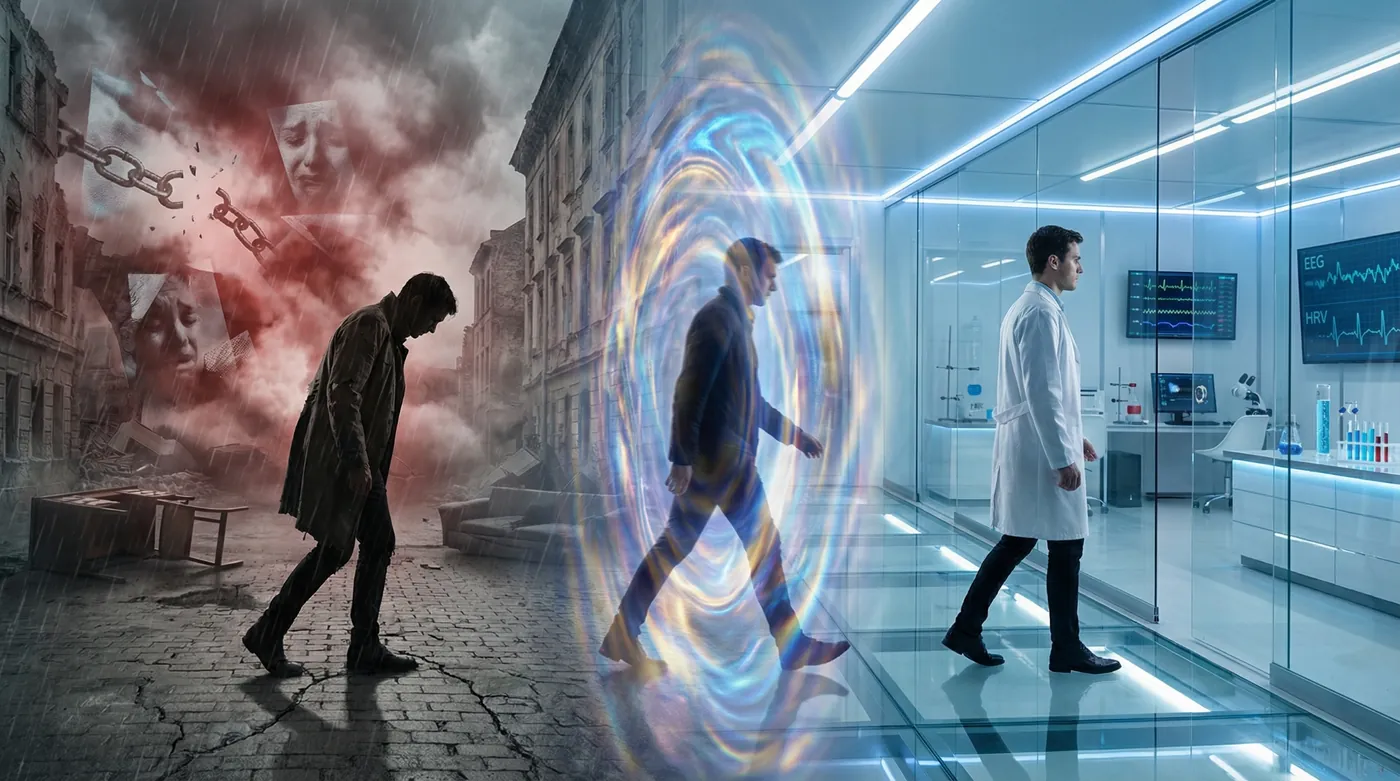
We can look at each other without overlay. Without the past that usually sits between two people like a frosted pane of glass. There is the possibility of seeing each other now — without preconceptions, without expectations, without comparing to «how it should have been.»
Interactions with people changed too. In the company of new people — at any scale, didn't matter — I stayed myself. It became very easy to talk to people who used to seem like a «different league.»
The Birth of the Personal Lab
Hard events happen to everyone. To every single person. No exceptions.
For most people, the same mechanism kicks in. The DMN takes the controls and runs its endless carousel: «Why did this happen?», «I should have done it differently», «What will they think of me now?»
But there is another path. And it is here that what I call the personal lab is born.
Picture this: an event happens. The body contracts. The emotion strikes. And in that moment — instead of falling into the familiar funnel of thoughts — you take a step to the side. Inside yourself. A gap appears.
In that gap, you are both the subject and the researcher at once. You are not suffering from the event — you are placing it on the lab bench.
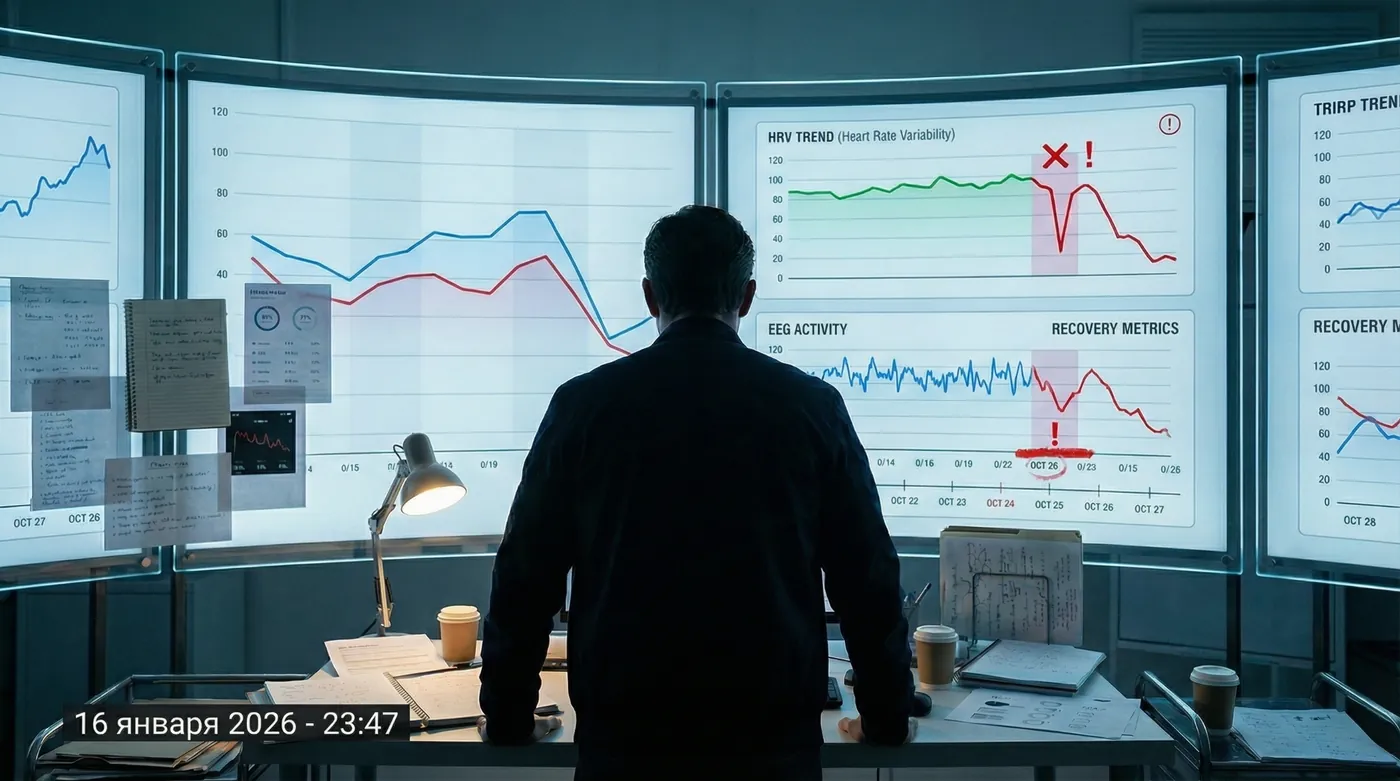
I kept journals. I logged states. In parallel ran data from an EEG and a fitness tracker. And when I compared the subjective entries with the objective numbers — I started seeing patterns.
In that period, something happened that any founder who has been betrayed by a partner will understand without explanation. A man I had trusted acted blatantly and meanly.
The body saw it.
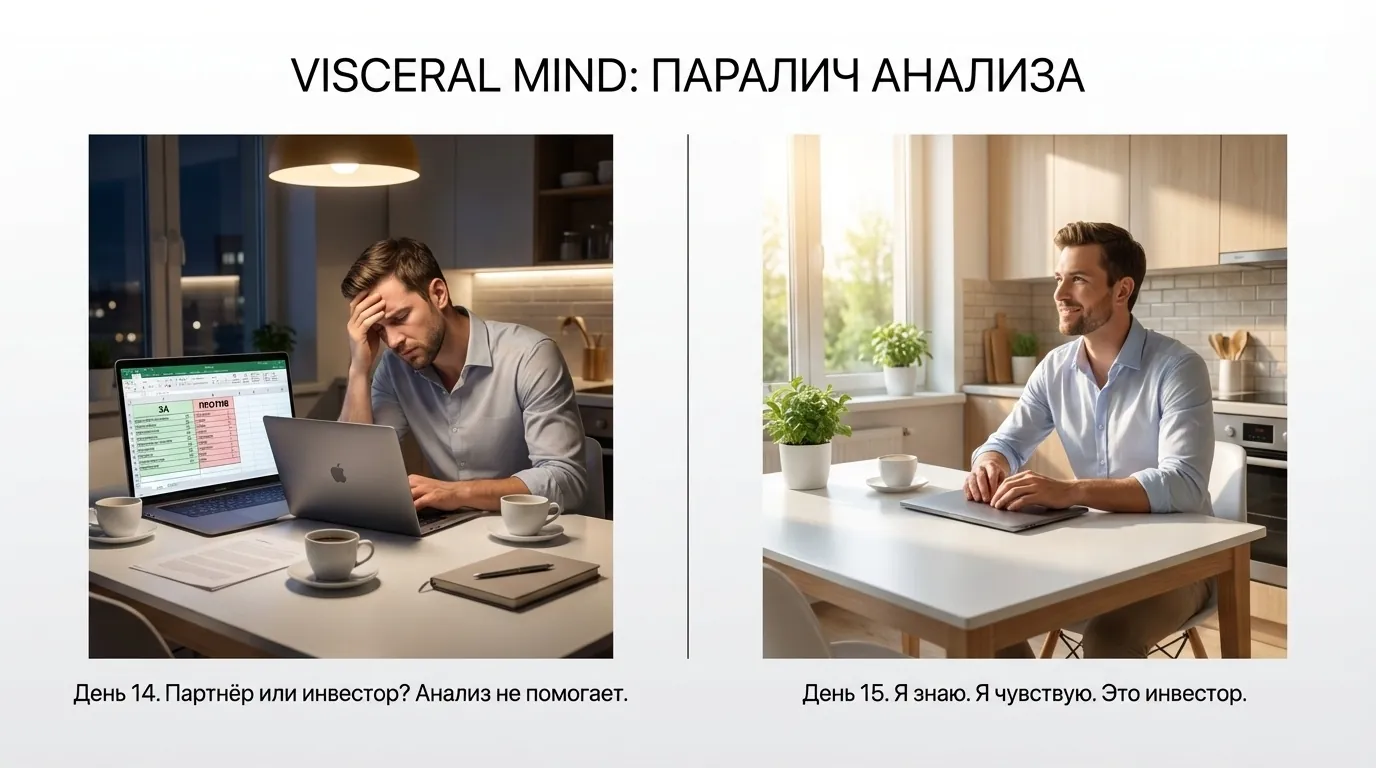
When I pulled up the data for those weeks — across thirty parameters of brain and body states — this is what showed up. In the period when the betrayal was already being prepared, but I had not consciously seen it — the body was signalling. HRV was dropping. Sleep was ragged. Recovery was worse.
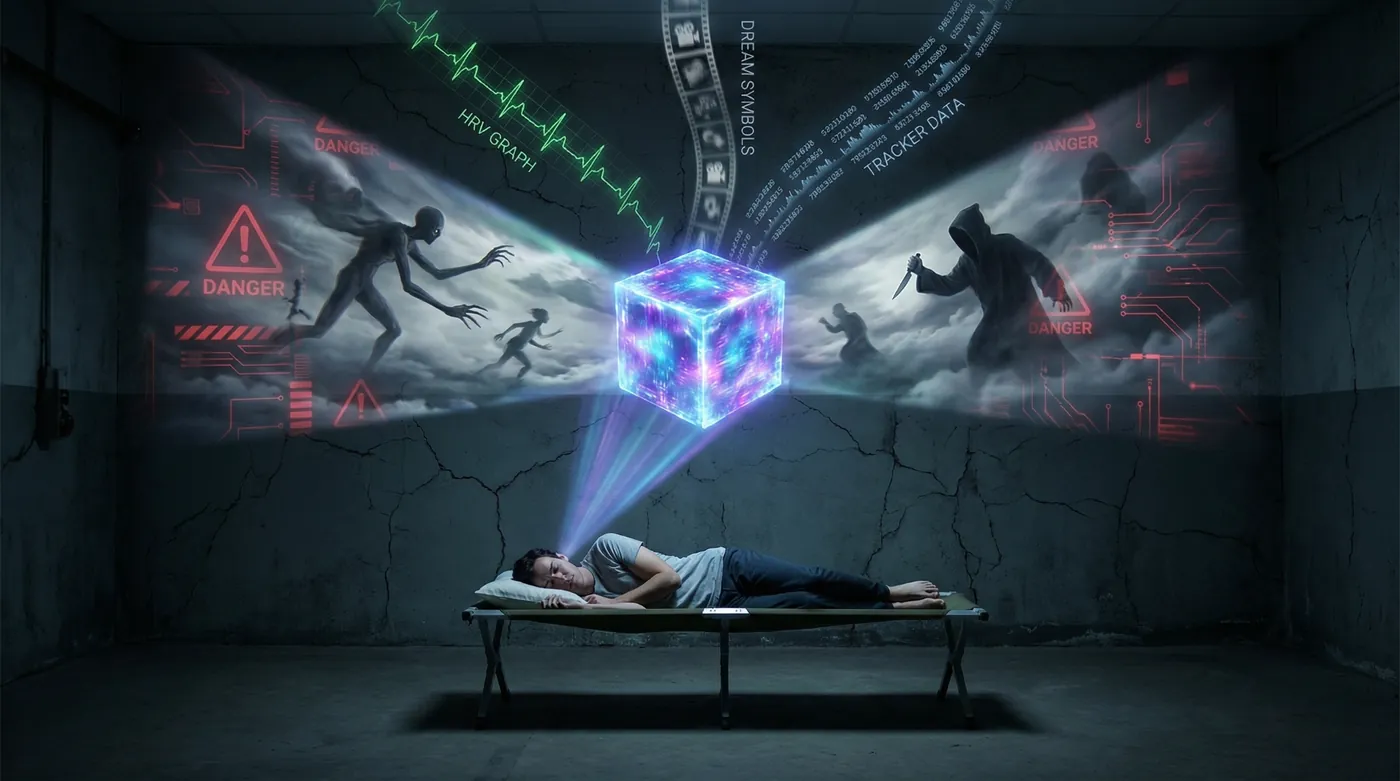
This is Visceral Mind in action. Not mysticism — data. Not intuition as fortune-telling — intuition as processing of signals the body picks up before the conscious mind does.
The Invisible Discovery
Things started happening that I couldn't explain by silence alone.
I'd sit down at my desk, drop into Nothing — and suddenly find that I could hold focus on a task for two, three, four hours straight without a single distraction. Without effort.
At other times, I'd close my eyes after a heavy day — and the body would recover in ten minutes as if I'd slept for three hours.
And sometimes — the strangest part — I'd pose a hard question, drop into the silence, and after a few minutes the answer would arrive. Not as the result of logical analysis. A ready-made solution would simply appear, whole.
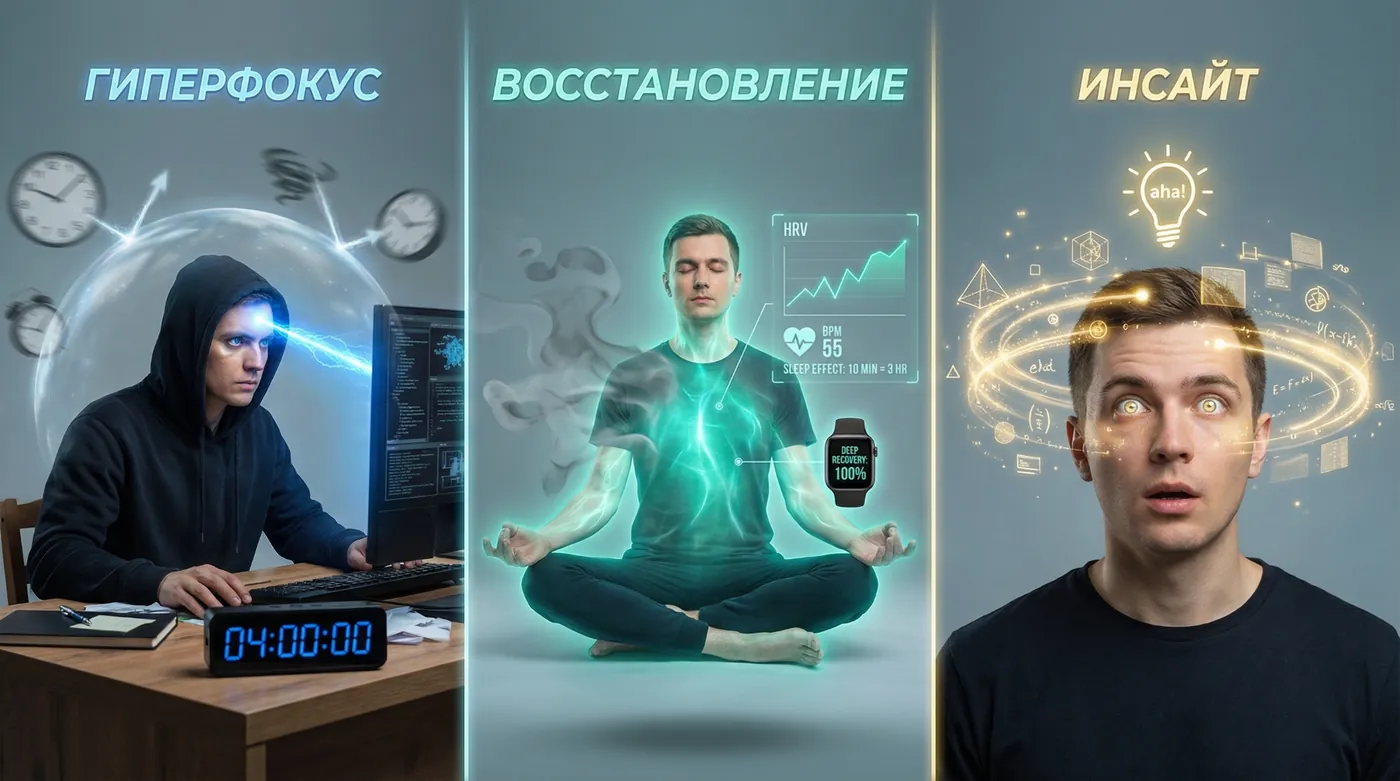
For a while I explained it simply: brain rests, brain works better. Logical.
But the rational model didn't explain why different entries into silence produced different results. These weren't variations of one state. They were different states. With different sensations, different functions, different results.
From the very beginning, the remote had been in my hands. I had just been pressing the same key over and over.
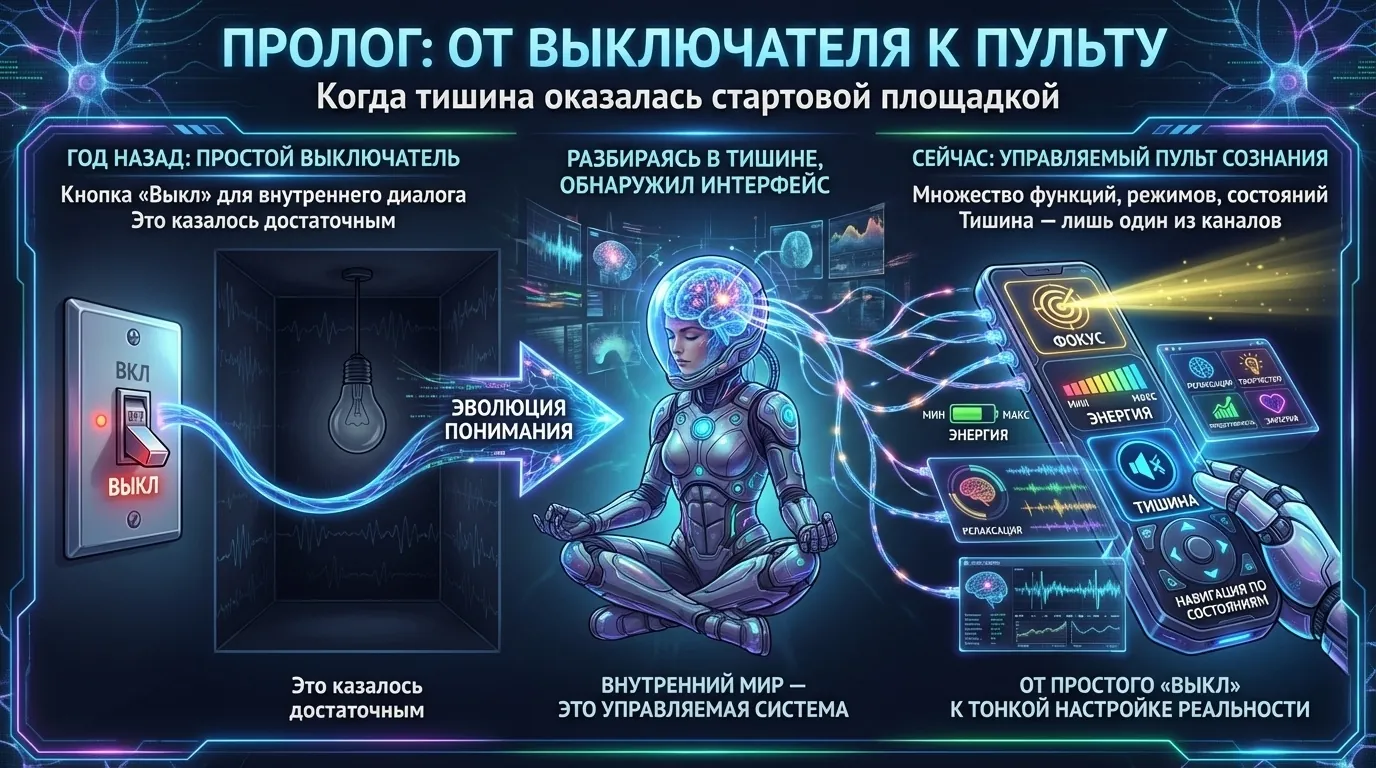
Later I understood something else: each of these states had been described long before me. Thousands of years ago — in Sanskrit, in Pali, in Arabic, in the language of Zen koans and Christian mystics.
I started verifying. What are these states? What do they do? How exactly do they help in ordinary life?
Presentation of the Remote
I spent a long time thinking about how to tell you this. What I built isn't a course, not a «technique,» not a «protocol.» It's something that has to be shown whole, in a single gesture.
So I decided to do it in the format of a tech keynote. The kind with the hall, the screen, and one person on the stage. The format Steve Jobs invented and which is used to introduce things that change the rules of the game.
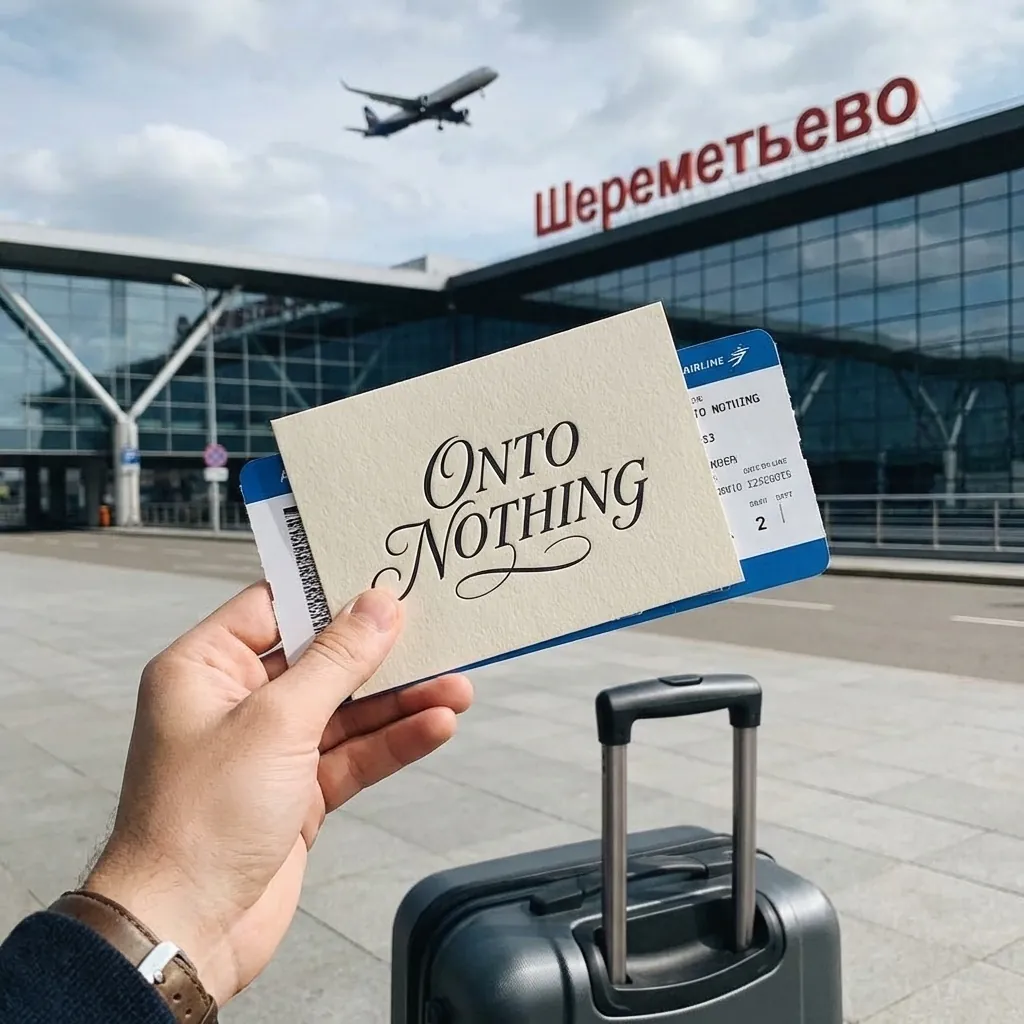
Imagine you're holding a ticket to Silicon Valley. You've been invited to a closed product launch by ONTO NOTHING.
Lights down.
— Every few decades, something appears that doesn't just change an industry — it changes how we live.
1440 → 1876 → 2007 → 2022
1440 — The printing press. Gutenberg built the printing press — and memes got their first way of reproducing without a voice. You no longer had to stand in a square and shout. One press of a lever, and the same idea copied a thousand times.
1876 — The telephone. Bell invented the telephone — and memes learned to move instantly. Through wires. Across oceans. Distance stopped being a barrier.
2007 — The iPhone. Jobs showed the iPhone — and memes got 24/7 access to your nervous system. Not when you sit down at a computer. Always. In your pocket.
2022 — ChatGPT. ChatGPT arrived — and memes learned to make themselves. Without a human. Faster than a human.
For the information living inside you.
Four hundred years of technological progress — not a single step in favour of the carrier.

— You already have a remote control for consciousness. You've always had it. The problem isn't that it doesn't exist. The problem is what kind of remote it is.
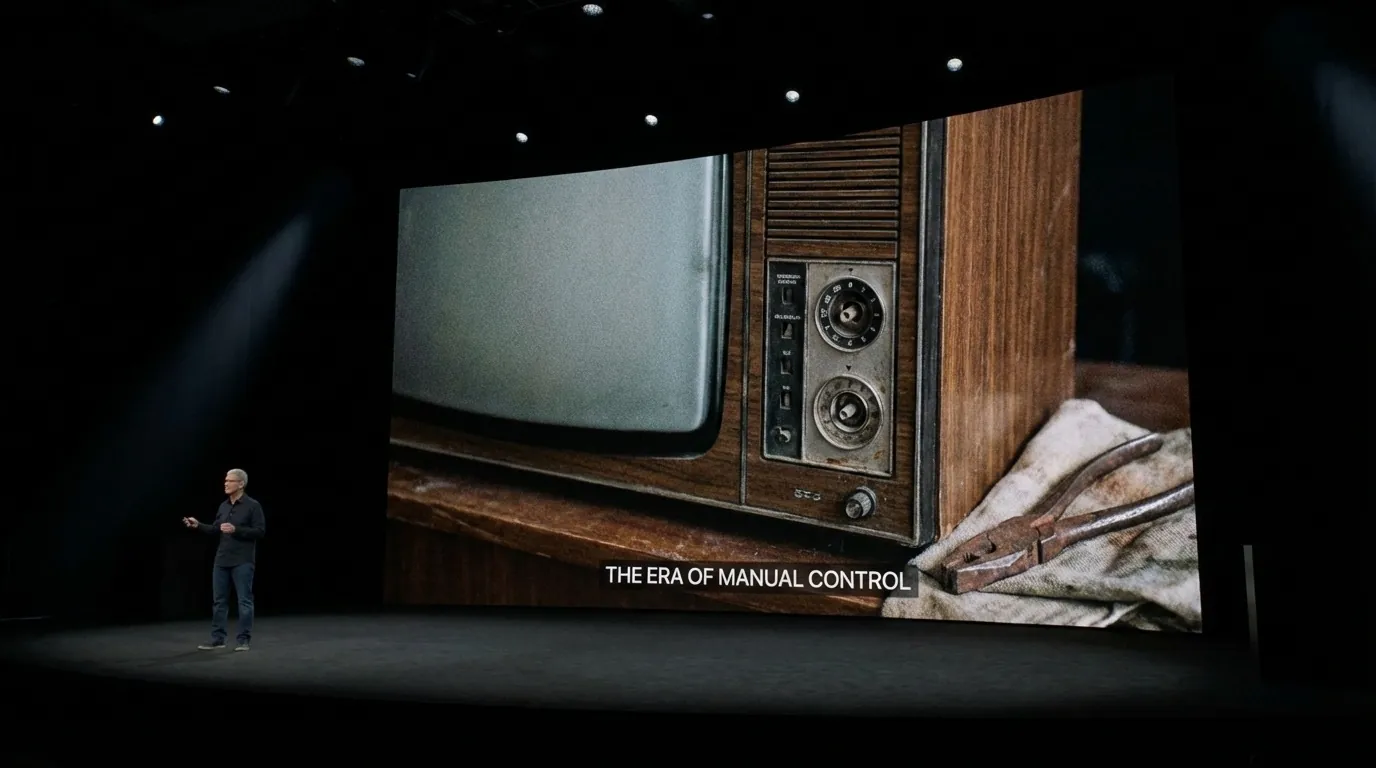
Remember those TVs? No remote at all. To change the channel — get up from the sofa, walk over, turn the dial. Click. Click. Click. Four channels. Half of them static. The dial fell off a year ago. You hold the antenna with your hand to catch a signal.
That's your current remote control for consciousness.
You want to relax — you need to «get up from the sofa»: carve out time, find a quiet spot, twenty minutes wrestling with thoughts. You want to focus — coffee, timer, phone away, telling yourself «get it together.» You want to fall asleep — counting sheep, box breathing, melatonin.
Four channels. Half of them static. The dial fell off. And you think this is normal. Because you haven't seen anything else.
The Three Networks and the Role of the Salience Network
— But pliers and inconvenience are just the tip of the iceberg. Forget the inconvenience. The problem is what happens to a TV that has been malfunctioning for years.
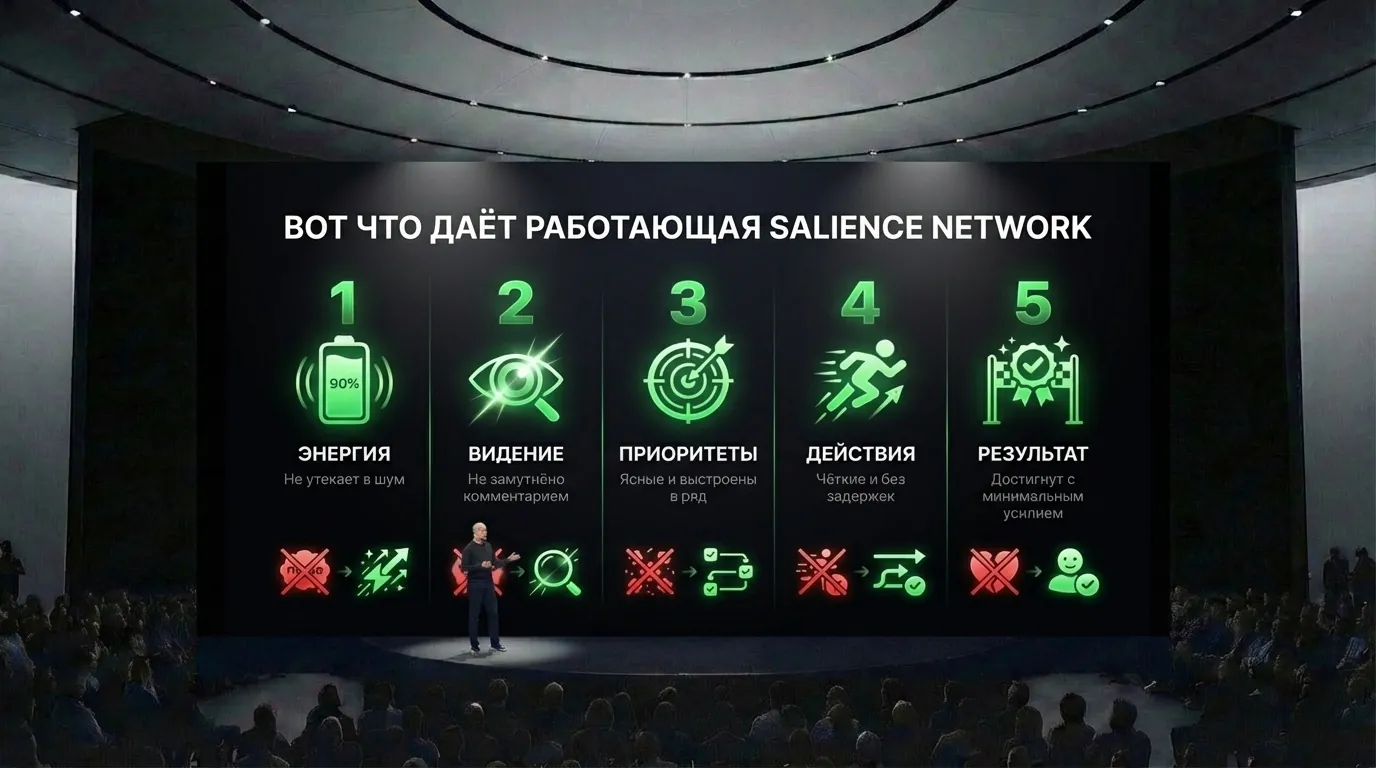
When you don't manage your states — your states start managing you. The absence of a remote isn't just «I'm tired.» It is:
A chronic beta-storm. Energy leak. Up to 20% of all the body's resources go to keeping the DMN running.
An existential vacuum. A hole inside, and you try to plug it with money, projects, people, but it keeps whistling through.
Loss of identification. You become a sum of reactions to external triggers.
Self-destruction. If the body can't manage energy efficiently — nature is harsh. The self-destruct programme is already running.
— To understand what's broken, let's open the hood. Because the problem isn't your willpower. The problem is the architecture.
In your brain there are three large neural networks — billions of neurons working together, like orchestras.
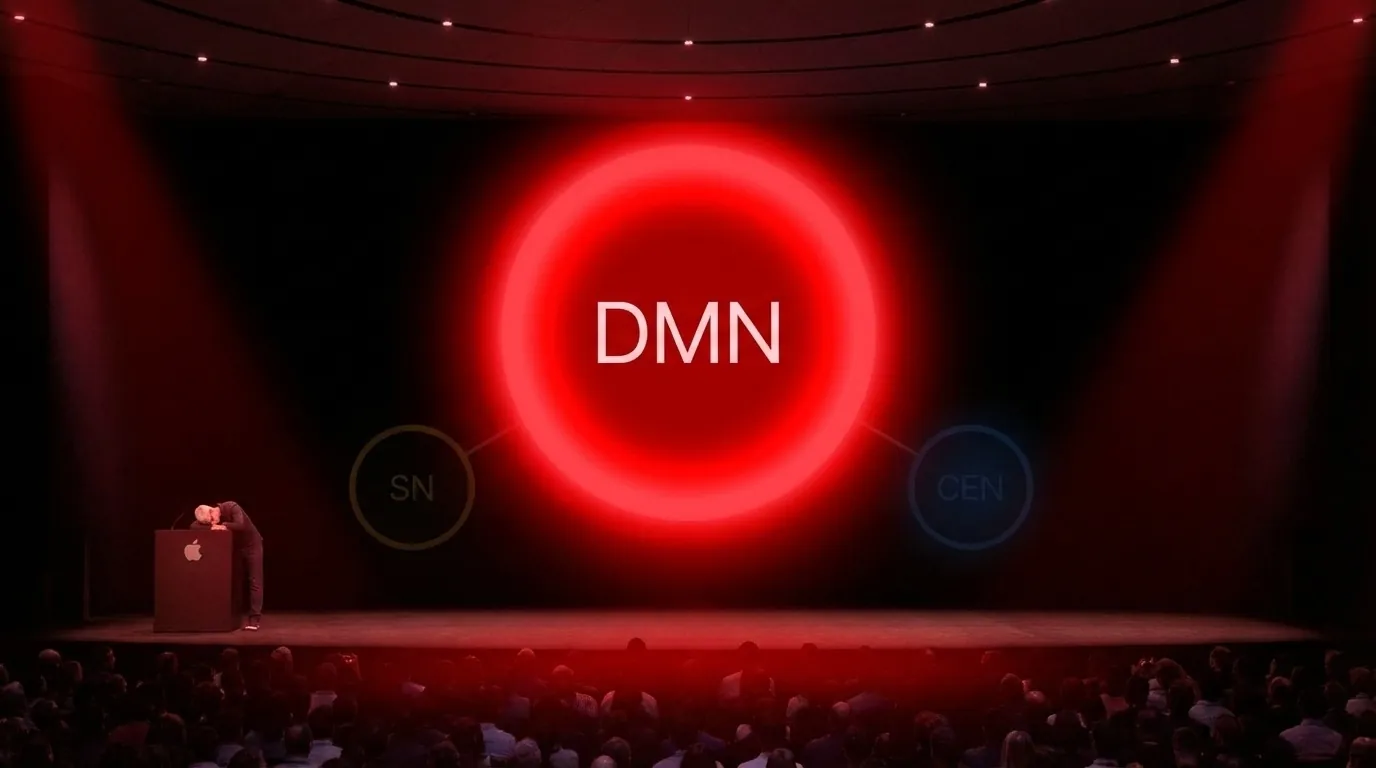
DMN — Default Mode Network
The default-mode network. «Radio in the head.» Inner dialogue, mind-wandering, rehearsing the past, simulating the future. In most people, the DMN is hyperactive — it captures the airwaves, gives the other networks no space to speak.
CEN — Central Executive Network
The executive network. Focus. Working memory, logic, problem solving. When you're really concentrated — that's the CEN.
SN — Salience Network
The salience network. The dispatcher. It decides which of the other two networks gets control right now — DMN or CEN. In most people, the SN is weak — untrained.
It's a literal description of a brain in which the SN doesn't work and the DMN has taken over the air.
Your brain has three core rhythms. Three frequencies on which it broadcasts.
Beta (13–30 Hz). Fast, sharp, like the tap of a typewriter. The voice of active thinking, analysis, anxiety.
Alpha (8–12 Hz). Slower, smoother, like calm breathing. The voice of relaxed awareness.
Theta (4–8 Hz). The slowest. Depth. The threshold of sleep. Theta appears when the brain enters states inaccessible to ordinary waking.
Every switch between networks leaves a clear mark on the EEG. Not blurry — distinct.
When the SN activates and takes control — dampening the hyperactivity of the DMN — the same thing happens on the instruments. Every time. For every participant.
The green ones soar.
The dispatcher has woken up.
A Map of Existing Methods
Before I explain what makes us different — let's look at what the market currently offers to someone who wants to manage their states.
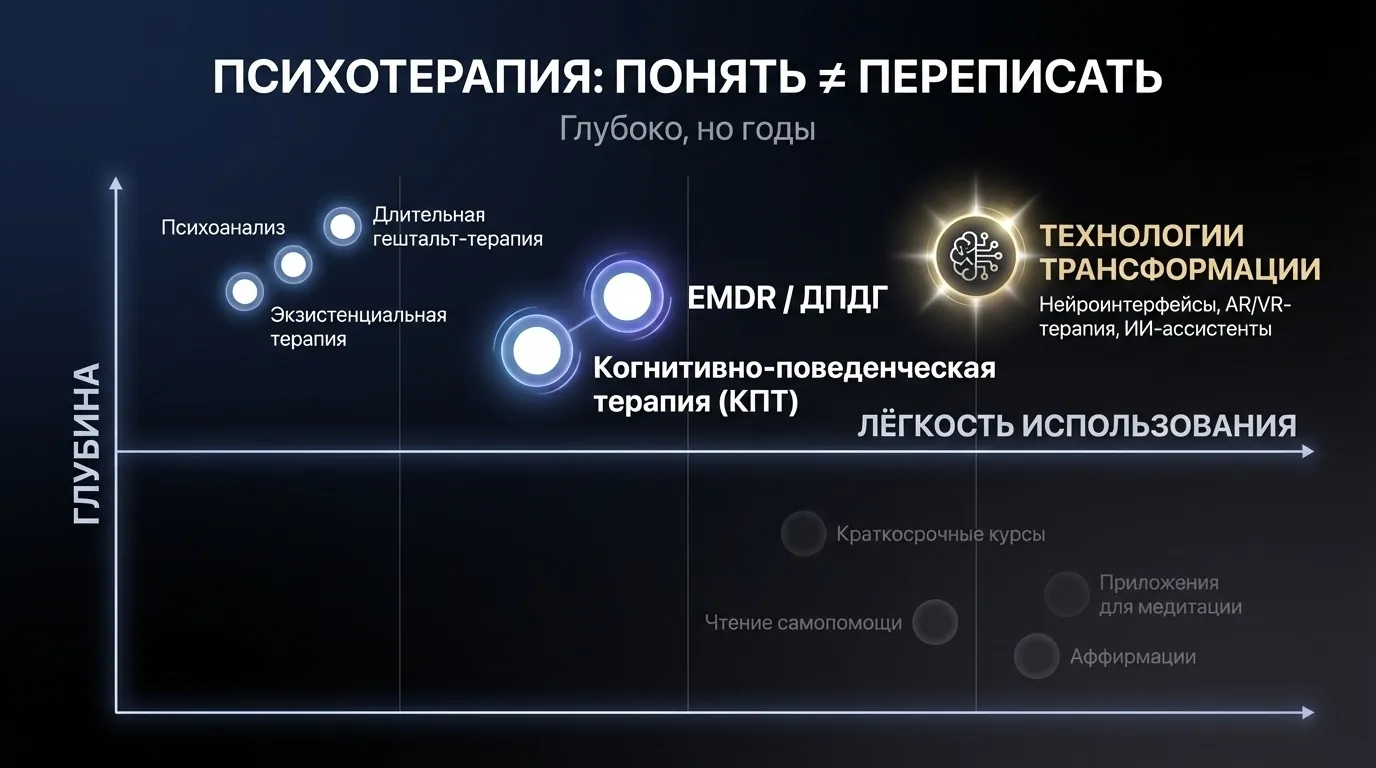
I'll draw you a simple chart. Two axes.
Vertical — depth. How fundamentally the method changes the work of the brain. At the bottom — cosmetics, temporary relief. At the top — real change at the level of neural networks.
Horizontal — ease. Not «how pleasant,» but how simple it is to get a result. On the left — years of discipline needed. On the right — instant.
Bottom right — things easy to try that change nothing. Right and a bit higher — chemistry that mimics results as long as you take it. In the middle — methods that work but require effort and time.
And the upper-right corner is empty.
Deep and easy. Real change at the level of neural networks — without years of discipline, without a clinic, without fighting yourself. Nobody had got there. Because everyone assumed: this doesn't happen. Depth and ease — always a trade-off.
Six Modes — The Operating System
— Here it is. Everything we talked about — three neural networks, the dispatcher, state switching, alpha, beta, theta — comes down to this.
At the centre — NOTHING. It is not one of the modes. It is the entry point. The operating system on which everything else runs.
From this point — and only from it — all six modes are accessible. Like the Shift key on a keyboard: by itself it types nothing, but as long as you're holding it — every key works differently.
NOTHING is the instant halt of the internal dialogue. Not slowing. Not watching the thoughts from a distance. A halt. Total. By your decision. In seconds.
Buddhists called it śūnyatā. Yogis — nirodha. Heidegger — Gelassenheit. I call it the NOTHING button.
Pure Nothing
Eyes closed. System zero. Reset.
Midday. Four hours of work behind you. The head packed with conversations, numbers, other people's expectations. The body feels heavy, even though you haven't made a single physical move. You're not tired — you are noisy.
The old way out: tough it out till evening. Or coffee — thirty minutes of the illusion of alertness, then a drop even lower.
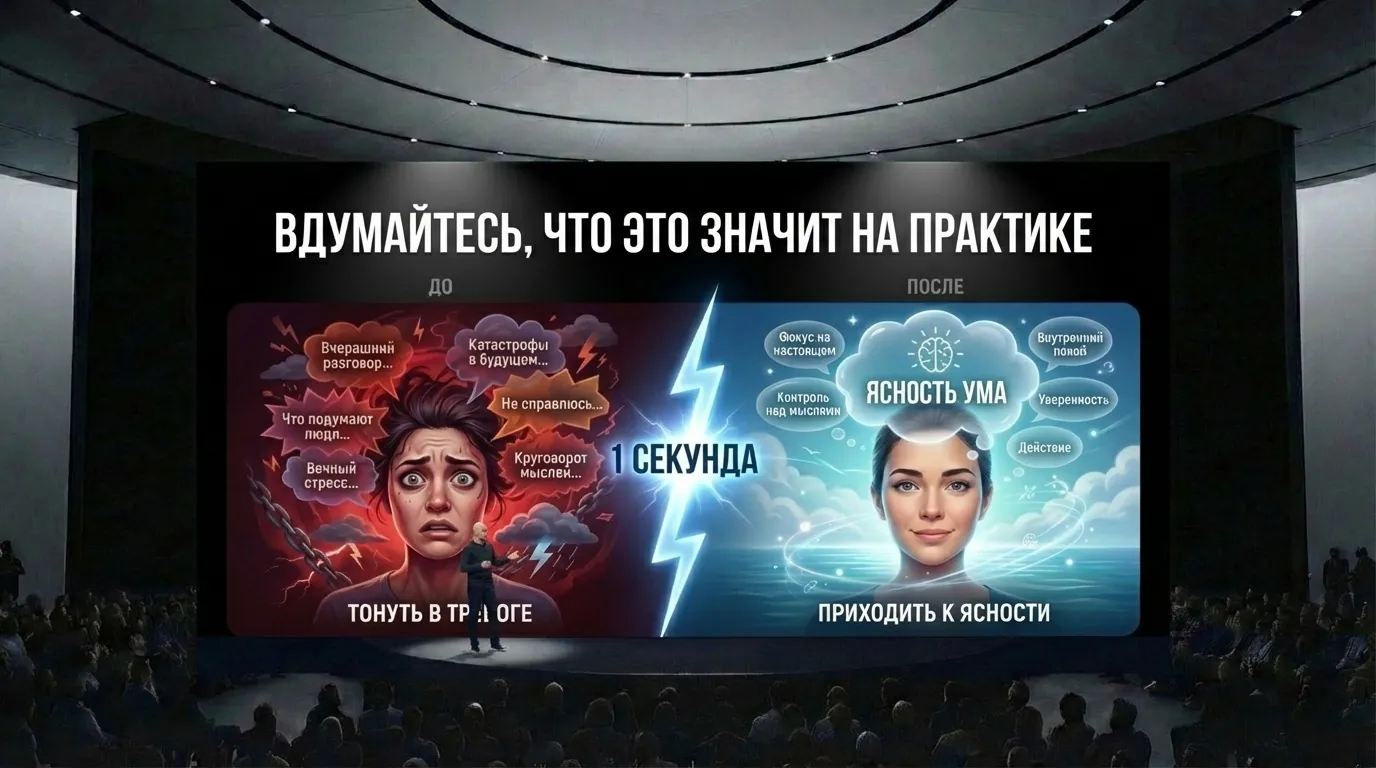
You press the button. Close your eyes. Three to thirty seconds. Beta crashes. Alpha soars. The internal radio goes quiet.
A minute later, you open your eyes. The head is clean. The body — light. Energy is back. Without coffee, without a break, without leaving the task.
This is the base mode. The zero point. Every day starts here — and you can come back to it as many times as you want.
Visceral Mind
Access to the body. The visceral intelligence. A compass that doesn't lie.
You live in your head. For years. For decades. The body has become transport for the brain. You feed it, wash it, sometimes train it. But you don't hear it. You don't feel it. The connection is broken.
And the body holds all the information. Four billion years of evolution have written into your cells a navigation system that works faster than any analysis. When a situation is dangerous — the body contracts half a second before the brain catches up. When someone is lying — your stomach tightens.
But you don't get these signals. Attention is locked in the DMN. In the head. In verbal noise. The body screams — you don't hear it.
Visceral Mind restores access. What it gives you:
Speed of decisions. Two minutes instead of two weeks. You enter Nothing, drop attention from head into body — and the body answers. Contraction or expansion. Warmth or coolness. Attraction or repulsion.
Accuracy of navigation. The mind lies. Easily. It rationalises fear as caution, laziness as wisdom, a dead end as strategy. The body doesn't lie. Ever.
Two minutes. And you are whole again. Not a head on a stick. Whole.
Quantum Genesis
Deep rewriting. The deepest mode. The most patient.
Every one of you has something that hasn't changed in years. A reaction that fires automatically. A fear you've learned to work around but never dissolved. A belief that's been holding for twenty years.
You close your eyes. Enter Nothing. And drop deeper — to the threshold where waking meets sleep. You are not falling asleep. You are fully aware. But the brain crosses into another mode.
Neuroscientists call this memory reconsolidation. Yogis called it prajñā. Alchemists — nigredo. Alpha and theta in balance. Neuroplasticity — maximal.
Twenty to forty minutes — and the old programme softens. Not «you work through it.» It loses rigidity. Stops being automatic. Space opens for the new.
Active Presence
Eyes open. Relaxation and focus simultaneously. What took monks twenty years.
Until now, all three modes worked behind closed eyelids. But life happens with open eyes. On the street. At the desk. At dinner with your child.
And here lies a fundamental problem. The Berger effect: open the eyes — alpha rhythm gets suppressed, the brain shifts into processing mode, the internal dialogue returns.
Richard Davidson at the University of Wisconsin found one exception. Tibetan monks. Tens of thousands of hours of meditation. In them — and only in them — alpha persisted even with open eyes.
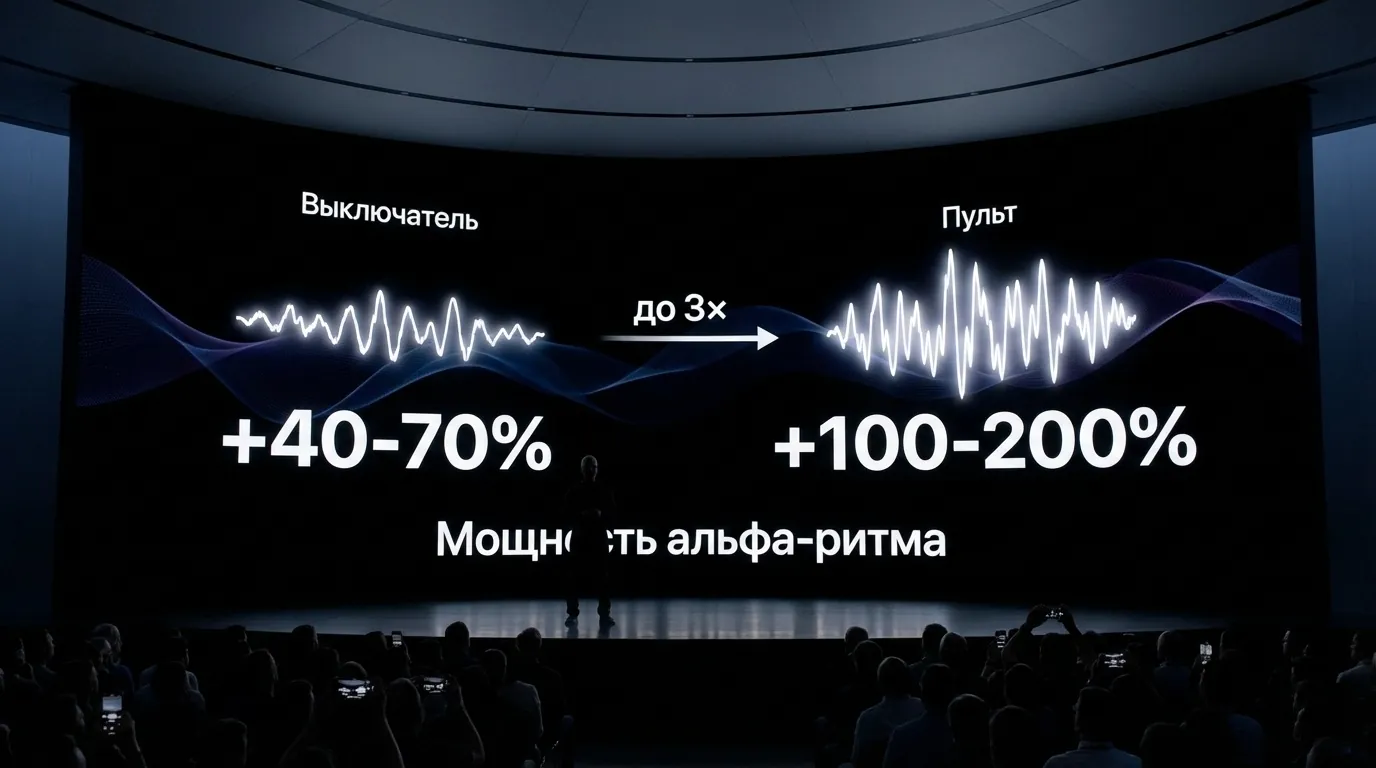
Not in twenty years. Now.
Relaxation index — 70–80%. With open eyes. This is neither sleep with open eyes nor trance. It is consciousness in its best version — without background anxiety, without mental chatter, but in full readiness to act.
You open your eyes from Nothing — and the world enters without commentary. Colours brighter. Sounds more dimensional. The person across from you — not a bundle of your expectations and projections, but a living being, whom you are seeing for the first time.
A walk with your child where you are actually here — not in tomorrow's deadline. A conversation with a partner in which you hear not just the words.
For the life you want to live, not scroll through.
Embodied Flow
Flow. For those of you who know.
You've been in this state. And you remember. The talk where you spoke for forty minutes without a prepared phrase — and every word landed. The negotiation where you saw three moves ahead.
Time disappeared. You disappeared. What remained was only the action — flawless, light as breath. Without effort. Without control. The inner critic was silent. There was no doubt.
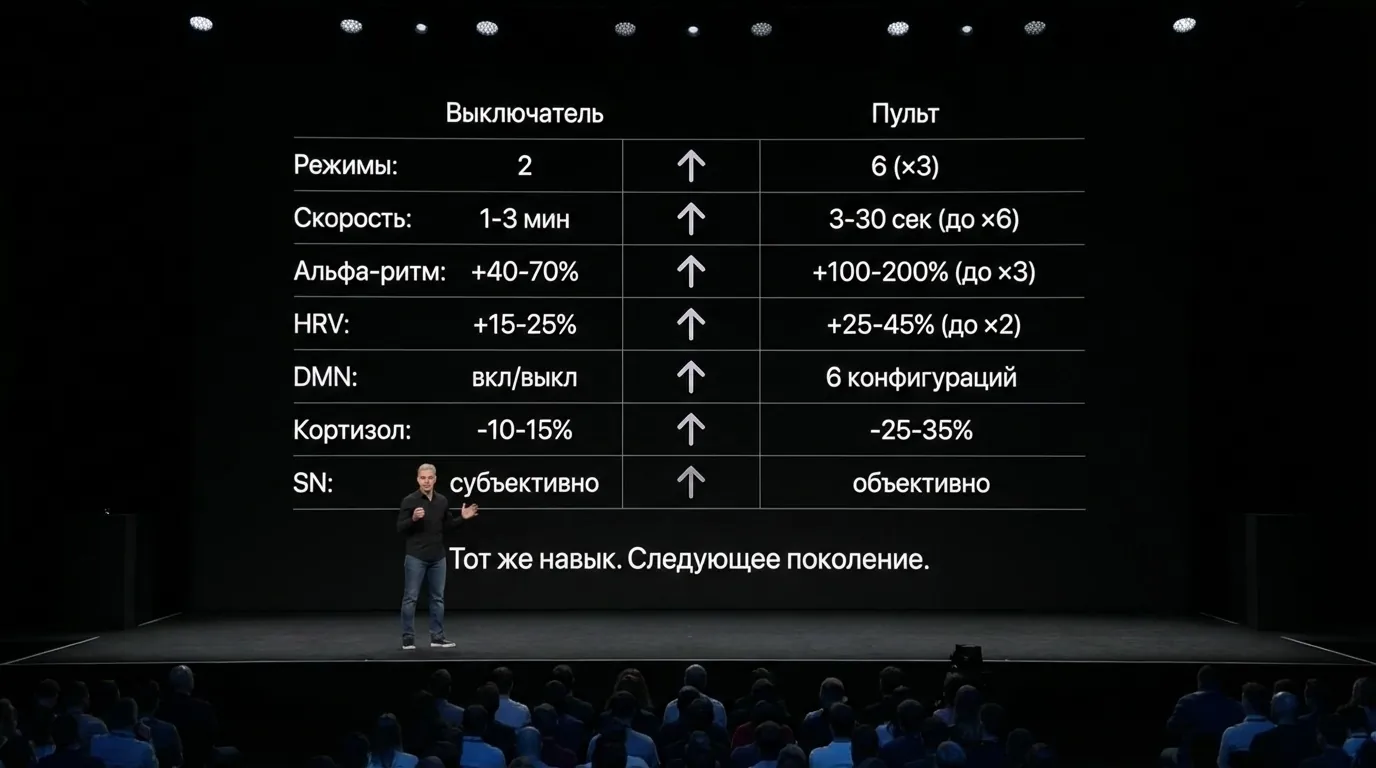
That's the best thing that has ever happened to you. And you know it is rare. Too rare. Sometimes months. Sometimes years between such moments.
The psychologist Csíkszentmihályi described it as a coincidence of conditions. A gift of fate. You got lucky — or you didn't.
He was wrong. Not about the description. About «can't be summoned.»
Embodied Flow is the flow button. You press it — and step into the state that used to arrive by chance. The inner critic switches off. The body is mobilised but not tense. Time stretches.
Japanese samurai trained for twenty years to reach mushin — «no-mind in action.» Miyamoto Musashi: «Do not think about the strike — the strike happens by itself.» Bruce Lee: «Be water.»
Before the stage. Before the meeting room. Before the start.
Transcendent Download
The last. The strangest. The most powerful.
To explain it, I first need to describe the state from which it operates.
Recall what happens in Active Presence. You open your eyes — alpha stays high. You are present. But your attention is focused — on the interlocutor, on the task, on the cup of coffee.
Now imagine that from that presence you expand attention. Not onto one object. Onto everything. Onto the whole field of perception at once. Sounds, body sensations, the space around you, thoughts — all simultaneously. Without choice.
Zoran Josipovic of New York University found something unexpected on fMRI: in this state both the DMN and the external-attention network activate simultaneously. They should be antagonists — yet here they work together.
Buddhists described this for millennia as śūnyatā — emptiness that is not empty but containing. Vedanta called it turīya — the «fourth state,» beyond waking, sleep, and dream.
The mechanism of insight
Beeman and Kounios (Northwestern and Drexel) captured the exact mechanism of insight on fMRI. One and a half seconds before the solution becomes conscious, a gamma burst fires in the right temporal cortex. That burst is always preceded by alpha silence.
First — silence. Then — expansion. Then — the flash.
That's exactly what Transcendent Download creates. Not by accident, not by luck — on request.
You pose a question. Not verbally — a verbal question activates the DMN. You pose it as a sensation. With the whole body.
And the answer arrives. Not as a thought. Not as an argument. As a finished package — with the whole structure, all the connections. A second ago it didn't exist — and here it is, whole.
Einstein walked. Edison fell asleep with metal balls in his hand. Tesla stared at walls. They weren't «thinking.» They were creating conditions. By accident.
not by accident — by decision.
Six Buttons — Summary Map
A Single Day. Six Switches.
Not a single act of willpower — only buttons on a remote.
Picture your day as a canvas where each hour is not chaos but a conscious choice. With the Remote you don't sacrifice time to complex practices.
It's simple: at any moment — at the wheel, at lunch, before sleep — you activate the mode you need with a single «click» in the mind. In 2–3 seconds.
A skill. One that, once installed, does not need updates or recharging.
The ONTO GENESIS Ecosystem
— The ONTO NOTHING Remote is a breakthrough. A skill that changes life. But a skill really comes into its own when it becomes part of a system.
When Jobs showed the iPhone — he didn't just show a phone. He showed an ecosystem. The device, the App Store, iTunes, iCloud — each element strengthened the others.
We've built an ecosystem. Not for entertainment. For consciousness.
Twelve months. Four technologies. One ecosystem.
1. The methodology
The technology of emptiness itself. The ONTO NOTHING Remote, the six modes, Salience Network activation — everything you've seen today. This is the core.
2. The neurointerface
A headband that records brain activity in real time. Four EEG channels. Alpha, beta, theta, delta — everything that's happening in the head, on the screen.
3. The fitness tracker
Body neurophysiology. Pulse. HRV. Stress level. Sleep quality — deep phases, REM, awakenings. 24 hours a day.
4. AI ONTOS
A system of four AI agents. They receive both streams of data — brain activity and body data — plus your journal. The monthly report reads like this:

«Relaxation Index rose from 2.05 to 7.68 — access to the deep resources of recovery. HRV grew from 38.5 to 44.3 ms (+15%) — the nervous system has learned to switch. Deep sleep increased from 92.5 to 107.4 minutes (+16%).
If the practice stabilises, the growth potential is up to +5 years of life. Current status: «Unstable Master» — elite capacities, regular calibration. Next step — move the dual-mode regime out of the training context into real-life scenes.»
This is the first complete system in history for managing consciousness — where skill, measurement, analytics, and support work together.
Four steps
Preparation. The book «My Mental Self» — the blueprint of your prison, whole. You speak out loud, you don't type. Four AI agents assemble the map. Not individual thoughts — the entire structure.
Initiation. A single day, carved out of the schedule. In the space — people in different ONTO NOTHING states. The nervous systems of those who are already in the silence broadcast it — physically, measurably. By the end of the day, you have the button.
Integration. Four to eight weeks. Daily tasks woven into ordinary life. Lift — three seconds of Pure Nothing. Negotiations — switch to Active Presence. The path becomes a road.
Research. Twelve months of a guided experiment on your own nervous system. With hypotheses. With data. With verification.
The switch exists.
Only one thing remains. Press it.
Off-stage
The keynote is over. But the book is not.
What you saw in close-up — the method, the three networks, the comparison of generations, the ONTO NOTHING Remote with its six modes — is the visible tip of the iceberg. What gets shown on stage.
Below the water — three years of work. Hundreds of sessions with participants. Thousands of EEG and HRV measurements. Dozens of iterations of every mode, every instruction, every pause. Partnership with Neiry. A global study with a verification protocol.
And the main thing — the thing you can't put on a slide: real people. The ones who went through the initiation first, who trusted the method when there was no EEG validation, no system of modes, no AI ONTOS — only my «try it.»
Without them, this chapter wouldn't exist. Not because I'd lack material. But because the method is not proved by one brain. It's proved by reproducing in other nervous systems — dozens of different ones, living different lives in different cities.
This chapter is not the finale of the book. It is a handoff point. Up to here, I told you how we got here. From here on — you have the blueprint of the remote in your hands. The rest is your territory.
And what changes when there are no longer two captains in one body — but one, who holds the wheel.