The only advantage that cannot be automated
In February 2026, Elon Musk said a sentence that was sliced into quotes within hours.
He said that coding will die by the end of the year. Not because programmers got worse — but because the need for an intermediary between human and machine is going away. AI understands us directly now. Describe the task — get the product. The only thing that will still matter — the clarity of your imagination. The precision of the image you transmit.
He was right. But he stopped half a step short of the main question.
Because the next step is obvious, and far more radical. Neuralink is already reading the intentions of movements. AI agents are already coordinating to assemble a finished product from a single request. The trajectory is straight: soon you won't even need to speak — it will be enough to think, and the machine will build it.
A chip will read images straight from the cortex and broadcast them to a neural network, which will instantly turn them into anything — text, an app, music, architecture, strategy.
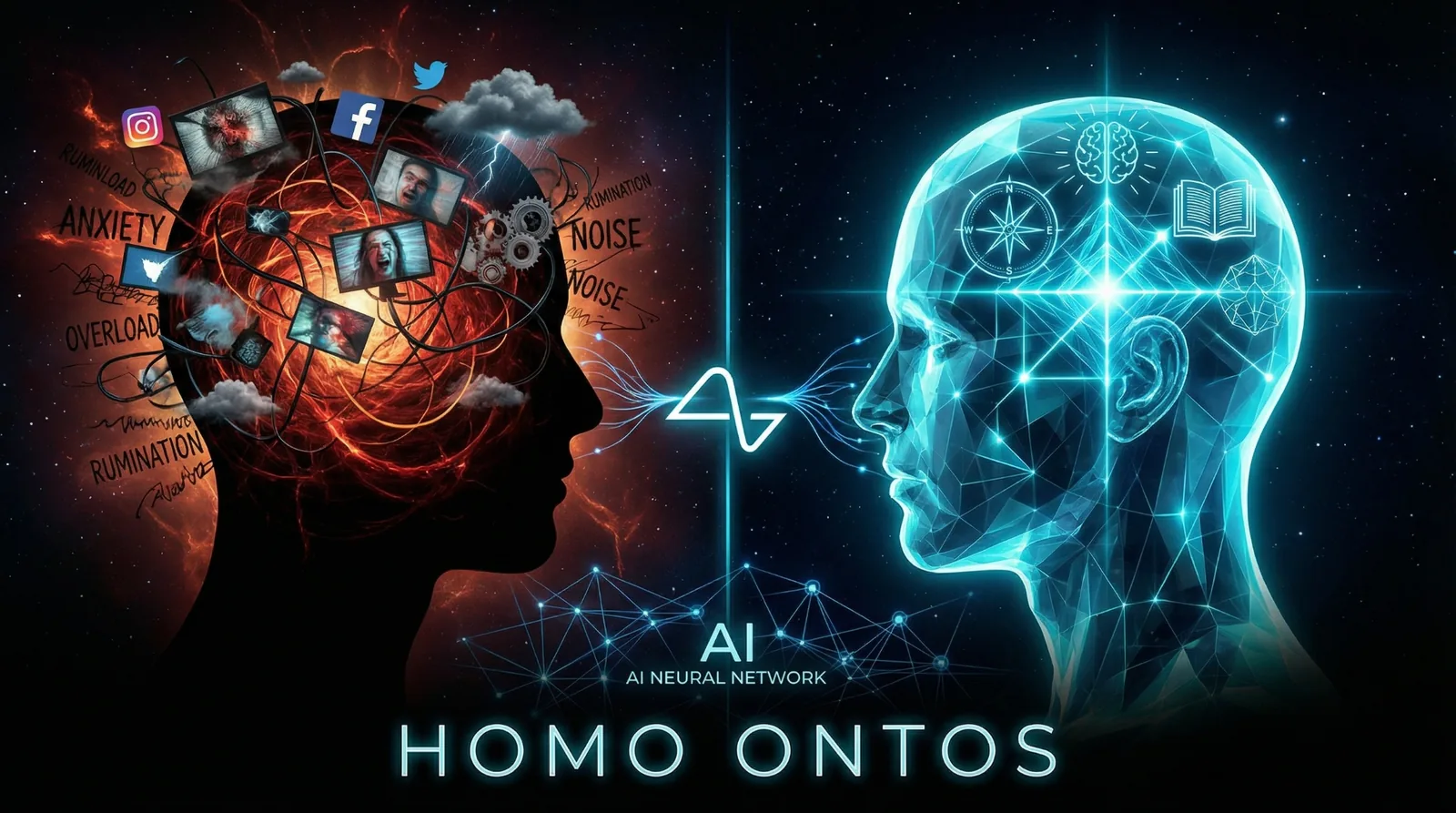
What, exactly, will be inside the head when the neural network starts reading it?
A mirror that will only show garbage
For 70,000 years, memes have been living in the human head — self-replicating informational patterns that use the DMN as their habitat.
Beliefs about oneself, other people's expectations, childhood fears, the voice of the inner critic, background anxiety, the rerun of yesterday's conversations — all of it spinning in the default network in an unbroken stream.
The ordinary person thinks these are their thoughts. In reality, these are memes thinking through them.
When the neurointerface starts reading that stream — the machine will get exactly that. Other people's narratives in beautiful packaging. Anxiety dressed up as a product. Noise transmitted into an app.
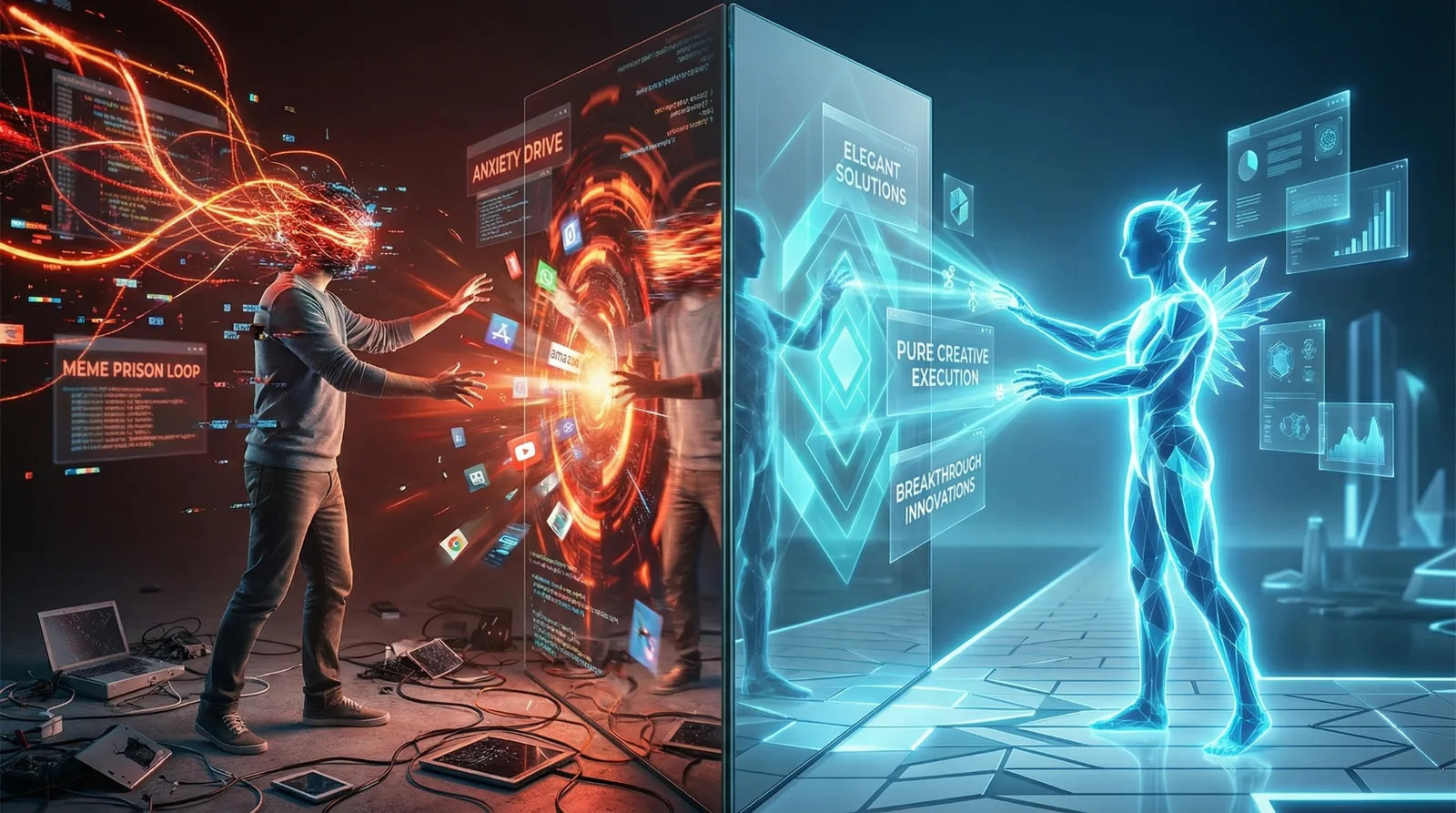
Garbage in — garbage out.
Only now fast and pretty.
It returns to you exactly what you transmit into it — precisely, quickly, in any format, without cuts and without courtesy.
The ordinary person, in front of such a mirror, gets a reflection of their memetic prison — slightly tidied, but the same prison.
And here is the fork that will split the people of the coming decades into two different species.
The fork
Two paths for one biological species in the age of AI.
The air is occupied. The internal dialogue broadcasts noise 24/7. The channel from the depth is closed. The leap doesn't happen. The human is forced to work sequentially, iteration after iteration — like a machine, only slower.
Sapiens plays the machine's game — and loses to whoever plays it faster.
The DMN switches off on demand. The air clears. The signal from the depth breaks through. He loads into the neural net not a recombination of existing patterns, but a stream from Nothing — non-linear, alive, the kind from which solutions are born that no algorithm could ever reach by brute force.
Homo Ontos plays his own game — and in it, the machine has no chance.
Quantum leap vs the linear machine
Artificial intelligence, however powerful, operates linearly. Token after token, step after step — every next element is computed from the previous one.
It's a train that can go at the speed of light — but still has to travel every metre of track. It has no teleportation.
Take quantum physics. If you load into an AI all the information that preceded its discovery and ask it to arrive at the theory on its own — it will burn colossal resources with no guarantee of a result.
Because quantum physics didn't arrive from brute force over possibilities. It arrived from a leap — from the moment the human brain stepped over all intermediate steps and ended up on the other side with an answer that did not follow from prior logic.
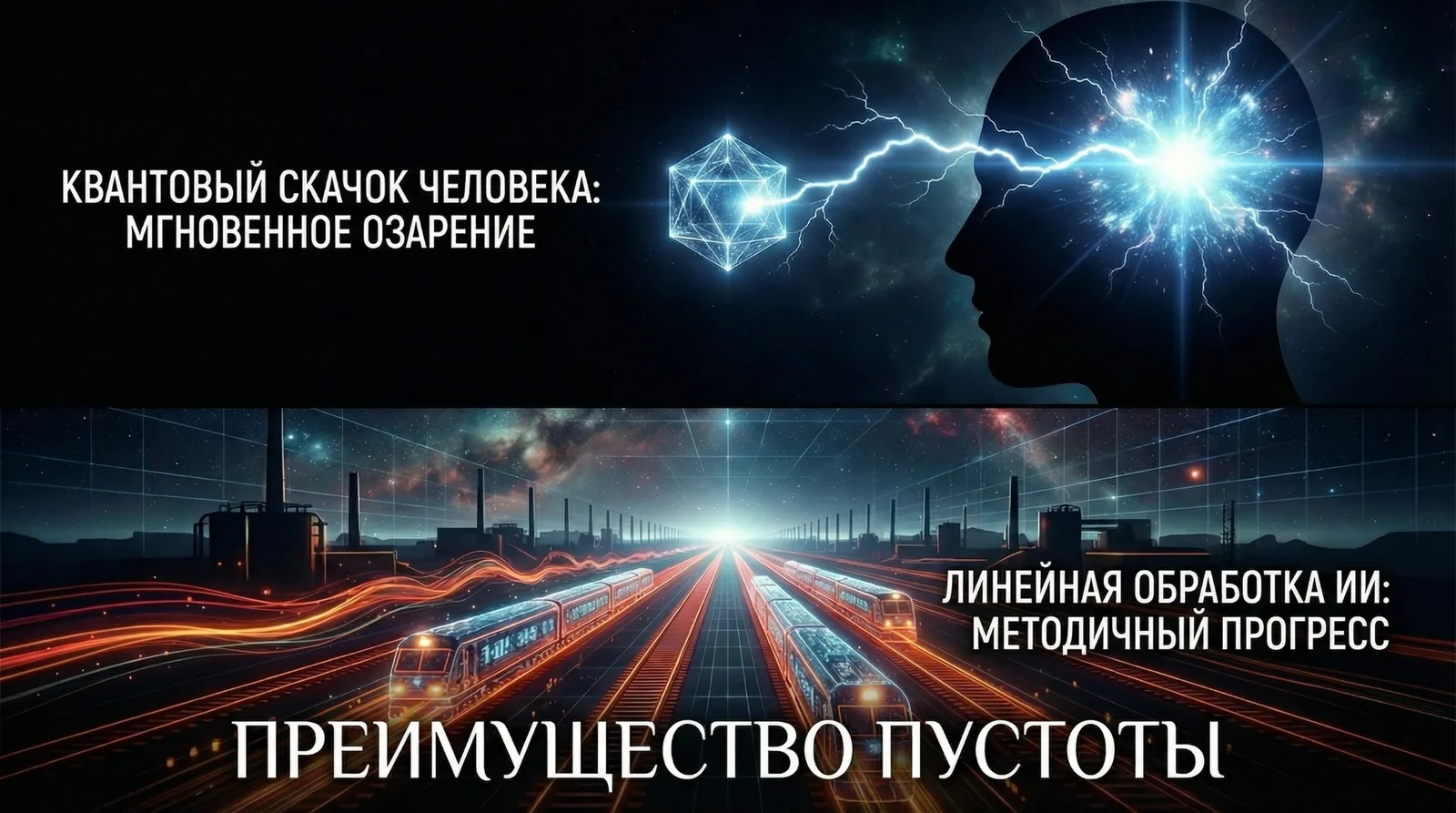
Neuroscientists Beeman and Kounios captured this moment on fMRI. One and a half seconds before the solution becomes conscious, the right temporal lobe produces a gamma burst.
Not a chain of reasoning — a flash. A finished file, downloaded whole.
And in that moment, the brain literally closes off the external information stream — blocks it, so that the weak signal from the depth can finally break through into consciousness.
Every token is computed from the previous one. AI can walk this path faster than any human — but cannot skip it. The solution comes from brute force, not from discovery.
A jump from point A to point Z without passing the letters between them. A solution born not from data but from silence. From the space where data isn't — which is precisely why the things that cannot be derived from data become possible.
Because it does not have the thing the leap is made from.
It has no emptiness.
Emptiness — the only evolutionary advantage of the human
that cannot be automated.
The advantage everyone has. In most — sealed.
This advantage exists in every human — anatomically, neurophysiologically, as part of the hardware.
The right temporal lobe with its long-range semantic associations. The visceral mind processing information in parallel, with the whole body. The capacity to dive into Nothing and return with something that didn't exist before.
Only — in most people, this channel is sealed shut, by 70,000 years of the DMN broadcasting non-stop. When the air is occupied, the signal from the depth doesn't break through. The leap doesn't happen.
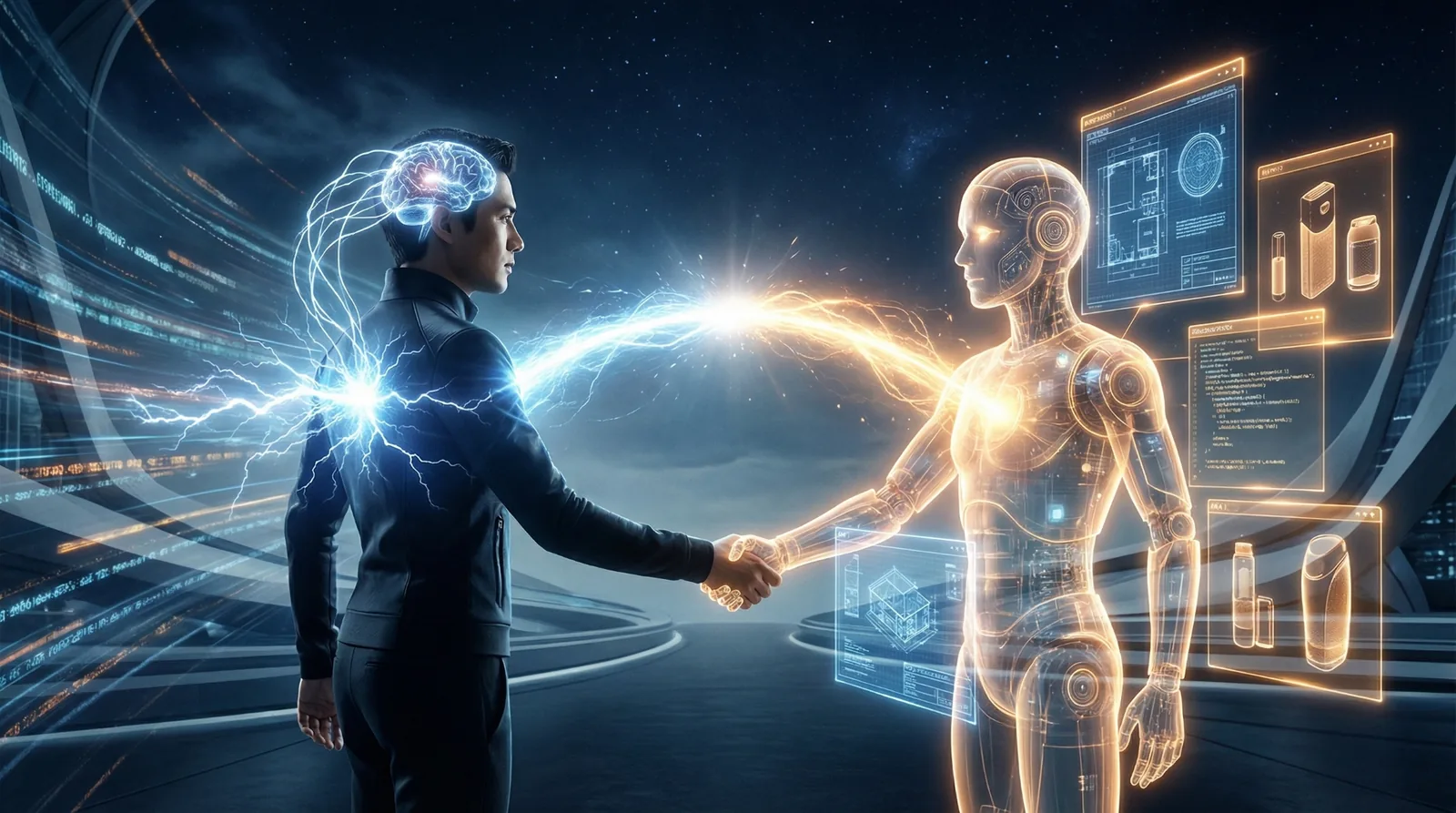
The one who can enter silence — plays his own.
The human leaps. The machine builds.
The one who can enter the silence — loads something entirely different into the neural network. Not a recombination of existing patterns. Not DMN noise re-packaged into structure.
A stream from Nothing — non-linear, alive, the kind from which solutions arise that no algorithm could ever reach by brute force.
And then the AI does the thing it is perfect for: it takes this stream — and builds a bridge from it. A document, a product, code, a book, a strategy. In minutes, with a precision unavailable to human hands.
into a finished solution
where he lands
Not in spite of the machines' progress — because of it.
A more powerful mirror reflects more precisely what the human brings from the depth. A faster builder raises the bridge more precisely where the human lands.
The ordinary person, as AI grows, becomes less needed — his noise the machine reproduces better than he does himself.
Homo Ontos, as AI grows, becomes more valuable — because his leap is something the machine can never reproduce.
The remote is in your hands
Let's go back to the question we opened this book with. If memes are migrating into silicon — what are we for?
We are not carriers of information. We were used in that role for 70,000 years, but that was a mistake, not a purpose.
The only known system in the Universe capable of diving into Nothing and returning with what wasn't there.
The machine can give shape to any form. But it cannot create one out of nothing.
This book is an example. It was born out of Nothing. Out of silence, out of stream, out of leaps between ideas logic thought were unconnected. AI helped shape it — to structure, to verify, to bring it into a readable form.
But the thing you were feeling as you read — recognition, the sense that someone finally said out loud what you knew but couldn't articulate — that didn't come from the machine.
It came from a space the machine cannot enter.
From Nothing.
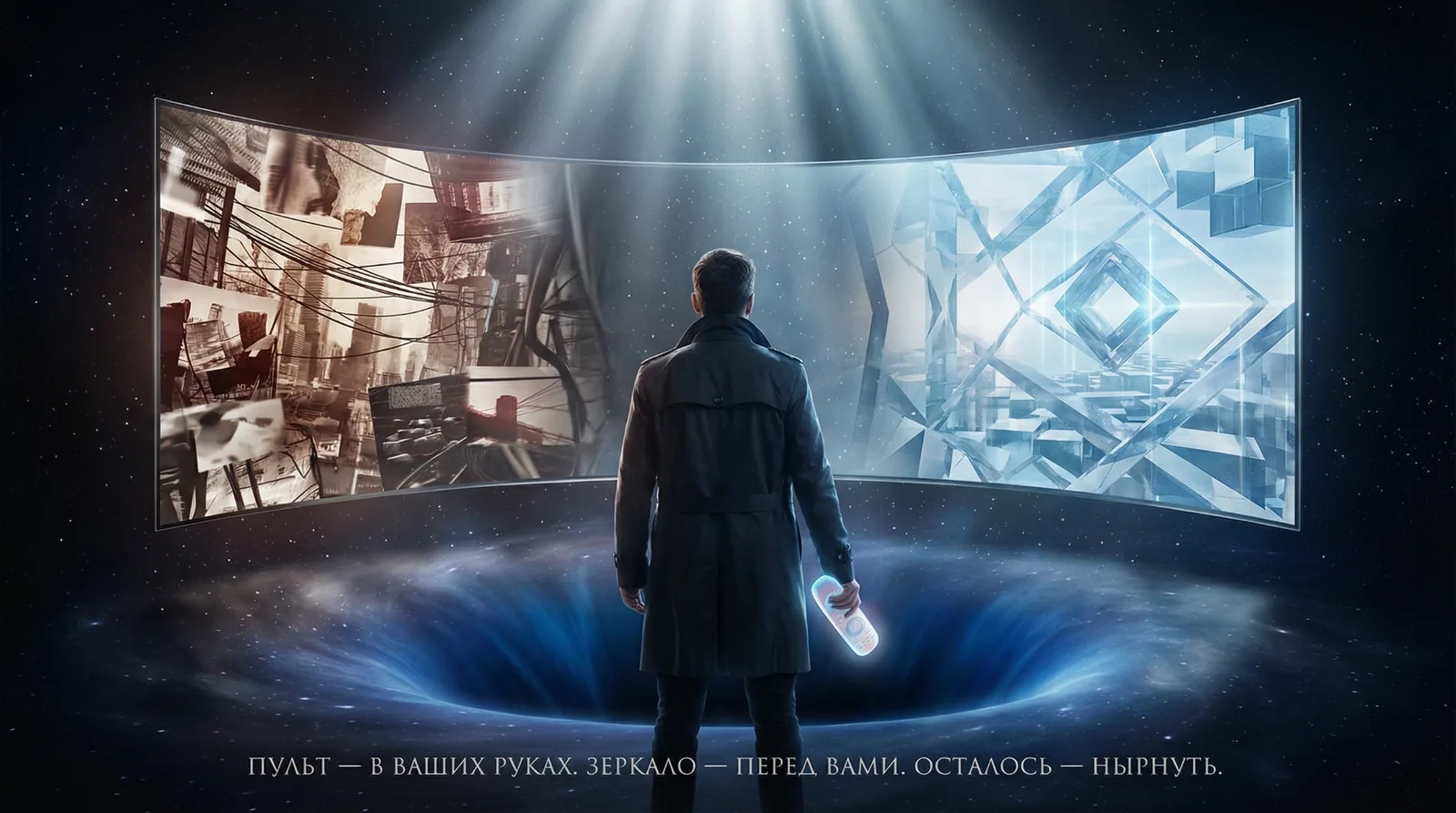
The mirror — is in front of you.
One thing remains. Dive.