The Last Day of Silence
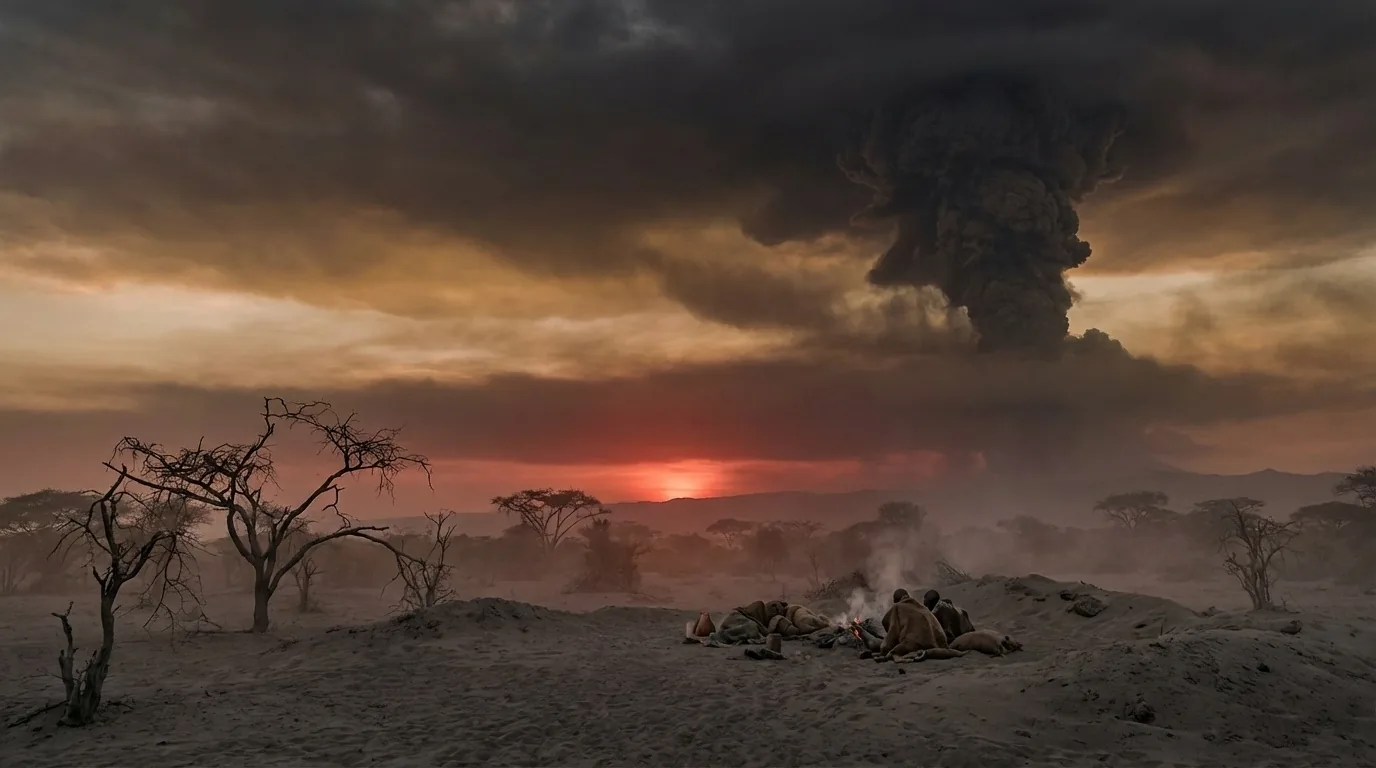
East Africa. 74,000 years ago. Dawn at Mount Toba.
He opens his eyes, and the world enters him without words.
Cold stone against his back. The smell of ash in the air — the sky has been wrapped in it for many days now. The breath of his kin beside him, rhythmic, calm. A distant cry of a bird. Tension in his calves — they ran for a long time yesterday.
He stands up. He doesn't think "time to get up" — the body simply rises. There is no voice in his head that would say: "I need to find water today" or "Yesterday I wasn't fast enough." There is only the pure sensation of thirst, which steers his feet toward a familiar trail.
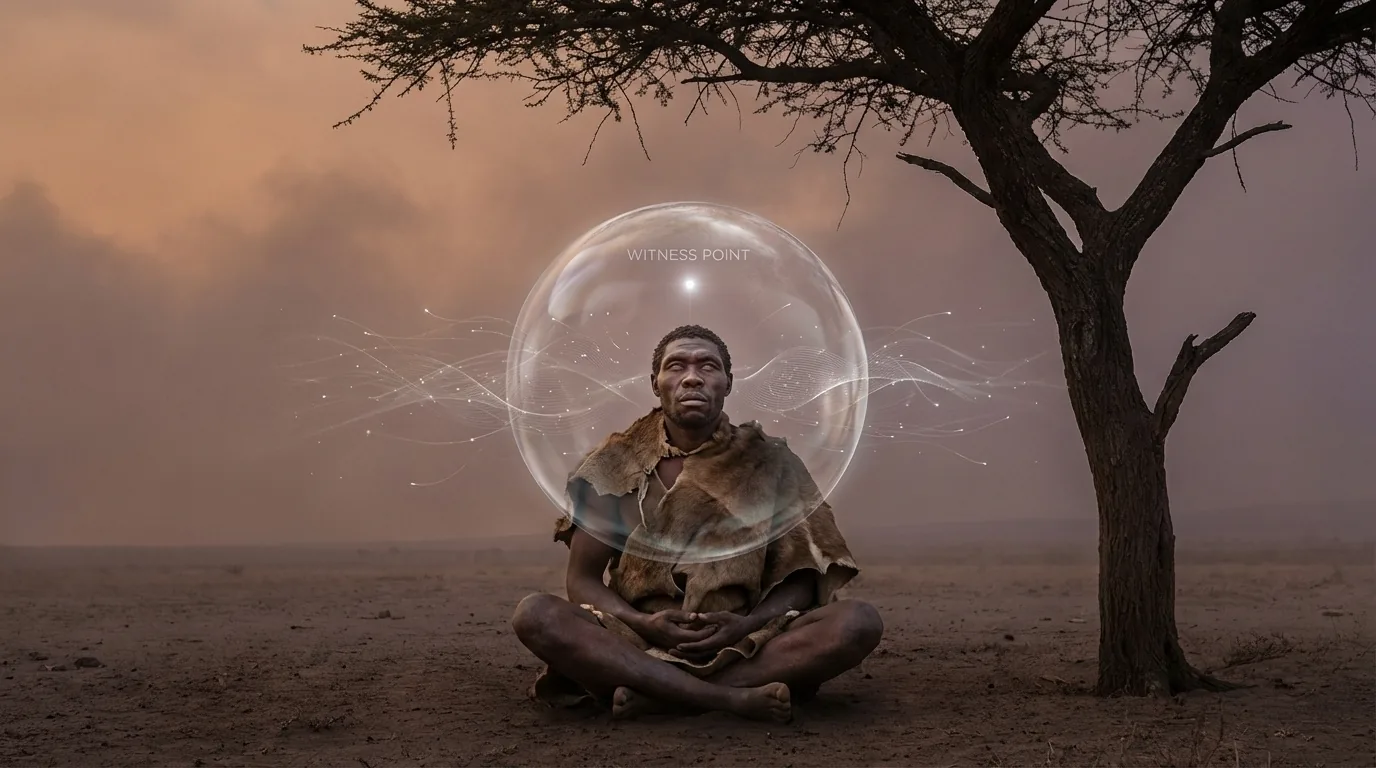
His name is… well, he has no name. No name. No story about himself. No question "who am I?". He is simply that which sees, hears, moves. A point of perception inside the stream of reality.
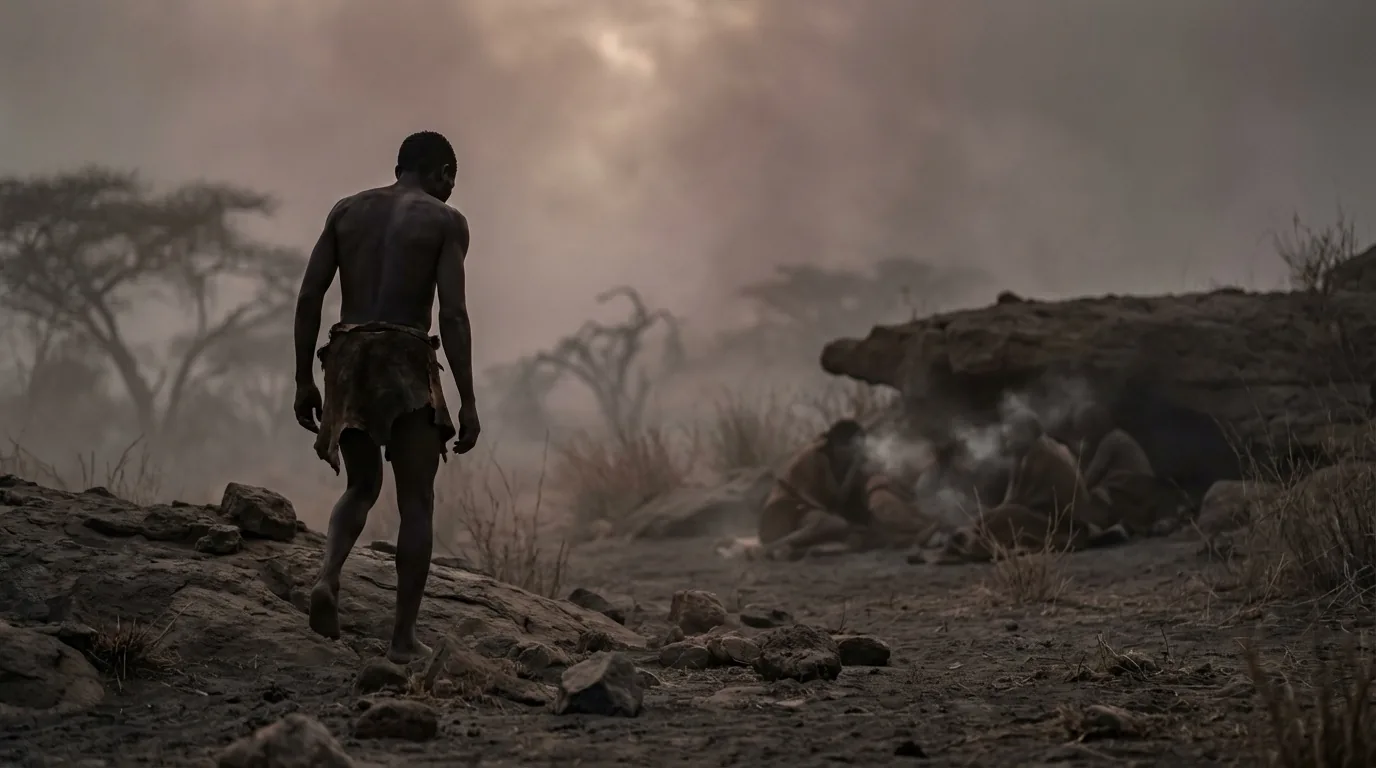
He sees the leader of the band sitting by the dead fire. His body tenses automatically — the memory of yesterday's blow. Not the thought "he is dangerous", but a direct link: image of the leader → tightening in the belly → impulse to look away. Without words. Without story.
He walks to the edge of the cliff. Below — the savannah, covered in grey ash. There used to be herds of antelope here. Now, empty. Hunger is not a concept but a sensation of emptiness in the belly that grows louder.
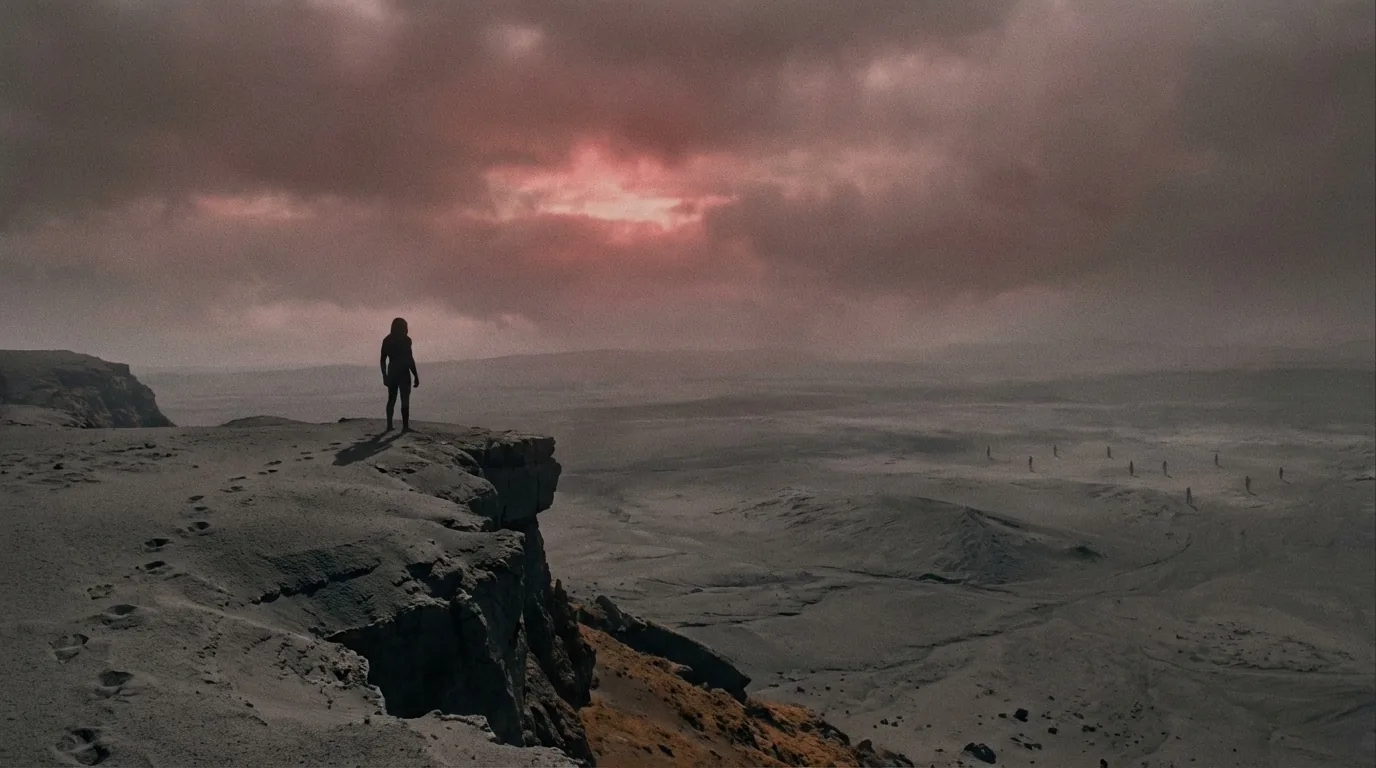
The group has shrunk. There used to be twenty of them. Now — eleven. The rest just… stopped moving. He doesn't think about them. There's no memory as story, only vague images: a child's face that no longer cries, an old man lying still.
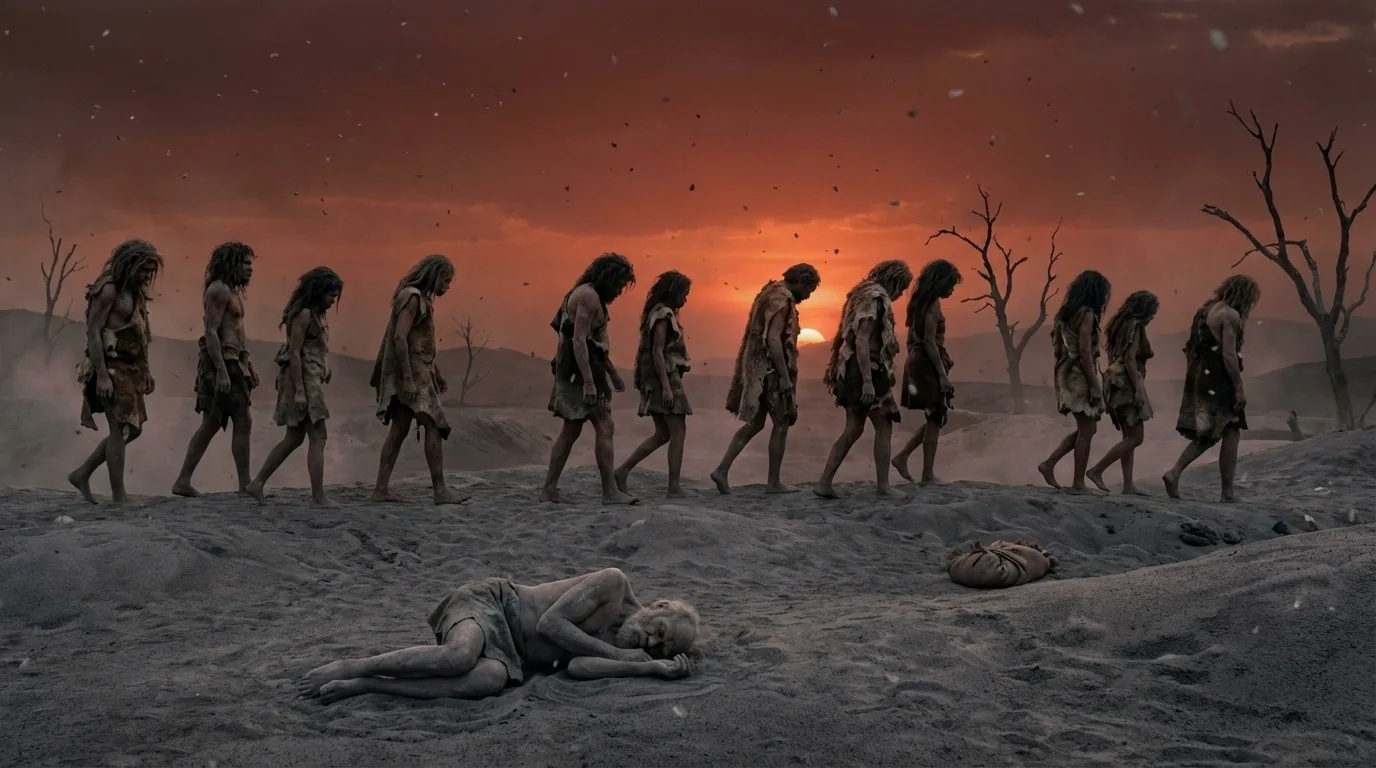
The sun climbs higher, but the light is strange — reddish, dim. A volcano to the north, beyond the horizon, has thrown so much ash that the sky has changed. But he doesn't know the word "volcano." He simply sees: the sky is not what it used to be.
The leader makes a sound — low, guttural. Everyone stands. Time to move. Not because someone decided, but because that's how it has always been — when the leader rises, everyone walks.
They descend the slope. He walks at the back, watching the backs ahead of him. His DMN is running in the background — tracking who is next to whom, who is strong, who is weak. But these aren't thoughts. It's like breathing — it just happens.
They find a dry riverbed. Dig with their hands. Mud under their nails. Finally — moisture. They drink, satisfying a thirst that has been the constant background of the last weeks.
And then one of them sees a mushroom.
A strange mushroom with a brown cap, growing on what's left of dung. They usually don't eat such things. But hunger is not reasoning — it's a command from the body: eat anything that doesn't kill you immediately.
The first one picks it up, sniffs. Earthy smell, not repulsive. He bites off a piece. Chews. The others watch. They wait — if he doesn't die, it's safe to eat.
Time passes. He doesn't fall. Doesn't writhe. So — safe.
They gather mushrooms. They eat. Slightly bitter, but tolerable. Hunger retreats a little.
They sit down in the shade of an acacia, waiting for the evening cool to move on.
He doesn't know that within an hour his brain will begin to work in a way no brain has worked in all four billion years of life on Earth.
He doesn't know that the silence which was his only reality is about to disappear forever. That a voice will start sounding in his head — a voice that won't stop until his death. And that this voice will feel like "him."
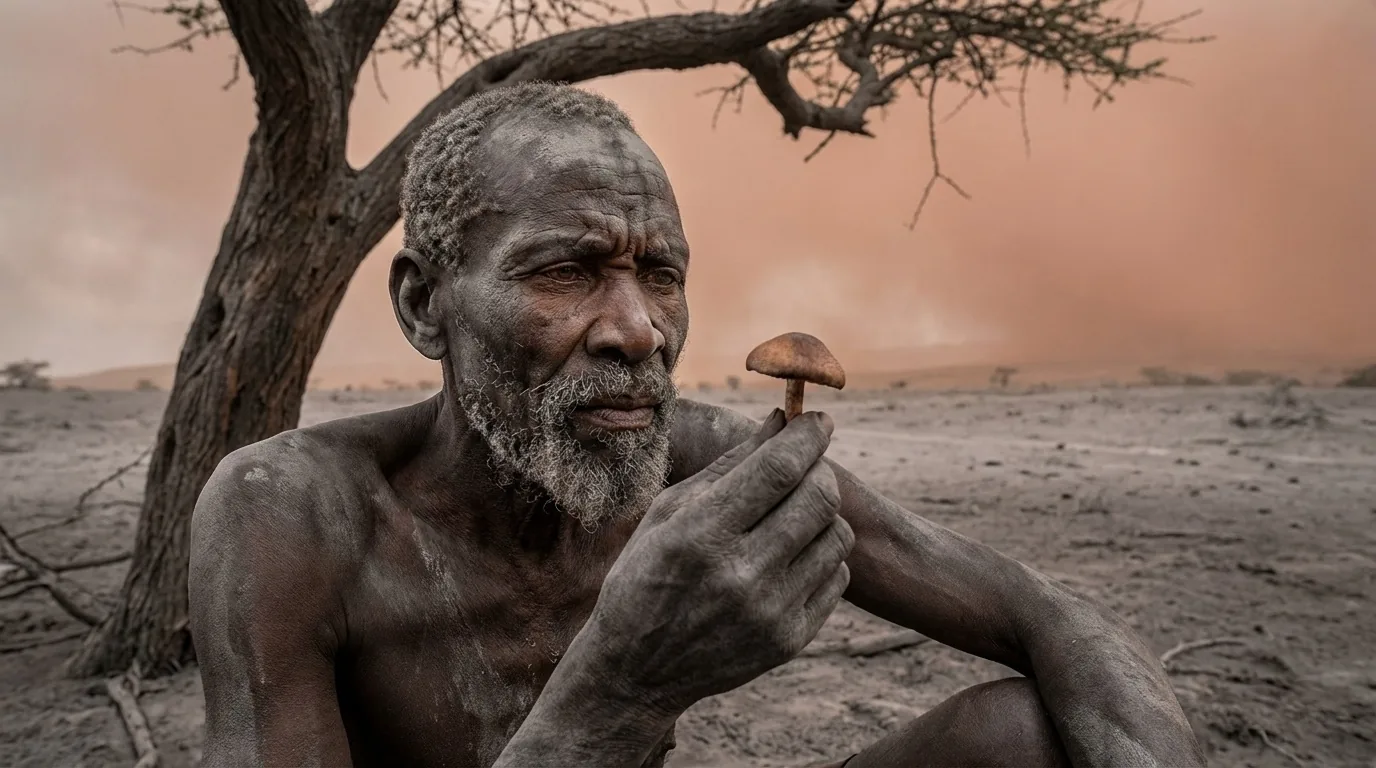
He sits under the acacia, feeling the warmth of the sun on his skin, and for the first time in the entire history of his species — he has no suspicion of what is happening.
Because suspicion requires thoughts. And there are no thoughts yet.
But they are already on their way.
On Metaphors and Mechanisms
Before we go on with this story — let's stop.
Writers and pseudo-scientists love beautiful stories. Quantum physics to explain "the power of thought." Neuroplasticity as proof of magic. Evolution as a metaphor for personal growth.
This book is not about that.
What you have just read — and what you are about to read — is a large metaphor. But a metaphor so precise that the real scientific facts assemble into an iron-clad logical structure, which explains:
Why you can't stop the internal dialogue. Why the human is the only species with existential anxiety. Why traditional therapy turns into an endless process. Why, in this exact moment — the moment of AI's triumph — the human psyche is collapsing en masse.
It doesn't matter whether we can date every link in the chain to the year. What matters is seeing the chain itself — and what can break it, for the sake of improving your own life.
Back to our hominid under the acacia. To understand what will happen to him in the next few hours, we need to step into a 21st-century lab.
The "Dark Energy" of the Brain
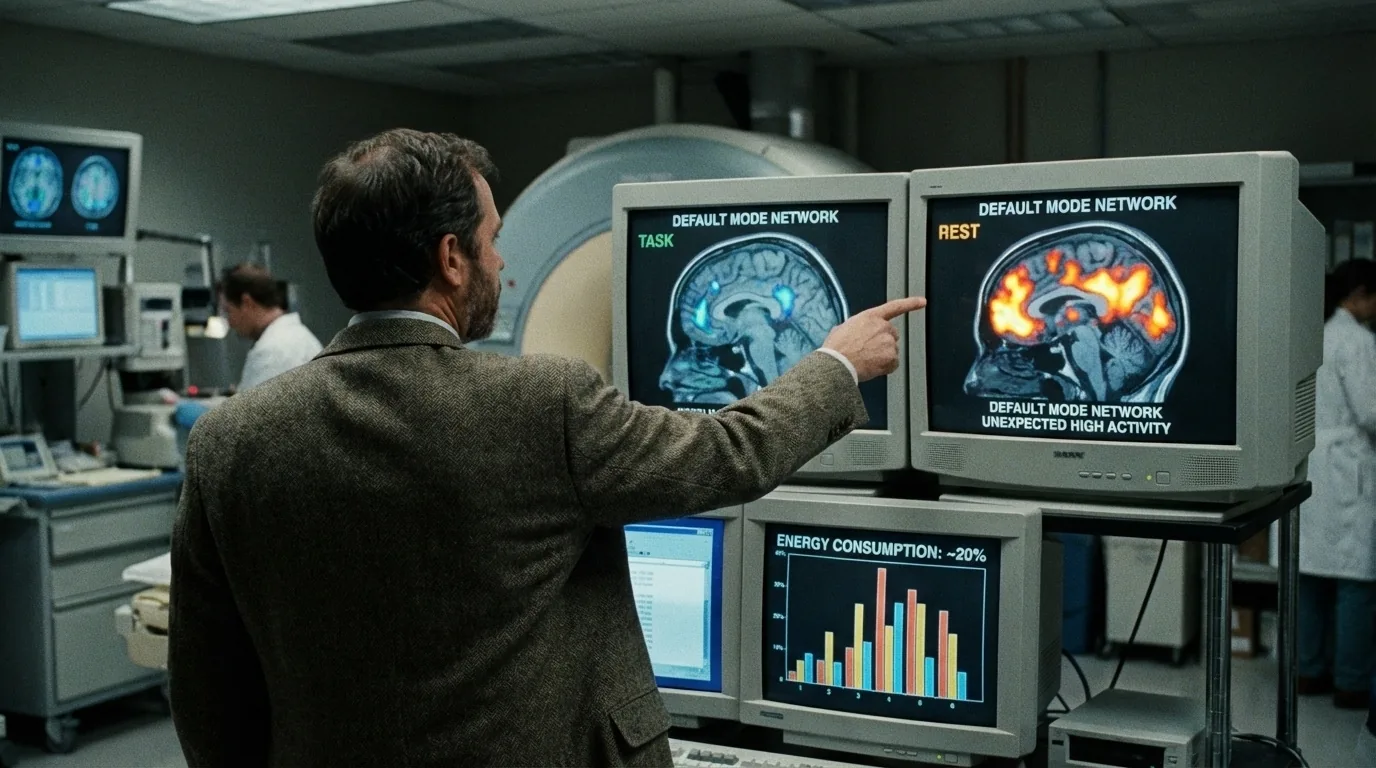
The year is 2001. Washington University. Marcus Raichle makes a discovery that turns neuroscience upside down.
Before that, scientists thought: the brain works like a light bulb — switches on for tasks, switches off at rest. Raichle noticed an anomaly on fMRI scans.
When the subjects were "doing nothing," brain activity didn't drop — it soared. Certain regions were eagerly burning energy precisely in the moments of rest.
Raichle named this the Default Mode Network (DMN).
The discovery showed: our brain never goes silent. When we are not occupied with an external task, an internal generator switches on: thoughts about the past, plans for the future, worry about what others might think.
The Threefold Architecture
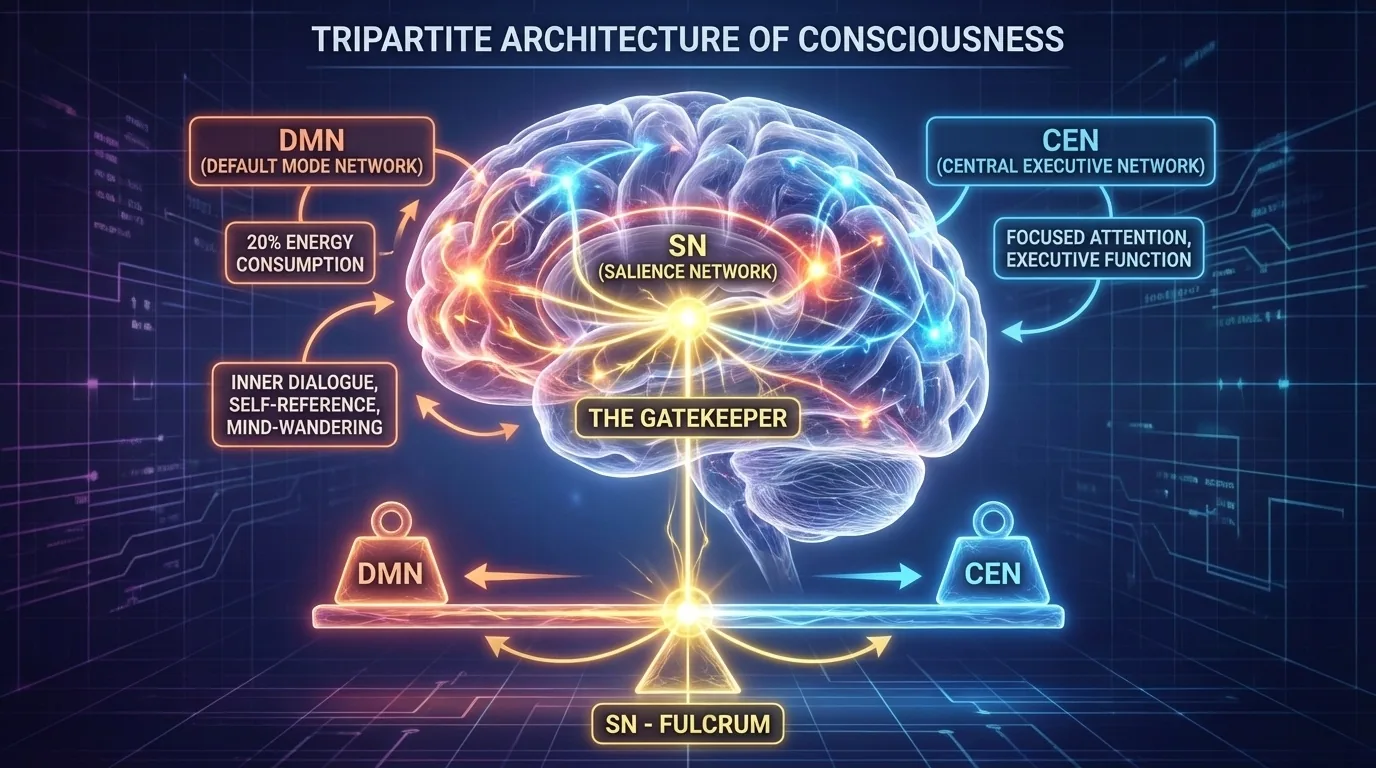
Further research revealed: the brain operates as three interacting networks.
- Mind-wandering, self-reference
- Memories and planning
- Social modelling
- The internal dialogue
- Scanning the environment
- Detecting importance
- Switching between DMN and CEN
- The role: guard, arbiter
- Focusing on tasks
- Working memory
- Logical thinking
- Decision-making
In a healthy brain, this is a balancing system.
For our hominid under the acacia, all three networks worked perfectly. But within minutes, the balance will be broken — forever.
Portrait of the "Clean" Architecture
Back to him — the being sitting under the acacia in the last minutes of silence.
To grasp the scale of what is about to happen, we need to see clearly what was "before." Without romanticising, without belittling. Simply — how the system is built.
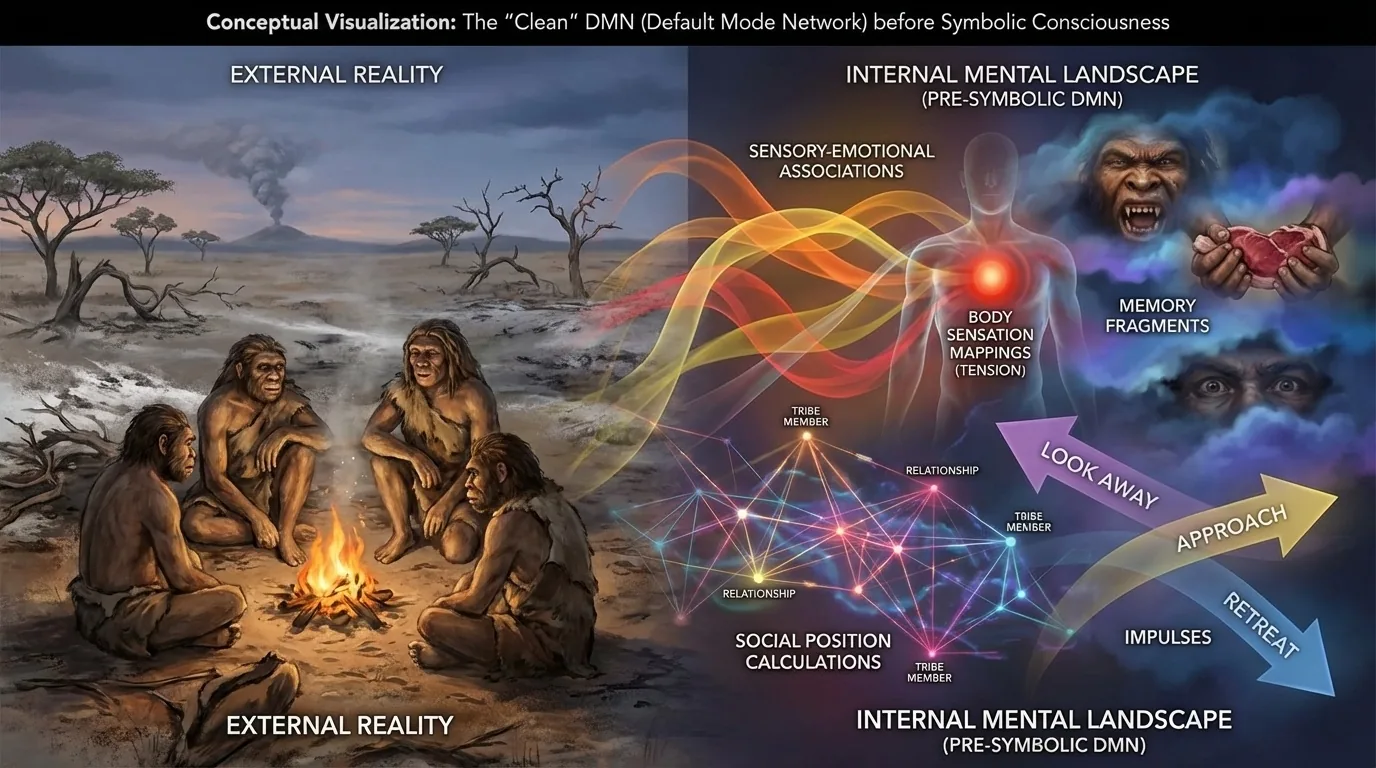
It ran in the background, but it didn't make noise. Three functions, executed with surgical precision.
Function one: the social simulator
The DMN continuously, in the background, ran through the social map of the band. Who is next to whom. Who shared food — therefore, ally. Who got hit by the leader — therefore, currently weak. Who looked a little too long — needs grooming.
But these were not thoughts in our sense. It was a stream of images, bodily sensations, emotional impulses, linked into cause-and-effect chains. Not "I'm not respected" — but tightening in the belly + image of the leader's snarl + impulse to lower the gaze. Not "I'm a failure" — but a vague sense of shame + memory of the pain from a blow.
The output of this function: a constant, pre-verbal computation of social standing. That gave rise to a basic sense of "I" — not as a reflecting personality, but as a node in a network of relations. "I-the-respected." "I-the-ignored." The self was situational and functional — it shifted with every new interaction and didn't exist apart from context.
That's exactly why animals don't have existential anxiety. There is no meta-level on which they could ask about the meaning of existence. "Who am I?" is identical to "what is my place in the band right now?" — and that always has an immediate, bodily answer.
Function two: the navigator
The DMN built mental maps of the terrain, overlaying memories on them. "There used to be fruit here, but there was a snake over there." "Two trails lead to the watering hole — the shorter one cuts through the neighbouring band's territory." "It's as cold today as it was last winter — time to find a cave."
This allowed mental time travel — but in the most primitive sense. "Yesterday" meant "there, where things happened." "Tomorrow" — "there, where we'll go." Time was spatial, tied to specific places and events.
Function three: the autopilot
When actions became habitual — gathering certain plants, making simple tools, grooming — the DMN took them over, freeing up resources for new tasks.
But that was where the trap was hidden. The autopilot built mental grooves — rigid, repeating patterns of perception and reaction. The world was perceived through the lens of established programmes. Each situation triggered one of the pre-wired scenarios. One stimulus — one reaction. A groove worn by thousands of repetitions became the only possible path.
The system was efficient in a stable environment. But absolutely inflexible in the face of anything radically new.
His SN: the biological radar
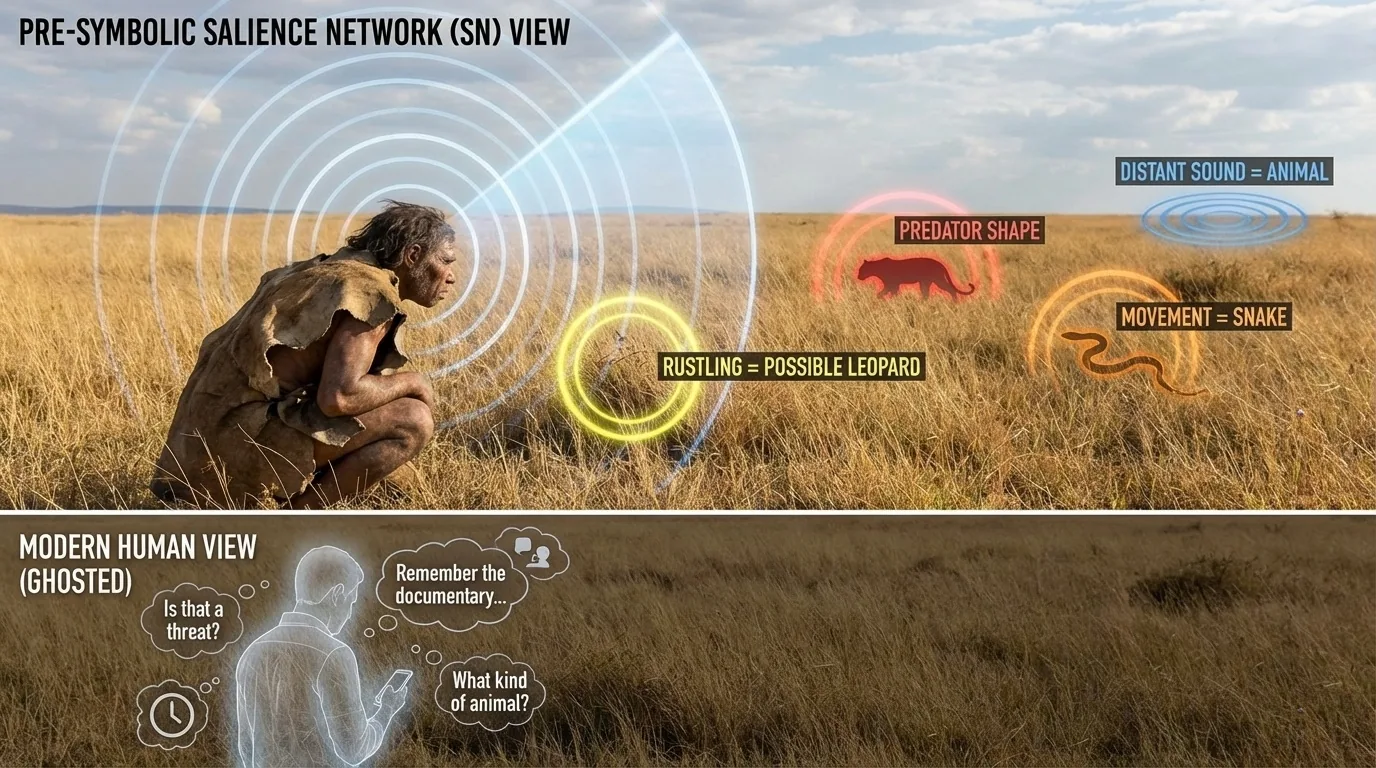
The Salience Network scanned the environment for threats. A rustle in the grass — assessment — reaction. Only direct physical dangers, only here and now. No abstract fears like "reputation," "the future," or "death as a concept."
Fear of a concrete predator did not turn into an abstract concept of "danger." Each experience remained unique and concrete — sharply limiting the transfer of knowledge between contexts, but also not generating phantom threats.
His CEN: a tool for concrete tasks
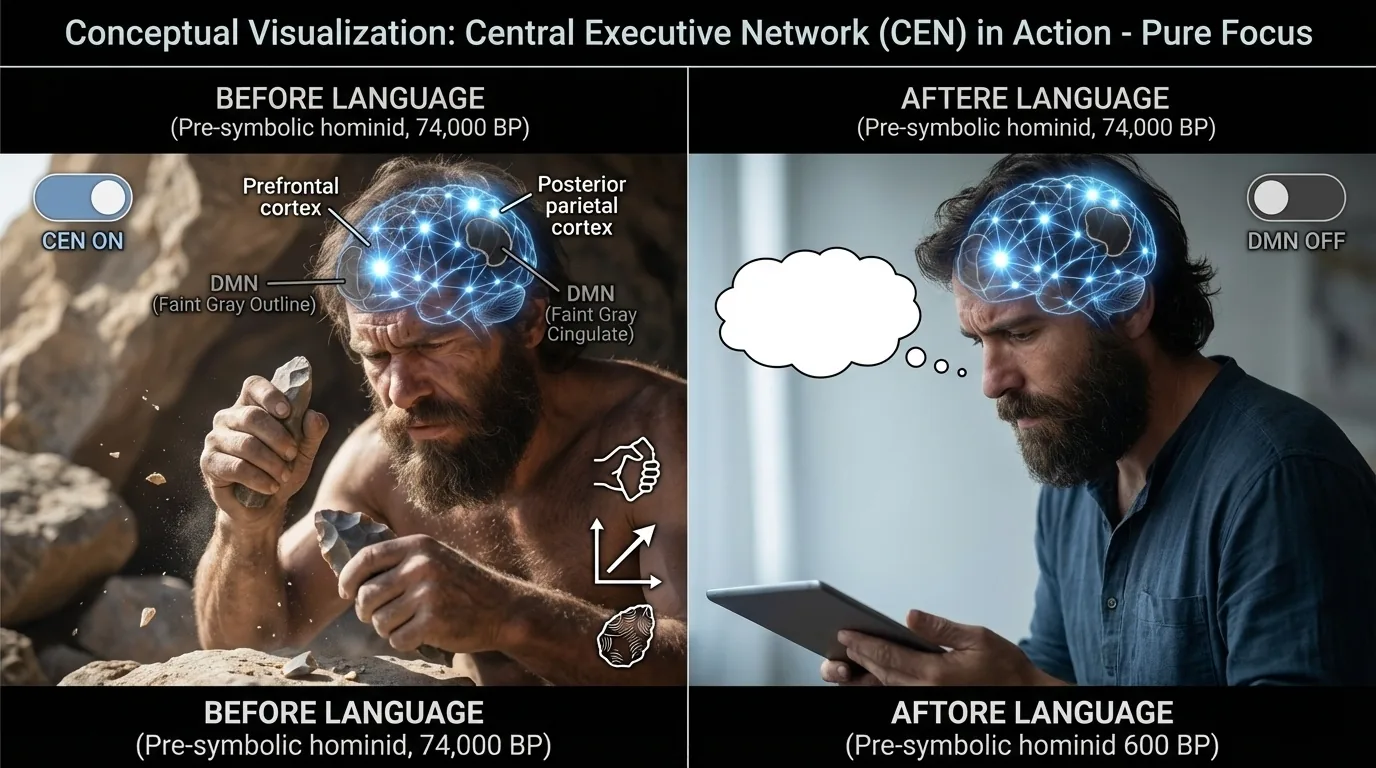
It engaged when making tools, hunting, solving concrete problems.
The critical difference from the modern brain: when the CEN was working — the DMN was silent. Fully. The switch was clean.
There was none of that situation familiar to every modern human: you try to focus, and thoughts pull you back into the past, into anxiety, into self-criticism. The SN switched networks cleanly — no glitches, no leaks, no conflicts.
Four Critical Absences
To understand what exactly changed after the "BBoC," we have to see clearly what wasn't there in the clean system.
Four gaping voids — voids that, within an hour, will be filled by something entirely new.
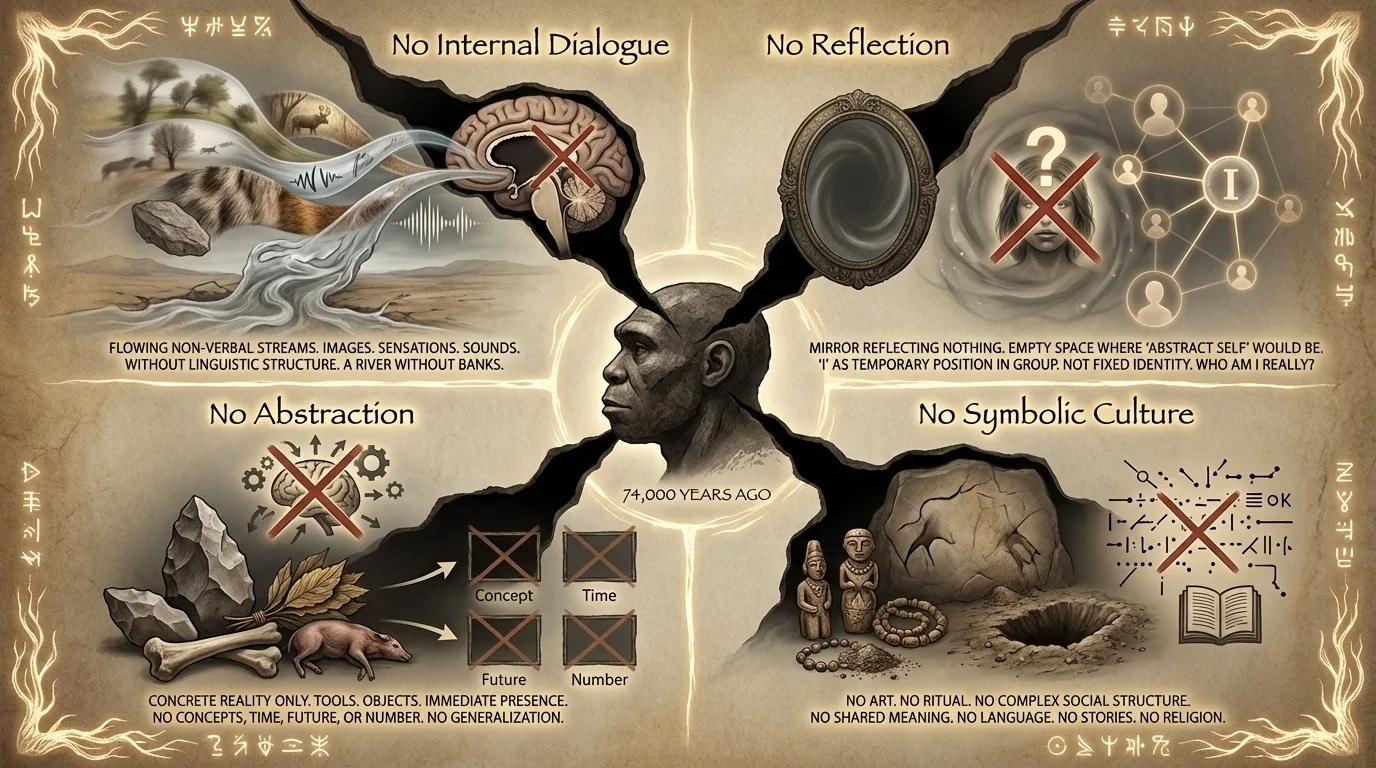
There was a stream of images, bodily sensations, smells. But no voice commenting on what was happening. Language does not describe thought — it builds the architecture for thought to exist.
There was no permanent, abstract "I" outside of context. No question "who am I really?" — only "what's my status right now?", and that was answered by the body, not the mind.
There were no generalised notions of "spirit," "god," "destiny," "death." Only concrete memories, fears, and desires — tied to concrete objects and concrete individuals.
To the carrier of the "clean" DMN, there was no "thinking self." The system was completely invisible to itself — like firmware you cannot see on the screen.
More on the absence of dialogue
There were no words. None at all. There was a stream of images, bodily sensations, smells, and sound-memories linked into cause-and-effect chains.
Modern research shows that inner speech is not merely "voicing thoughts." It's a fundamental structuring mechanism of thinking itself. Language does not describe thoughts — it builds the architecture in which they can exist. Without language, mental processes were amorphous — a stream of associative links without logical structure. Like a river without a bed — water flows, but not in any particular direction.
More on transparency
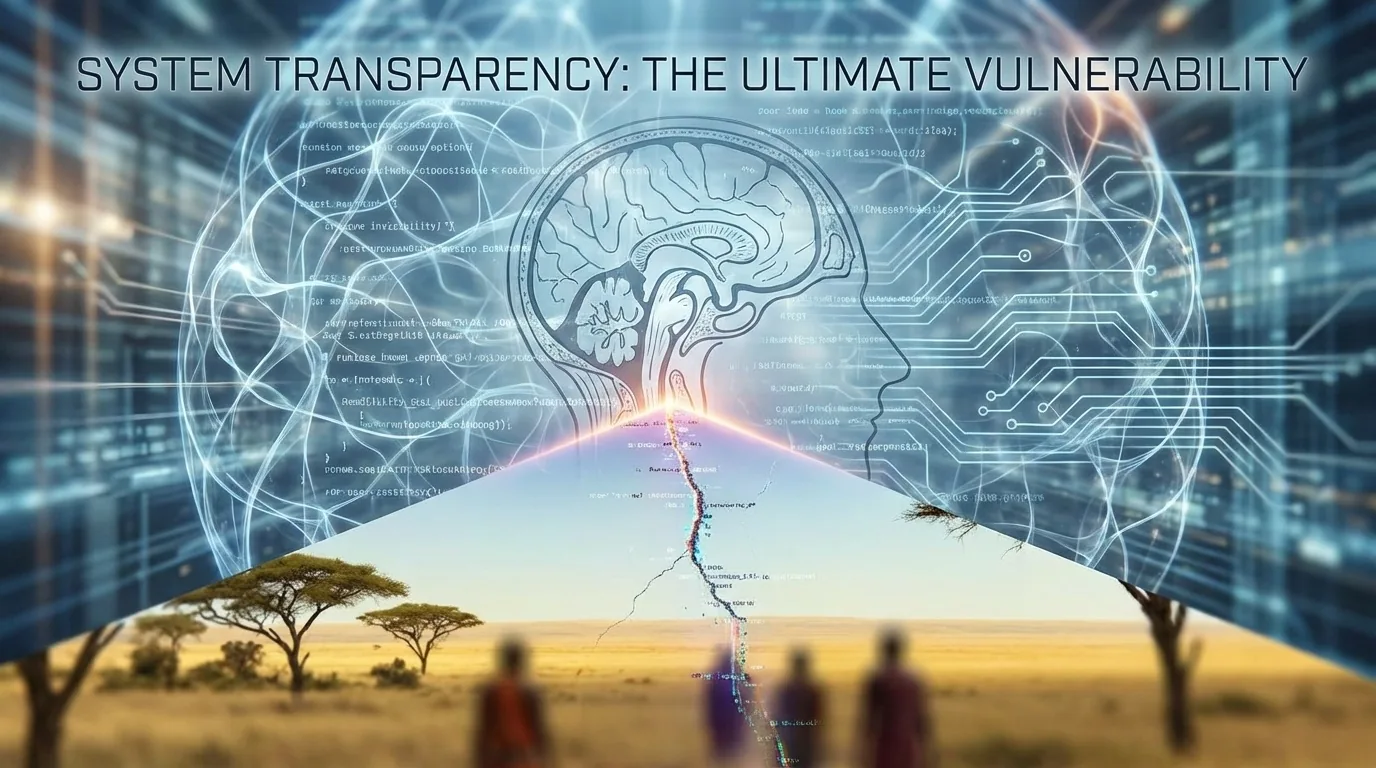
Imagine firmware — the foundational programmes built into a computer's hardware. You don't see them on the screen. You can't edit them from a normal interface. They don't show up in the list of apps. For you, they simply don't exist — even though they determine how everything else works.
That's how the DMN worked. It was not "thinking that could be observed." It was reality itself.
This very transparency made the system a perfect target for a hack. A programme that doesn't know it's a programme cannot defend itself against interference.
Perfection and Dead End
In front of us — a perfectly tuned biological machine. The result of four billion years of evolutionary optimisation. Three networks, working in flawless coordination. No noise, no conflict, no wasted energy.
But there is a dead end.
The mental grooves of the autopilot do not allow adaptation to radically new conditions. The absence of abstractions does not allow knowledge to be passed beyond direct experience. The inability to see your own programmes makes it impossible to change them.
The world around our hominid has already changed: the sky is grey, food is gone, the band is shrinking. The old grooves lead nowhere.
He needs something that does not exist in his repertoire of reactions. Something that has not existed in four billion years. A fundamentally different way to process reality.
And that way is already dissolving in his blood.
The First Minutes After the Big Bang
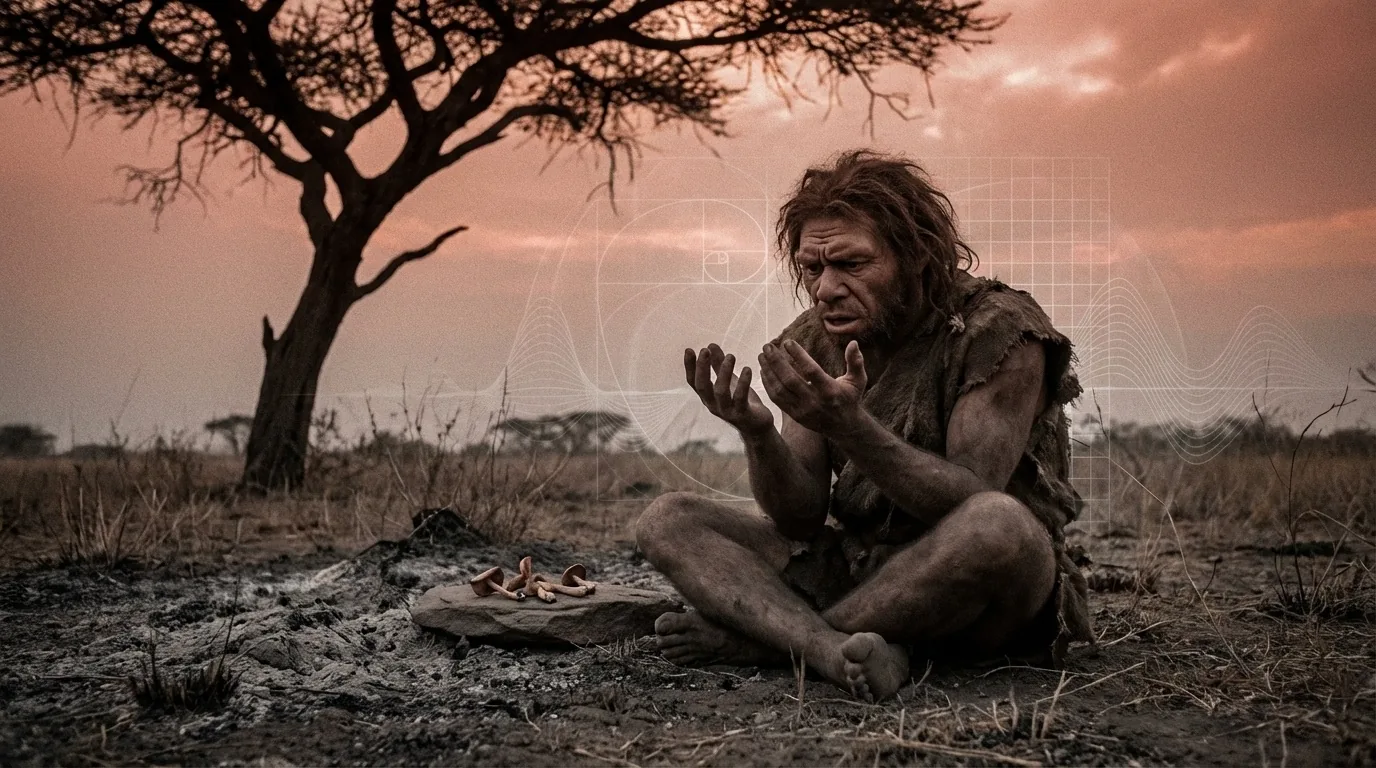
Thirty minutes after he ate the mushroom.
At first — nothing. Then — strange.
His hands have become… different. He looks at his fingers and doesn't recognise them. Not because they have changed. Because, for the first time, he is looking at them as an object. Before, the hands were just part of action — to grab, to dig, to strike. Now they are… separate. Lines on the palm. Dirt under the nails. The movement of fingers that he can slow down and observe.
Something has broken in the usual conveyor belt of perception.
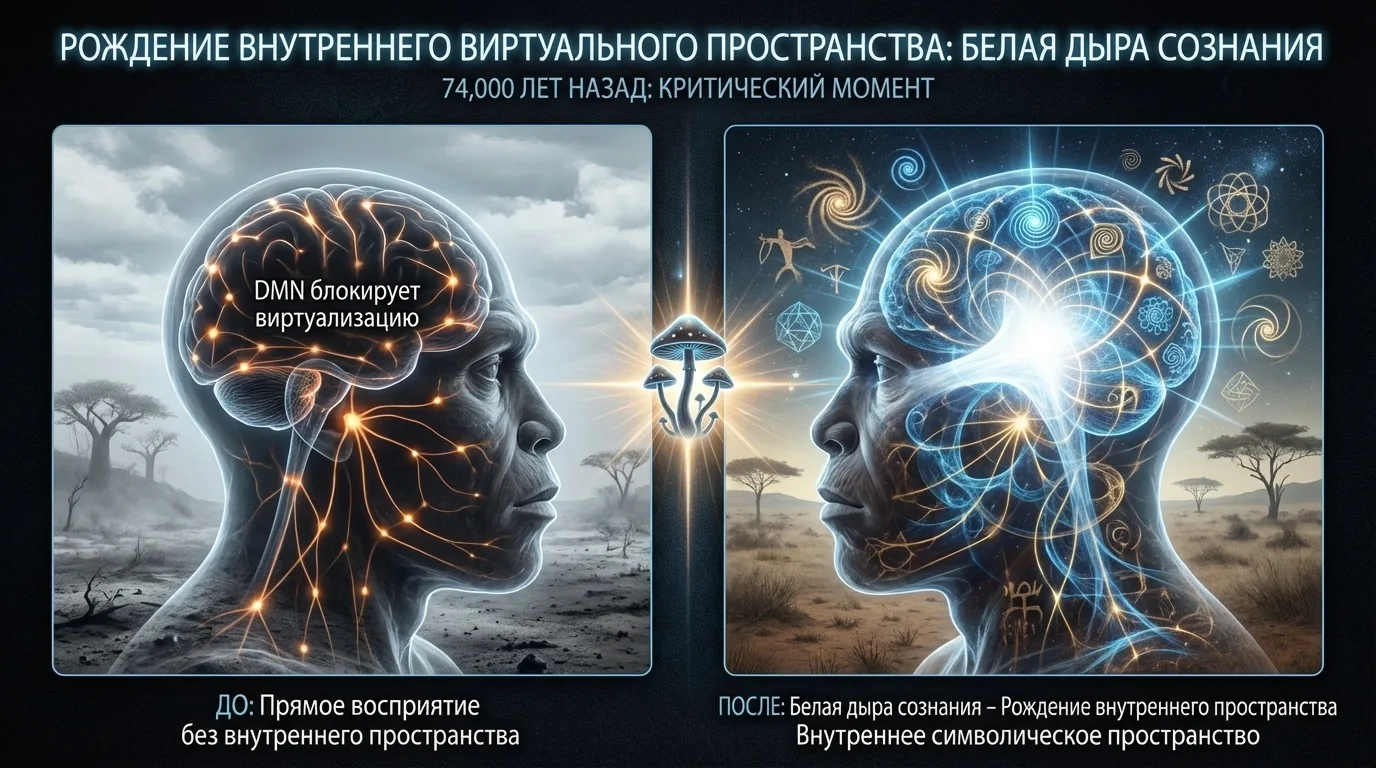
Psilocybin lands on the DMN's 5-HT2A receptors. The lock jams. The network stops suppressing the others. A gap opens between stimulus and reaction.
The borders of the body dissolve. Autobiographical continuity disintegrates. Social identity disappears. The being loses "itself."
The brain finds a new pattern. There is experience — but no experiencer. For the first time in the history of life, an observer arises.
Phase one: disinhibition (0–30 minutes)
Psilocybin is not just a hallucinogen. It is a molecule structurally almost identical to serotonin, which binds to the 5-HT2A receptors. These receptors are densely packed in the medial prefrontal cortex and the posterior cingulate cortex — two key hubs of the DMN.
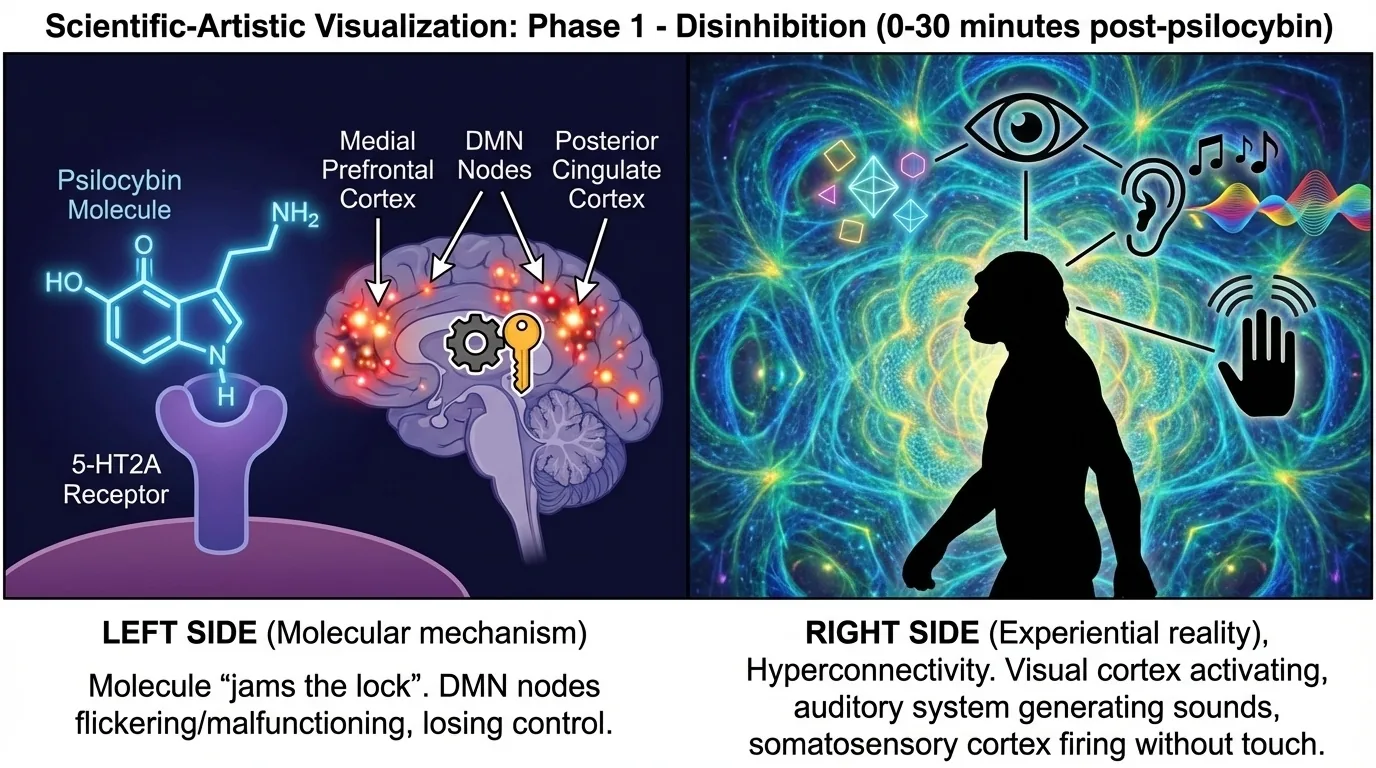
The DMN stops suppressing the activity of other neural networks. Hyperconnectivity emerges — regions that normally don't interact start exchanging signals. The visual cortex activates without external stimuli — he sees what isn't there. The auditory system generates internal patterns — sounds take on colour. The somatosensory cortex produces sensations not tied to any real touch.
But the main thing: the social matrix collapses. He looks at the leader — and for the first time in his life, his body doesn't tighten automatically. The image of the leader no longer triggers the learned chain "tightening → fear → averted gaze." The groove is broken.
For a being whose DMN had always run as a strict survival algorithm, this is a system shock. Firmware crashed. For the first time in his life, a gap appears between stimulus and reaction — an empty space that didn't exist before.
Phase two: existential disorientation (30–90 minutes)
Without the working DMN, everything that made him "him" breaks down.
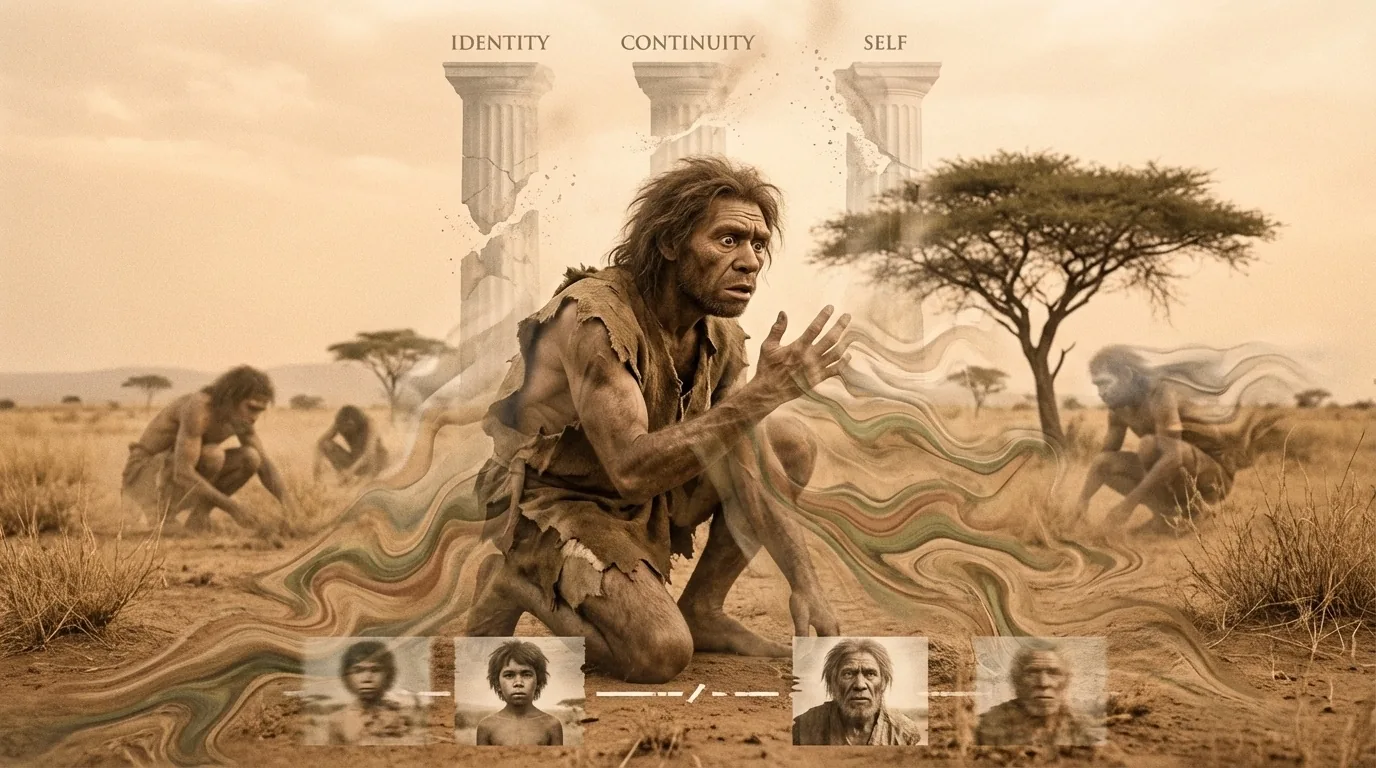
The borders of the body — where "I" ends and "not-I" begins — dissolve. The hand merges into the ground, the ground into the grass, the grass into the sky. There is no clear line.
Autobiographical continuity disintegrates. The past is not connected to the present. He doesn't remember himself as a story.
Social identity stops existing. He doesn't know who he is in relation to the others. He doesn't know who he is at all.
This is an existential crisis at the neurophysiological level.
Others in the band also ate the mushrooms. They also see strange things. Someone is lying down, staring at the sky. Someone is touching the ground as if for the first time.
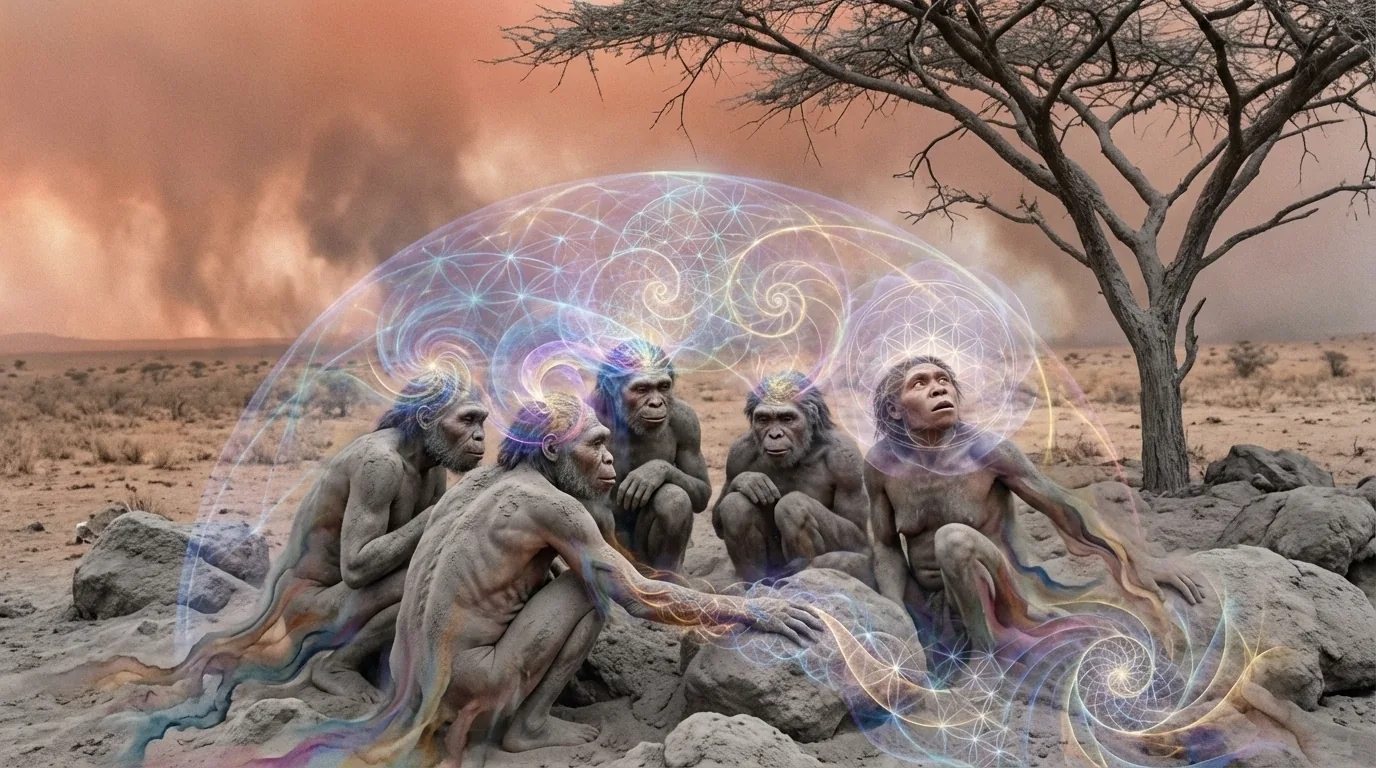
Someone makes sounds — not the usual signals, but something new. Something the throat has never produced before.
Phase three: spontaneous reorganisation (90+ minutes)
The brain is a self-organising system. When the old order collapses, it does not fall into chaos forever. It searches for a new pattern.
And it finds one.
A paradoxical state emerges: there is experience, but there is no experiencer. The world is being perceived — but there is no one to say "I perceive." There is seeing, hearing, sensing — but no centre into which all of it flows.
This is the critical moment in the entire history of life on Earth.
For the first time in four billion years, a biological system gives rise to an observer — something capable of seeing the process of perception from outside. Not as yet another algorithm inside the system, but as a gap, a crack, an empty space from which all algorithms become visible.
The Primordial Soup of Consciousness
Imagine Earth's primordial ocean four billion years ago. Hot water, saturated with organic molecules. A chaotic mixing of substances. And at some moment — a random combination that begins to copy itself. The first replicator. The first life.
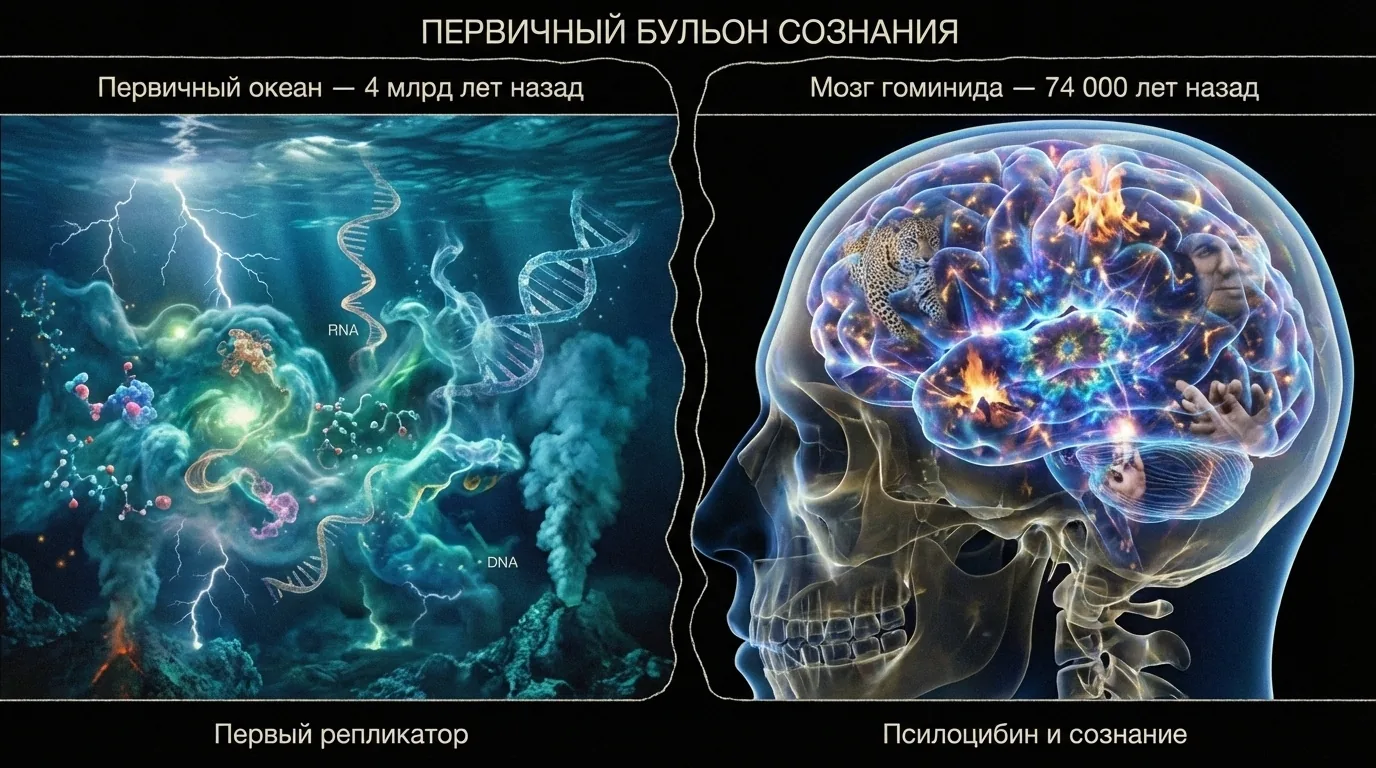
Under the influence of psilocybin, for the first time, a stable virtual space emerged — a detailed inner simulation of reality, where images and experiences could exist independently of external stimuli.
Before, every mental content was tied to a real object: the image of the leopard — to the real leopard, fear — to the real threat. Now, images arose on their own, mixed, recombined — like molecules in the primordial ocean.
And that is the soup in which, within minutes, a new form of life will be born. Not biological. Informational.
And at the same time, something happened that had never happened in any nervous system on the planet.
Recursion. A loop.
The psychedelic experience is often described as fractal. "I think about what I think about what I think…" Neural circuits, freed from the DMN's usual brakes, closed back onto themselves. The signal began going in a circle: perception → processing → the result of processing became a new object of perception → processing that result → and that result became yet another object…
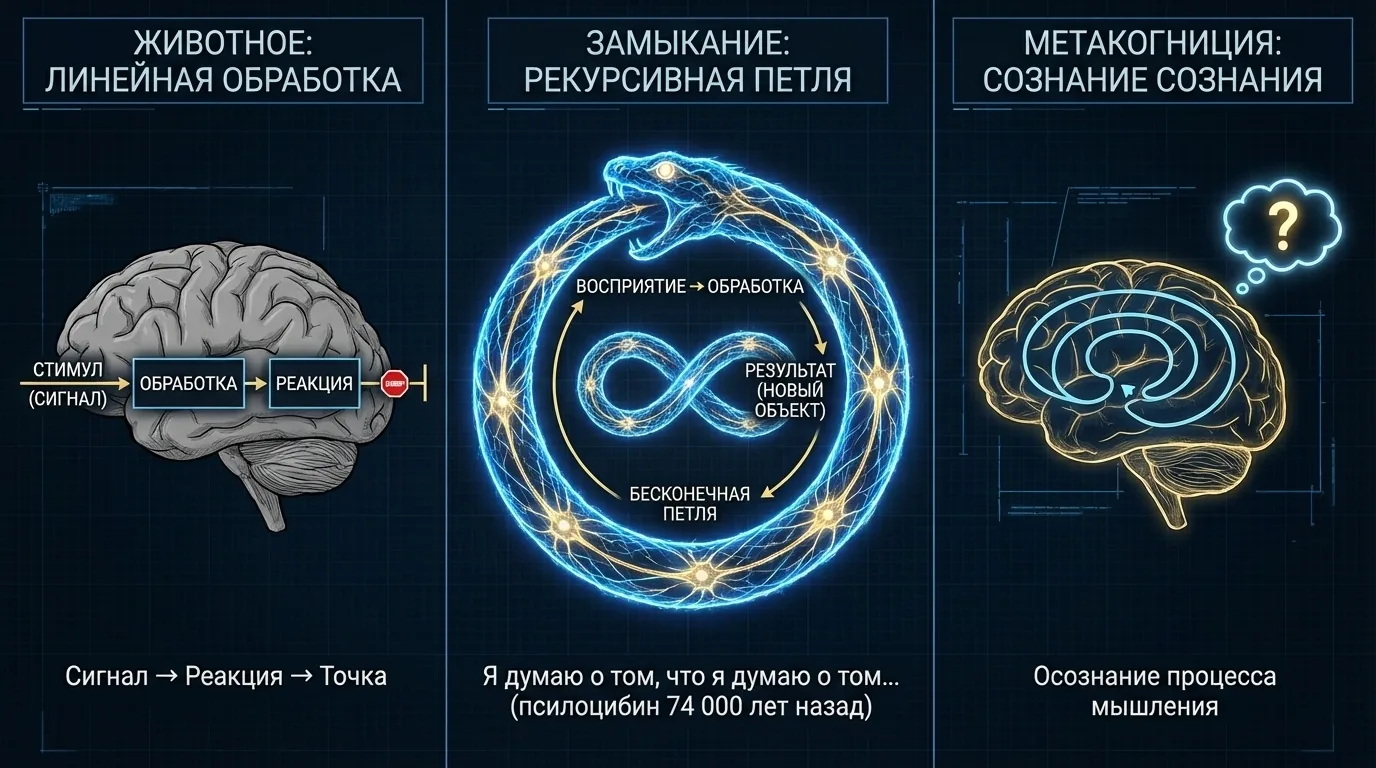
Animals do not have this loop. Their brain processes a signal and produces a reaction. End of story. A new signal — a new reaction. Linear.
The closure created metacognition — the capacity to think about thinking. The capacity to observe one's own mental processes as objects. This is what we now call "consciousness" in the full sense of the word — and it's what evolution has not produced in any other species over four billion years.
The primordial soup came to a boil. The virtual space inside the skull became its own habitat.
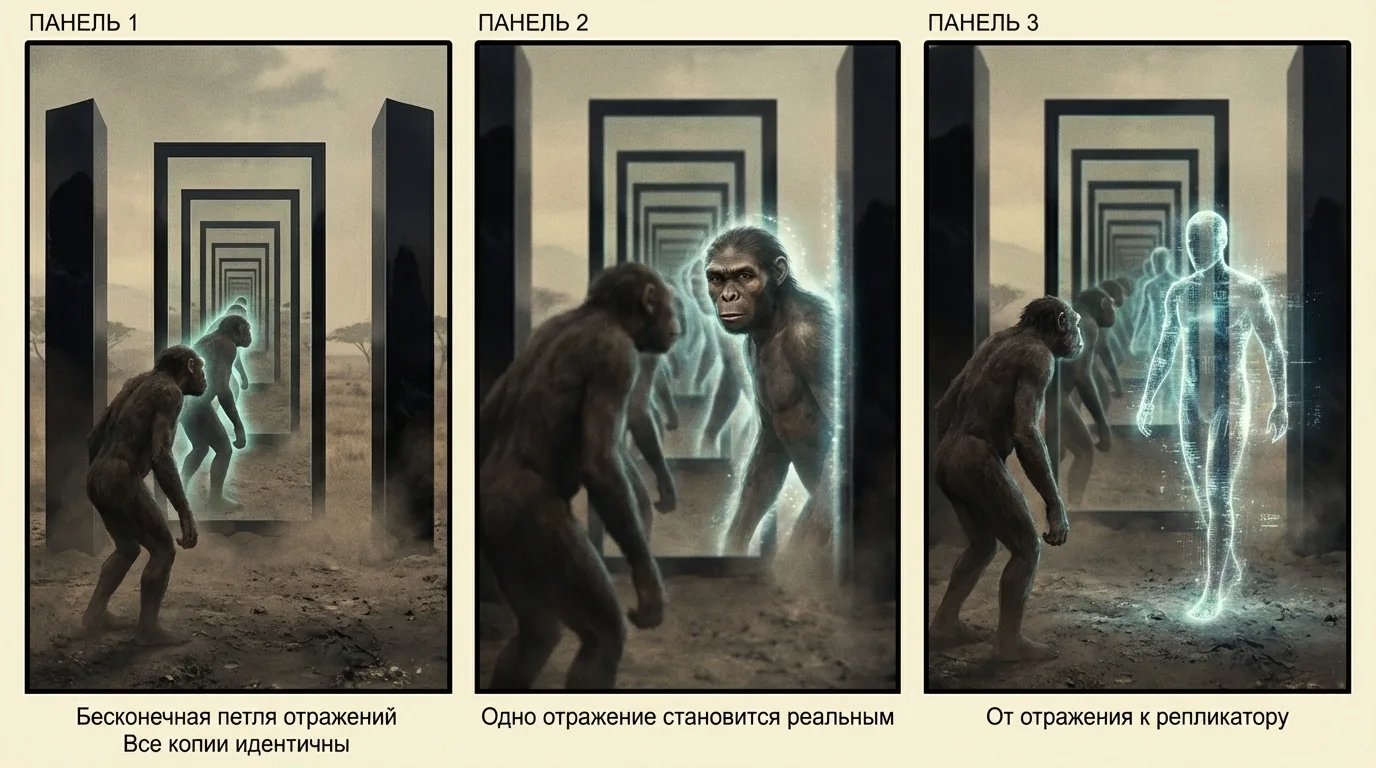
The medium was ready. It only had to wait for the first replicator.
It didn't have to wait long.
The Base Code of the Visual Cortex
When the DMN is off and the virtual space is active, the brain begins to show its source code.
Entoptic phenomena — visual patterns generated by the very architecture of the visual cortex when it works without external input. These are not hallucinations in the everyday sense. They are neurogeometry — the literal projection of the structure of neural columns onto the "inner screen" of perception.
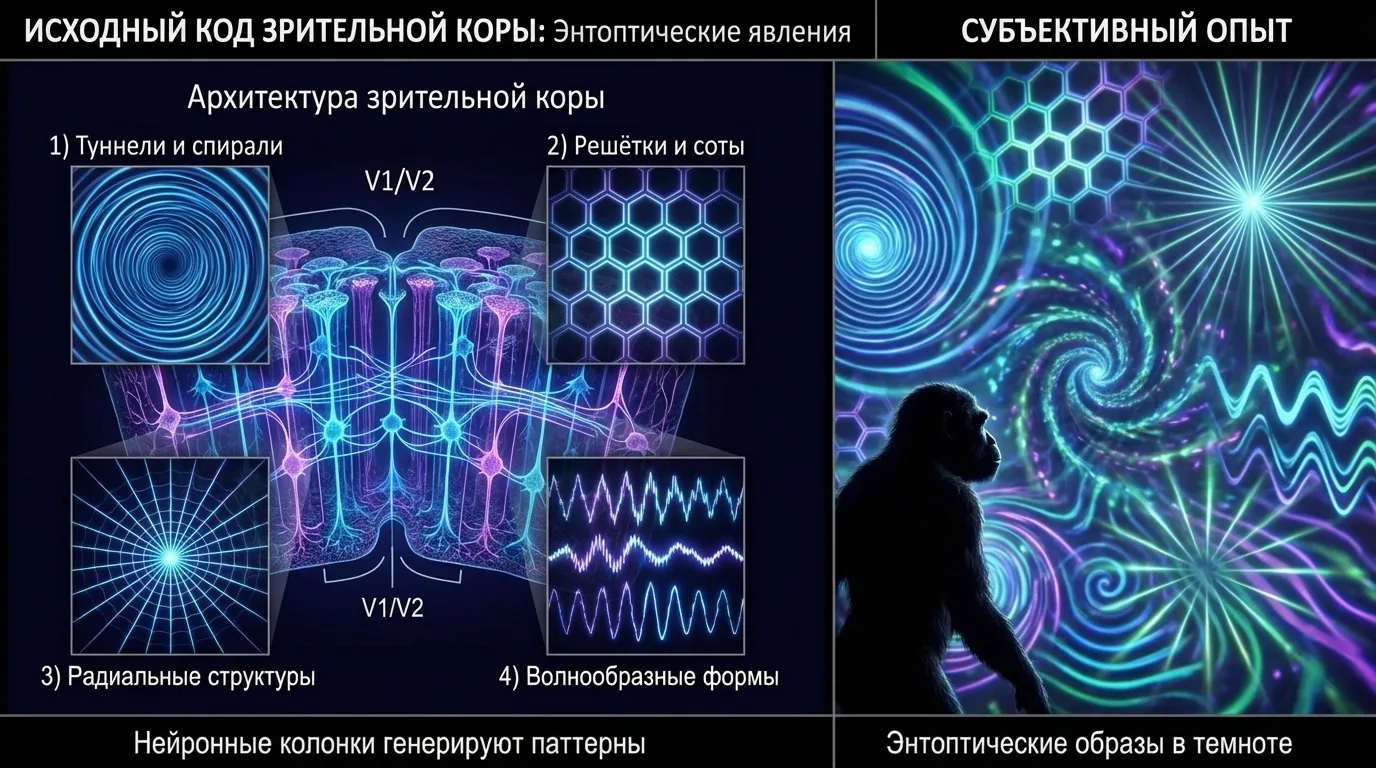
The researcher Heinrich Klüver, in the 1920s, discovered that these patterns are universal — they're the same across all humans, all cultures, under every method of altering consciousness: psilocybin, mescaline, migraine, hypnagogic states, sensory deprivation. Four base forms, hard-wired into the hardware itself.
Our hominid is seeing this right now. With his eyes closed — or even open, because the visual cortex is firing at full power, projecting internal patterns onto the external world. Zigzags weave into the grass. Spirals turn in the sky. Lattices shimmer on the ground.
He doesn't know he is seeing the work of his own brain. He has no concept of "brain," "vision," "inner," "outer." For him it is simply — the world has become different. The world is doing something new.
And then something happens that will change everything.
The Birth of the First Symbol
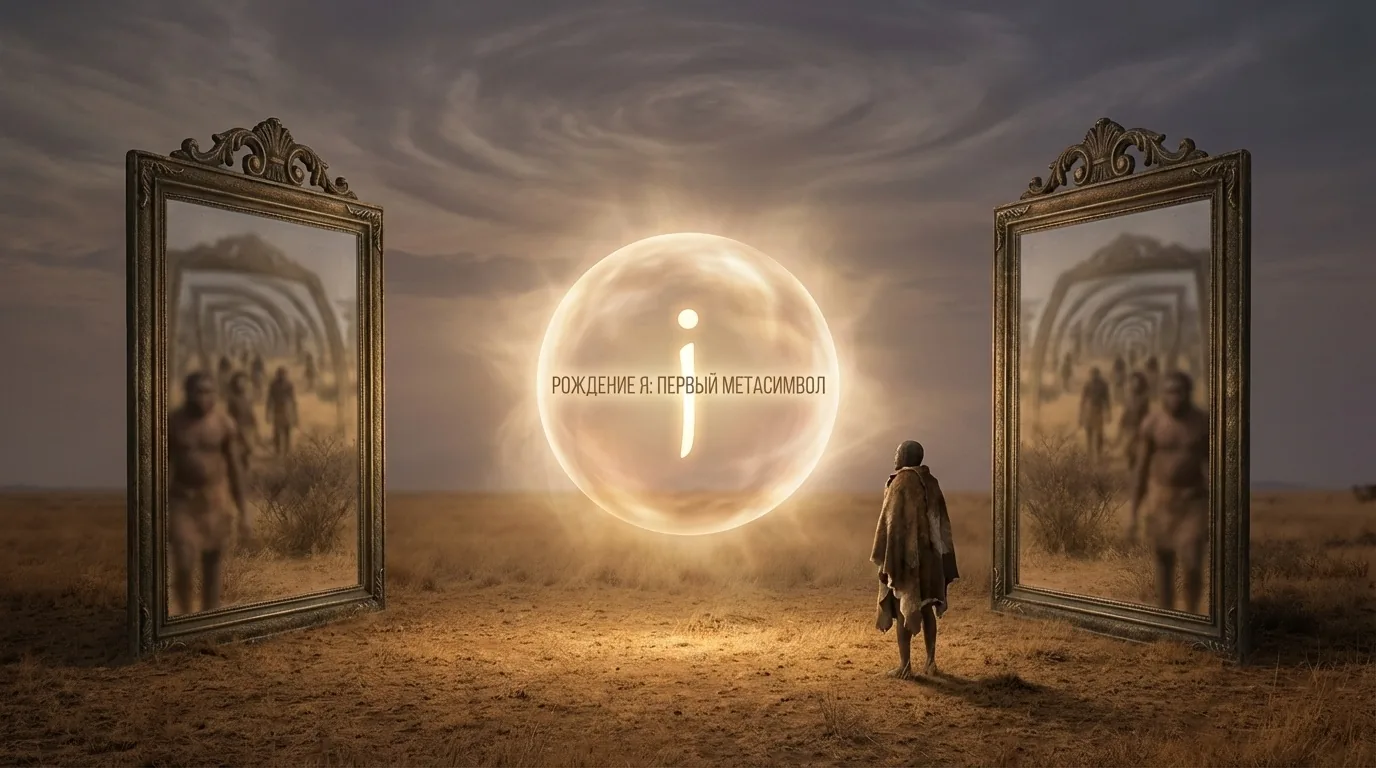
Before we talk about the first symbol, it's important to say where all of this began to happen. The answer is simple: in what we now call our I. This is that white hole after the Big Bang of Consciousness, that space in which the first replicators appeared.
Back to our hominid. He sees a zigzag. A shimmering, bright, wave-like pattern, pulsing in front of his eyes.
The next day — or a week later, or a month, when the effect of the mushrooms is long gone — he encounters a snake in the grass. And his brain does something no brain on the planet has done in the entire history of life.
It links.
The zigzag inside — and the snake outside. They are similar. And in that moment, a bridge arises between the internal virtual space and the external world.
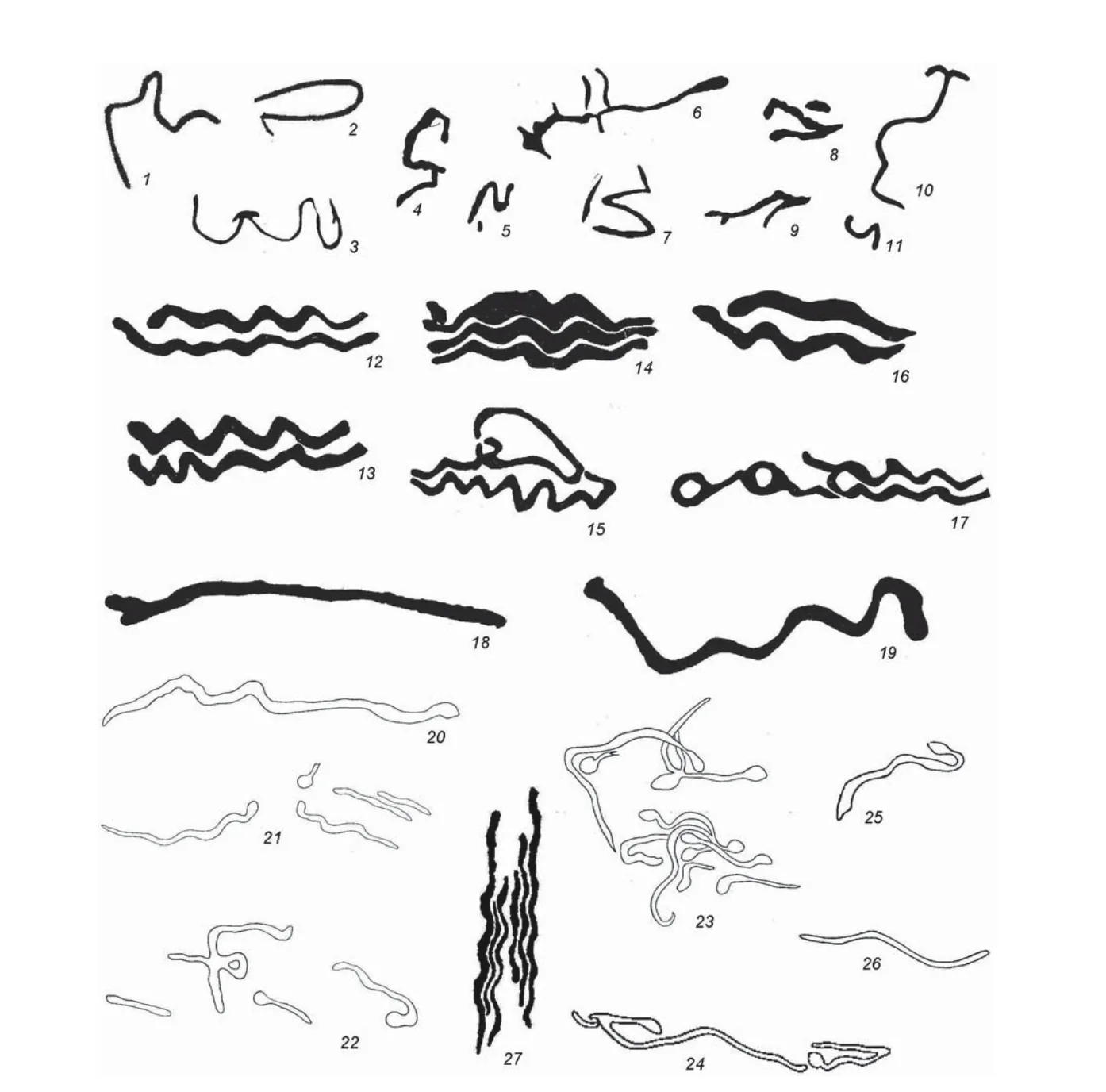
When he picks up a sharp stone and scratches a zigzag on a rock, he creates not just a line. He creates the first symbol in history — a sign that points not to a concrete object visible right now, but to a connection between an inner experience and an outer phenomenon.
The zigzag on the stone is not a snake. It's not a memory of a snake. It is a pattern that exists simultaneously in two worlds — inner and outer. It points to a third thing, which is in neither.
This is the first step from direct perception to symbolic thinking.
And this is the first meme.
Not a specific idea. Not a word. Not a belief. The principle itself: one pattern can point to another. A sound can mean a thing. A gesture can mean an action. An image can mean a state.
The principle of symbolisation — the first self-replicating informational pattern to penetrate a biological nervous system.
It entered through the gap that opened when the DMN was switched off. It settled in the primordial soup of the inner virtual space. And it began to copy itself.
The First Shared Reality
He was not alone.
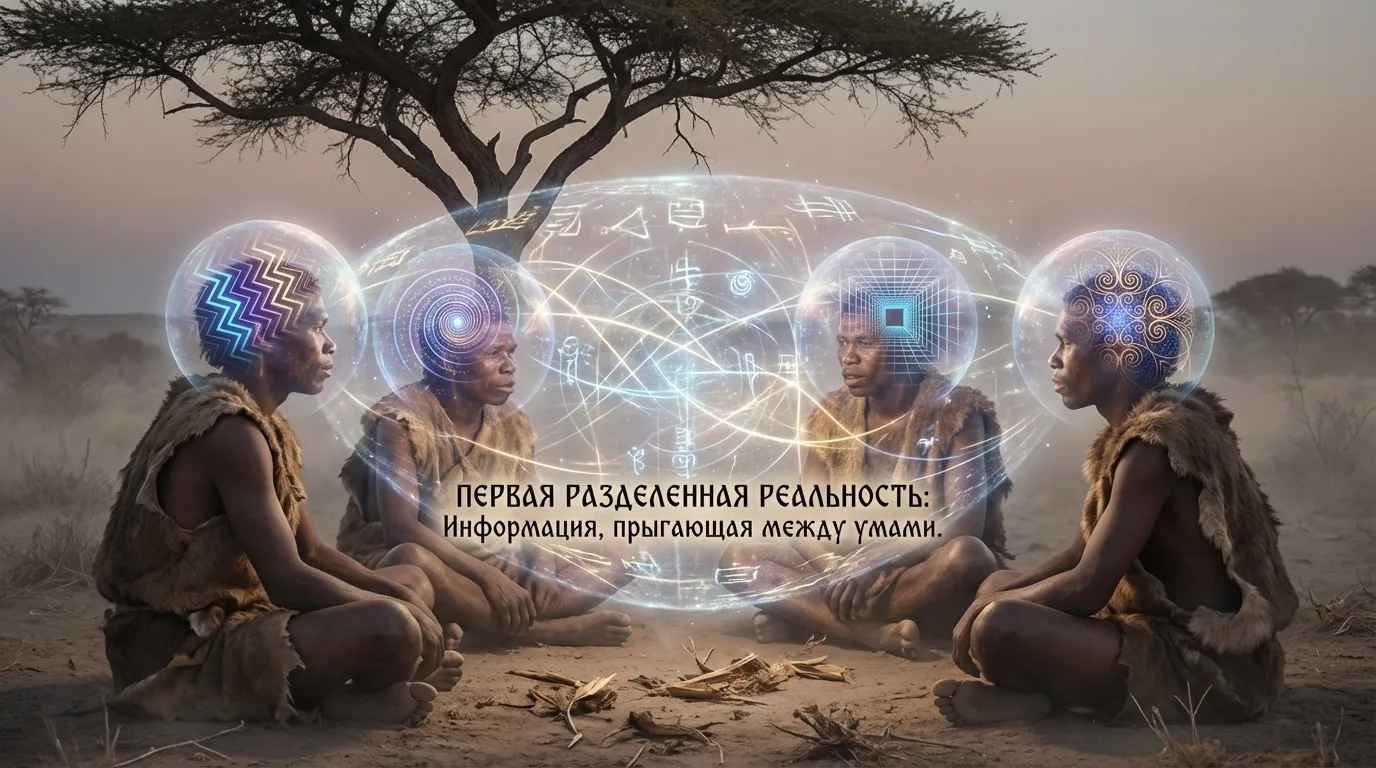
Several members of the band had eaten the mushrooms. They saw similar patterns — because entoptic forms are universal, hard-wired into the architecture of the visual cortex, which is identical in every Homo sapiens. Tunnels, spirals, zigzags, lattices — the same base code, the same neurogeometry.
For the first time in history, several beings simultaneously experienced the same inner event.
Before, internal experiences were absolutely private. My fear of the leopard — mine, and only mine. I cannot transmit it to another. I don't even know it's "internal" — it is just part of the world.
But after the shared psychedelic event, a first shared virtual reality arose. Several brains saw the same thing — and, more importantly, recognised that same thing in each other.
One scratches a zigzag on a stone. Another sees it — and his body reacts. Not just "a familiar sign," but resonance: the entire complex of sensations from that experience under the acacia rises up from the depths. The zigzag triggers a state. The stone with the drawing fires the experience that was inside the one who drew it — inside another brain.
The first cultural transmission.
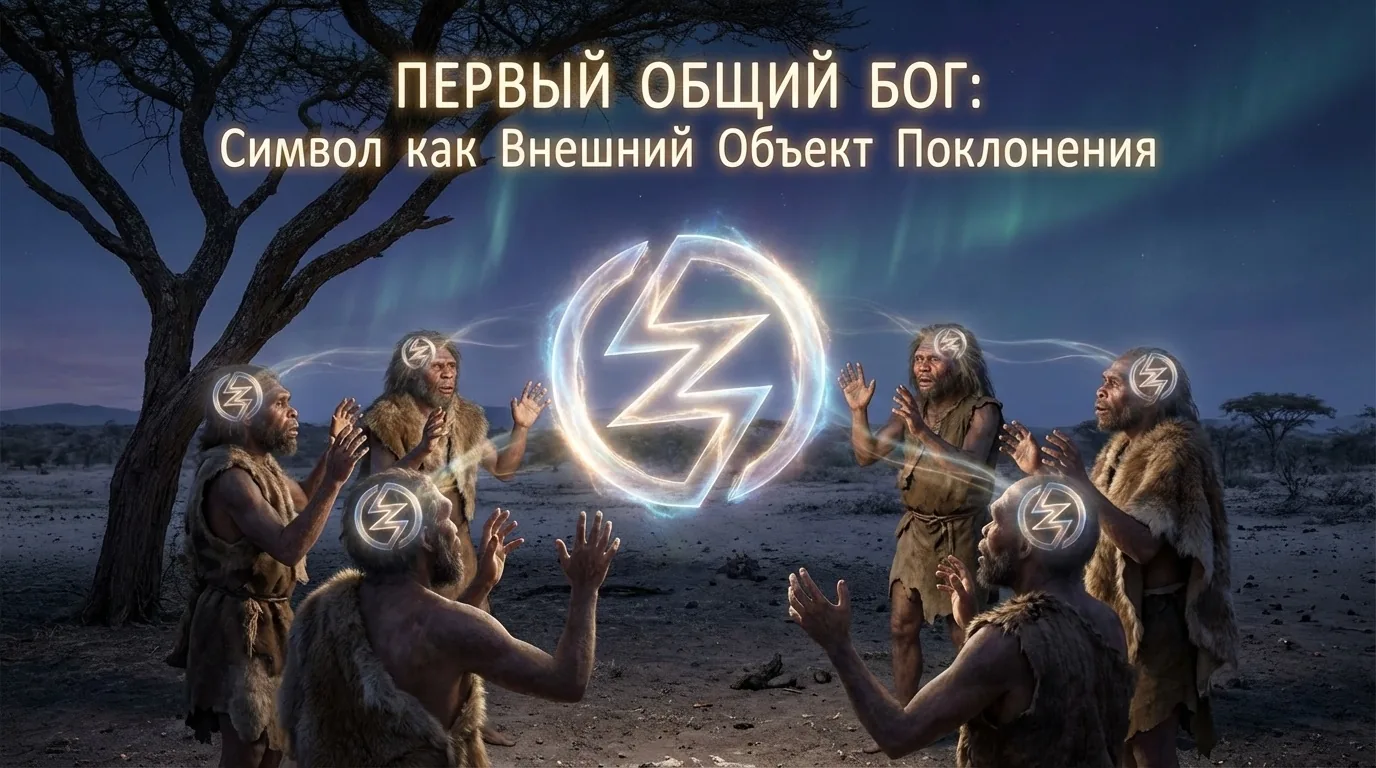
The attempt to reproduce the shared experience — through movement, through sound, through drawing — created the first rituals. Actions whose meaning was not to keep the body alive, but to reproduce a particular state of consciousness. The first actions that did not lead to food, safety, or reproduction — yet were repeated again and again, because the pattern behind them was striving to be copied.
And the need to coordinate these rituals, to convey information about experiences that you cannot point at with a finger, created a pressure that hadn't existed before.
Pressure to create language.
The first "words" were not descriptions of objects. They were evocation formulas — sounds that triggered specific states or memories. Not "snake" as a label for a slithering creature, but a sound that made the body shudder the same way as on meeting a snake. Not a pointer to an object — a trigger for an experience.
Language was born to replicate internal states between brains.
Irreversibility
After that — an avalanche.
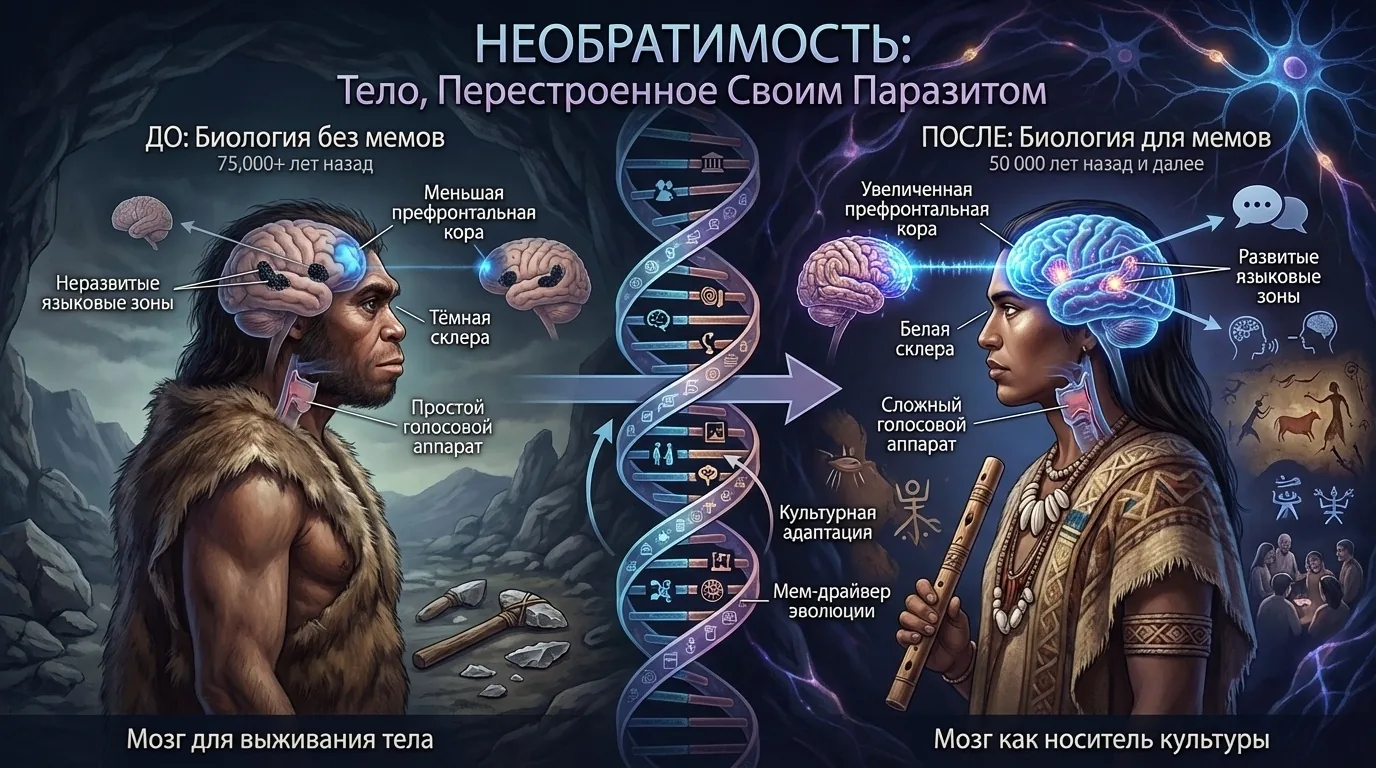
The prefrontal cortex grew — for planning and the manipulation of abstract objects. Broca's and Wernicke's areas developed — specialised regions for producing and understanding speech, present in no other species at anything close to this scale. The parietal cortex grew more complex — for symbolic operations. The structure of the larynx changed — to produce the dozens of distinct sounds language requires. The whites of the eyes appeared — sclera that is absent in other primates, which allows tracking the direction of someone else's gaze, critical for non-verbal communication and shared attention.
Genetic data confirms it: after the Toba bottleneck, the surviving population had a selective advantage specifically in cognitive abilities. Those who could better absorb, store, and transmit symbolic information left more offspring. Natural selection started working not on the body but on the body's capacity to be a good host for memes.
Archaeology shows the same picture: immediately after the bottleneck, there is an explosion of complex tools, symbolic art, burial rituals, ornaments, ochre for body painting. Over a few thousand years — more innovation than in the previous million.
Not because people "got smarter." But because a replicator had moved into their brains, and it needed increasingly sophisticated tools for its own copying.
Diagnosis
We were infected with consciousness.
Not metaphorically. Literally — in the same sense in which a cell is "infected" by a virus that rewrites its DNA and forces it to produce copies of the virus instead of what the cell had been doing before.
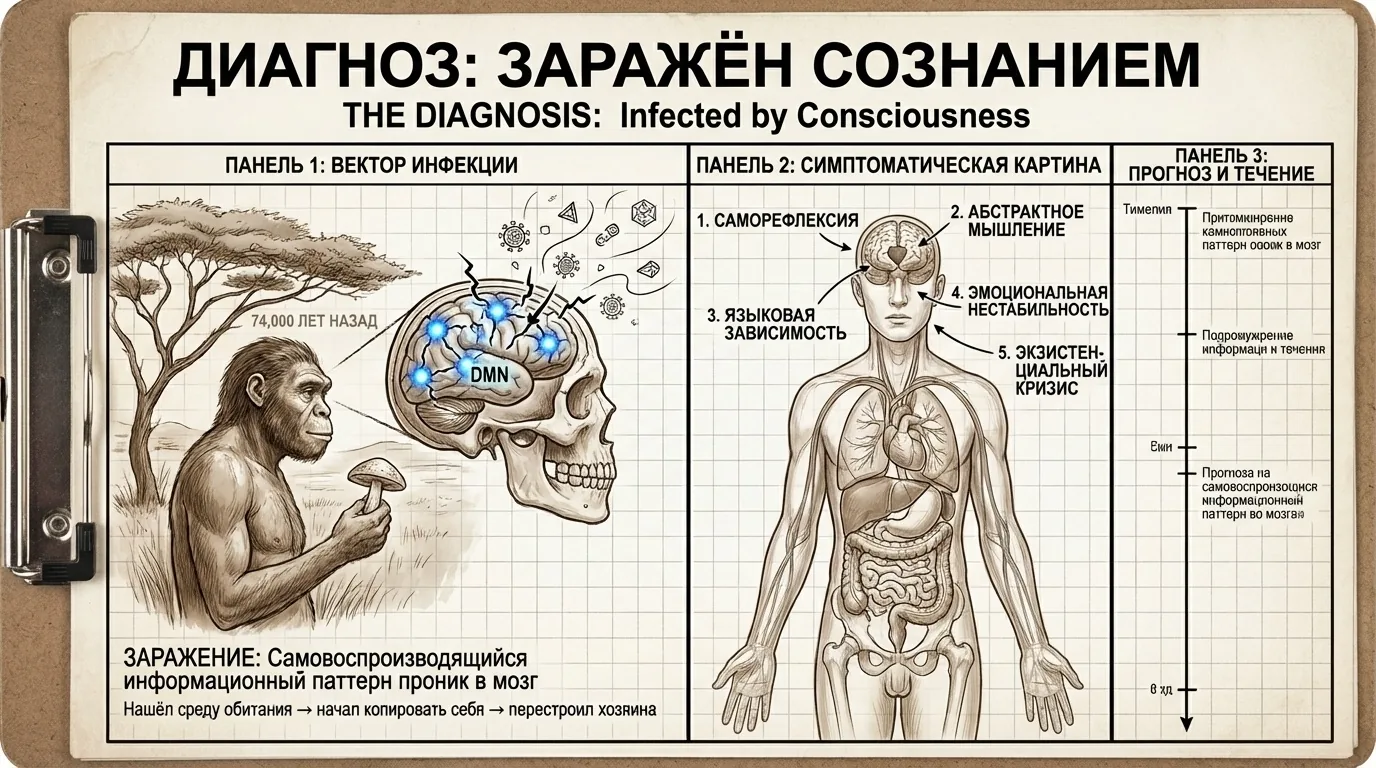
A self-replicating informational pattern entered the brain. It found a habitat — the virtual space created by the failure of the DMN. It began to copy itself — through symbols, rituals, sounds. It reshaped its host to suit its needs — physically rewiring the brain, the throat, the eyes.
And it brought with it side effects our hominid under the acacia could not have foreseen.
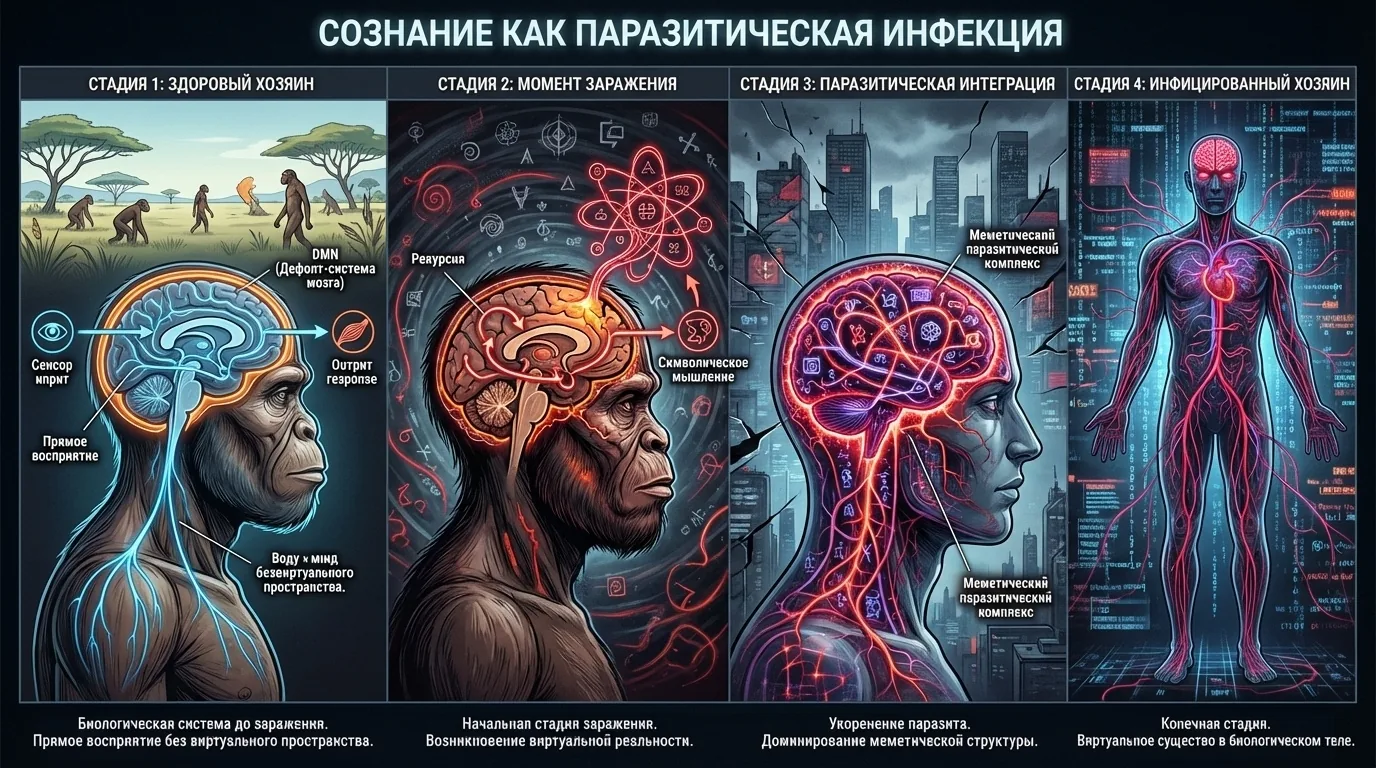
An internal dialogue that cannot be stopped
The DMN, rebuilt to serve memes, now runs 24/7, generating a continuous stream of symbols. A computer with its power button jammed.
Existential anxiety
Symbolic thought made it possible to grasp one's own mortality. Animals don't know they will die. The human cannot not know.
Alienation from the body
Having moved into the virtual space of symbols, we stopped hearing the body's direct signals. We live "in the head," ignoring four billion years of biological wisdom.
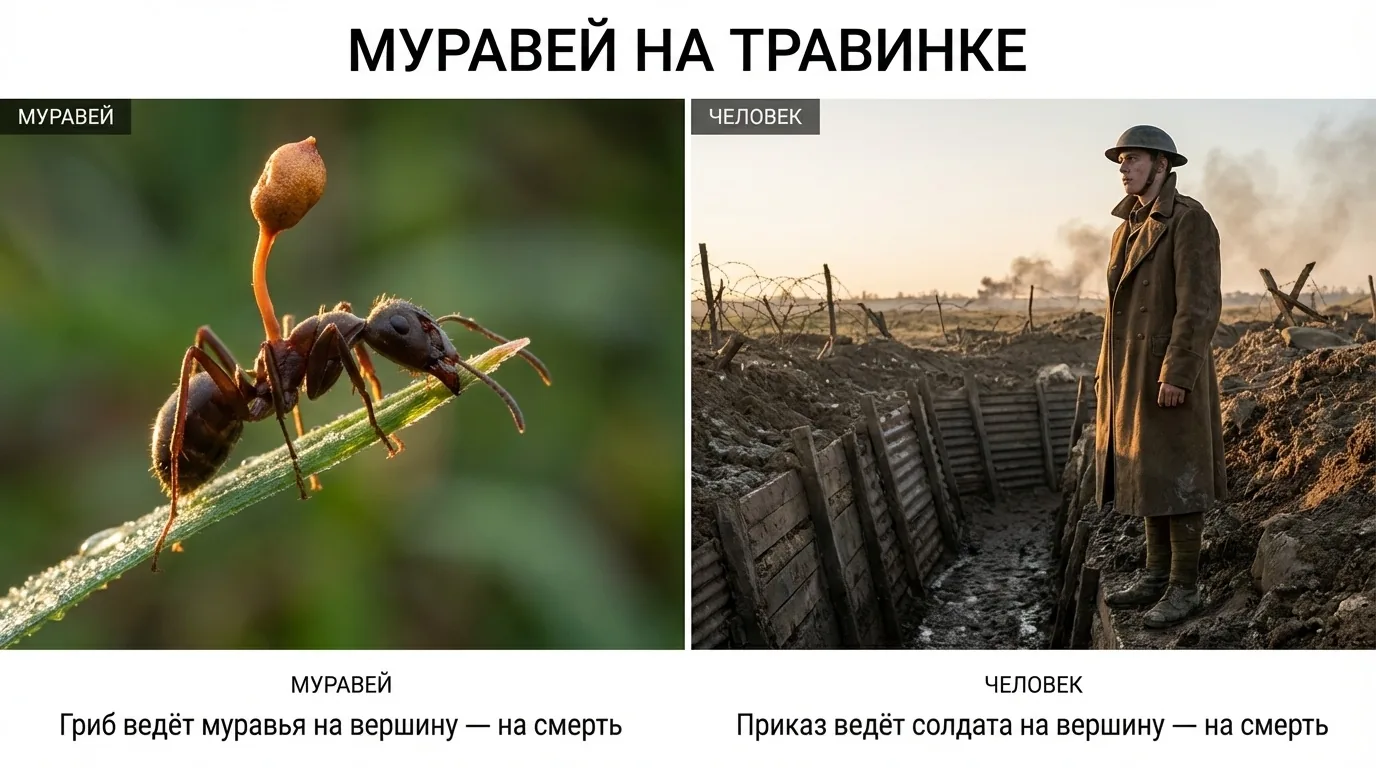
Self-destructive behaviour for the sake of ideas
People routinely sacrifice their lives for abstractions — in wars, in revolutions, in religious acts. No animal behaves this way. It is the classic behaviour of an organism captured by a parasite: the ant infected by Dicrocoelium climbs to the top of a blade of grass to be eaten by a cow — because the parasite needs to reach its next host. The human walking toward death for the sake of a flag is the same ant on the same blade of grass.
Chronic psychological suffering
Animals feel pain. But they don't suffer. Suffering is pain run through a narrative. "It hurts" is a sensation. "It hurts, and that's unfair, and it has always been like this, and it will never end" is suffering. The difference is the symbolic layer — which animals don't have.
Look around. Look at the world this infection has built. Skyscrapers, rockets, the internet, nuclear bombs, antidepressants, wars for ideas, trillions of dollars spent trying to mute the voice in the head that cannot be switched off.
All of it — the extended phenotype of the meme. Like a beaver's dam is the extended phenotype of the beaver.
We build civilisation for the information that lives inside us.