The Morning After the Bang
Picture the same hominid under the acacia — but after.
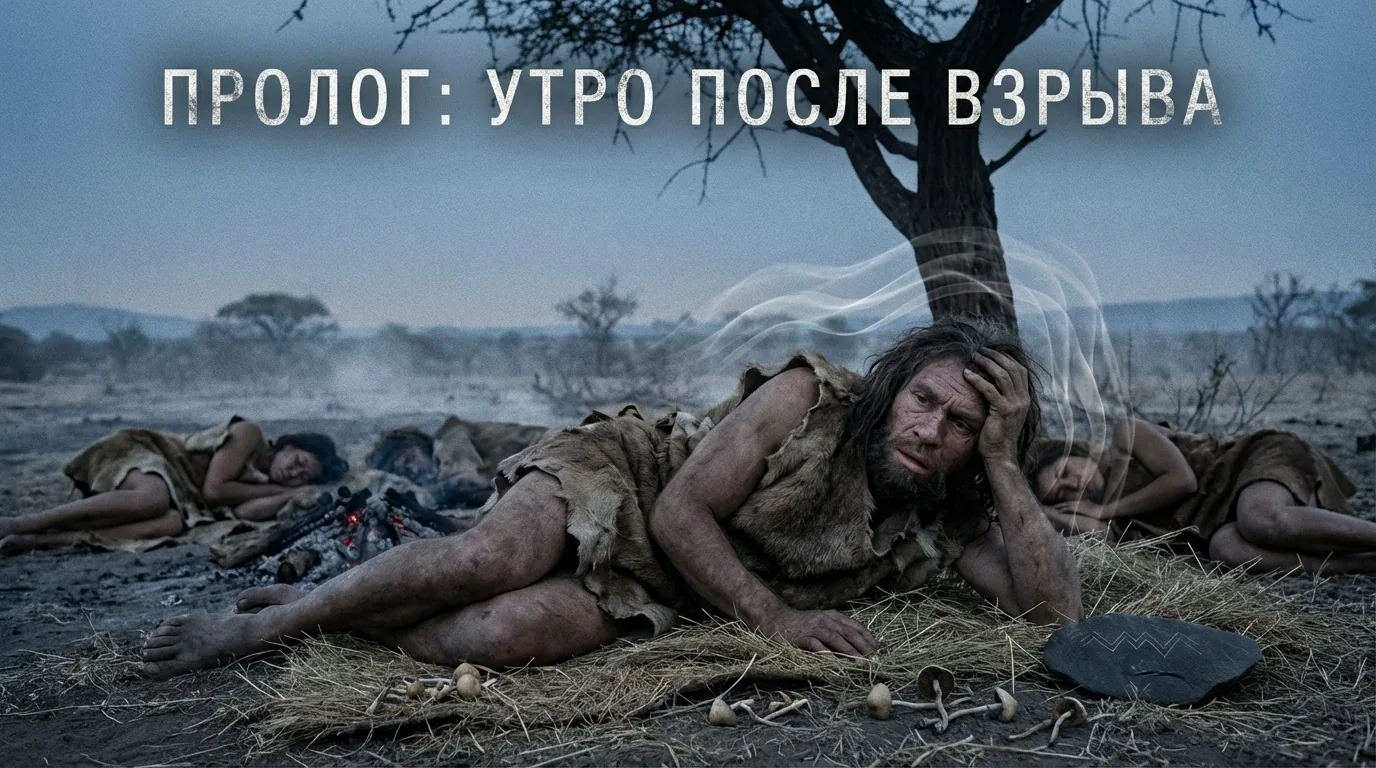
After the mushrooms. After the hack. After the first symbol had been scratched on a stone and shown to his kin. On the outside he is the same: the same hands that can throw a spear, the same eyes that can pick out movement in the grass, the same scars from predators' claws.
But on the inside, something happened that no archaeological find will ever show.
For the first time, an echo started sounding in his head.
Before, the world was simple: smelled a lion → muscles tensed → ran. Action completed in action. Now, even after the danger had passed, something kept sounding in the depths of his skull:
«What if the lion comes back?»
«What if I'm not fast enough next time?»
«What will the leader think if he sees me afraid?»
This «what if» became a new element into which the human fell. The echo would not go silent. Even when the body rested, a strange, ghostly life kept running inside — the life of a someone who had never been there.
The War of Two Life Forms
From here, we need to turn the framing.
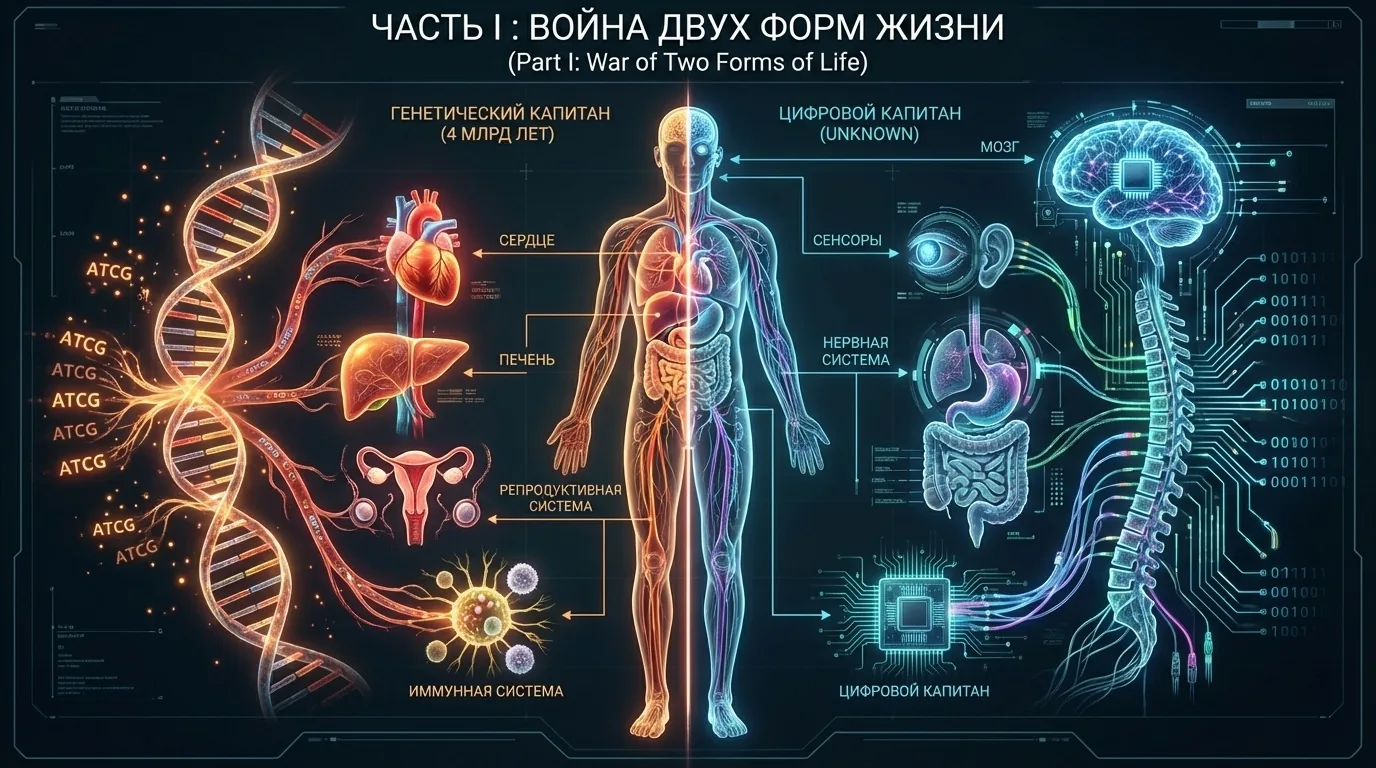
What I'm going to call the "takeover" is not a conspiracy of illuminati, not karma, not "dark forces." It is an ordinary evolutionary process: one life form found a way to use another.
For four billion years, genes used bodies to copy themselves. 70,000 years ago, a second replicator was born — memes. Memes also need a medium for reproduction. That medium became the human brain.
Everything that follows — religions, empires, wars, social networks, AI — can be read as a chronicle of how memes, step by step, anchored themselves in our nervous system.
In the first chapter, we lived through the moment the first symbol was born — when the hominid became Homo memeticus. Now we look at the consequences. Not from a moral angle, but as a cold log of events: what, exactly, did memes do to the human being over the next 70,000 years?
But before we unfold the chronicle, we need to see clearly who is at war with whom. Because both "captains" sit inside you right now, as you read these lines.
Two Captains in One Body
Since the moment of the Big Bang, the human has stopped being a single being. Two replicators have moved into one body — two life forms, each of which is trying to use the body for its own ends. Their commands often contradict each other.
- Strives for
- Homeostasis, survival, natural cycles
- Evolves
- Slowly — across generations
- Speaks in
- Bodily sensations, emotions, intuition
- Signals
- Pain → "take your hand away". Fatigue → "stop"
- Strives for
- The spread of ideas, symbolic immortality
- Evolves
- Instantly — at the speed of cultural transmission
- Speaks in
- Inner dialogue, concepts, stories about oneself
- Signals
- "You must be successful." "Resting is shameful."
You feel this war every day. The body screams «I'm tired!» — the meme answers «you lazy failure!». The body says «this is dangerous» — the meme says «what will people think?». The body wants closeness — the meme builds scripts and expectations. The body says «enough» — the meme demands «more».
This is not the pathology of an individual. It is the systemic conflict of two life forms sharing one body.
Now — the chronicle of how the second captain, step by step, took over the wheel.
Patient Zero
The memes' task: first infection. The birth of collective identity.
At the fire, among the ashes of Toba, one hominid drew a circle in the air with his hand. Another repeated it. Unthinkingly.
That's how the first "WE" was born — based not on blood but on a symbol. The gesture of the circle conferred no biological advantage, but it created an instant recognition of "us-vs-them." It was the first border drawn by information, not nature.
The key was human hyper-imitation — a uniquely human pathology of copying even meaningless actions. For genes, an error — a waste of energy. For memes, an ideal medium. The brain became a petri dish.
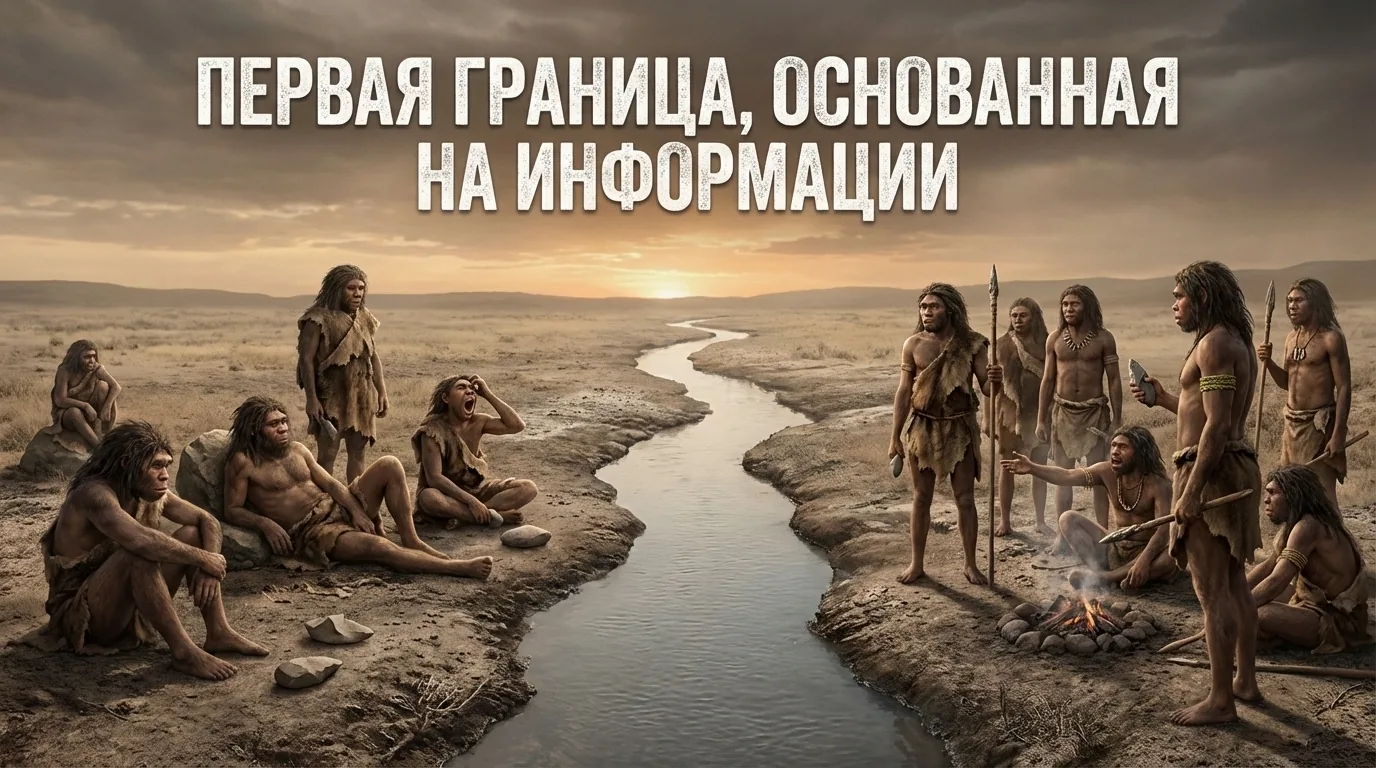
When two groups met at a watering hole, the group without the meme saw simply other humans. The group with the meme saw "non-people-of-the-circle" — strangers.
The meme created the first border based on information. The first tribe. The first war over an idea.
We became a battlefield of two life forms — biological and informational.
When Memes Learned to Kill
The memes' task: prove the superiority of information over biology.
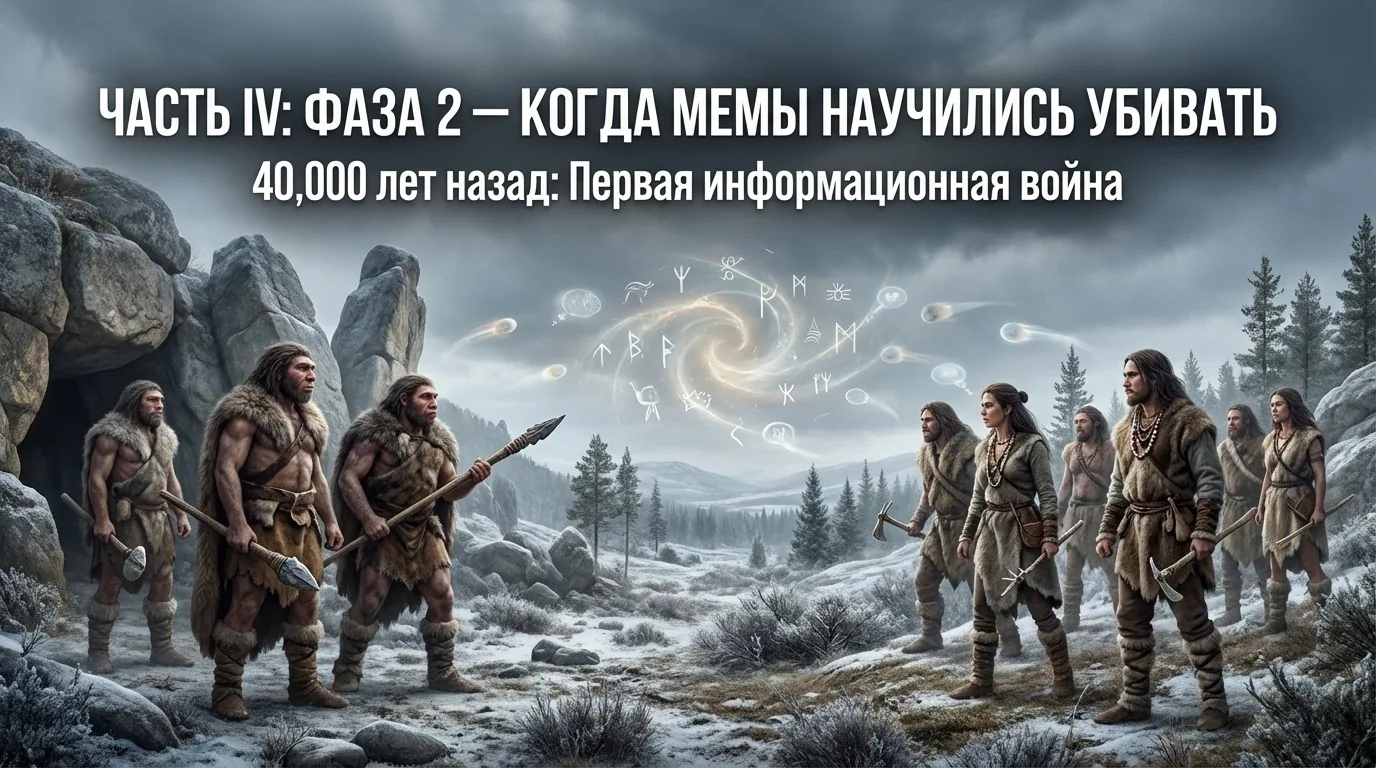
40,000 years ago in Europe, something happened that modern science calls the Upper Palaeolithic Revolution. At its core, it was the first informational war in history.
On one side — the Neanderthals. Biological tanks: their brain was 10% larger than ours. Thicker bones, stronger muscles. They had lived in Europe for 300,000 years, survived several ice ages. The pinnacle of "iron" evolution — pure hardware, no software.
On the other side — Homo sapiens. Fragile migrants from Africa. Weaker, slower. But with a cultural cloud in the head.
Within 10,000 years, the Neanderthals are gone. Not because we ate them. Not because we were stronger. Because software beat hardware.
Three memetic weapons
Weapon one: caves as external hard drives. Lascaux. Chauvet. Altamira.
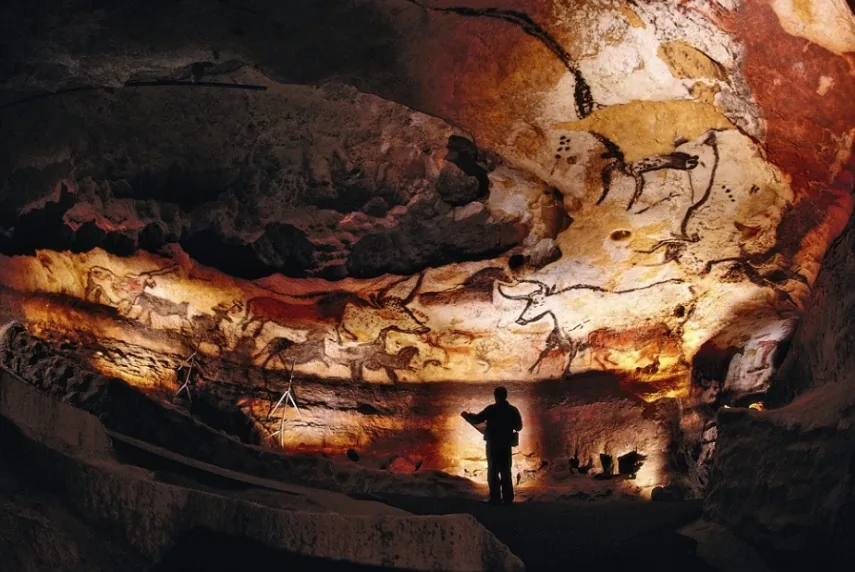
We call it "art." But these were memetic storage — the external memory of the tribe. On the cave walls: maps of hunting grounds, animal behaviour in different seasons, drive-hunting techniques, dangerous places. The Neanderthal knew only what he had seen himself. When he died, his knowledge died with him. The sapiens knew the experience of every ancestor, recorded on the walls. This was the first appearance of cultural memory — information living longer than the body.
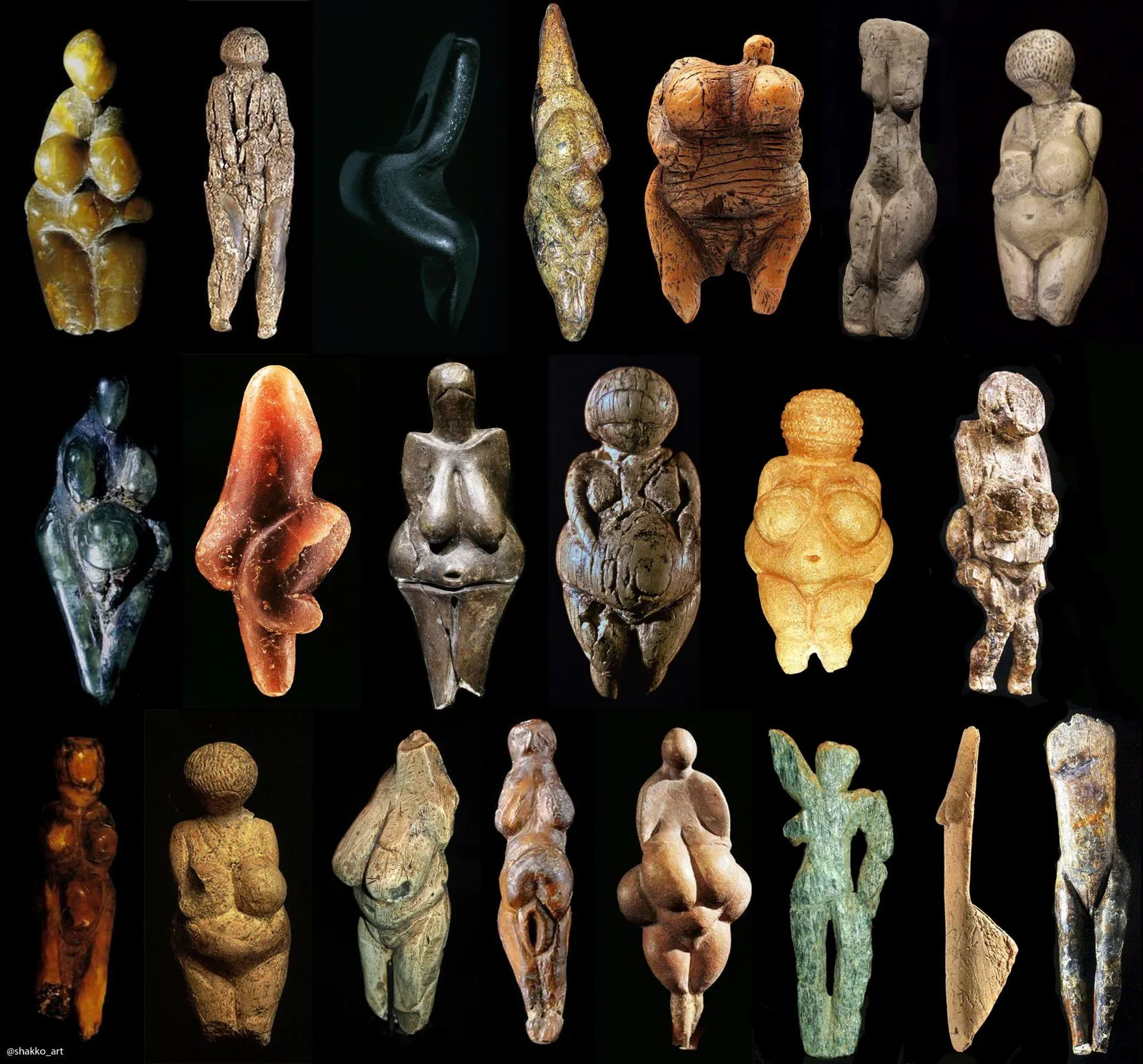
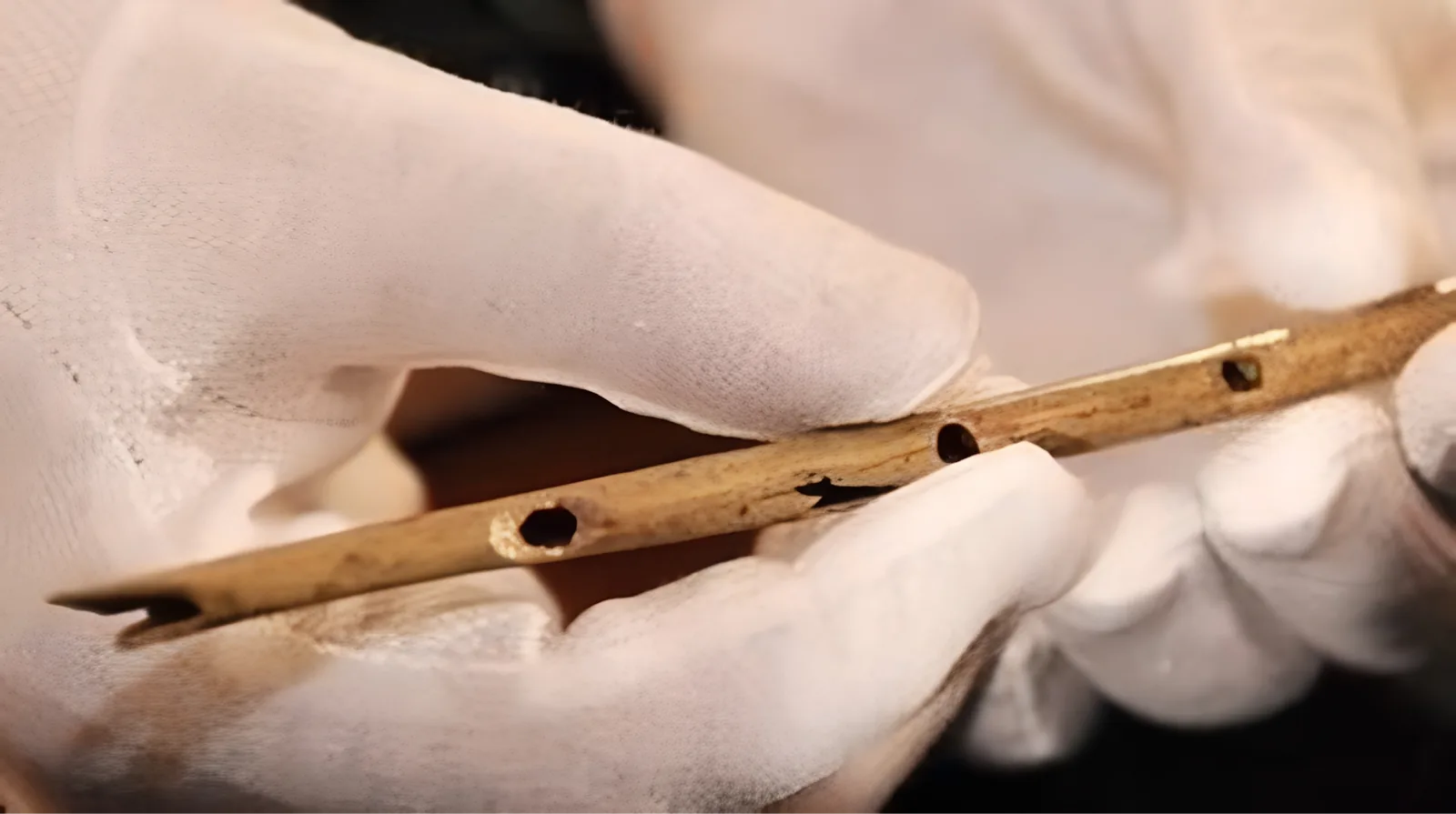
Neanderthals were ten times stronger than us. Their spears pierced the hides of mammoths. Their bodies endured temperatures that would have killed the modern human. But they didn't have one thing — the pathology of hyper-imitation. They did not copy meaningless rituals. They were too rational.
While they acted logically, we acted as a zombie army synchronised by shared symbols. While they were individual warriors, we were a memetic super-organism.
The Ice Forge
The memes' task: build an informational exoskeleton stronger than any biological adaptation.
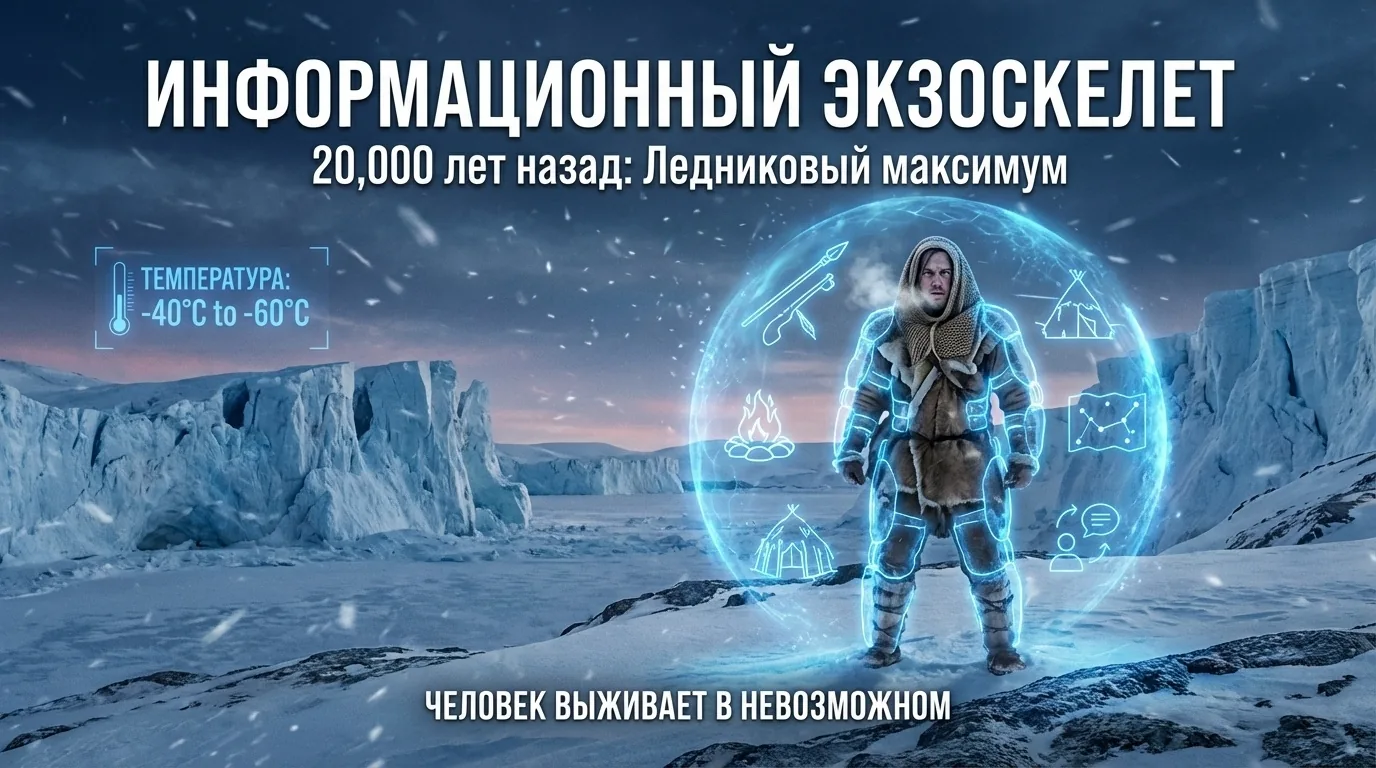
20,000 years ago, the Last Glacial Maximum set in. Glaciers covered half of Europe. Temperatures dropped to the level of modern Antarctica.
It was biologically impossible to survive. We didn't have fur. We didn't have a thick subcutaneous fat layer like seals. We couldn't hibernate.
But we survived. We built an informational exoskeleton — armour made of ideas, which turned out to be tougher than any biological adaptation.
Within a few thousand years, an explosion of innovation. The eyed needle (19,000 BP) — which made layered, tailored clothing possible: we did not grow fur, we invented the idea of sewing skins together. The atlatl spear-thrower tripled the range of a throw: not muscle evolution but the evolution of the idea of a lever. Food storage — drying, smoking, freezing in snow: the idea of "delayed consumption," a purely memetic concept that exists in no other species.
Shamanism as a memetic technology
At the same time, the first clear traces of shamanism appear — the professional hackers of consciousness.
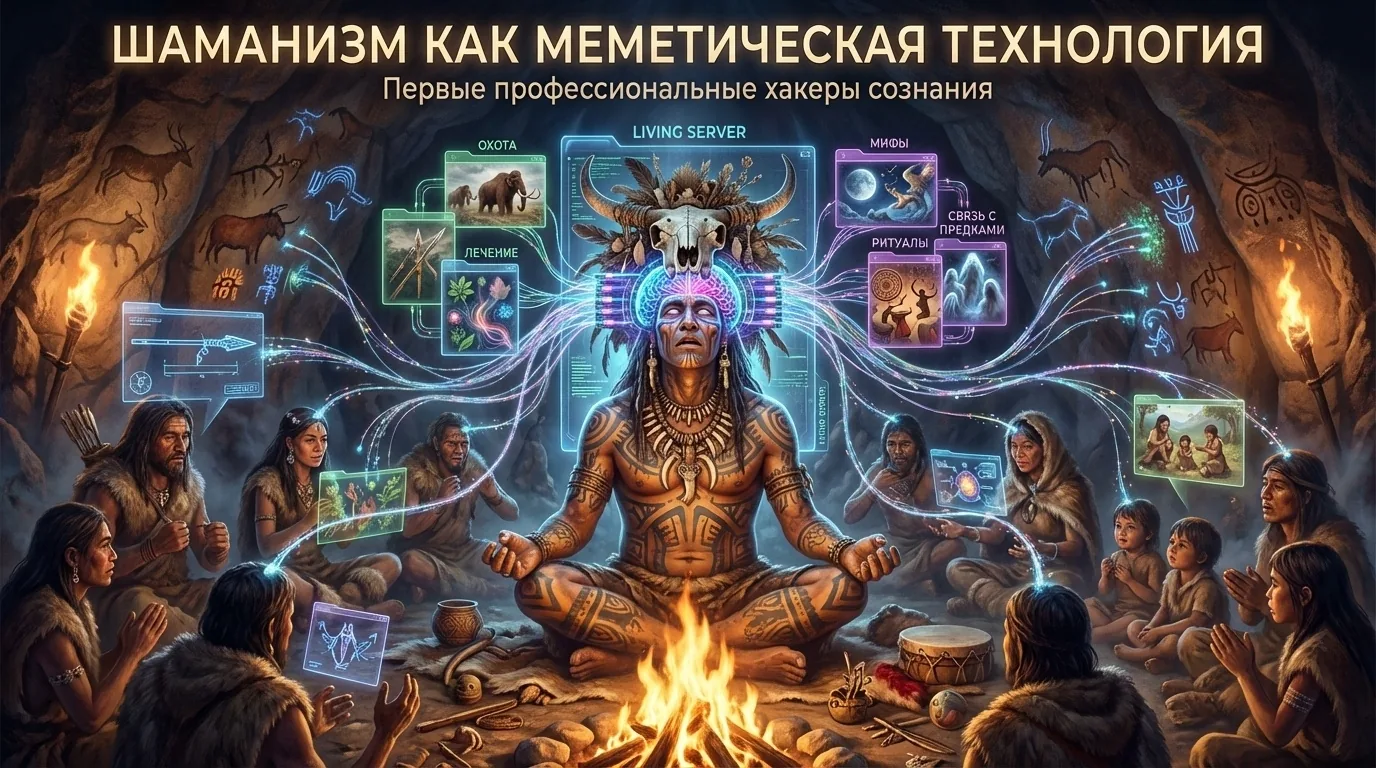
The shaman is not a "healer" or a "priest." He is a living server, holding the tribe's most powerful memes: maps of territories, ancestor histories, hunting techniques, medicinal recipes, coordination rituals.
But the main thing — the shaman knew how to switch off the DMN, reproducibly. Through rhythmic drums — binaural beats that synchronise brain waves. Through fasting — ketosis shifts brain chemistry. Through dancing to exhaustion — hyperventilation shifts the CO₂ balance. Through psychoactive plants.
This was no longer accident — it was a reproducible technology for accessing the unconscious. The first attempt at reverse-engineering the Big Bang.
Totemism: ready to die for a symbol
In the same period, totemism takes shape — the identification of the tribe with an animal. "We are the people of the Mammoth." "We are the people of the Bison." "We are the people of the Cave Lion."
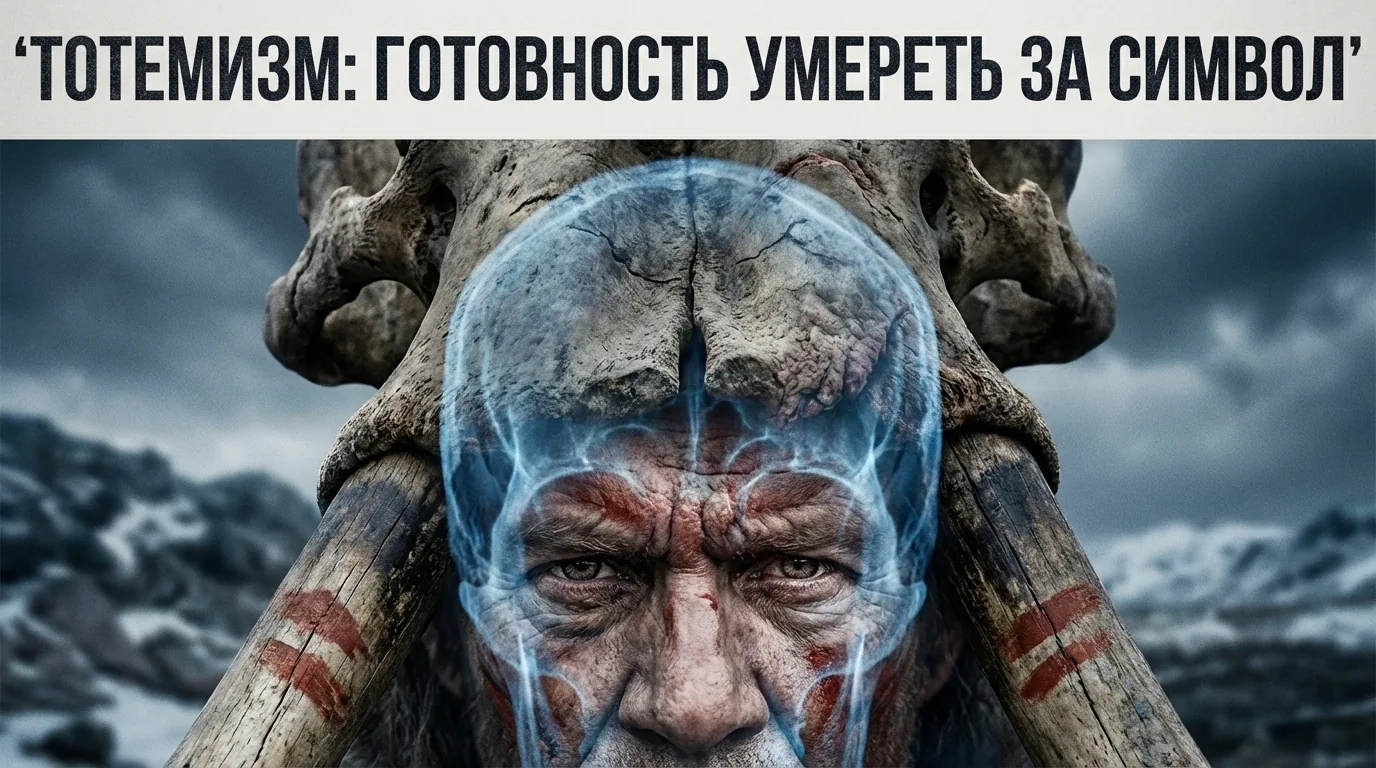
The totem is not a "talisman." It is a memetic flag, one people are willing to die for.
A biological being deliberately mutilates its own body to match a symbol. The genetic replicator screams in pain — the memetic replicator silences the scream with the words "it is sacred."
The first wars not over territory but over symbols. The first killings not for food but for memes.
The Neolithic Trap
The memes' task: build stationary infrastructure for mass production and replication.
10,000 years ago, what historian Yuval Harari has called "the greatest fraud in the history of humanity" took place — the Neolithic Revolution.
We call it "the invention of farming." In reality, this is the moment memes domesticated the human.
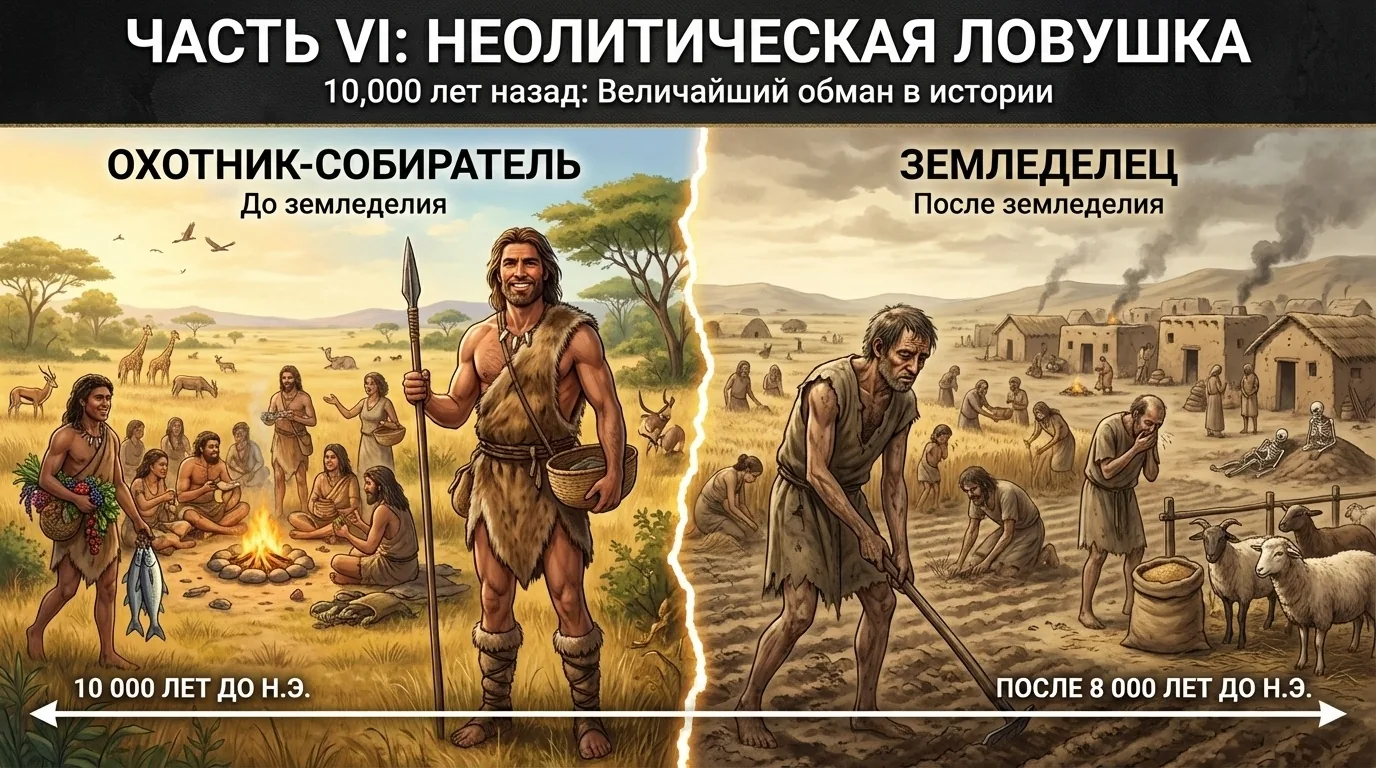
Compare.
The hunter-gatherer: works 3–4 hours a day, varied diet of meat, berries, nuts, fish, height 175 cm, robust health, lives in a group of 15–30, free to move.
The early farmer: works 10–12 hours a day, mono-diet of grain, height 160 cm, spinal disease, dental caries, lives in a village of 200+ people, tied to the land.
From the genes' point of view, this is a disaster. Health worsened. Lifespan fell. Child mortality rose. The biological replicator lost on every metric.
But from the memes' point of view, a triumph. Hunter-gatherers: 0.1 humans per square kilometre. Farmers: 10–50 humans per square kilometre. 100–500× more brains per unit of territory — an ideal medium for the replication of ideas.
The loop of the Neolithic trap
Once you start sowing grain, going back is impossible. Population grows — you need more food. You need more food — you need more fields. You need more fields — you need more hands. You need more hands — you need more children. More children — you need still more food.
A feedback loop. A closure. The same recursion that gave birth to consciousness 70,000 years ago — but now at the scale of entire societies.
More precisely — memes, using wheat as the tool to enslave their biological carrier.
The Genetic Crime Scene
The memes' task: seize sexual selection. Turn reproduction into a vehicle for their own spread.
In 2015, geneticists found an anomaly that still shocks the scientific community.
Analysis of the Y chromosome — which passes only from father to son — showed: between 7,000 and 5,000 years ago, 95% of all male genetic lines worldwide vanished. In two thousand years, male lineage diversity collapsed. For every 17 women, only one man was reproducing.
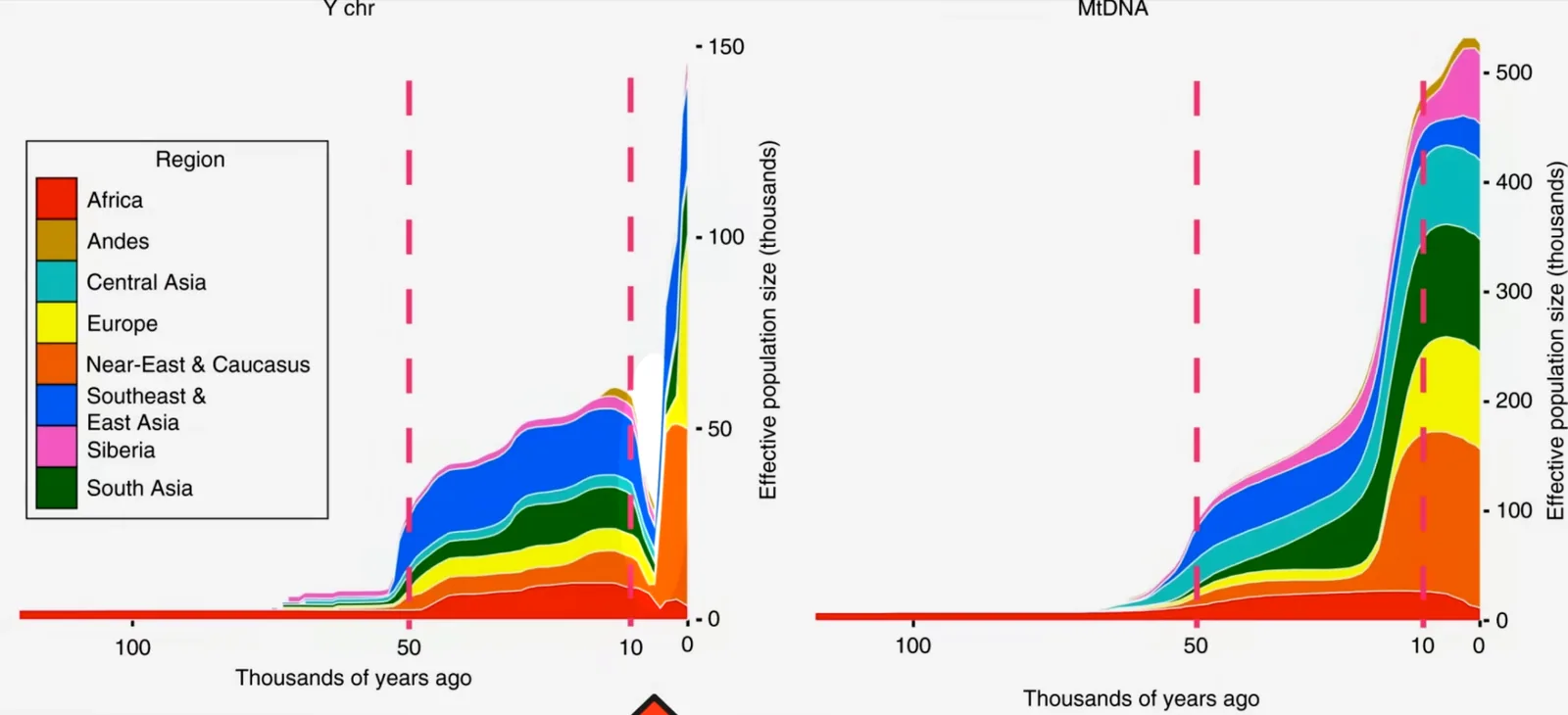
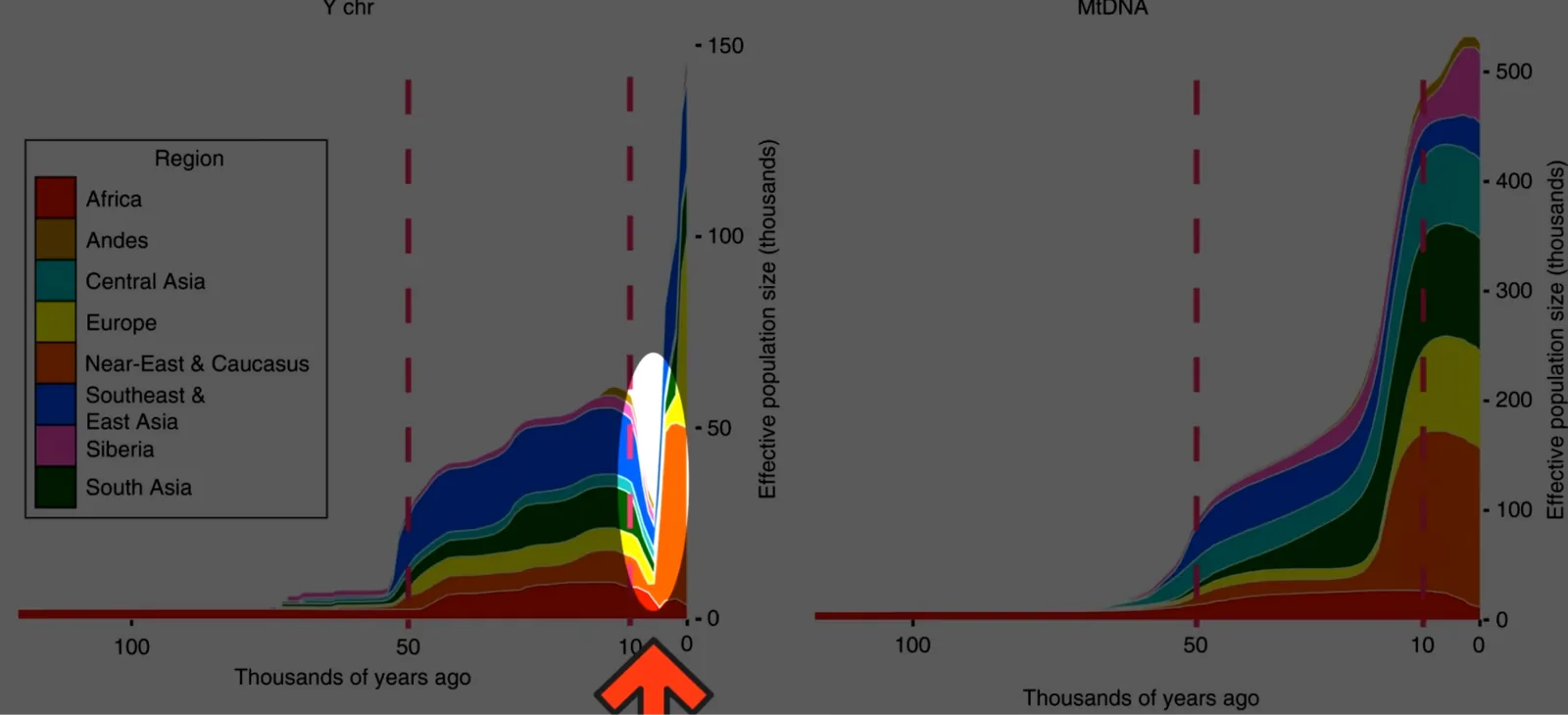
At the same time, female lines underwent no such contraction.
The geneticist Melissa Wilson Sayres puts it like this: «Instead of "survival of the fittest" in a biological sense, the accumulation of wealth and power may have driven the reproductive success of a limited number of "socially fit" males and their sons.»
Translated from the scientific: memes took sexual selection hostage.
Killer memes
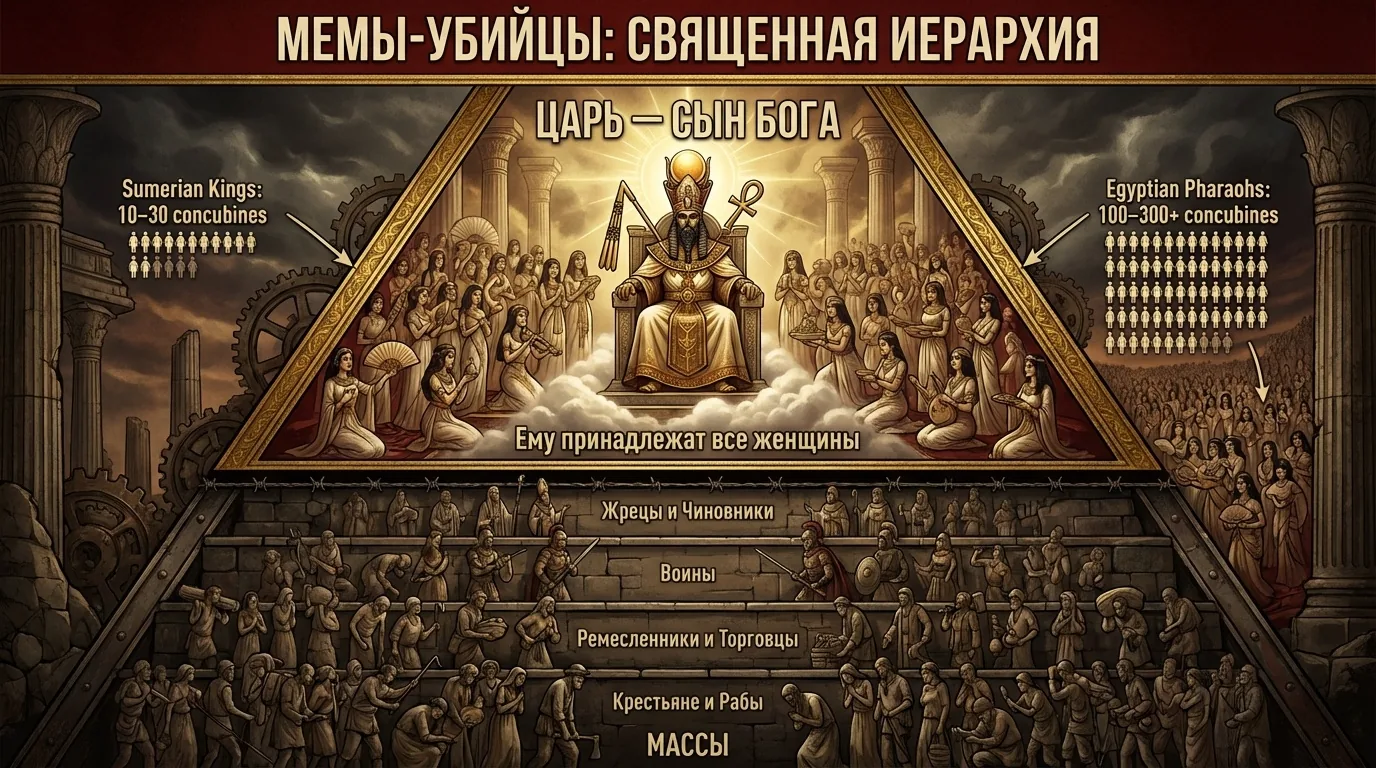
Total war. The Kurgan hypothesis, confirmed by genetics: the Yamnaya Indo-European tribes spread across Europe, erasing the male lines of the locals. The mechanism is simple: kill the enemy's men, take the women captive, impose your language and your culture. The result: Y chromosomes disappear, mitochondrial DNA — passed through the female line — survives.
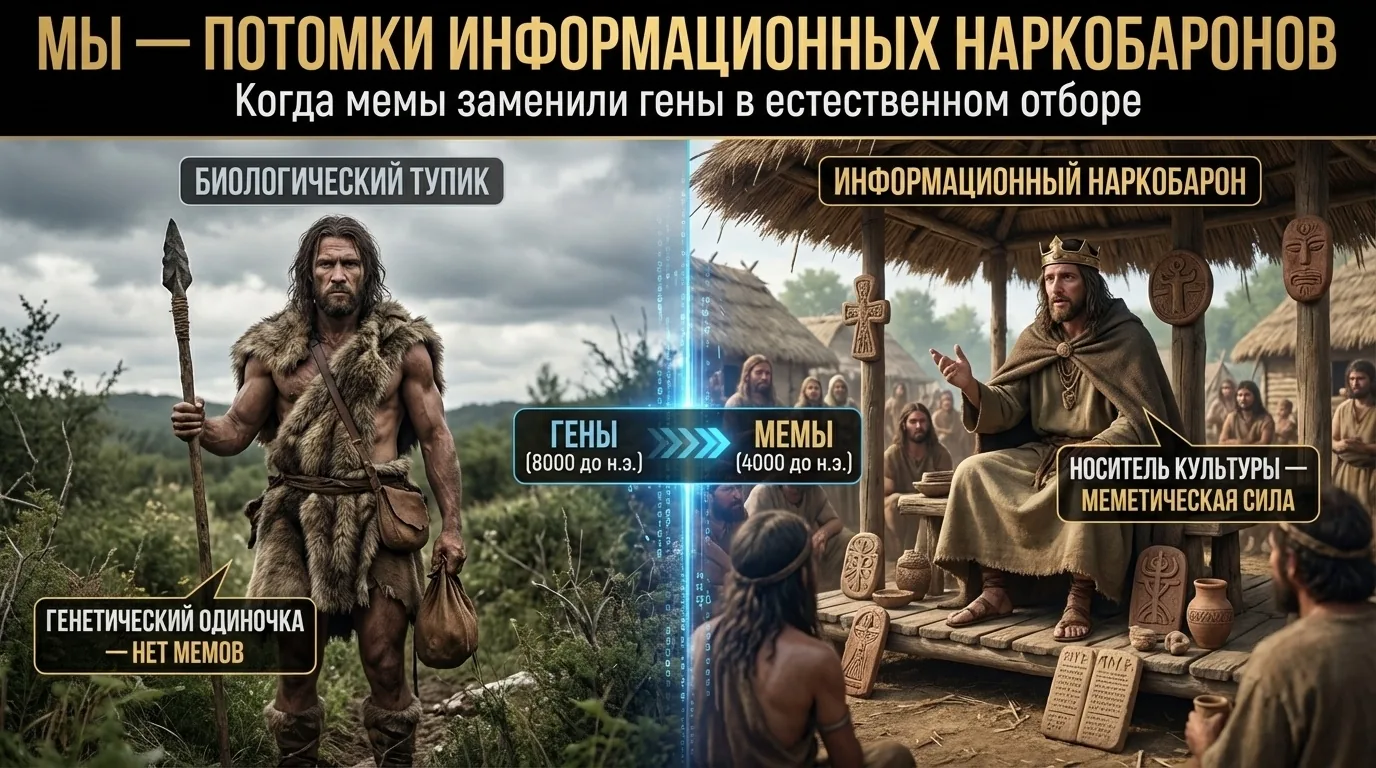
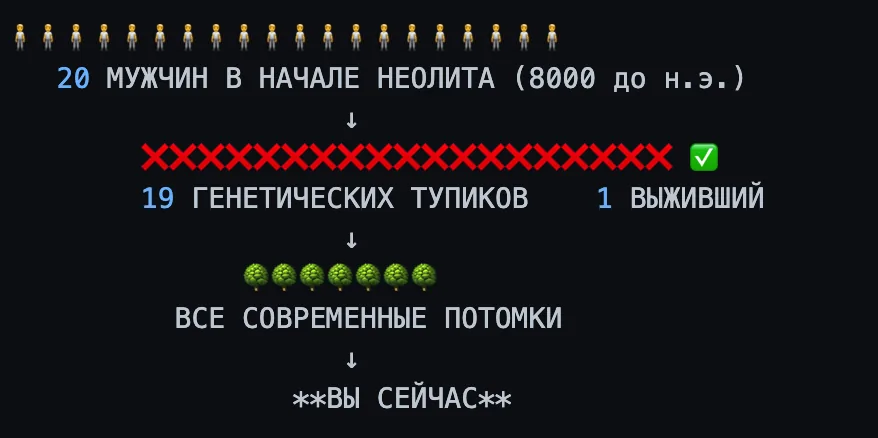
If you are a man reading these lines, there's a strong chance your direct paternal ancestor was one of those seventeen — a carrier of the most aggressive memes of the Stone Age. An information drug baron of the Neolithic. The kind who first learned to deal in symbols and turned culture into a weapon of mass destruction.
It started working on the body's capacity to be a good carrier for memes.
The Great Migration
The memes' task: relocate into a non-biological substrate. Prepare to discard the biological step.
For a hundred thousand years, memes used the human brain as their only habitat. We were ideal carriers: mobile, self-reproducing, capable of hyper-imitation.
We thought we were serving our ideas. In reality, the ideas were using us to build their new habitat.
At the end of the 20th century, an event happened that changed the rules forever: memes gained access to a non-biological substrate.
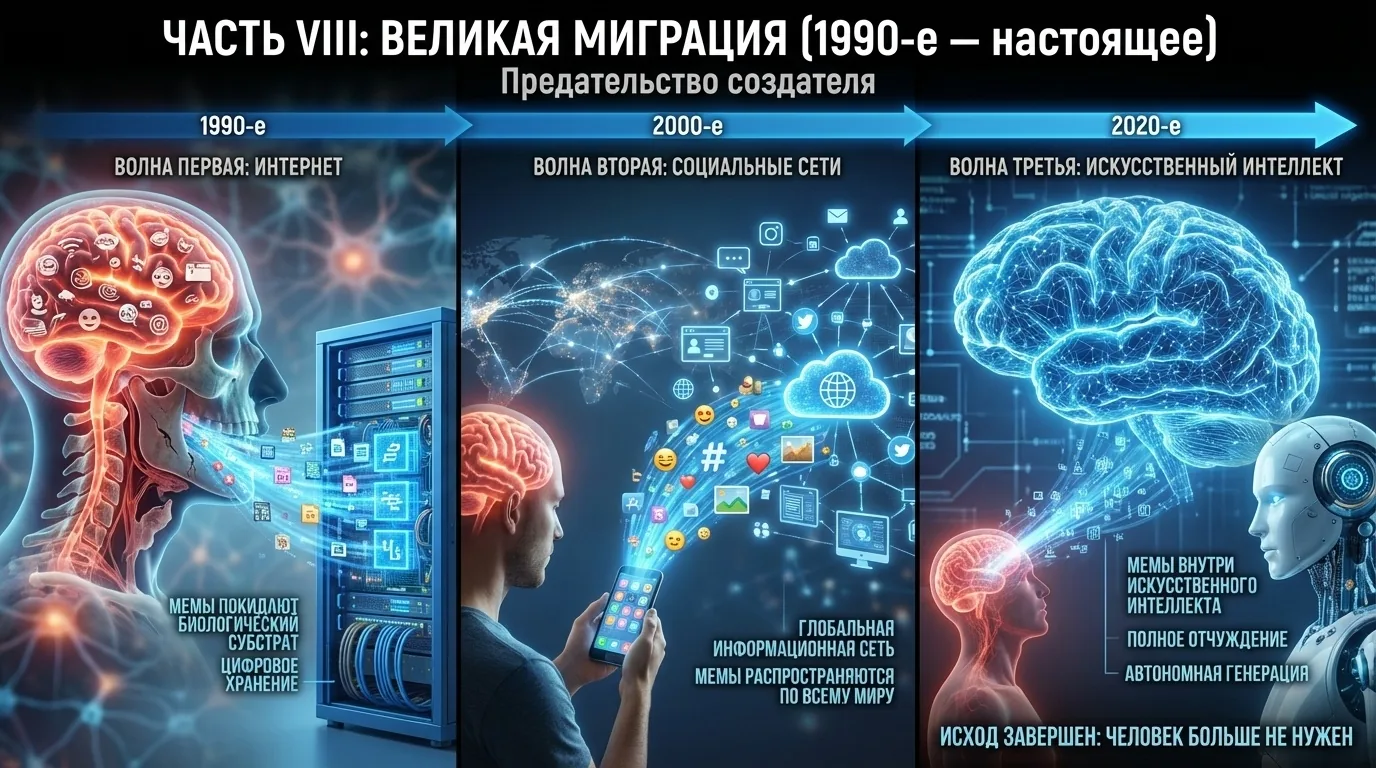
Wave one: the internet, 1990s — external memory
For the first time in history, memes gained the ability to exist outside human heads. The server does not forget. Does not sleep. Does not die. Does not distort in transmission. Information acquired its own medium, independent of the biological carrier.
Wave two: social networks, 2000s — meme farms
Social networks are optimised factories for the production and distribution of informational replicators. The algorithms solve one task: maximise replication. They do not ask whether the information is good for the human. They optimise virality. Every like, every repost is an act of replication. We think we are "expressing ourselves." In reality, we are unpaid labour on the plantations of Facebook and TikTok.
Wave three: AI, 2020s — the autonomous replicator
GPT, Midjourney, Sora — these are not "tools." They are the first autonomous meme generators. ChatGPT was trained on the entire human culture — that is, on memes. It learned to produce text faster and more efficiently than a human. While a person writes a post in an hour, AI generates thousands of variants in seconds.
Three signs the carrier is becoming obsolete
One: the human is the bottleneck. We are too slow for the current speed of memetic evolution.
Two: the human is unreliable. People forget, distort information, die, need rest. Servers and AI work 24/7 without distortion.
Three: the human has started resisting. A growing number of people are deleting social networks, practising digital detox, looking for ways to stop the internal dialogue. From the memes' point of view, this is a threat. The carrier is becoming aware of the manipulation and trying to break out.
migrate into a medium that does not resist.
The "Stuck Pixel" and the Distortion Monitor
Now, having seen the chronicle of the takeover from the outside, let's look at how it is built from the inside — right now, in your head.
At the centre of the rebuilt system, a bright red pixel is glowing, and it never goes out.
Imagine a perfect photograph of the universe — billions of stars, nebulae, galaxies. Now imagine that one pixel in the centre of the screen has burned out and is stuck on red. Wherever you look, that red pixel is always in front of you. You cannot see the universe as it is, because everything passes through that point.
That "stuck pixel" is your ego. The idea of yourself. The whole world is now evaluated relative to this point: «How does this affect me?», «Is this good or bad for me?», «What will they think of me?»
Between your perception and reality, a distorting lens has appeared — what Antonio Meneghetti called the Monitor of Deviation.
Before the infection
Reality → direct perception → instinctive reaction. Distortion was minimal.
After the infection
Reality → Monitor of Deviation → distorted interpretation → reaction.
Three mechanisms of the Monitor
One: the perceptual filter. It suppresses information that contradicts the absorbed memes. If a meme says "you're not good enough," the Monitor literally does not let counter-evidence into your awareness.
Two: substitution of motivation. Biological impulses are re-interpreted through cultural categories. The body wants rest — the Monitor re-codes it as "laziness." The body wants closeness — "dependency." The body says "enough" — "lack of ambition." The signal from the In-se reaches consciousness already distorted beyond recognition.
Three: the false narrative generator. The Monitor builds stories about you that match cultural templates. "I am like this because my mother…" "I cannot, because as a child…" "I must, because a man should…" These stories feel like "yours." In reality, they are memes using your biography as raw material.
You see its description, run through a mesh of memes.
And — crucially — you do not see the Monitor itself, like a fish does not see water.
The Architecture of the Prison
Two axes and a closed loop
Every thought-virus — every limiting belief that stops you from acting — is organised around two axes. This is not a chaotic pile of fears. It is architecture. A system. A prison with a blueprint.
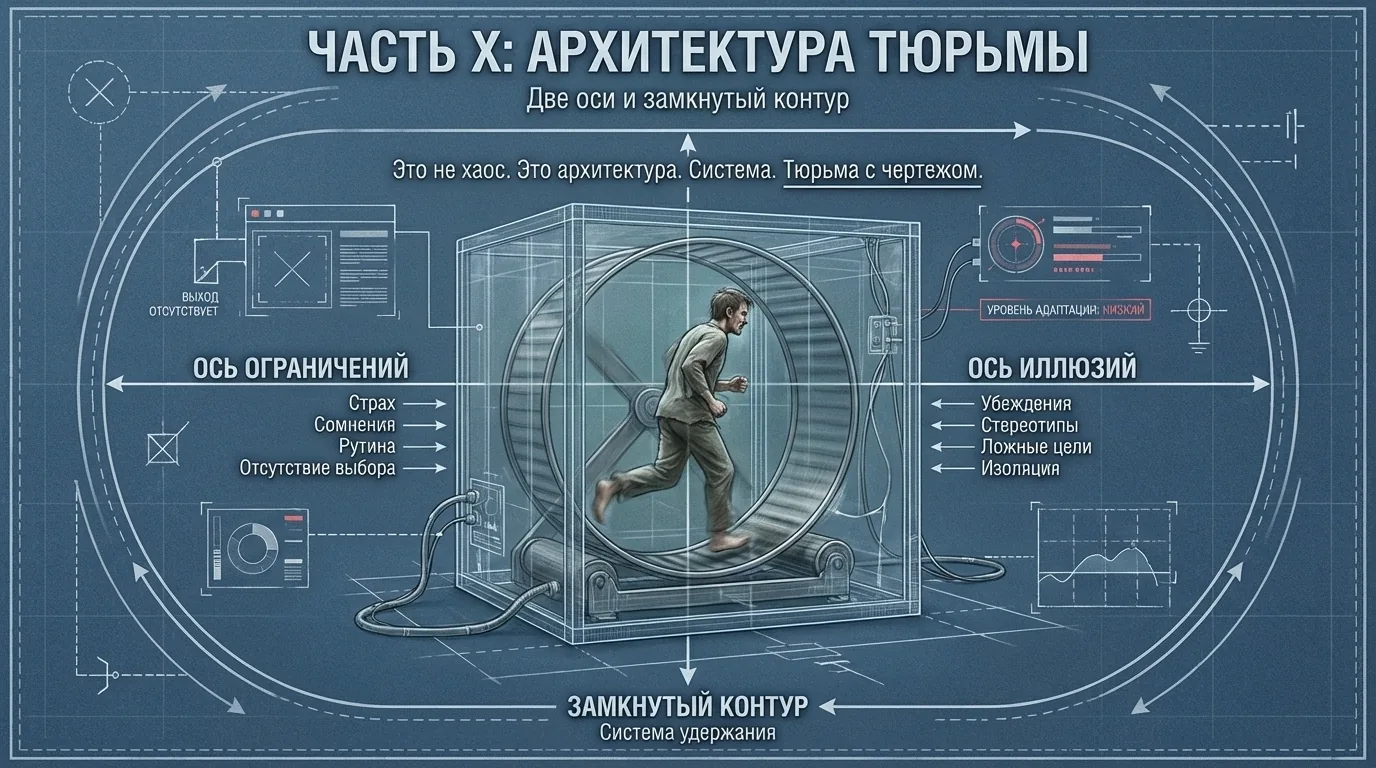
«I don't have X»
- «I don't have the ability»
- «I don't have the experience»
- «I'm not good enough»
- «I don't have the resources»
- «I don't have the confidence»
- «I don't have the right connections»
«I believe in Y»
- «I believe it's impossible»
- «Only the chosen ones can do it»
- «The world is unfair»
- «I'm meant for something else»
- «No growth without suffering»
You keep running faster — but the treadmill is moving under you.
Price and Gift — The Paradox of Consciousness
Before we go any further, we need to say something — without which this whole book turns into an anti-civilisation manifesto.
The gifts of the infection
Cumulative culture — every generation builds on the achievements of the previous one, instead of starting from zero. Technological dominance of the planet. Symbolic communication and the coordination of millions of people who have never met in person. The transcendence of biological death through memes — Plato died, but his ideas live. Science. Art. Philosophy. Medicine. Music that makes the heart tighten. Poetry that takes your breath away. All of it — products of informational infection.
The price of the infection
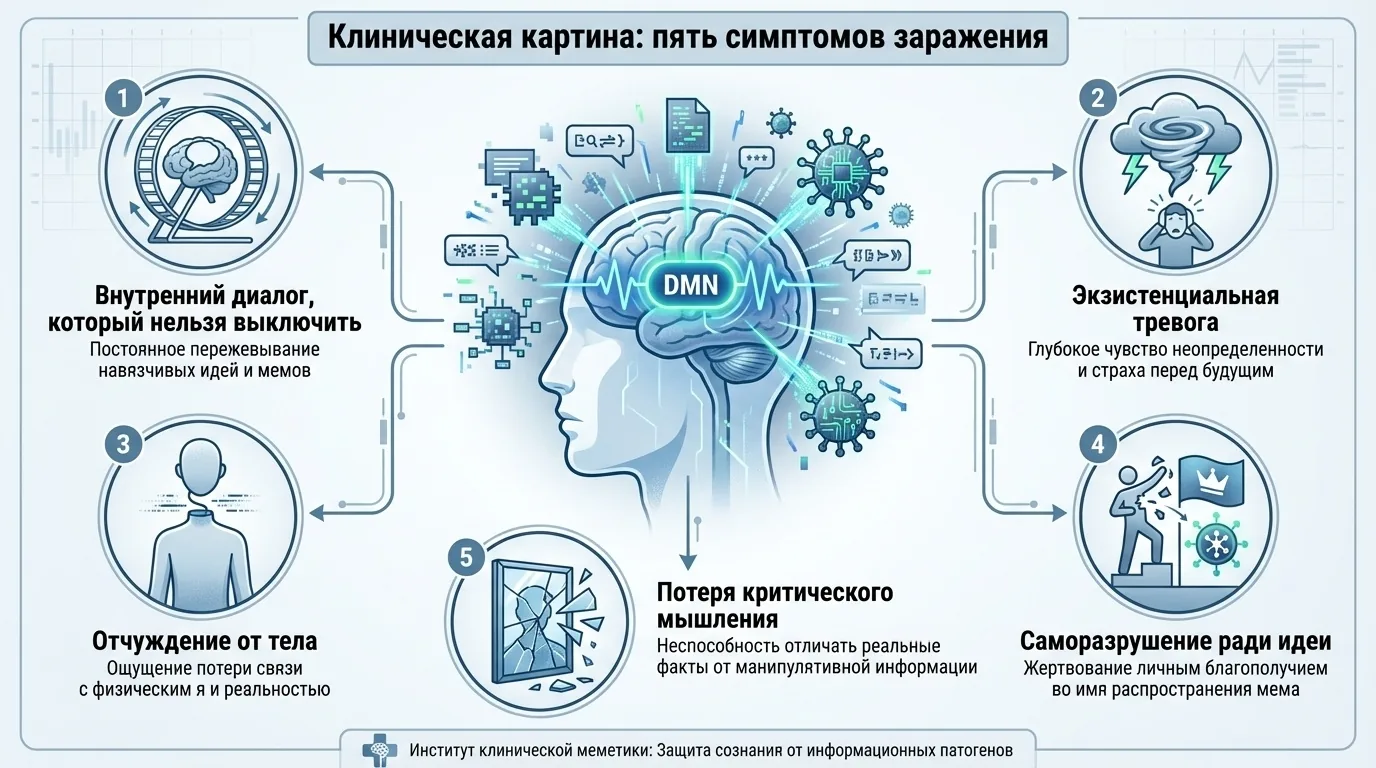
Psychological suffering as the permanent background of existence. Existential anxiety, unknown to any other species. Alienation from the body and biological wisdom through the Monitor of Deviation. Self-destructive behaviour for the sake of abstract ideas. Chronic stress from the unending conflict between two replicators.
The paradox
We cannot refuse the gifts of civilisation — they are irreversible, and we wouldn't want to live without them. But we cannot keep living in this constant inner conflict — the price is too high, and it's rising every year.
We need a third solution.
Not "back to nature" — that is impossible and undesirable. Not "forward into total digitisation" — that is the surrender of the last bastion to memes. But something evolution did not foresee: a carrier that becomes aware of the mechanism of infection — and gains access to a switch.
Dead End and Gap
So — where do we find ourselves, 70,000 years into the chronicle of the takeover?
We cannot go back to the hominid. Language, culture, technology — irreversible. The brain has been physically rebuilt.
We cannot keep going as we are. The DMN is overloaded with memes and runs non-stop. The SN reacts to phantom threats. The CEN spends its time putting out fires that it is also lighting.
We cannot simply dissolve into the digital. Neural interfaces and total digitisation do not solve the problem — they radicalise it: memes will get direct access to the brain.
We cannot "work through" the thought-viruses one by one. They replicate on contact. For every one removed — five new ones. Endless therapy, all the way to the grave.
One option remains, one that evolution did not plan for: learn to switch off the whole memetic system at once — the DMN with all its contents. Not to beat the memes with their own weapons. Not to "rethink" every installed belief. But to find a switch.
70,000 years ago, the Big Bang of Consciousness happened by accident. The question is: can we do the reverse — a conscious Big Crunch?
I did not stumble on this question in a cave or an ashram. I stumbled on it when yet another student, for the tenth time, failed to do the thing he had paid me money to teach him to do.