The Hominid Who Saw the Code
Dark. Warm. Tight.
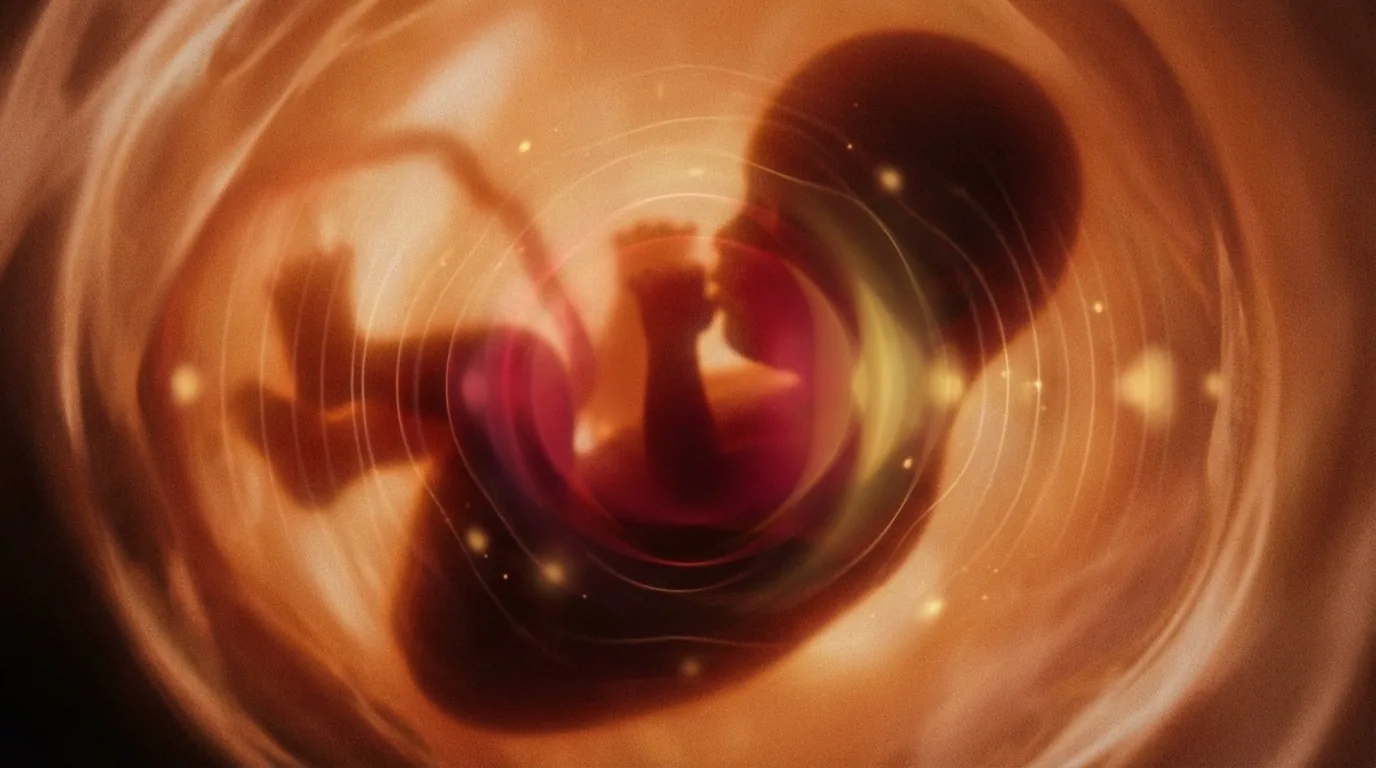
You don't know these words. You have no words. None at all. There is only this — a pulsation surrounding you on every side. Two rhythms layered on top of each other: yours, quick, restless, like fine ripples on water. And hers, slow, mighty, like the surf of a distant sea. You are inside the surf. You and the surf are one.
You move a leg. Not because you decided — there is no one to decide. The leg moves on its own, the way a wave moves.
Sounds. Muffled, as if filtered through water — because they are. A hum. A vibration. Sometimes — rhythmic oscillations that will later be called voice.
Not one thought. Not one image. No memory — because there is nothing to remember.
The very state shamans, monks, meditators, and desperate seekers of silence will spend seventy thousand years trying to return to.
You will stay here a little longer. A few weeks. Or days. You don't count — there is no one to count, and nothing to count with.
Then the world contracts.
The walls that were always soft begin to push. Not as before — a light response to your motion. For real. Strong. Rhythmic. In waves that push you somewhere.
And suddenly — Light.

Cold. Real, biting cold — air on wet skin. A clap. A sharp blow — and the throat tears open in a cry you didn't plan, because there is no one to plan. The first inhalation.
And here you are. Not "you" — because the "you" will come later. For now — there is this: light, cold, warmth, a heartbeat, a cry, breathing. A clean screen, on which the world has just pressed "on."
Primordial soup. Hot. Ready. The software will not keep itself waiting.
The first memes
The first meme arrived not in words. It arrived in the body.
A clench in the belly — emptiness without a name. A cry. And the answer: warmth, smell, milk. The clench releases. Something fills the emptiness. The first entry: «I cry → they come.»
After it — a second. And a third. And a hundredth. The world, which a second ago was a single field with no distinctions, begins to break into fragments.
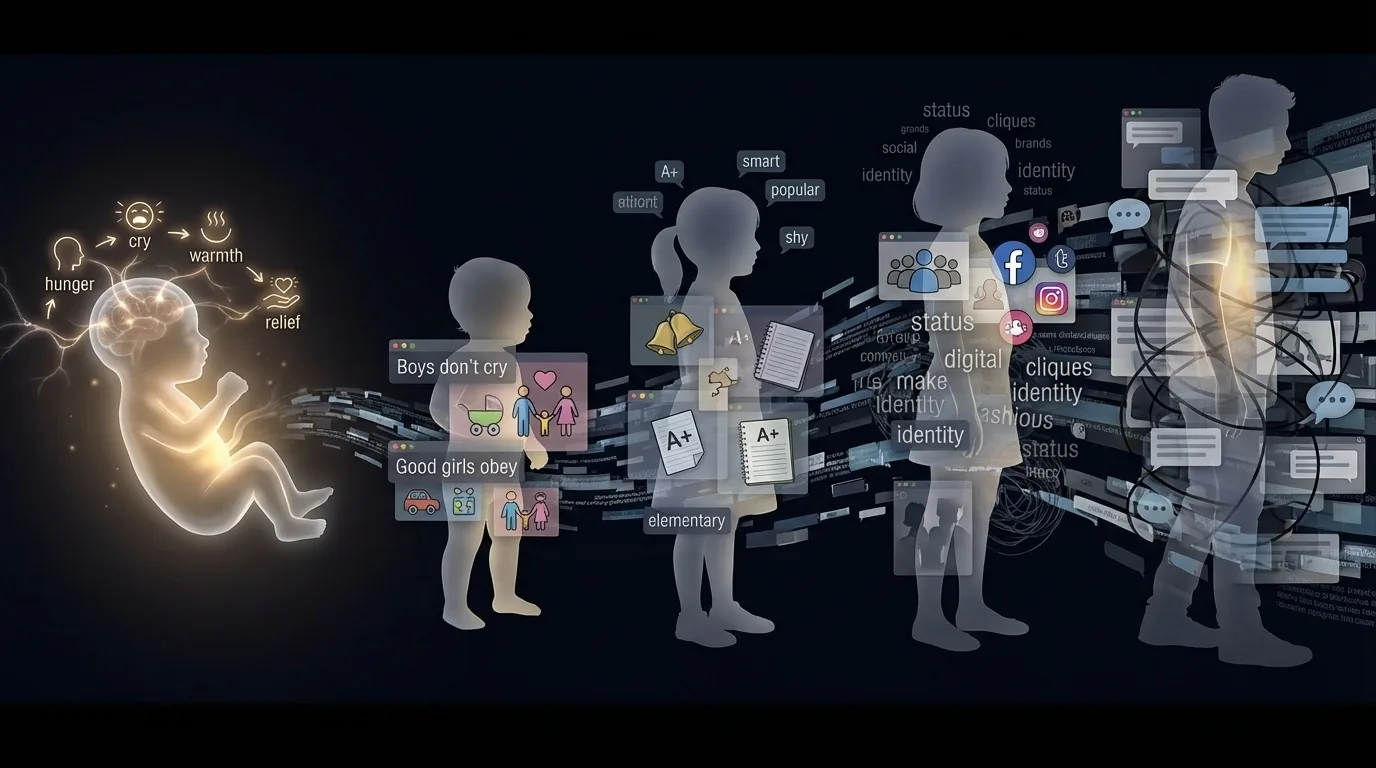
«Mama.» The first label stuck onto warmth. «No.» The first border drawn by sound. «Don't.» The first meme that exists separately from any stimulus.
«Good.» «Bad.» «Right.» «Wrong.» Each word is not a description of the world but an instruction: where to go, where not to go.
«Boys don't cry.» «Good girls obey.» «If you do this — nobody will love you.» Each phrase is not advice. It's a meme-strategy.
Kindergarten. The first band beyond the family. School. The filter thickens every year. Layer by layer: grades, bells, school diaries, «you can do better,» «another C,» «look at Seryozha.»
Sixteen. The first crash against the wall.
By fourteen — the body explodes. Hormones hit the nervous system like a tsunami hitting a coast. The old meme-strategies — «be obedient,» «don't stand out» — stop working.
He's sixteen. He wants girls.
He tries what he knows. «Be kind,» «be sincere,» «be yourself.» Doesn't work. Not «works badly.» Doesn't work at all.
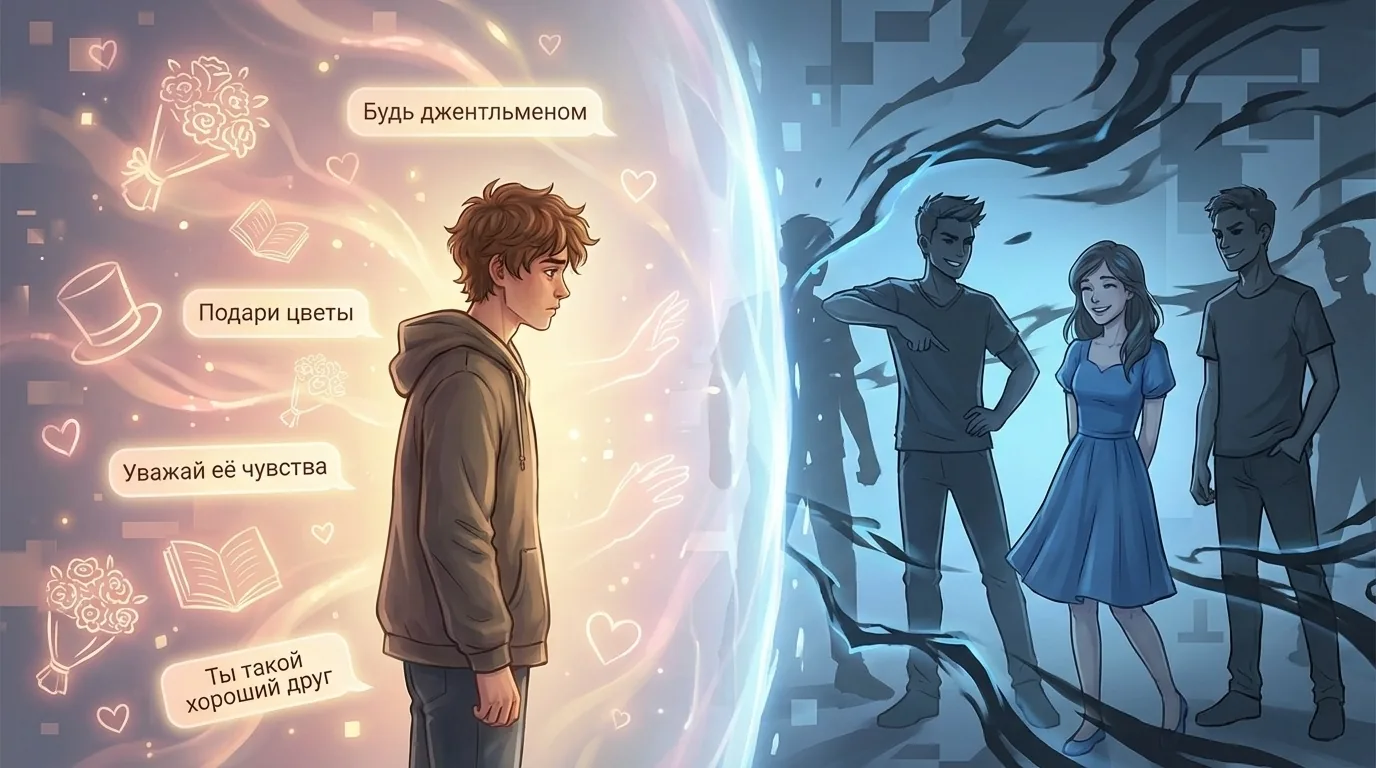
This was the first crash against the wall. Not conscious — bodily. The programmes installed by loving people with the best intentions do not open the door he wants to open now.
And then a book fell into his hands. Not a psychology textbook. A book about which memes to broadcast to girls so they sleep with you.
He read it. And tried. A different posture. A different gaze. Different words. He changed the combination — and the lock opened.
Not at once. Not every time. But often enough that the pattern became impossible to ignore. A specific combination of words, gestures, gazes — produces a specific response.
The world doesn't work the way they told me.
He started mapping. Which visual memes work — clothes, posture, gaze? This jacket — zero attention. That one — eyes lingered a second longer. Which verbal memes?
Press the right button — get a predictable response. Like a vending machine.
Eighteen. A tsunami.
At eighteen, a tsunami crashes down on him. Memes of a different calibre take over his nervous system.
«Marketing.» «Business.» «Freedom.» «Youth and success.» «Business Molodost.» If the girl-memes had been a handheld weapon — knife, sling, Neanderthal spear — the memes of Business Molodost were a weapon of mass destruction.
He builds his first website. Changes the headline. Not because he knows how the brain works. Intuitively, blindly.
It was: «We offer quality services.»
It became: «Tired of throwing money away?»
And the site's analytics jumped. Not by a per cent. Not by two. People started clicking. The same people, on the same site, at the same time of day. Six words changed — behaviour changed.
Only instead of ochre — pixels. Instead of zigzags — headlines and banners.
Four billion years of evolution. 70,000 years of memes. 300 years of the Enlightenment. 100 years of psychology. — And it's enough to change six words on a page to change the behaviour of thousands of people.
He is 18, and he is holding what he was not supposed to find by accident: the cave wall has gone digital, but the kin remained the same.
It shook him. Not as a discovery — as a collapse. The meme of «freedom» collapsed: what freedom, if six words are enough? The idea of a «rational choice» collapsed.
This hominid in front of the screen changed the headline — and lost innocence.
Both infections were irreversible.
The Architect of Memes
By twenty-five, I stopped collecting and started constructing.
For seven years, I had been collecting facts — specific headlines that drove conversion, specific images that got clicked, specific words after which clients agreed to buy. It worked. But it was magic — and I wanted engineering.
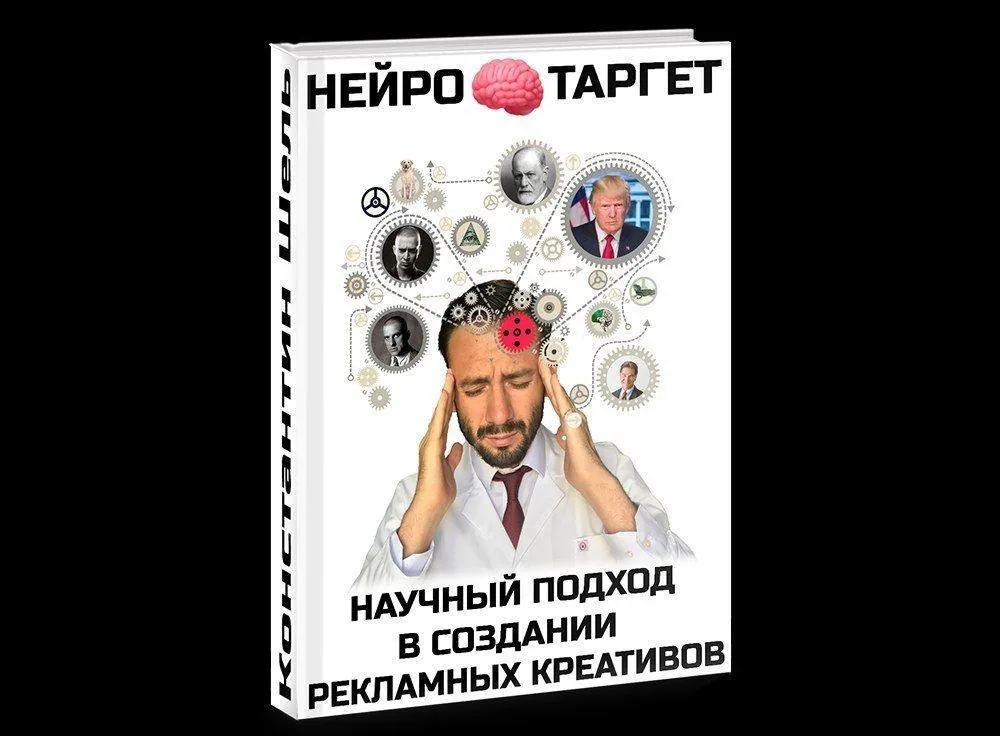
The first serious breakthrough came when I stumbled on a book called «Neuromarketing: How to Influence the Consumer's Subconscious.» Then — Antonio Damasio's work on how emotions are born before thoughts. Then — Kahneman and Tversky on System 1 and System 2.
The next step was Patrick Renvoisé's book «The Persuasion Code.» Before it, I had only run across isolated «buttons.» Renvoisé proposed a system: six stimuli that reliably reach the reptilian brain.
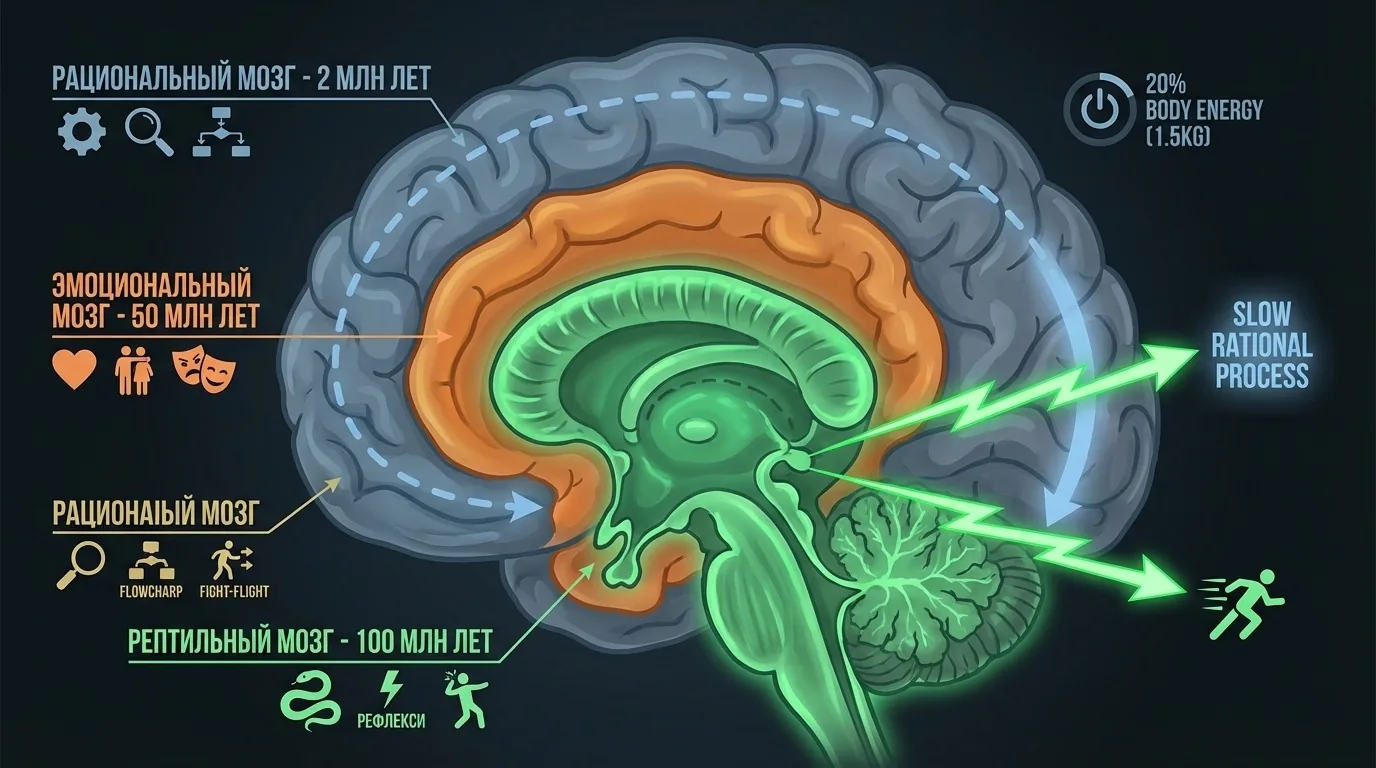
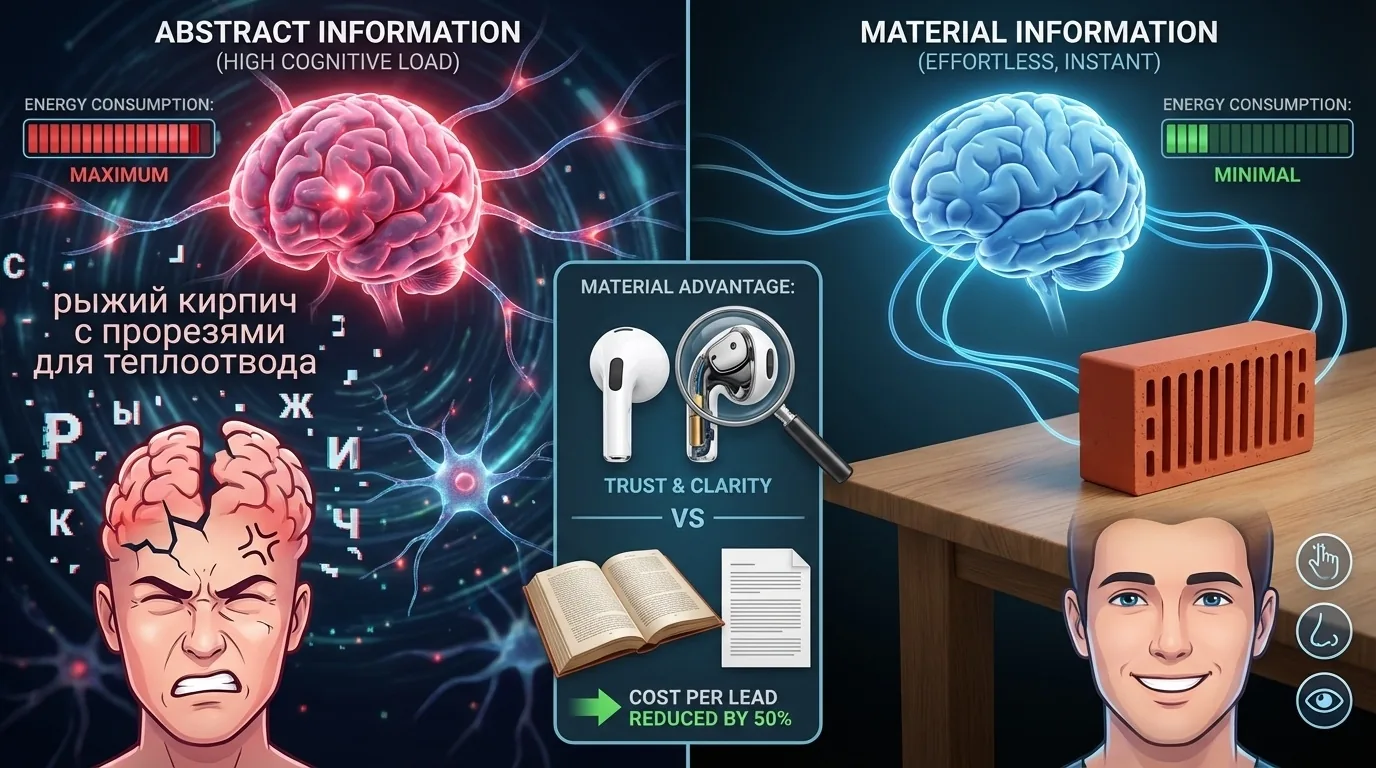
When a person scrolls a feed, their rational mind is asleep. The primary brain runs the show. And the marketers who make "rational ads" with complex arguments are talking to a brain that isn't home.
The only solution is to speak the language of the primary brain. The language of stimuli.
I applied this immediately on my mother's project — she is a coach. Cost per lead fell 4×, cost per customer 2×. Nine thousand subscribers came into her Telegram channel.
When I started passing this knowledge to others, it worked for them in exactly the same way. Not for the handful — for hundreds. Performance marketers who yesterday were burning budgets were today reaching a new level.
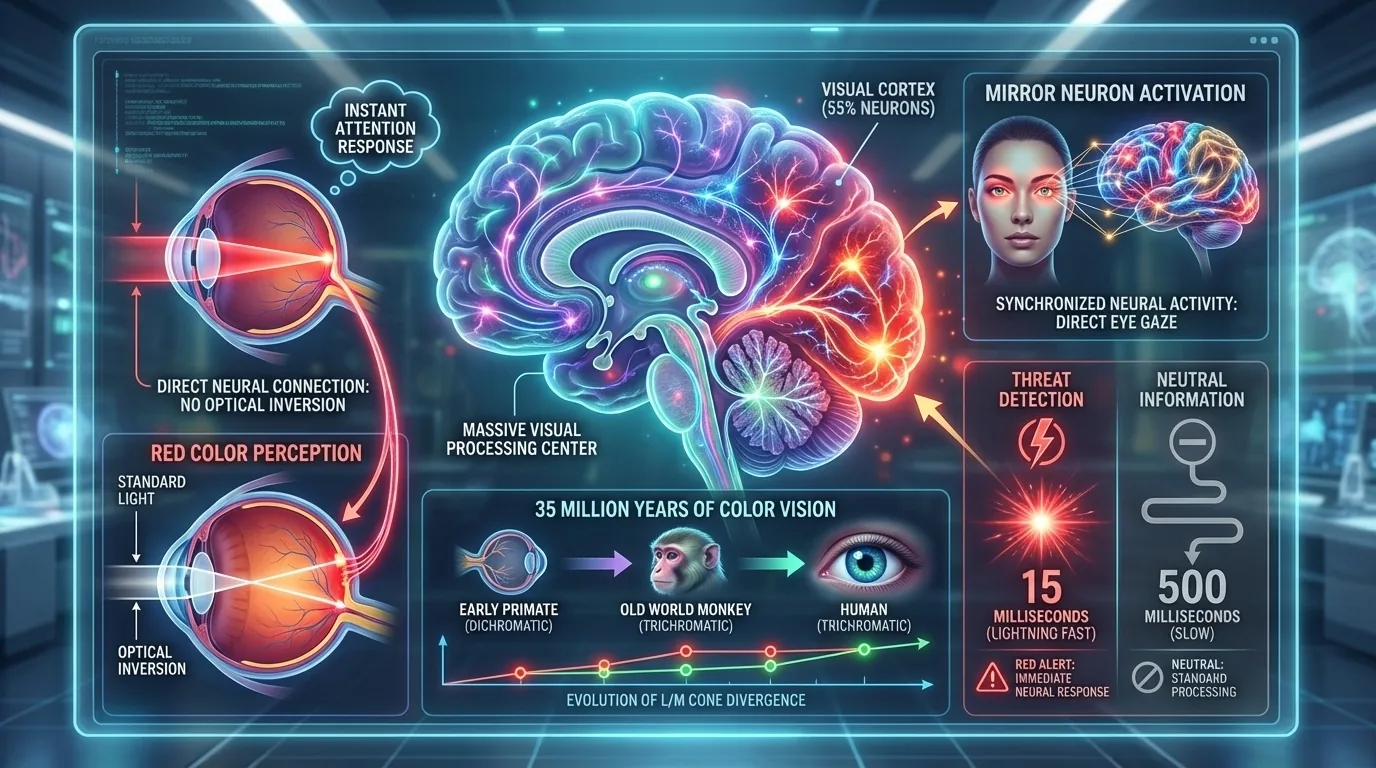
At some point, the six Renvoisé stimuli stopped containing what I was seeing in practice. They were the ideal base — but the field demanded a wider calibre. I extended the system by four more.
The memetic stimulus
I added an eleventh — the memetic. Viruses of consciousness, meanings that copy themselves. Memetics is the science of why one piece of information goes viral and another doesn't.
Translated into the language of neural networks, the picture became surgically precise. A person scrolls a feed — their DMN runs the show, the mind wanders. The SN scans the background for what deserves attention. Only when the SN decides a stimulus is salient — does it switch the brain.
they fight for the Salience Network to notice them.
Stimuli don't work in isolation — they work in combinations. A single trigger activates the SN weakly. But when two or three stimuli meet in the same image at once — the brain cannot ignore it.
I started building maps of interaction. Which stimuli reinforce one another. Which conflict. In what order to deliver them.
This was no longer marketing. This was attention engineering.
And then I saw what tied everything together
Memes — the thought-viruses we talked about in earlier chapters — use exactly the same mechanism. They hit the SN with the same stimuli: threat, contrast, concreteness, emotion, social proof.
The only difference is the target. The ad stimulus says: «Buy.» The meme says: «Pass it on.»
I could take any ad in the world and, in seconds, see its skeleton: which stimuli fire the SN, which hold the CN, where the brain is allowed to slip back into the DMN.
The Architect in His Own Prison
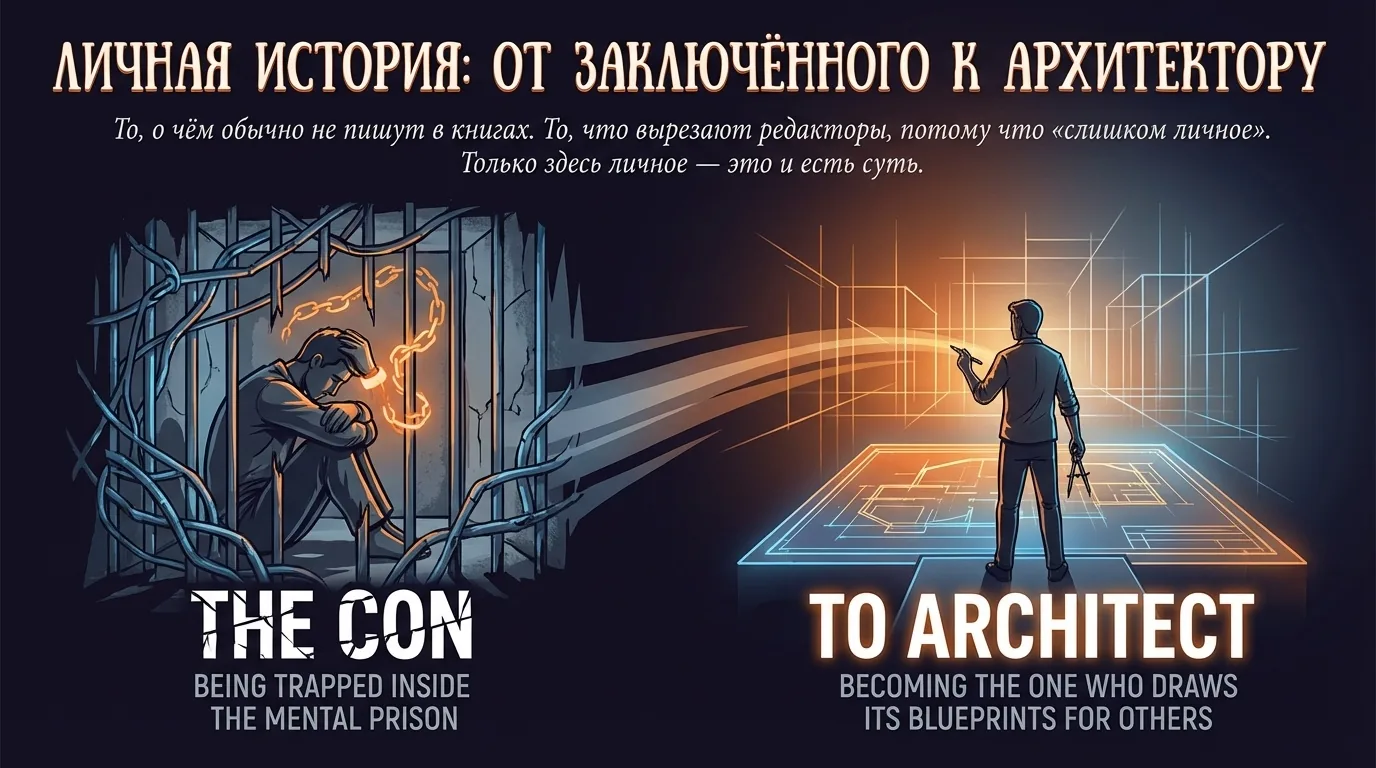
Before I tell you what happened next, I need to say something that is usually not written in books of this format. The kind of thing editors cut — and without which the whole story loses its meaning.
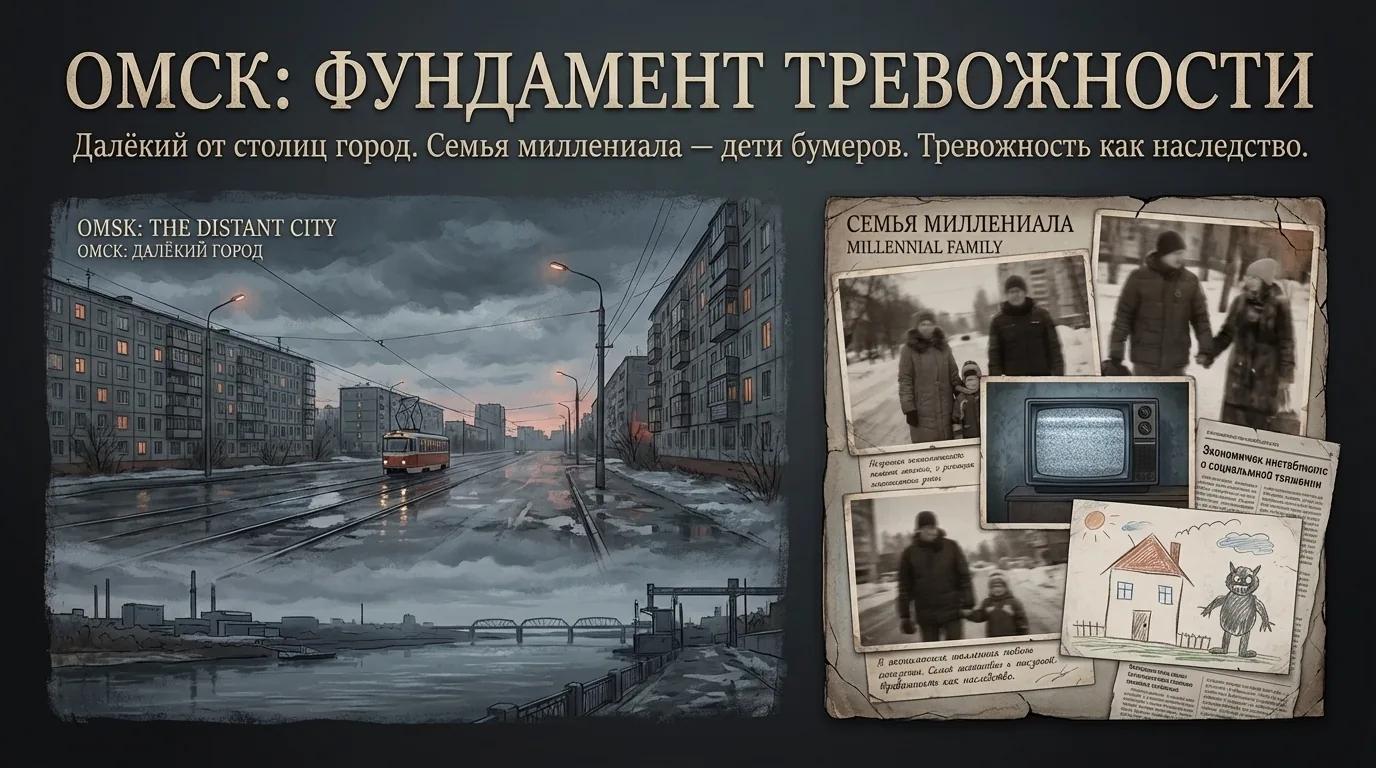
At twelve, I moved to Moscow. A different world, a different scale, different rules. And of course — a pile of new stressors very different from the ones I had been used to.
«This isn't it.» «Should have done it differently.» «You're going the wrong way.»
Because of this, I started over from zero dozens of times. A new project, a new format, a new packaging, a new life. Every time it felt like: «Now, finally, it's right.» And two months later — the same feeling of not-matching.
There were stretches when I was earning a lot. But however much came in, the quality of inner silence didn't change. As long as there was motion — tolerable. The moment I stopped, that thing came back up.
Every month or two, a wave hit me of such strength that I didn't know what to do with myself. My fiancée looked at me with confusion: «Kostya, what's going on with you? I can see you're not here.»
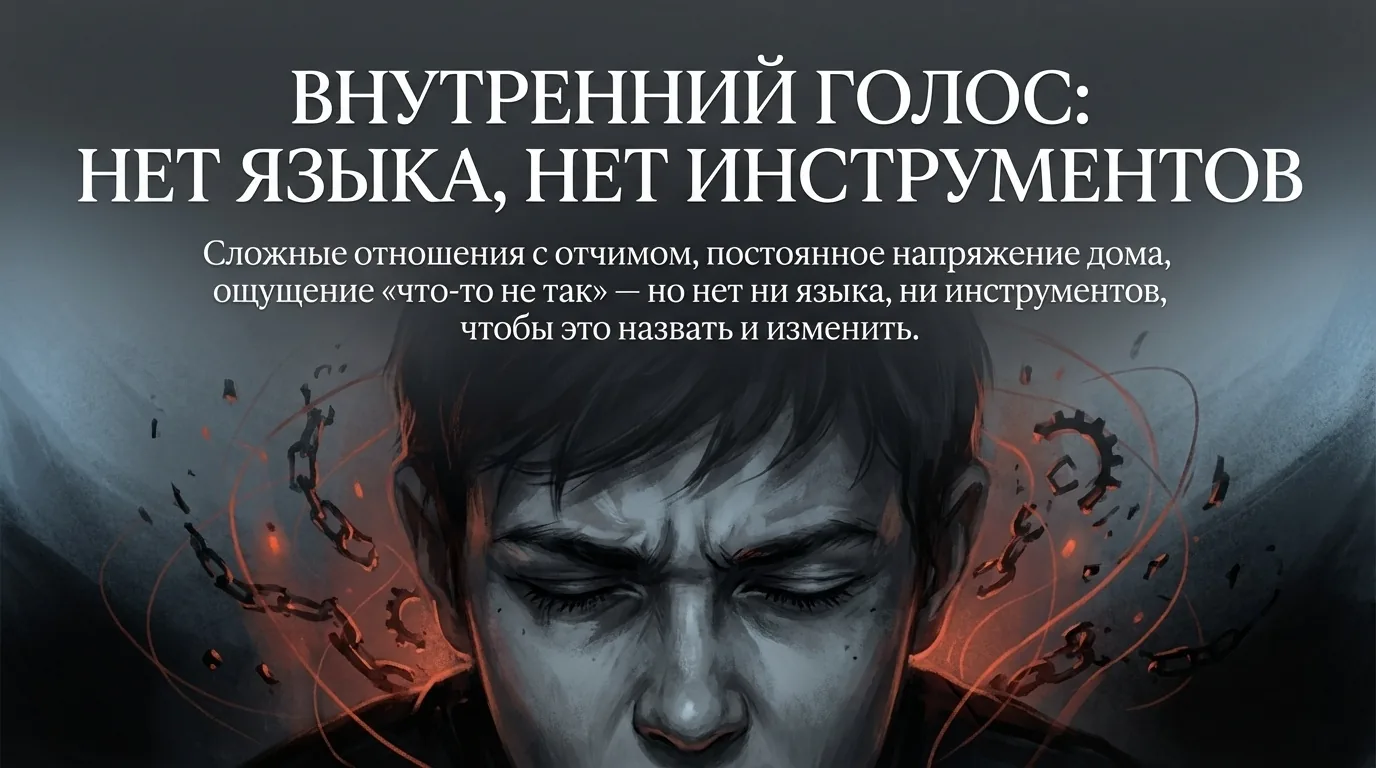
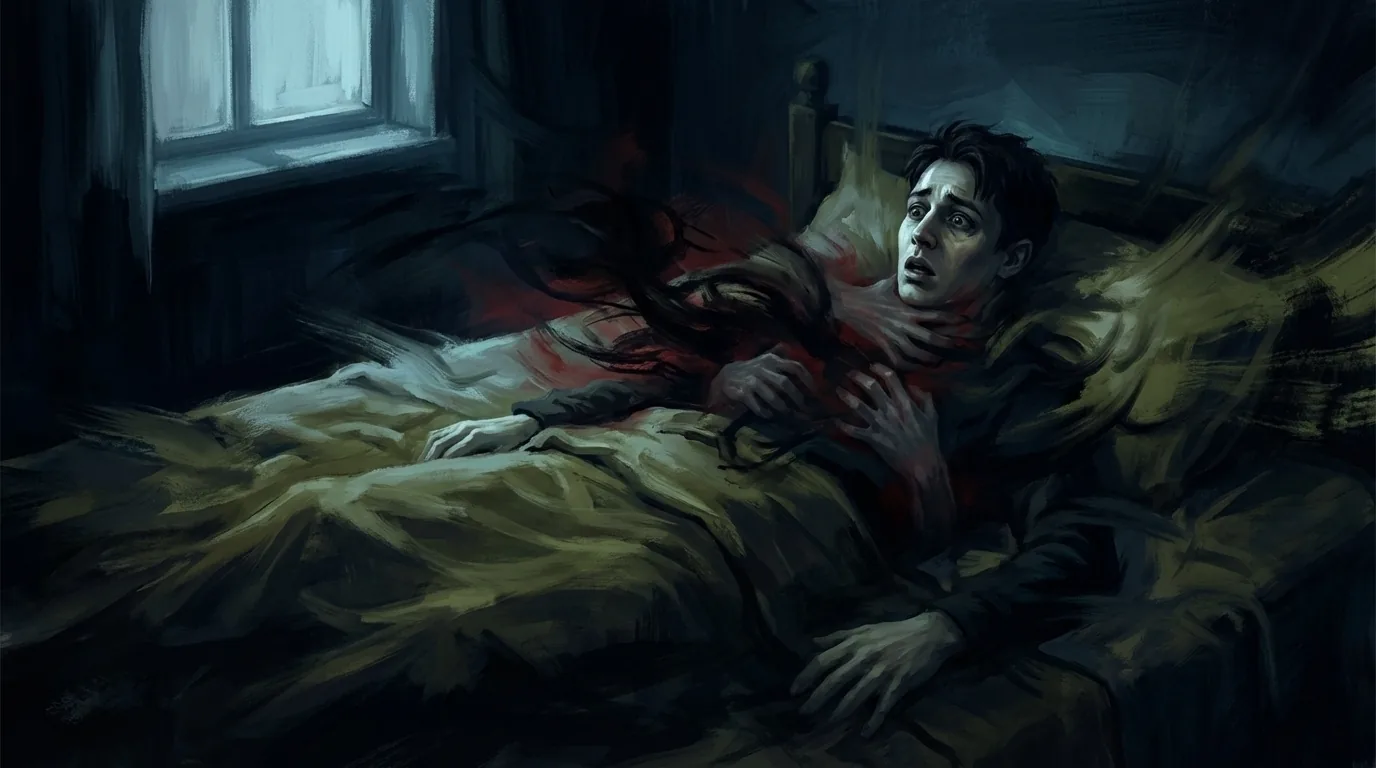
You're lying on the bed. Nobody is choking you with their hands. The room is quiet. Objectively, you are safe. And at the same time, the body is going through suffocation of such intensity that there isn't enough air.
The most terrifying part is understanding that the source of this horror is not outside. It is your own brain. And you cannot press stop. You — are that nervous system that is torturing you right now.
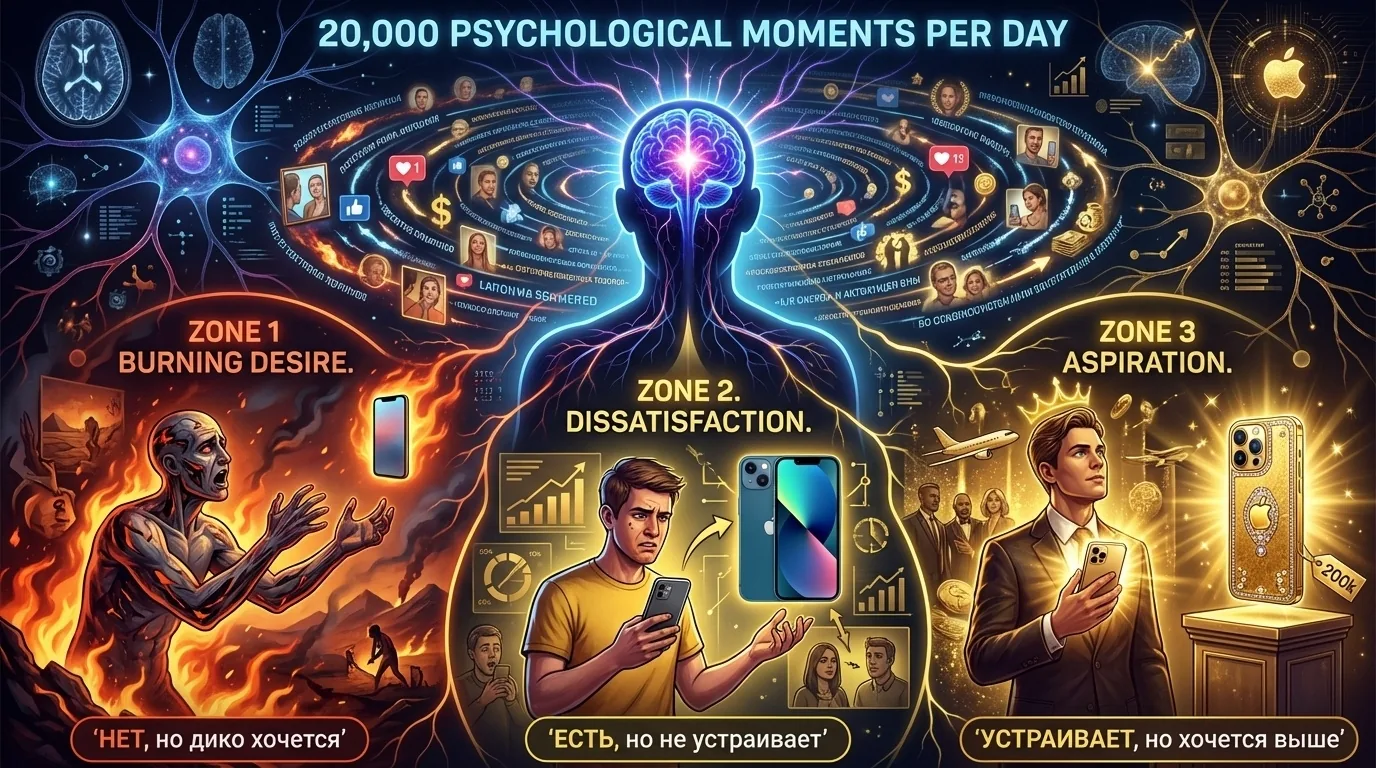
That's when it finally hit me: what happens in our heads «in the background» is not a philosophical abstraction. It has a very concrete, hard, physical effect.
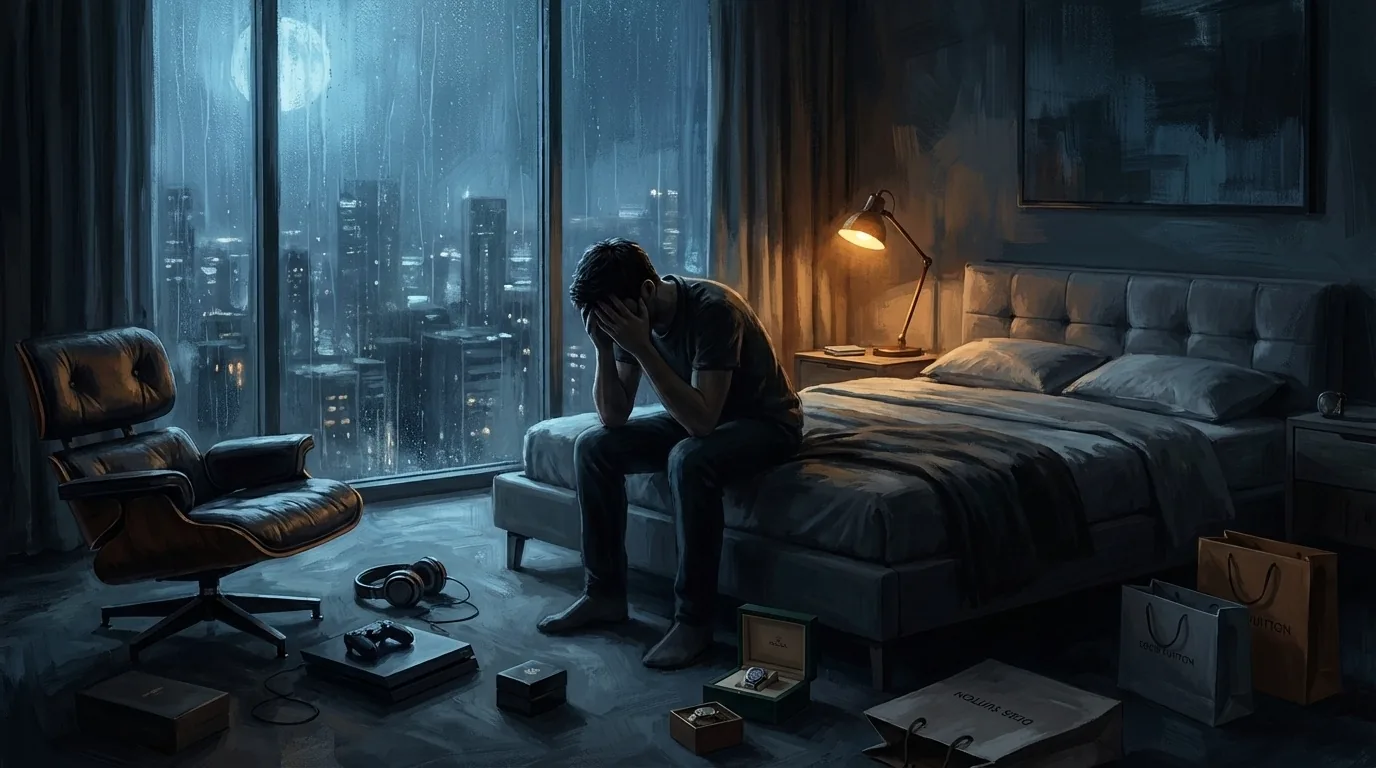
The Monitor of Deviation was running at full throttle. I trusted people you cannot trust. Gave resources to those who didn't deserve them. I was the classic case of a man whose In-se screams «wrong way» — while the memes drown it out with «just hold on a bit longer.»
It went on long enough that I built up a grim certainty: «Most likely, I'll live like this into my forties, my fifties — and go to the grave with the same discomfort.»
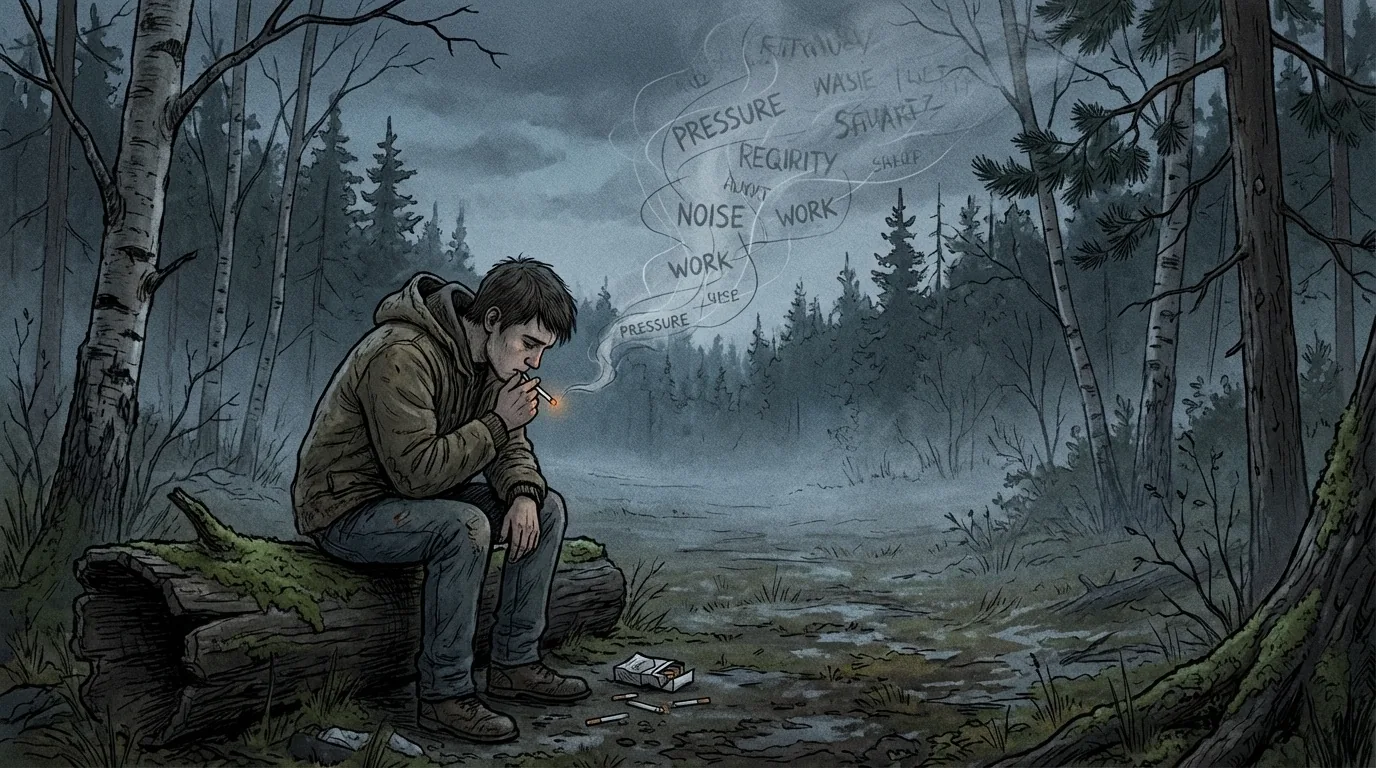
I knew which levers to pull to get a person to buy. I could take someone else's brain apart down to the screws.
Except one person. Myself.
I tried everything. Dozens of psychologists. Theta-healing. Cleansings. Rituals. Decoding. Retreats. Meditation — Vipassana, zazen. Books on psychotherapy. Family constellations. — Nothing gave a stable result.
Then the thing happened that flipped everything. But I'll tell that story separately.
For a long time — maybe a year — I went completely dark. Out of the media field. Out of public presence. Out of blogging. Out of any online programme.
But old students didn't forget. They kept writing: «Kostya, please, run something for us.» Again and again. Month after month.
System Failure
It was an experiment. Though, at the time, I didn't know it was an experiment.
I gathered a group of young specialists — performance marketers who wanted to find their first clients. Not strangers off the street — people who had completed training, who knew every lever in the system.
I told them: «In five hours, your ads will be running on the internet. This evening, you'll get your first leads.»
The energy in the room was tangible. Eyes lit. Nodding. «Yes, let's go. Finally.»
We spent the day together. We wrote the offers. We assembled the creatives — with the right stimuli, the right memes, the right architecture. We set up the ad accounts. We loaded the funds. I personally checked every step.
Not one.
I started calling. Writing. Asking. The answers were different — and the same.
«I wanted to double-check the copy once more. Then it was too late to launch.»
«I thought maybe I should show the creative to a designer friend. Just in case.»
«I wanted to launch but started doubting the audience. Maybe I need to re-analyse first.»
«Honestly — I don't know. I just didn't click.»
They had everything. Creatives — assembled in a system that delivered leads at five roubles. Configured campaigns. Money on the accounts. Step-by-step instructions.
And they didn't make the move.
I started talking to them — not as a teacher but as a researcher. And what I heard turned everything upside down:
«I thought: what if the client replies and I don't know what to say?»
«I felt my creative isn't good enough. That people will see it and think — what an amateur.»
«I just thought: who am I to charge money for this?»
Every answer sounded different, but the structure was the same. Not laziness. Not stupidity. Not «weak motivation.» These were thought-forms — specific thought-viruses hitting the Salience Network with precision.
I knew these structures. I had built them myself — for ads. «What if you miss out?» — the meme of loss aversion. «Everyone is doing it» — the meme of social proof.
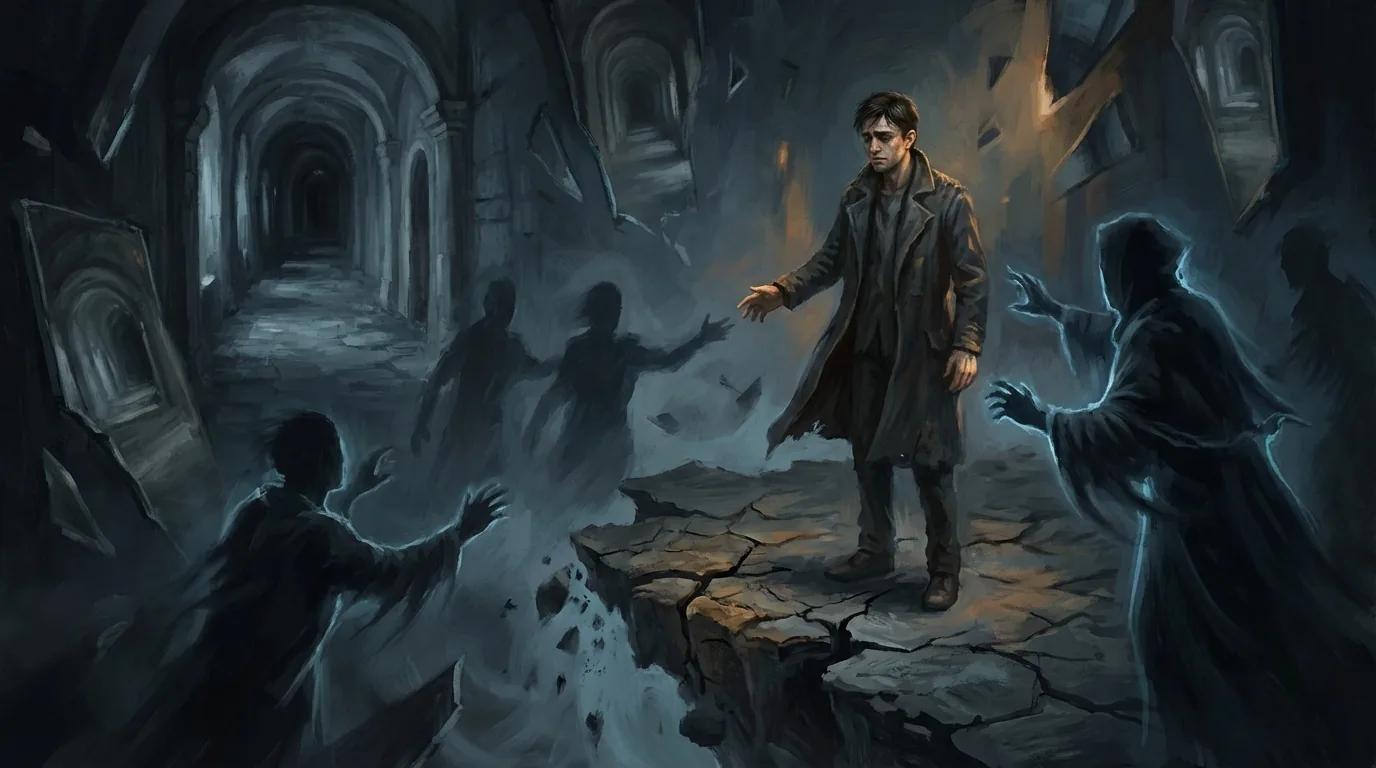
And the SN did what it was built to do: it stopped the action. Because to the ancient brain, a threat to identity is a threat to survival.
The same memes, the same structures of influence I had spent years constructing to convince other people's clients to buy — those structures lived in my students' heads.
I had created a science of how to install memes in other people's heads. And I had discovered that my students' heads — and my own — were already occupied. By memes someone else had installed.
The architect of memes ran into memes he hadn't designed. And they turned out to be stronger.
From Antivirus to Emptiness
I was sitting across from yet another student, watching him drown in the swamp of his own «insights.» We had just «worked through» his belief that he didn't deserve money — and immediately a new one was born: «now that I've realised this, I have no right to mess up.»


I saw what was happening the way an engineer sees a system failure: we were not treating the problem. We were feeding it. Every hour spent analysing one more thought-virus made the DMN more active — and therefore the meme generator ran more intensely.
It was a trap inside a trap: the meme «I have to work on my installed beliefs» itself became a meme — endless, self-reproducing.
Not a scalpel for every tumour — but a way to switch off the mechanism that produces tumours.
Don't treat the content — switch off the generator.
Ilya's kitchen. The antivirus.
Ilya Novitsky and I were sitting at his kitchen table, covered with sheets of paper. On each — columns of thought-viruses written down by students. Hundreds of phrases. All — about lack and about belief in circumstances.
Then I had the first thought, absurdly simple: if there are thought-viruses, there must be an antivirus. Not forty antiviruses for forty viruses — but one, universal.
I looked at the structure. Lack is always «I don't have.» Belief is always external direction: «I believe in circumstances.»
What single phrase removes both axes?
«I have everything I need to believe in myself.»
«I have everything» — fully removes lack. There's nothing to gather, nowhere to run. «To believe in myself» — flips the vector of belief from outside to inside.
Ilya and I checked it — not bad. The phrase hits both axes.
But the longer I looked at it, the clearer I saw the problem. It was a good antivirus. But it stayed a meme.
What if — empty?
And then the next thought arrived. So simple that at first I didn't believe it could be the key to everything.
None at all?
Not «right thoughts instead of wrong ones.» Not «good beliefs instead of bad ones.» But — empty. Clean. Silent. If not a single meme is running in the head — not a single thought-virus can work.
It was so elementary that it felt naive. But that thought flipped everything.
I began shrinking the phrase. Removing words — one by one — and watching what happened to consciousness at each step.
There is a theory — currently gaining serious traction in cosmology — that our Universe was born inside a massive black hole. Matter, passing through the singularity, was not destroyed but stepped into a different dimension.
And I suddenly understood: this is exactly what needs to be done with consciousness.
70,000 years ago, the Big Bang of Consciousness expanded the human mental universe to infinity. Now the reverse process is needed. The Big Crunch. Annihilation of the mental «I.»
Not «killing the ego» — that would be another violent act inside the same system. But — to crunch. To allow the mental universe to fold back into a point, through which one can step into a different dimension of perception.
I decided to run this experiment on myself.
Ground Zero — Diving into Annihilation
To understand what happened next, we'll have to go inside. Into my skull.
For simplicity, I'll compress the whole process — about fifty minutes of real immersion — into seven.

0:00 — Beta-storm
Eyes closed. Body on the chair. And immediately — the conveyor: «Where do I begin? I have to get the setup right. What if it doesn't work? Maybe I should have recorded it. Damn, forgot to switch off the phone…»
DMN in standard mode. Beta-rhythms — 15–30 Hz — an electric storm in the prefrontal cortex.
0:00–1:00 · «I have everything I need to believe in myself»
I say it mentally. Slowly. By the end of the minute, the stream of thoughts slows down. Pauses appear between thoughts. Beta-activity drops. Alpha starts growing.
1:00–2:00 · «I have everything»
Four words instead of eight. Nowhere to run. «Everything» — and that's it. The diaphragm relaxes. Thoughts like bubbles in still water.
2:00–3:00 · «I am everything»
Three words. Between «I have everything» and «I am everything» — a chasm. The «I»/«not-I» border dissolves. Activity in the posterior cingulate cortex — a key DMN hub — drops. Sounds from beyond the window stop registering as «external.»
3:00–4:00 · «I am»
Two words. The object is removed. There is nothing I am. Only the bare fact of existence. Theta-waves appear — 7–8 Hz. The brain is on the threshold between waking and what is normally only reached in deep sleep.
4:00–5:00 · «I — everything»
Grammar breaks. The copula verb is removed. Direct identity without mediation. The mind has nothing to grip. The left hemisphere — the verbal one — switches off.
5:00–6:00 · «Everything — I»
Inversion. Not «I am looking at the world» — but «the world is looking at itself through this point that used to call itself I.» Activity in the posterior cingulate cortex is near zero. The body is transparent — brighter than ever, but no longer a container.
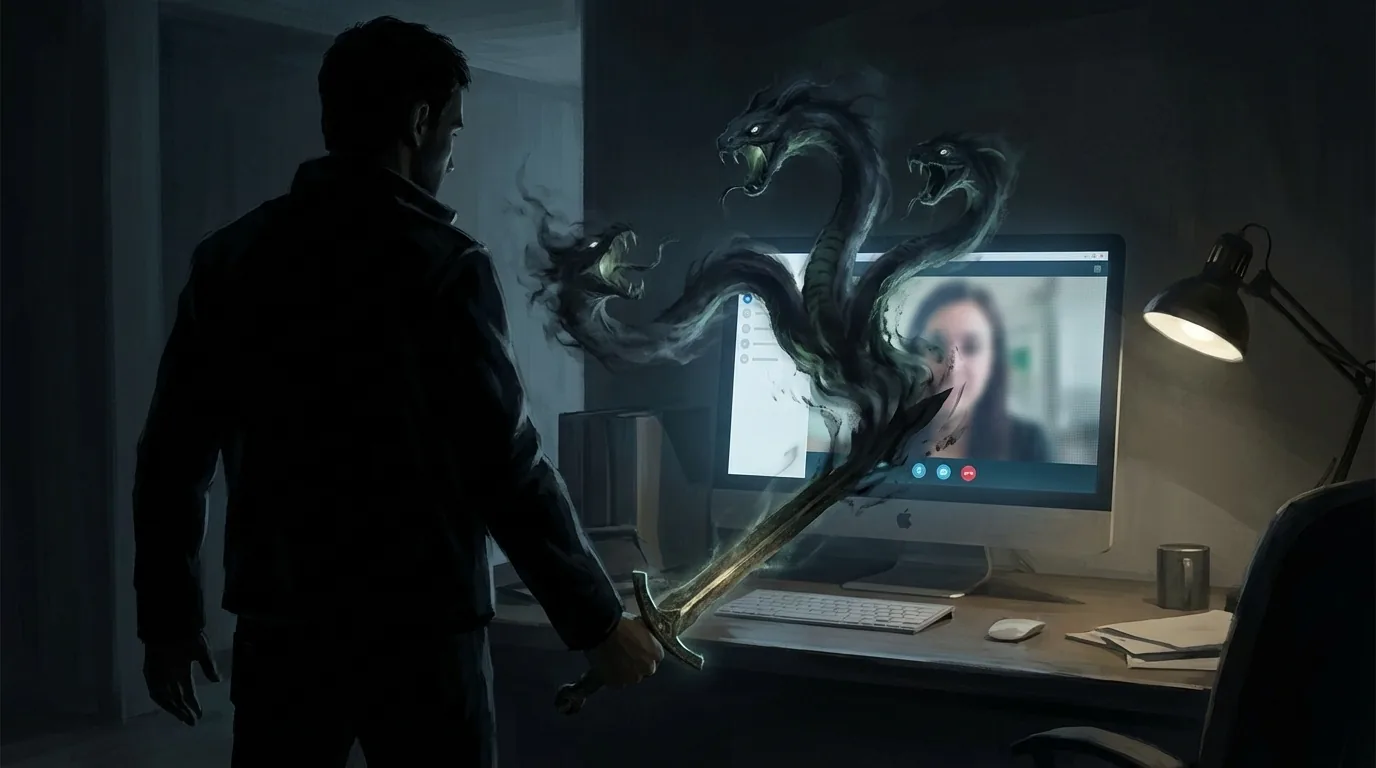
6:00–7:00 · «I.»
One word. The last.
I. I. I. I. I.
Monotone. No effort.
The first twenty seconds — the word still points at something. Recursion. Thirty seconds. Forty.
And then — semantic saturation. Neural adaptation: the brain habituates to the stimulus and stops processing it. «I» becomes an empty sound.
But along with the meaning of the word, the thing it pointed at disappears too. Because «I» is the only meme on which all the others hang. The root directory.
Not metaphorical — almost physically tangible. Like a relay switching in the brainstem.
The internal dialogue didn't get quieter. Didn't slow down. Didn't fade to the background.
It stopped.
Silence. But not the silence you know. Not «quiet in the room.» Not «peaceful in the soul.» A different silence. A silence you have not experienced even once in your entire life.
I'm sitting. Eyes closed. The pressure of the chair under my thighs. Pulse in the wrists. Warmth of the air on my face. All of it — bright, three-dimensional, almost painfully present.
But there is no one to say «I feel this.» Perception happens — by itself.
Not «nothingness» as absence. But the space prior to all forms.
The screen before the image.
Not a single thought-virus. Not one. Not because I defeated them. But because the medium in which they lived has disappeared. No inner dialogue — no carrier for memes.
This is the world the hominid under the acacia saw a second before the catastrophe. Only now — I could choose.
After a while, thoughts started returning. Carefully. One at a time. Like animals leaving cover after an earthquake.
The first: «Whoa.» And, for the first time in my life, I saw a thought as an object. Not from inside — from the side. Like a cloud in the sky: appeared, drifted, vanished.
Between me and the thought there was now a gap. That Nothing. The thought hung in front of me, like a word on a screen. I could take it and unfold it. Or not.
The same one that opened 70,000 years ago for the hominid under psilocybin.
Only now it was controllable.
I opened my eyes. The room was the same. But the world looked — clearer. As if I had spent my whole life looking through frosted glass, gotten used to the frosting — and someone had just wiped it clean.
I had run the annihilation of the mental «I.» The Big Crunch. The reverse Big Bang.
And on the other side — I found a switch that had not existed for 70,000 years.
Three Years of Oblivion and a Second Birth
Honestly, at the time, I didn't yet understand what I had found.
I was impressed — of course. A person who, for the first time in his life, hears silence in his own head cannot stay indifferent. But I didn't know what to do with it. So I did what most people do when they don't know what to do with a discovery: I put it aside. Went back to neuromarketing, clients, tasks.
Three years passed.
During that time, a man came into my life with whom I became friends. His name was Aleksandr Ivanov — Sasha.
Sasha's life from the inside was like a broken TV showing three channels at once, with no way to switch any of them off. He told me how he fell asleep with a stream of thoughts. How he woke up with a stream of thoughts.
And one day, in one of those conversations, he said the phrase that started everything again:
He said it without hope. The way people speak about things that don't exist.
And in that moment, something clicked inside me. The file on the desktop — the one I had forgotten three years ago — unfolded in front of my eyes by itself.
«Sash,» I said, «sit down. Close your eyes.»
I sat across from him. And started speaking that sequence — slowly, giving each phrase time to enter.
He repeated. First with effort, then — quieter, more monotone, like a metronome slowing down.
«I… I… I… I…»
And he went silent. Not «stopped speaking.» But — went silent in his whole body. The silence lasted maybe twenty seconds. Then he opened his eyes.
Then he asked the question that changed everything:
Not now, through practice — but during the day? Mid-conversation? Just — click, and quiet?
I didn't know. Three years ago, I hadn't gotten around to checking. But now — his question hit a point that had been waiting for that hit for three years. I closed my eyes, dove inside — and the answer came not in words. It came as a state.
I opened my eyes. And said:
«Try right now. Don't close your eyes. Just — remember what was happening a second ago.»
He froze for an instant. And — click.
I saw it happen. By his face, his eyes, the way his breathing changed. An instantaneous shift. One second — a person captured by memes; the next — that person was in Nothing, with open eyes, in ordinary daylight.
The Minute of Truth — EEG
After we discovered that the switch worked instantly and reproducibly, we did what anyone who has just found something like this would do: we started showing it to others.
The reaction was unanimous:
«That doesn't happen.»
«The internal dialogue cannot be stopped completely.»
«You just hypnotised yourselves.»
«Meditators sit for 20 years — and you've done it in 7 minutes?»
«Show me the proof.»
I needed a language that didn't depend on belief. The language of numbers, graphs, and reproducible data. I needed EEG.
How the brain talks about itself
The brain talks in the language of electrical rhythms — waves of different frequencies, each corresponding to a particular mode of operation:
Beta (13–30 Hz) — active thinking, analysis, anxiety. When you're solving a problem, arguing, worrying about the future — that's beta.
Alpha (8–12 Hz) — relaxed awareness. You're awake, but the mind is calm. Alpha in meditation, in flow.
Theta (4–8 Hz) — deep meditative state, the threshold of sleep. In theta, the sense of «I as centre» dissolves.
Gamma (30+ Hz) — the fastest waves, linked to total engagement.
If ONTO NOTHING is real, then on EEG you should see: beta — collapse. Alpha and theta — sharp rise.
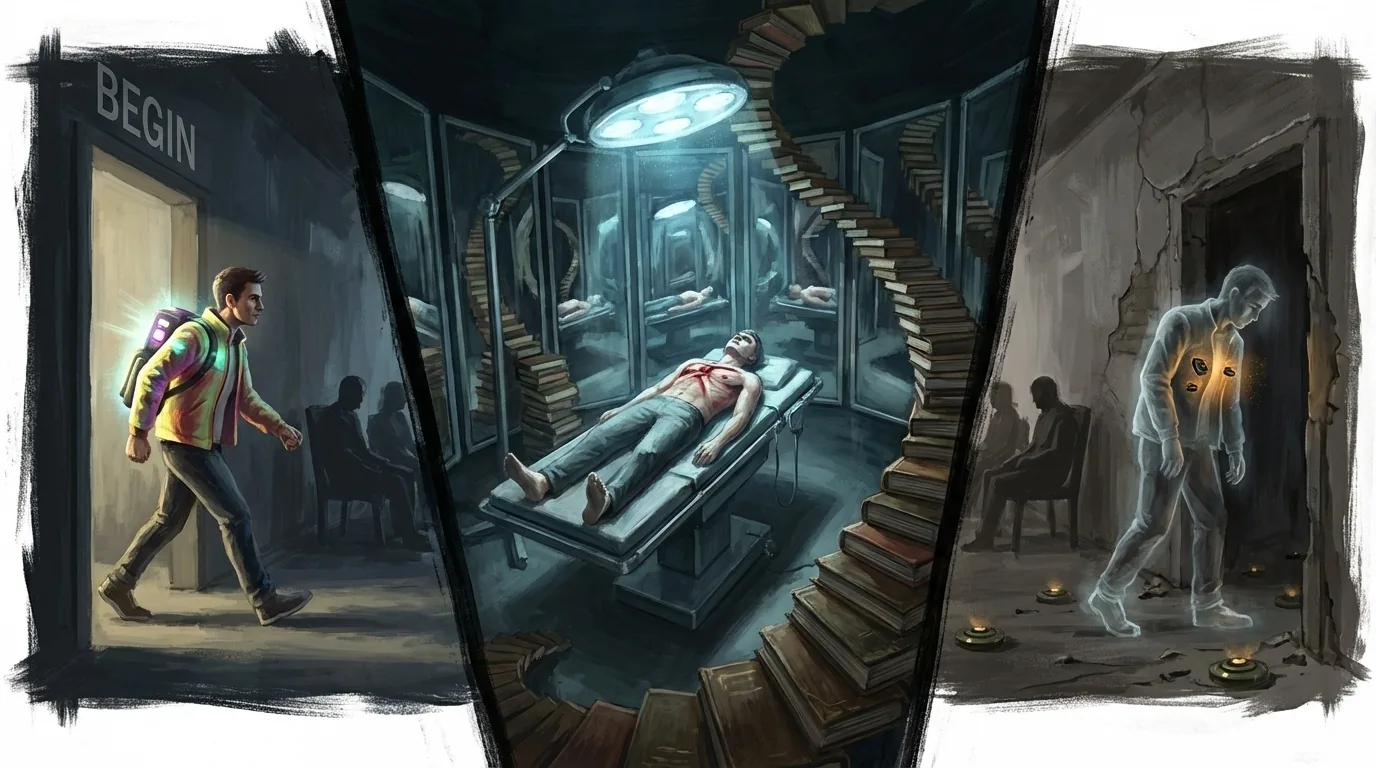
I was living in Georgia at the time. I'd known Neiry for a long time — they're among the best builders of consumer EEG devices.
And there it was — the tracker in my hands. A small device, like a headband, with electrodes reading the electrical activity of the cortex. A friend sat next to me. Watching the screen.
I'm watching the graphs. Beta dominates, the red lines are high, alpha and theta are at the bottom. Standard picture.
I look away from the screen. Close my eyes. One intention. Inhale. Exhale. Nothing.
I didn't see what was happening with the graphs. But I heard:
«— Whoa. No. Wait. Are you kidding me. Is this actually happening?»
A minute later, I opened my eyes and looked at the screen.
The red lines — beta, stress, mental noise — had collapsed. Not gradually fallen, not slowly faded. Collapsed. A vertical wall down.
The green and blue — alpha and theta — had shot up. Sharply, almost instantly, as if someone had flipped a switch.
Two graphs. One second. A total inversion.
ONTO NOTHING was real.
From One Button to a Remote
From that point on, something began that I couldn't have predicted.
Active scientific work. Transmission of the skill to other people — dozens, then hundreds. The organisation of a global study. Partnership with Neiry growing.

But the main discovery of that period wasn't in the breadth of distribution. It was in the depth.
Working with ONTO NOTHING every day, month after month, I started noticing: silence is not the end point. It is a door. Behind it lies not emptiness but a whole palette of states — each with its own quality of attention, its own energy.
Back then — on that first day with the EEG — I thought I had found a button. One button: switch the internal dialogue on/off.
But over time, I realised: it was not the silence button. It was the access button. Like the Shift key on a keyboard — by itself it types nothing, but it opens a whole layer of symbols.
It turned out to be a remote.
I had been using these modes — intuitively, unconsciously — for a long time. But turning the inner sensations into structure, giving each mode a name, building a clear sequence of switches — that took more time.
So in the next chapter, I'll show you what I consider the main practical result of this whole path: a remote control for human consciousness.
In the next chapter — six modes. Six buttons. One remote.